What is Digital Asset Management Strategy
A Digital Asset Management Strategy defines how organizations store, organize, govern, and distribute content across teams and channels. A strong Digital Asset Management Strategy aligns content flow with business outcomes, improving control over media libraries and reducing duplication across teams. The foundation of a Digital Asset Management Strategy begins with classification rules, access governance, and lifecycle planning for assets.
A structured Digital Asset Management Strategy supports scale by connecting Digital Asset Management Tools with workflows that reduce manual handling and improve content discoverability. Businesses adopt DAM Software and a Digital Asset Management Solution to centralize assets and strengthen content visibility. Integration of PIM ERP integration improves product data alignment with assets, strengthening operational flow.
Digital Strategy Asset Management helps unify content planning across marketing and product teams. Digital Asset Management for small businesses improves content control without complexity. Learning How to manage Digital Assets improves speed of retrieval and reuse across campaigns. A strong Digital Asset Management Strategy enhances governance, consistency, and structured content distribution across the organization.
Understanding the Role of a DAM System
A Digital Asset Management Strategy defines how a Digital Asset Management Platform organizes, stores, and distributes digital content across business environments. A strong Digital Asset Management Strategy ensures consistent handling of assets inside Digital Asset Management Tools and DAM Software, supporting structured content flow. A Digital Asset Management Strategy connects marketing, product, and sales teams through controlled asset access.
A Digital Asset Management Solution manages images, videos, documents, presentations, and brand files as digital assets. Businesses rely on Digital Asset Management Strategy to reduce scattered storage and improve retrieval across systems. Digital Strategy Asset Management connects asset governance with content planning across departments.
Integration with PIM ERP integration links product data with assets across ecommerce ecosystems. A Digital Asset Management Strategy works alongside CMS and ecommerce platforms to maintain content alignment. Digital Asset Management for small businesses improves content handling without complexity. Understanding How to manage Digital Assets supports better control and reuse across workflows.
Challenges Businesses Face Without a DAM Strategy
A Digital Asset Management Strategy resolves scattered file storage that occurs when organizations operate without a Digital Asset Management Solution. Without a Digital Asset Management Strategy, assets remain dispersed across drives, cloud folders, and email threads, limiting visibility inside Digital Asset Management Tools and DAM Software environments.
A strong Digital Asset Management Strategy eliminates difficulty in locating and reusing assets by centralizing libraries through a Digital Asset Management Platform. Digital Strategy Asset Management improves accessibility, enabling faster retrieval and reuse across campaigns. Lack of Digital Asset Management Strategy leads to repeated creation of similar assets and wasted effort.
Brand inconsistency arises when a Digital Asset Management Strategy is absent, causing mismatched visuals across channels. Version control issues increase without Digital Asset Management Tools, leading to outdated files circulating in workflows. Collaboration gaps appear across teams and agencies when Digital Asset Management for small business or enterprise systems are not implemented. How to manage Digital Assets effectively depends on adopting a structured Digital Asset Management Strategy integrated with PIM ERP integration.
Key Components of an Effective DAM Strategy
A Digital Asset Management Strategy defines key components that guide content control, storage, and distribution across an organization. A strong Digital Asset Management Strategy begins with business goals that connect asset usage with revenue outcomes. A Digital Asset Management Strategy defines how Digital Asset Management Tools and DAM Software support asset lifecycle management across teams.
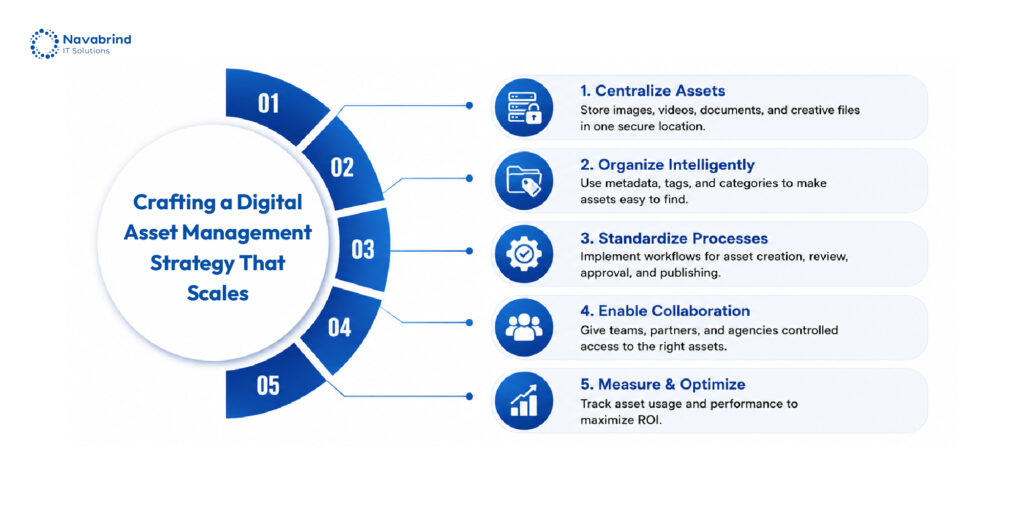
A Digital Asset Management Strategy includes asset organization through taxonomy models that classify media, documents, and brand files inside a Digital Asset Management Solution. Metadata and tagging standards strengthen retrieval inside a Digital Asset Management Platform, improving consistency across digital libraries. A Digital Asset Management Strategy assigns user roles and permissions to control access across teams and agencies.
A Digital Asset Management Strategy integrates workflow design with PIM ERP integration to connect product data with creative assets. Digital Strategy Asset Management strengthens coordination between marketing and operations. Digital Asset Management for small businesses improves asset control at scale. Understanding How to manage Digital Assets ensures better reuse and governance across channels.
DAM Integration with Business Systems
A Digital Asset Management Strategy enables structured connectivity between enterprise systems and content environments. A strong Digital Asset Management Strategy links Digital Asset Management Solution with product and marketing ecosystems, ensuring controlled asset flow across platforms. Digital Asset Management Strategy strengthens alignment between Digital Asset Management Tools and business applications used across teams.
A Digital Asset Management Strategy connects PIM ERP integration with content repositories, aligning product data with media assets for consistent usage across commerce channels. Digital Strategy Asset Management ensures coordinated distribution of digital content across CMS and ecommerce systems without fragmentation. A Digital Asset Management Strategy integrates DAM Software into enterprise workflows to support asset availability across departments.
A Digital Asset Management Strategy improves synchronization of assets across marketing channels through centralized governance. Digital Asset Management for small businesses benefits from connected systems that reduce duplication and improve control. Learning How to manage Digital Assets strengthens operational clarity across platforms. A Digital Asset Management Strategy builds a connected content ecosystem across business tools and distribution networks.
Best Practices for Digital Asset Management Implementation
A Digital Asset Management Strategy starts with auditing existing repositories to identify redundant, outdated, and unused files before migration into a Digital Asset Management Solution. A strong Digital Asset Management Strategy ensures clean data foundations across Digital Asset Management Tools and DAM Software, improving long-term usability.
A Digital Asset Management Strategy establishes standardized file naming conventions that improve searchability inside a Digital Asset Management Platform. Digital Strategy Asset Management strengthens consistency across teams by enforcing structured labeling practices for every digital asset.
A Digital Asset Management Strategy supports workflow optimization by reducing manual handling in approval and publishing processes through PIM ERP integration and connected systems. A Digital Asset Management Strategy defines access controls and security policies to govern asset usage across departments and external agencies.
A Digital Asset Management Strategy monitors asset performance and usage analytics to refine content value over time. Digital Asset Management for small businesses improves control without complexity. Understanding How to manage Digital Assets enhances visibility, governance, and operational alignment across channels.
How DAM Improves Marketing and Ecommerce Operations
A Digital Asset Management Strategy accelerates campaign execution by organizing assets inside a Digital Asset Management Solution, reducing delays across creative and marketing teams. A strong Digital Asset Management Strategy connects Digital Asset Management Tools and DAM Software to streamline content readiness for launch cycles.
A Digital Asset Management Strategy strengthens brand consistency across channels by maintaining controlled asset usage through a Digital Asset Management Platform. Digital Strategy Asset Management ensures marketing outputs follow unified content standards across campaigns and customer touchpoints.
A Digital Asset Management Strategy improves ecommerce product content by integrating PIM ERP integration with asset libraries, aligning product data with images and media files. This structure enhances product presentation and reduces mismatches in listings. A Digital Asset Management Strategy supports omnichannel marketing by distributing approved assets across multiple platforms from a single environment.
A Digital Asset Management Strategy enhances collaboration by enabling shared access across teams, agencies, and stakeholders. Digital Asset Management for small businesses improves coordination without operational friction. Understanding How to manage Digital Assets strengthens productivity, governance, and content delivery efficiency across marketing ecosystems.
Choosing the Right DAM Platform for Your Business
A Digital Asset Management Strategy guides selection of a Digital Asset Management Solution by defining scalability expectations, integration needs, and long-term content governance goals. A strong Digital Asset Management Strategy evaluates how Digital Asset Management Tools and DAM Software support growth without disruption across evolving business demands.
A DAM Strategy assesses integration capability with PIM ERP integration, CMS, and ecommerce platforms to ensure smooth asset movement across systems. Digital Strategy Asset Management supports evaluation of cloud-based and on-premise environments based on security, control, and operational requirements.
A Digital Asset Management Strategy identifies platform features such as metadata handling, workflow control, and asset versioning inside a Digital Asset Management Platform. Multi-region and multi-language support becomes essential for global content operations, strengthening consistency across markets.
A Digital Asset Management Strategy ensures long-term scalability by aligning platform choice with future content expansion. Digital Asset Management for small businesses supports gradual adoption without disruption. Understanding How to manage Digital Assets ensures better selection, governance, and operational continuity across digital ecosystems.
Measuring the Success of Your DAM Strategy
A Digital Asset Management Strategy measures success through tracking asset usage across campaigns and platforms inside a Digital Asset Management Solution. A strong Digital Asset Management Strategy evaluates how Digital Asset Management Tools and DAM Software influence content performance, visibility, and reuse efficiency across marketing and commerce workflows.
A Digital Asset Management Strategy improves workflow efficiency by reducing delays in asset retrieval, approval, and distribution within a Digital Asset Management Platform. Digital Strategy Asset Management supports measurement of operational improvements by comparing pre-implementation and post-implementation content cycles.
A Digital Asset Management Strategy evaluates time and cost savings by reducing redundant asset creation and improving reuse across departments. Integration with PIM ERP integration strengthens alignment between product content and digital assets, improving consistency and reducing operational overhead.
A Digital Asset Management Strategy enhances content reusability by enabling centralized access to approved assets across teams. Digital Asset Management for small businesses improves performance tracking without complexity. Understanding How to manage Digital Assets supports data-driven decision-making, improving governance, efficiency, and long-term content value across the organization.
The Future of Digital Asset Management
A Digital Asset Management Strategy evolves with AI-powered tagging that enhances classification inside a Digital Asset Management Solution. A strong Digital Asset Management Strategy improves asset discovery through Digital Asset Management Tools and DAM Software, reducing time spent locating content across repositories. A Digital Asset Management Strategy strengthens content intelligence by supporting AI-driven metadata enrichment across a Digital Asset Management Platform.
A Digital Asset Management Strategy enhances automation in distribution workflows, improving coordination across marketing and commerce systems. Digital Strategy Asset Management aligns content flow with customer engagement paths across channels. A Digital Asset Management Strategy integrates PIM ERP integration to connect product data with enriched assets for consistent delivery.
A Digital Asset Management Strategy supports personalized customer experiences by enabling targeted asset delivery based on usage behavior. Digital Asset Management for small businesses improves adaptability in content operations. A Digital Asset Management Strategy plays a key role in headless and omnichannel commerce by ensuring content portability across systems. Understanding How to manage Digital Assets strengthens governance, scalability, and content value across evolving digital ecosystems.
Frequently Asked Questions
1. What is a digital asset management strategy and why does it matter?
A digital asset management strategy is a planned approach for organizing, storing, governing, and distributing digital content such as images, videos, documents, and brand files. It matters because it reduces content chaos, improves brand consistency, and ensures faster access to approved assets across teams and channels.
2. How to build a digital asset management strategy for your business?
Start by defining business goals, identifying asset types, and setting metadata standards. Then establish user roles, access rules, and workflow processes. Finally, choose a suitable DAM platform and integrate it with existing systems like CMS, ecommerce, and product data tools.
3. What are the best digital asset management tools for small businesses?
Small businesses benefit from cloud-based DAM platforms that offer asset storage, tagging, search, and sharing features. Tools that support scalability, easy onboarding, and integration with marketing platforms work best.
4. How does DAM software improve team collaboration and workflow efficiency?
DAM software centralizes assets, allowing teams to access approved files in one place. It reduces duplicate work, improves version control, and speeds up content approvals and campaign execution.
5. How to measure the ROI of a digital asset management solution?
ROI is measured by tracking reduced content creation time, improved asset reuse, lower storage duplication costs, faster campaign launches, and increased productivity across marketing and sales teams.
Related Articles









 Post
Post