Brands create an endless stream of content: campaign visuals, product videos, sales presentations, social creatives, PDFs, design files, and marketing resources. Yet in countless organizations, these assets remain buried across cloud folders, inboxes, Slack conversations, USB drives, and employee desktops. Teams waste valuable hours searching for files, recreating missing content, or publishing outdated versions that damage brand consistency and revenue performance.
This growing content disorder creates operational friction across marketing, ecommerce, retail, manufacturing, media, and distribution environments. As digital channels expand, unmanaged assets increase storage waste, delay approvals, slow campaign execution, and create compliance risks. Without Digital Asset Management, businesses struggle to maintain brand accuracy and asset visibility at scale.
Digital Asset Management systems solve this challenge through centralized organization, controlled access, metadata tagging, version tracking, and streamlined digital asset management workflow processes. This guide explains how digital asset management solutions function, the commercial value DAM software delivers, and the key features businesses should evaluate when selecting the best digital asset management platform for long-term growth.
What Is Digital Asset Management And Why It Matters Now More Than Ever
Digital Asset Management refers to the process of organizing, storing, controlling, and distributing digital content from one centralized environment. Businesses rely on Digital Asset Management to maintain brand consistency, accelerate campaign delivery, and eliminate content confusion across departments.
A digital asset includes product images, promotional videos, audio files, presentations, catalogs, logos, creative source files, brand guidelines, design templates, documents, animations, and 3D assets. As organizations expand across ecommerce platforms, marketplaces, mobile apps, and social channels, asset libraries grow at an unsustainable pace.
Traditional file storage platforms like Google Drive or Dropbox store files, yet they lack the governance, metadata structure, permissions, approval controls, and search intelligence available in digital asset management systems. DAM software supports asset discovery, version tracking, usage control, and digital asset management workflow coordination across teams.
Marketing departments, creative studios, ecommerce teams, legal divisions, sales groups, and IT departments depend on DAM solutions daily. Once asset libraries cross thousands of files, disconnected storage systems create delays, duplicate production costs, compliance exposure, and lost revenue opportunities.
The Real Cost of Not Having a DAM System
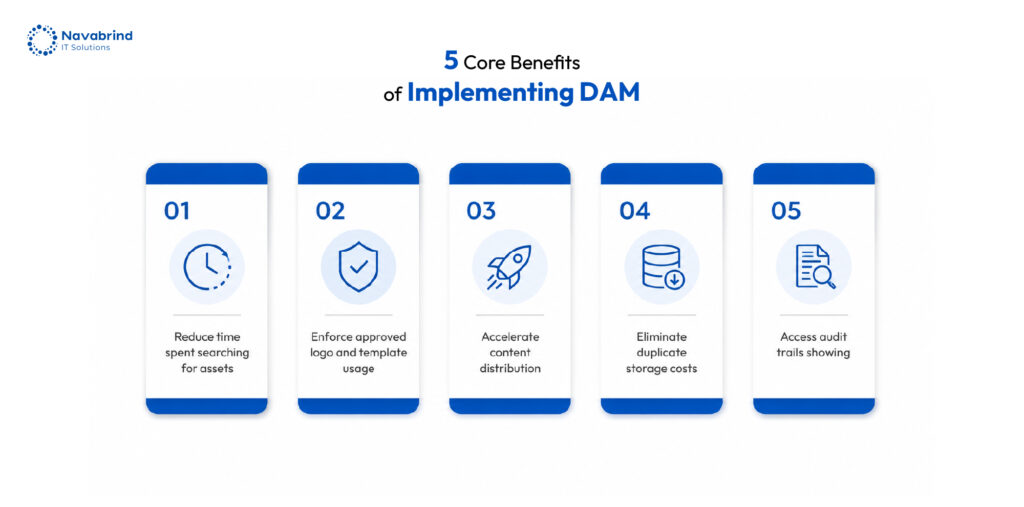
Organizations without Digital Asset Management operate in a constant cycle of delays, duplication, and brand risk. Employees spend substantial portions of their workday searching for files across emails, shared folders, cloud drives, and disconnected platforms. Finance leaders recognize this as a hidden operational expense that quietly drains productivity budgets month after month.
Without digital asset management systems, creative teams recreate assets that already exist because nobody can locate approved versions. Designers lose valuable production time resizing banners, reformatting files, and responding to repetitive asset requests instead of contributing revenue-generating creative work.
Brand inconsistency creates another commercial risk. Outdated logos, expired promotional graphics, and unauthorized visuals reach websites, social channels, and partner networks, weakening brand credibility. DAM software prevents this confusion through governed access, version control, and centralized brand distribution.
Legal exposure increases when businesses cannot monitor licensing rights, content usage permissions, or asset access history. Digital asset management workflow controls reduce copyright violations, GDPR concerns, and compliance failures.
DAM solutions accelerate campaign launches, ecommerce publishing, and sales enablement by keeping approved content accessible, searchable, and deployment-ready.
Digital Asset Management Workflow From Creation to Distribution
A successful Digital Asset Management strategy depends on workflow design, not storage capacity alone. Organizations handling large-scale content operations require a digital asset management workflow that controls assets from creation through approval, distribution, archival, and rights governance. Without workflow discipline, content libraries become chaotic, difficult to search, and risky to manage.
The process begins during asset creation. DAM software captures metadata at ingestion, including creator details, campaign association, licensing information, regional usage permissions, and asset categories. Consistent naming conventions and taxonomy structures support scalable organization across departments.
Review and approval workflows eliminate fragmented email feedback loops by centralizing stakeholder collaboration inside digital asset management systems. Brand teams, legal reviewers, and regional managers approve assets before publication, preventing unauthorized or outdated content from reaching external channels. Version tracking distinguishes draft, approved, and archived states with complete asset history visibility.
Digital asset management tools strengthen discoverability through metadata standards, smart collections, keyword search, and visual recognition capabilities. DAM solutions distribute content through partner portals, CMS integrations, ecommerce platforms, and social publishing environments. Organizations can transform one master asset into multiple formats during download, reducing duplicate production work.
Rights management and archival controls complete the lifecycle by monitoring license expiry, preserving audit trails, and governing asset retirement policies for compliance protection.
Digital Asset Management Solutions: Categories and Use Cases
Digital asset management solutions address different operational challenges depending on business structure, content volume, and distribution requirements. Selecting the wrong DAM software creates workflow friction, low adoption, and disconnected asset governance. Organizations achieve stronger ROI when Digital Asset Management aligns with operational priorities and content delivery models.
Brand-focused digital asset management systems support marketing departments managing logos, campaign visuals, templates, and brand guidelines across distributed teams and external partners. These DAM solutions emphasize branded portals, controlled asset access, template governance, and partner collaboration.
Product-centric DAM software supports retailers, manufacturers, and ecommerce businesses handling product imagery, packaging assets, catalogs, specification sheets, and 3D files. Integration with ecommerce ecosystems and product information management platforms strengthens catalog accuracy and channel consistency.
Media-oriented digital asset management tools manage large-scale video libraries, production footage, audio assets, and broadcast content. Features such as proxy review, frame-level metadata, and production delivery pipelines support fast-moving creative environments.
Enterprise DAM solutions focus on organization-wide governance across multiple regions, brands, and departments. Advanced permissions, SSO integration, audit visibility, and enterprise-grade security controls help global businesses manage large digital ecosystems with operational accountability.
Best Digital Asset Management Platforms: What Separates Good from Great
The best digital asset management platforms deliver far beyond file storage. High-performing Digital Asset Management solutions strengthen content governance, accelerate distribution, reduce operational waste, and support scalable asset operations across departments, regions, and partner networks.
Search performance remains one of the defining capabilities inside digital asset management systems. Teams require fast asset discovery through metadata filters, AI-assisted tagging, visual recognition, and keyword search accuracy. Flexible metadata structures, controlled vocabularies, and bulk editing capabilities strengthen organization across expanding asset libraries.
Integration capability shapes long-term platform value. DAM software connected with Adobe Creative Cloud, Figma, Canva, CMS platforms, ecommerce ecosystems, PIM environments, and marketing tools eliminates fragmented workflows and content duplication.
Deployment architecture also influences operational fit. Cloud-based DAM solutions support rapid deployment with lower infrastructure demands, whereas on-premise environments prioritize data governance. Hybrid and headless digital asset management tools support composable ecosystems and API-driven content delivery models.
Vendor evaluation should extend beyond subscription pricing. Organizations must assess migration support, onboarding quality, SLA commitments, security certifications, backup policies, scalability performance, and product roadmap maturity before selecting a digital asset management platform.
DAM Software: A Closer Look at the Technology Layer
DAM software operates far beyond the capabilities of generic cloud storage platforms. Traditional storage tools focus on file retention, yet Digital Asset Management introduces intelligence, governance, automation, and scalable content operations across enterprise ecosystems.
At the center of digital asset management systems sits the metadata engine. Structured metadata organizes assets through predefined fields such as campaign name, region, product category, creator, licensing rights, and approval status. Unstructured metadata expands discoverability through AI-generated labels, visual recognition, and contextual analysis.
Machine learning capabilities continue reshaping digital asset management solutions. Auto-tagging identifies objects, products, scenes, and brand elements inside images and videos. Predictive search engines surface relevant assets based on user behavior, metadata relationships, and content similarity. DAM solutions can analyze video sentiment, verify file quality, and transform formats for channel-ready delivery.
API-first architecture gives digital asset management tools a major advantage inside composable ecosystems. DAM software integrates with CMS platforms, ecommerce systems, PIM environments, mobile apps, and omnichannel delivery pipelines through flexible APIs.
Security architecture remains equally critical. Encryption, access logging, data loss prevention controls, CDN distribution, and scalable transcoding infrastructure support secure asset operations across global content environments.
Digital Asset Management Tools: Building Your Supporting Stack
Digital Asset Management delivers maximum business value when connected with the wider ecosystem of digital asset management tools supporting content creation, commerce, publishing, and campaign execution. DAM software acts as the central governance layer linking creative production, product information, marketing operations, and distribution channels into one connected asset environment.
Creative teams rely on integrations with Adobe Creative Cloud, Figma, Canva, and video collaboration platforms to keep approved assets connected with active production workflows. Designers access brand-approved content without searching across disconnected storage systems, reducing duplication and maintaining visual consistency.
Content publishing environments gain substantial operational advantages through DAM solutions integrated with CMS platforms. Organizations eliminate duplicate media uploads, maintain centralized asset governance, and accelerate omnichannel publishing through connected workflows. Headless CMS and headless digital asset management systems support API-driven content delivery across websites, mobile apps, marketplaces, and digital experiences.
PIM integration strengthens ecommerce operations by synchronizing product assets with product data. Digital asset management workflow connections maintain image accuracy, packaging consistency, and catalog synchronization across commerce platforms.
Marketing automation and CRM integrations extend DAM capabilities into campaign execution and sales enablement. Approved assets flow into email campaigns, sales portals, and customer engagement platforms with governed access, version control, and performance visibility.
Implementing a DAM System: A Practical Roadmap
Digital Asset Management implementations fail when organizations treat DAM software as a storage project instead of an operational transformation initiative. Successful deployment requires governance planning, workflow alignment, metadata discipline, and long-term adoption ownership across departments.
Implementation begins with a full asset audit. Organizations must identify existing repositories, cloud storage platforms, local drives, creative archives, and disconnected content libraries. Stakeholder requirements, access permissions, and workflow dependencies shape the foundation of digital asset management systems.
The strategy phase defines taxonomy structures, metadata frameworks, naming standards, ingestion policies, approval workflows, rights governance, and distribution rules. Without organizational consistency at this stage, digital asset management workflow performance weakens rapidly as asset libraries expand.
Vendor selection should include proof-of-concept testing using active business assets and cross-functional user groups. Organizations evaluating DAM solutions must assess scalability, onboarding quality, SLA commitments, migration support, integration capability, and governance flexibility.
Migration phases should include asset cleansing, duplicate removal, metadata enrichment, and staged ingestion planning to protect ongoing creative operations. Adoption success depends on role-focused training, DAM administrators, searchable documentation, and governance ownership.
Long-term optimization requires continuous taxonomy refinement, usage analytics, metadata maintenance, and regular health reviews across digital asset management tools and repositories.
Measuring DAM ROI: Proving the Business Case
Digital Asset Management delivers measurable commercial impact across productivity, compliance, operational efficiency, and content delivery performance. Leadership teams evaluating DAM software require measurable outcomes tied to cost reduction, workflow acceleration, and revenue enablement rather than storage capacity alone.
One of the largest ROI drivers comes from reduced search time. Employees spend significant portions of their workday locating files, requesting assets, or recreating missing content. Digital asset management systems reduce this operational waste through searchable metadata, governed repositories, and centralized asset visibility.
Organizations using digital asset management solutions also reduce creative production expenses by eliminating duplicate asset creation and repetitive formatting work. Faster approvals and governed digital asset management workflow processes shorten campaign launch timelines, helping marketing and ecommerce teams publish content without bottlenecks.
Compliance performance strengthens through controlled access, license tracking, audit visibility, and approved asset distribution. DAM solutions reduce copyright violations, expired asset usage, and off-brand publishing incidents that create financial and reputational exposure.
Beyond measurable savings, Digital Asset Management improves collaboration, accelerates creative execution, strengthens brand consistency, and reduces operational frustration across departments. Most organizations achieve measurable DAM software ROI within the first operational cycle, with compounded value increasing as asset libraries and distribution channels expand.
Frequently Asked Questions:
1.What is digital asset management and how does it work?
Digital Asset Management is the process of organizing, storing, governing, and distributing digital content from a centralized platform. Digital asset management systems use metadata, tagging, permissions, version tracking, and workflow controls to help teams locate, manage, approve, and distribute assets quickly across departments and channels. DAM software reduces content duplication, improves brand governance, and accelerates asset accessibility.
2.What are the key benefits of using a DAM system for businesses?
Digital Asset Management improves productivity, strengthens brand consistency, reduces asset recreation costs, and accelerates campaign execution. DAM solutions support faster asset discovery, governed approvals, rights management, audit visibility, and controlled distribution. Businesses using digital asset management tools gain stronger operational control across marketing, ecommerce, creative production, legal compliance, and partner collaboration.
3.What is the difference between DAM and CMS?
A CMS manages website content publishing, page creation, and digital experiences. Digital asset management systems focus on organizing, governing, and distributing assets such as images, videos, documents, creative files, and brand resources across multiple channels. DAM software acts as the centralized asset repository feeding content into CMS platforms, ecommerce systems, and marketing environments.
4.How does digital asset management software improve marketing workflows?
DAM software improves marketing execution through centralized asset access, metadata-driven search, governed approvals, version control, and connected distribution workflows. Marketing teams locate approved assets faster, avoid outdated content usage, reduce production delays, and maintain brand consistency across campaigns, social channels, websites, and partner networks.
5.What types of files can be stored in a digital asset management system?
Digital asset management systems support a wide range of content formats, including product images, campaign visuals, videos, audio files, PDFs, presentations, design templates, logos, CAD files, brand guidelines, packaging assets, documents, animations, and 3D content. DAM solutions organize these assets through searchable metadata and controlled access governance.
Related Articles









 Post
Post