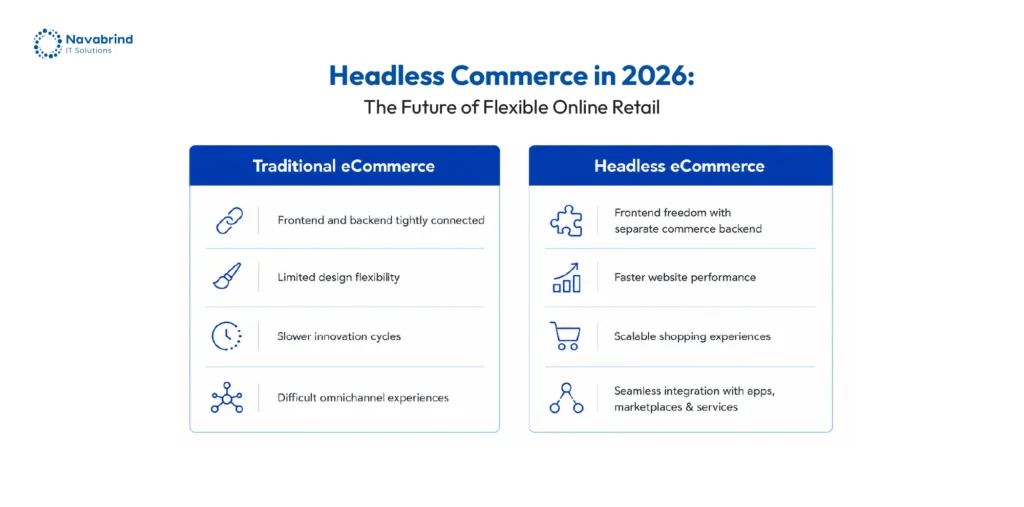
Headless e-commerce platforms redefine e-commerce architecture by separating frontend experience from backend commerce logic. Headless Ecommerce Platforms enable brands to deploy Headless architecture and Headless E-commerce architecture that decouple presentation layers, improving customer experience through API-driven commerce. Top headless commerce platforms enable faster experimentation across channels and support scalable Headless commerce development for brands shifting away from traditional ecommerce systems. Traditional platforms bind frontend and backend into single stacks, limiting flexibility, whereas Headless commerce platforms support flexible content delivery and faster innovation cycles. Benefits of headless commerce include stronger channel agility, improved performance across touchpoints, and enhanced integration capability with external services. Headless solution adoption in 2026 reflects growing demand for composable commerce environments where APIs manage data exchange and frontend systems evolve independently. Businesses evaluating Top headless commerce platforms prioritize architecture flexibility, integration readiness, and long-term scalability across digital commerce ecosystems driving revenue growth outcomes across commerce ecosystems landscapes.
Why Headless Commerce Is Growing Rapidly
Expansion of headless commerce platforms reflects omnichannel shopping demand across web, mobile, marketplaces, and retail touchpoints. Headless architecture separates frontend experience from backend commerce logic, enabling flexible interface delivery across channels. Headless E-commerce architecture enhances frontend flexibility, performance speed, and content orchestration across devices. Top headless commerce platforms enable personalization engines that drive AI-driven commerce experiences across user journeys. Headless commerce development supports mobile applications, IoT devices, wearable interfaces, and multi-device engagement without frontend constraints. Benefits of headless commerce include composable commerce capabilities, scalable integrations, and improved experience continuity across channels. Composable commerce architecture strengthens modular service exchange across catalogs, payments, and content systems. Headless solution adoption aligns with enterprises seeking adaptive digital commerce frameworks that support continuous iteration across frontend experiences and backend services. API-driven ecosystems enhance integration across payment gateways, product catalogs, and analytics services across digital commerce environments driving sustained commerce evolution across enterprise ecosystems at scale.
Key Features to Look for in a Headless Ecommerce Platform
Headless commerce platforms evaluation focuses on API-first architecture enabling separation of frontend systems and backend commerce services across digital ecosystems. Top headless commerce platforms deliver scalability for enterprise traffic loads and high-volume transaction environments across commerce networks. Headless architecture supports frontend framework compatibility enabling diverse interface development across web applications, mobile interfaces, and interactive touchpoints. Headless E-commerce architecture supports multi-store and multi-region commerce operations across varied catalogs and pricing models. Integration capability across ERP, PIM, CMS, and CRM platforms strengthens data flow across enterprise systems and commerce workflows. Security standards, performance optimization, and cloud infrastructure reliability remain critical selection factors for Headless commerce development initiatives. Benefits of headless commerce include improved integration flexibility, channel expansion capability, and enhanced system orchestration across commerce environments. Headless solution adoption aligns with scalable digital commerce transformation strategies supported by Top headless commerce platforms, enabling long-term commerce ecosystem expansion across distributed digital infrastructures.
Shopify Plus: Flexible SaaS Headless Commerce
Headless commerce platforms, including Shopify Plus, drive composable storefront models within Headless architecture and Headless E-commerce architecture across digital commerce ecosystems. Top headless commerce platforms evaluation places Shopify Plus for storefront flexibility, Hydrogen framework for frontend development, Oxygen infrastructure for hosting delivery layers across distributed environments. Headless commerce development using Shopify Plus enables DTC and enterprise brands to deploy varied buying experiences across product discovery, checkout flows, and content presentation. Benefits of headless commerce include expanded channel adaptability, faster iteration cycles for storefront interfaces, and improved integration across commerce services. Shopify Headless architecture enables multi-brand and multi-region commerce operations within a single Headless solution framework connecting commerce APIs, content systems, and backend services. The selection of headless commerce platforms depends on scalability requirements, developer experience, and ecosystem integration readiness with ERP, PIM, CMS, and CRM systems to support long-term commerce expansion across digital ecosystems.
Adobe Commerce (Magento) Enterprise Headless Commerce Powerhouse
Headless commerce platforms, such as Adobe Commerce, strengthen enterprise-grade digital ecosystems through Headless architecture and Headless E-commerce architecture, designed for complex commerce operations. Top headless commerce platforms position Adobe Commerce as a leader, thanks to Magento PWA Studio and GraphQL capabilities that enable flexible storefront development and robust data exchange across commerce layers. Headless commerce development within Adobe Commerce supports high-complexity B2B and B2C environments requiring advanced catalog management, pricing rules, and customer segmentation across global operations. Benefits of headless commerce include improved scalability for large product catalogs, enhanced integration across ERP, PIM, CMS, and CRM systems, and stronger performance across high-traffic commerce environments. Headless solution deployment with Adobe Commerce enables modular commerce orchestration across multiple storefronts, regions, and business units within a composable ecosystem. Top headless commerce platform selection for enterprise brands prioritizes extensibility, integration depth, and architectural flexibility across evolving digital commerce infrastructures.
BigCommerce: API-Driven Commerce for Fast Growth
Headless commerce platforms like BigCommerce strengthen API-driven commerce ecosystems within Headless architecture and Headless E-commerce architecture supporting rapid expansion across digital channels. Top headless commerce platforms include BigCommerce due to strong API capabilities enabling storefront separation and flexible frontend creation using Next.js and React frameworks. Headless commerce development within BigCommerce supports multi-channel selling across marketplaces, social commerce, and branded storefronts with consistent data flow across systems. Benefits of headless commerce include improved channel orchestration, faster frontend iteration, and expanded integration across ERP, PIM, CMS, and CRM platforms supporting commerce operations. Headless solution adoption in BigCommerce enables mid-market brands to scale commerce operations without rigid system constraints, supporting catalog expansion and varied customer engagement models. Top headless commerce platform selection for growth-focused businesses prioritizes API flexibility, ecosystem connectivity, and frontend adaptability in evolving digital commerce environments, supporting long-term revenue expansion across distributed commerce networks.
Commercetools: Enterprise-Grade Composable Commerce
Headless commerce platforms such as commercetools enable enterprise-grade composable ecosystems through Headless architecture and Headless E-commerce architecture designed for distributed digital operations. Top headless commerce platforms position commercetools around MACH principles with microservices, API-first commerce, and cloud-based modular services supporting global commerce execution. Headless commerce development using commercetools enables flexible commerce construction across product catalogs, pricing models, and customer journeys spanning multiple regions and business units. Benefits of headless commerce include strong scalability for enterprise workloads, tailored commerce experiences across segments, and enhanced integration with ERP, PIM, CMS, and CRM systems within composable environments. Headless solution deployment in commercetools supports industry use cases across retail, manufacturing, travel, and subscription-based commerce models requiring high adaptability. Top headless commerce platform selection for enterprise transformation prioritizes composability, integration depth, and infrastructure resilience in evolving digital commerce ecosystems, enabling long-term operational agility and commerce expansion in global markets.
Salesforce Commerce Cloud: AI-Powered Headless Ecommerce
Headless commerce platforms such as Salesforce Commerce Cloud support enterprise digital ecosystems through Headless architecture and Headless E-commerce architecture enhanced by AI-driven commerce capabilities. Top headless commerce platforms include Salesforce Commerce Cloud, thanks to Einstein AI, which enables personalized commerce experiences across customer journeys and engagement points. Headless commerce development within this platform supports omnichannel commerce management across web, mobile, in-store, and service channels with unified commerce data orchestration. Benefits of headless commerce include improved personalization outcomes, stronger integration with Salesforce ecosystem tools, and enhanced coordination across ERP, PIM, CMS, and CRM systems. Headless solution deployment within Salesforce Commerce Cloud supports enterprise requirements for scalable commerce operations, advanced analytics, and customer lifecycle optimization across global markets. Top headless commerce platform selection for large organizations prioritizes AI-driven insights, system connectivity, and architectural adaptability to support long-term commerce transformation across complex digital commerce environments and multi-regional business structures.
Emerging Headless Ecommerce Platforms in 2026
Headless commerce platform expansion in 2026 includes emerging API-first ecosystems shaping the next phase of digital commerce through Headless architecture and Headless E-commerce architecture, designed for adaptable development environments. Top headless commerce platforms now include open-source and developer-focused systems such as Saleor for flexible commerce builds, Medusa for modular commerce development, Commerce Layer for global transaction orchestration, Swell for adaptable commerce infrastructure, and Vendure for enterprise-level custom commerce applications. Headless commerce development across these platforms enables rapid storefront creation, extensible APIs, and flexible backend orchestration that support diverse commerce models. Benefits of headless commerce include improved developer control over architecture design, scalable integration across ERP, PIM, CMS, and CRM systems, and enhanced adaptability for evolving commerce requirements. Adopting headless solutions across emerging platforms supports composable commerce strategies that prioritize modularity, extensibility, and distributed system design. Top headless commerce platforms selection in this segment focuses on developer experience, API flexibility, and global readiness across digital commerce ecosystems.
15 Best Headless Ecommerce Platforms Compared
Platform
|
Core Strength
|
Ideal Use Case
|
Architecture Type
|
|
Shopify Plus
|
Fast storefront setup, Hydrogen support
|
DTC brands, fast scaling stores
|
SaaS Headless
|
|
Adobe Commerce (Magento)
|
Complex catalog & B2B logic
|
Large enterprise commerce
|
Hybrid / Enterprise
|
|
BigCommerce
|
API flexibility, multi-channel selling
|
Mid-market growth brands
|
SaaS Headless
|
|
commercetools
|
MACH-based composable setup
|
Global enterprise systems
|
Composable Commerce
|
|
Salesforce Commerce Cloud
|
AI-driven personalization
|
Large enterprise retail
|
SaaS Headless
|
|
Saleor
|
GraphQL-first flexibility
|
Developer-led commerce builds
|
Open-source
|
|
Medusa
|
Modular Node.js commerce engine
|
Custom storefront projects
|
Open-source
|
|
Commerce Layer
|
Global commerce orchestration
|
Multi-region selling
|
API-first SaaS
|
|
Swell
|
Flexible backend commerce API
|
Startups & agile teams
|
Headless API platform
|
|
Vendure
|
Extensible TypeScript commerce
|
Custom enterprise builds
|
Open-source
|
|
Elastic Path
|
Composable commerce APIs
|
Enterprise omnichannel systems
|
Composable SaaS
|
|
VTEX
|
Unified commerce + marketplace
|
Large retail & marketplaces
|
SaaS Commerce
|
|
Fabric
|
Retail commerce infrastructure
|
Enterprise retail scaling
|
Composable SaaS
|
|
OroCommerce
|
B2B commerce specialization
|
B2B distributors
|
Open-source / Enterprise
|
|
Spryker
|
Modular enterprise commerce
|
Complex commerce ecosystems
|
Composable platform
|
Open-Source vs SaaS Headless commerce platforms
Headless commerce platforms landscape splits between open-source and SaaS models across Headless architecture and Headless E-commerce architecture supporting varied enterprise requirements. Top headless commerce platforms in the open-source category enable full code-level control, flexible customization, and extensible commerce development for teams requiring tailored system design. SaaS Headless commerce platforms deliver managed infrastructure, reduced operational overhead, and faster deployment cycles across commerce environments. Headless commerce development within open-source systems supports deep customization across storefront logic, APIs, and backend services, while SaaS-based Headless solution frameworks focus on scalability, uptime management, and integrated service delivery. Benefits of headless commerce across both models include modular architecture, improved integration across ERP, PIM, CMS, and CRM platforms, and enhanced multi-channel commerce capability. Selection between models depends on customization requirements, internal development capacity, and long-term commerce strategy across digital ecosystems. Top headless commerce platforms evaluation considers cost structure, flexibility range, and infrastructure ownership across evolving commerce operations and enterprise growth objectives.
Frequently Asked Questions
1.What is headless commerce and how does it work?
Headless commerce platforms separate frontend presentation from backend commerce logic using Headless architecture and Headless E-commerce architecture. Data flows through APIs, enabling flexible storefront experiences across web, mobile, and connected devices. Headless commerce development uses this structure to deliver content, products, and checkout interactions without frontend limitations, forming a scalable Headless solution for evolving digital commerce systems.
2.Which headless ecommerce platform is best for small businesses?
Top headless commerce platforms for smaller operations include BigCommerce, Shopify Plus, and Medusa due to flexible setup models and API-first design. These platforms support Headless commerce development with lower complexity, allowing rapid storefront creation and integration with CMS, CRM, and payment systems within a Headless solution environment.
3.What are the Benefits of headless commerce for online stores?
Benefits of headless commerce include improved storefront flexibility, stronger integration across ERP, PIM, CMS, and CRM platforms, and enhanced performance across multiple channels. Headless commerce platforms enable faster experimentation with customer experiences through Headless architecture and scalable backend services supporting multi-channel commerce growth.
4.How much does headless ecommerce development cost?
Headless commerce development cost varies based on platform selection, integration scope, and customization depth across Headless commerce platforms . Enterprise-grade Headless solution implementations using commercetools or Adobe Commerce require higher investment due to advanced integration layers, while SaaS-based systems like Shopify Plus or BigCommerce reduce infrastructure complexity and implementation effort.
5.What is the difference between headless and traditional ecommerce architecture?
Traditional ecommerce architecture combines frontend and backend into a single system, limiting flexibility. Headless commerce platforms separate both layers using Headless architecture and Headless E-commerce architecture, enabling independent frontend development, API-driven communication, and scalable integration. Headless commerce development supports faster innovation cycles and multi-channel delivery through a modular Headless solution approach.
Schedule a conversation with us now!
Related Articles









 Post
Post