Your accountant reports one set of numbers. Your warehouse team shows another. A customer is waiting for a shipment that your system confirmed as available yet the shelves say otherwise. This disconnect is not a small glitch. For businesses running on tight margins, one mismatch can trigger lost revenue, delayed orders, and damaged trust.
This is the daily reality for companies relying on disconnected tools instead of a unified Odoo erp for wholesale distribution approach. When financial records and inventory data fail to align, decision-making becomes guesswork. In a distribution environment, that gap between numbers and stock levels doesn’t just slow operations it puts profitability at risk.
This blog post breaks down why these mismatches happen inside traditional ERP software for distribution, how a robust distribution ERP system eliminates these gaps, and what adopting Odoo ERP for wholesale distribution means in terms of cost and capability. You’ll also see how it compares with platforms like NetSuite and whether it can fully support growing operations.
For any ERP for a distribution company aiming to scale without operational friction, relying on fragmented wholesale distribution software is no longer viable. Transitioning to Odoo erp for wholesale distribution marks a shift from reactive problem-solving to controlled, predictable growth.
The Unique ERP Challenges Facing U.S. Wholesale Distributors
Wholesale distribution runs on volume, velocity, and razor-thin margins. One disconnect across systems can ripple through procurement, inventory, finance, and customer delivery within hours.
High SKU volumes with constant price shifts create a moving target. Managing thousands of items across changing supplier costs and customer pricing tiers pushes traditional ERP software for distribution beyond its limits. Without a connected distribution erp system, pricing errors and margin leakage become routine.
Operations expand across multiple warehouses, regions, and fulfillment points. Stock transfers, inter-warehouse visibility, and demand allocation demand coordination that fragmented wholesale distribution software cannot sustain. This complexity exposes gaps that delay shipments and distort inventory accuracy.
Margins leave no room for error. A single fulfillment mistake, wrong item, incorrect quantity, delayed dispatch can erase profit from multiple orders. For an ERP for a distribution company, execution precision is not optional, it defines survival.
Customer relationships add another layer. Contract-based pricing, negotiated discounts, credit limits, and payment terms vary across accounts. Managing these variables across disconnected tools leads to billing disputes, delayed collections, and strained partnerships. A cohesive Odoo erp for wholesale distribution framework brings these variables under one system, reducing friction across sales and finance.
Compliance requirements introduce operational pressure. Lot tracking, expiry monitoring, and serialization are critical in sectors like food, pharmaceuticals, and chemicals. Missing a traceability record can trigger regulatory penalties and product recalls risks no distributor can afford.
Then comes the patchwork reality: accounting in QuickBooks, inventory in Excel, warehouse activity in a standalone WMS, and communication through email threads. This disconnected stack creates data silos, duplicate entries, and constant reconciliation. Teams spend time fixing inconsistencies instead of driving growth.
This is where the case for a unified Odoo ERP for wholesale distribution becomes unavoidable. A connected distribution ERP system replaces fragmented workflows with a single operational backbone, aligning inventory, finance, sales, and logistics into one controlled environment.
Why U.S. Wholesale Distributors Have Inventory and Accounting Mismatches
Inventory and accounting mismatches don’t appear out of nowhere, they are the result of fragmented workflows and delayed data movement. For any business relying on disconnected ERP software for distribution, these gaps build silently until they disrupt operations and financial visibility.
Root cause 1: Disconnected systems
Inventory sits in one platform, accounting in another. Data moves through exports, imports, or spreadsheets instead of a connected distribution erp system. This separation creates conflicting records, forcing teams to reconcile numbers instead of trusting them.
Root cause 2: Data entry lag
Warehouse activity updates stock levels instantly on the floor, yet financial records depend on someone entering that data later. This delay creates timing gaps where inventory shows movement, but accounting does not reflect the transaction. For businesses without an integrated Odoo erp for wholesale distribution, this lag becomes a daily issue.
Root cause 3: No transaction-level COGS tracking
Cost of goods sold gets calculated after transactions close rather than at the moment of sale or dispatch. Without synchronized costing inside a distribution erp system, margins appear inaccurate, and profitability analysis loses credibility.
Root cause 4: Inconsistent valuation methods
Applying FIFO in one system and average cost in another leads to conflicting inventory values. When valuation logic lacks consistency across wholesale erp software, financial statements no longer align with actual stock movement.
Root cause 5: Returns and adjustments outside the system
Returns, damaged goods, and stock corrections get handled through spreadsheets or informal processes. These adjustments never fully reflect in accounting, creating hidden discrepancies that accumulate over time in fragmented wholesale distribution software environments.
Root cause 6: Multi-location transfers without financial impact
Stock moving between warehouses updates inventory counts but fails to reflect corresponding accounting entries. Without a connected ERP for distribution companies, inter-location transfers distort valuation and reporting.
The downstream effect
These issues don’t stay confined to operations. Purchasing decisions rely on inaccurate stock levels, leading to overstocking or shortages. Financial statements lose reliability, affecting investor confidence and planning. Audit exposure increases as inconsistencies surface under scrutiny. This is why businesses adopting Odoo erp for wholesale distribution shift toward a connected distribution ERP system to eliminate delays, unify valuation logic, and align inventory movement with financial records at the source.
What Modules Does Odoo ERP Include for Wholesale Distribution Management?
A high-performing Odoo erp for wholesale distribution setup connects operations, finance, and customer management into one continuous flow. Each module feeds the next, eliminating gaps that lead to delays, errors, and lost revenue. This is what transforms fragmented wholesale distribution software into a connected distribution erp system.
Inventory Management:
Track stock levels across multiple warehouses with complete visibility. Control putaway rules, automate replenishment, and maintain accurate inventory valuation. This module forms the backbone of any ERP for wholesale distributors, ensuring stock data aligns with operational activity.
Purchase Management:
Create purchase orders, manage vendor price lists, and account for landed costs without delays. Vendor performance tracking helps improve procurement decisions, reducing cost leakage within ERP software for distribution environments.
Sales Management:
Handle customer-specific pricing, quotations, and order confirmations in one place. Sales teams access accurate inventory and pricing data, preventing order errors and improving customer satisfaction within a wholesale erp software framework.
Accounting & Finance:
Capture financial impact at the moment transactions occur. Automated journal entries, synchronized COGS tracking, and accurate reconciliation ensure financial statements reflect actual operations. This alignment is critical for any ERP for a distribution company focused on profitability.
Warehouse Management (WMS):
Manage receiving, picking, packing, and shipping with barcode-enabled workflows. Warehouse execution stays aligned with system data, reducing fulfillment errors across wholesale distribution software processes.
Lot & Serial Number Tracking:
Maintain complete traceability from supplier to end customer. This capability supports compliance, recall readiness, and quality control across regulated industries using a distribution erp system.
CRM (Customer Relationship Management):
Track leads, manage pipelines, and maintain customer history in one connected environment. Sales and operations stay aligned, strengthening long-term relationships within Odoo erp for wholesale distribution deployments.
Reporting & Dashboards:
Access custom KPIs, inventory valuation insights, and margin analysis without relying on external tools. Decision-makers gain visibility across operations, finance, and sales inside one ERP software for distribution.
EDI & Integrations:
Connect with 3PL providers, shipping carriers, and e-commerce platforms. Data flows across systems without duplication, strengthening the ecosystem around your wholesale erp software.
How the modules work together:
A sales order triggers inventory allocation, which updates warehouse picking. Once shipped, the system records revenue and cost instantly in accounting. Procurement responds to stock levels, and reporting reflects these movements without delay. This continuous data flow is what defines a connected distribution erp system. For any ERP for wholesale distributors, this level of integration replaces disconnected tools with a single operational framework by ensuring inventory, finance, and customer data stay aligned from order to delivery.
How Odoo ERP Integrates Inventory and Accounting for Distributors
At the heart of Odoo erp for wholesale distribution lies a non-negotiable principle: each stock movement triggers a corresponding financial entry. No duplication. No delays. No reconciliation gaps. This is what separates a connected distribution erp system from fragmented wholesale distribution software.
How the flow works in practice:
1.Procurement to stock valuation:
A vendor bill enters the system and links with the purchase order. As goods arrive, inventory levels update instantly, and product valuation adjusts based on the selected costing method. At that moment, the system records the financial impact through journal entries with no secondary action required inside your ERP for the distribution company.
2.Sales to revenue and cost recognition:
A confirmed sales order initiates delivery. Once goods leave the warehouse, inventory reduces and cost of goods sold reflects in accounting at the transaction level. The invoice follows with aligned values, ensuring revenue and cost stay synchronized within your ERP software for distribution.
3.Returns without data gaps:
When a return gets processed, stock levels reverse, and the financial side follows through with a credit note. Inventory and accounting remain aligned without separate workflows with something disconnected wholesale erp software setups fail to achieve.
4.Inventory valuation that stays consistent:
Choose FIFO, Average Cost, or Standard Price once. The system applies that method across transactions without deviation. This consistency removes valuation conflicts that commonly appear in legacy wholesale distribution software environments.
5.Landed cost allocation at the source:
Freight, customs duties, and handling charges attach to product cost at the time of receipt. This ensures inventory reflects true cost from the start, strengthening margin visibility across your distribution erp system.
6.Multi-warehouse financial alignment:
Stock movement between warehouses updates inventory and financial records at the entity level. No missing entries. No valuation distortion. For any growing ERP for wholesale distributors, this control is critical.
7.The reconciliation advantage
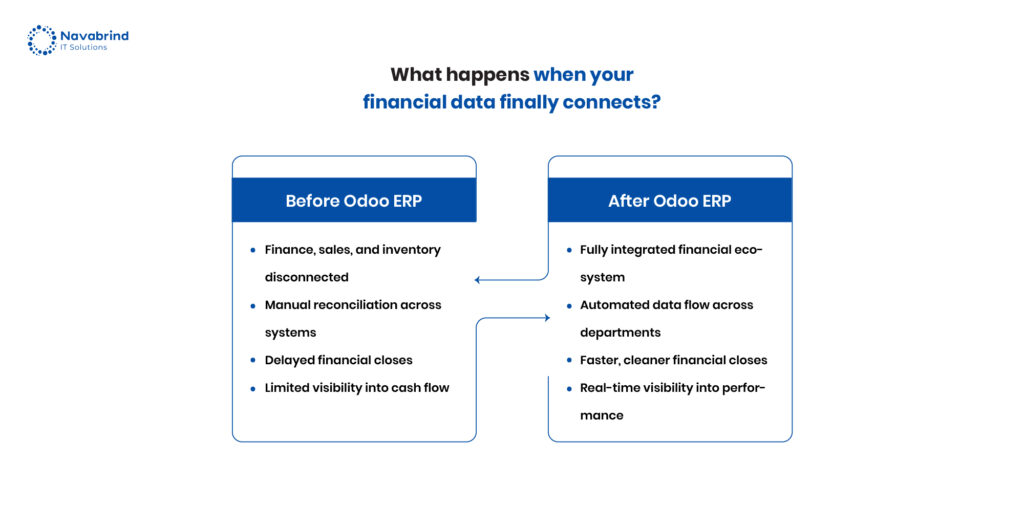
Since inventory and accounting stay aligned at the transaction level, month-end closing shifts from a time-consuming reconciliation exercise to a quick validation step. Finance teams close books in days instead of chasing discrepancies for weeks.
This level of integration is what makes Odoo erp for wholesale distribution a serious upgrade for any ERP for distribution company by eliminating mismatches at the source and replacing reactive fixes with controlled, consistent operations.
How Odoo ERP Reduces Manual Data Entry for U.S. Distributors
Manual data entry drains time, slows execution, and introduces costly errors. In a fragmented setup, teams spend hours re-keying purchase orders, invoices, inventory updates, and shipment details across disconnected tools. This hidden workload is often 15–25 hours per week across departments that acts as a silent cost center inside traditional ERP software for distribution. A connected Odoo ERP for wholesale distribution environment removes this burden by linking workflows from procurement to delivery without human intervention at each step.
What Odoo automates end to end:
1.Procurement flow with 3-way matching:
Purchase orders, vendor bills, and goods receipts align within one system. Once matched, accounting entries follow without re-entry, eliminating duplication inside your distribution erp system.
2.Order-to-cash execution:
A sales order converts into a delivery order, and once fulfilled, the invoice is generated with aligned data. No retyping. No missed details. This continuity strengthens accuracy across wholesale erp software operations.
3.Inventory adjustments with financial impact:
Stock corrections reflect inventory and accounting at once. Teams avoid separate entries, keeping data consistent across your ERP for distribution companies.
4.Replenishment without spreadsheets:
Reorder rules monitor stock levels and create draft purchase orders when thresholds are reached. Procurement responds faster without relying on external tracking tools within wholesale distribution software.
5.Shipping workflows connected to orders:
Delivery orders generate shipping labels and documentation, linking warehouse activity with logistics execution inside the distribution erp system.
6.Accounts receivable follow-ups:
Customer statements and payment reminders trigger automatically, improving cash flow without repetitive administrative work in your ERP software for distribution.
7.Barcode-driven warehouse execution:
Receiving, picking, and shipping rely on barcode scanning instead of keyboard input. This reduces entry errors and speeds up operations across Odoo erp for wholesale distribution deployments.
8.EDI integration for order intake:
Customer orders enter the system through electronic data interchange, removing the need for manual order creation. This is critical for distributors handling high order volumes within ERP for wholesale distributors.
Before vs. after: operational impact
Without a connected system, a single order passes through multiple hands, sales enters it, warehouse rechecks inventory, finance re-enters billing details, and logistics prepares shipment manually. Each step introduces delays and inconsistencies. With Odoo erp for wholesale distribution, that same order flows across modules without interruption. Sales confirms, inventory allocates, warehouse executes, and accounting records the transaction all within one continuous process. This shift replaces repetitive data entry with controlled workflows, allowing teams to focus on fulfillment speed, customer experience, and revenue growth.
What Is the Best ERP for Small Distribution Businesses in the U.S.?
Small distributors don’t fail because of demand, they struggle due to systems that can’t keep up with growth. Choosing the right ERP software for distribution determines whether operations scale smoothly or break under pressure.
What small distributors should evaluate:
- Total cost of ownership:
Look beyond license fees. Factor in implementation, customization, and ongoing support. A solution that appears low-cost upfront can become expensive if it requires multiple add-ons or heavy maintenance.
- Ease of use without an IT team:
Small businesses need a system that teams can adopt quickly. Complex platforms slow down onboarding and increase dependency on external support.
- Inventory and accounting integration depth:
This is non-negotiable. A reliable distribution erp system must align stock movement with financial records at the transaction level. Without this, discrepancies and reconciliation delays will persist.
- Scalability with growing SKUs and order volume:
The system should handle expansion like new products, warehouses, and customers without requiring a platform switch.
- U.S. tax, compliance, and reporting support:
Accurate financial reporting, audit readiness, and compliance capabilities are critical for long-term stability in any ERP for a distribution company.
Competitive Comparison for Small Distribution Businesses
| ERP |
Best For |
Starting Cost |
Weakness |
| Odoo |
Small–mid distributors |
Low–mid |
Requires a skilled implementation partner |
| NetSuite |
Mid–enterprise |
High |
Cost structure limits accessibility for smaller firms |
| Fishbowl |
QuickBooks add-on users |
Low–mid |
Inventory-focused, limited accounting depth |
| SAP Business One |
Mid-market |
High |
Complex setup, longer deployment cycles |
| Cin7 |
Product-based SMBs |
Mid |
Accounting integration lacks depth |
Why Odoo Stands Out for Small Distributors:
For businesses evaluating the best ERP for distribution, Odoo erp for wholesale distribution offers a balanced approach between cost, capability, and scalability. It allows companies to start with essential modules like inventory, sales, and accounting and expand as operations grow. This phased approach reduces upfront investment while maintaining a connected wholesale erp software foundation. Unlike systems that rely on external integrations, Odoo aligns inventory and accounting within one environment. This eliminates reconciliation gaps and strengthens financial visibility with an advantage that many wholesale distribution software solutions fail to deliver. For any ERP for wholesale distributors aiming to scale without operational friction, Odoo provides a pathway from small business operations to mid-sized growth without requiring a system replacement.
Can Odoo ERP Replace NetSuite for Wholesale Distribution Companies?
This question comes from mid-sized distributors investing $3,000–$8,000 per month in NetSuite and questioning whether the return justifies the spend. At that level, expectations shift from basic functionality to measurable impact on margins, speed, and control.
1.Where NetSuite delivers value
NetSuite brings strong financial management, multi-entity consolidation, and robust reporting capabilities. For organizations with complex corporate structures, these strengths support governance and visibility across entities.
2.Where NetSuite creates friction for distributors
Cost becomes a limiting factor. Licensing, add-ons, and support contracts drive expenses upward as operations grow. Customization requires specialized expertise, slowing down changes in workflows. For distributors managing dynamic pricing, inventory movement, and fulfillment cycles, slow iteration impacts responsiveness. This is where traditional ERP software for distribution starts to feel restrictive.
What Odoo brings as an alternative:
- Lower total cost with comparable capability
A well-implemented Odoo erp for wholesale distribution delivers inventory and accounting integration at a significantly lower total cost. Businesses gain control without the overhead tied to enterprise-heavy pricing models.
- Faster deployment timelines
Implementation cycles move faster due to flexible architecture and a wide ecosystem of modules. Distributors can go live sooner and start seeing operational impact without extended delays common in large-scale ERP rollouts.
- No vendor lock-in constraints
With an open-source foundation, Odoo erp for wholesale distribution gives businesses flexibility in customization and ownership. This reduces dependency on a single vendor and allows adaptation as operations evolve.
- Ecosystem aligned with distribution needs
From warehouse workflows to pricing structures and logistics integrations, the platform supports a wide range of use cases required in wholesale erp software environments.
Migration Considerations
Switching from NetSuite to a new distribution ERP system requires careful planning:
- Data migration complexity:
Historical transactions, inventory records, and financial data must be mapped accurately. Poor migration leads to reporting gaps and operational confusion.
- User retraining:
Teams must adapt to new workflows. Training ensures adoption and prevents productivity dips during transition.
- Go-live risk management:
A phased rollout reduces disruption. Starting with key modules like inventory, sales, and accounting helps stabilize operations before expanding across the full ERP for distribution company setup.
What the Migration Looks Like:
A typical transition involves process mapping, data migration, configuration of modules, user training, and phased deployment. With the right implementation partner, businesses move from fragmented or rigid systems to a connected distribution ERP system that aligns inventory, finance, and operations from day one. For distributors evaluating the best ERP for distribution, the decision comes down to control versus cost. Odoo ERP for wholesale distribution offers a path to reduce overhead, increase agility, and strengthen operational alignment without compromising on capability.
Rolling out an Odoo erp for a wholesale distribution environment demands careful planning. Distribution operations carry complexity that goes beyond standard ERP deployments, and overlooking these factors leads to delays, cost overruns, and adoption issues.
Why distribution ERP implementations are complex:
- High-volume historical inventory data
Migrating years of stock records, valuations, and transaction history into a new distribution erp system requires accuracy. Any inconsistency impacts reporting, costing, and opening balances.
- Existing integrations across the ecosystem
Distributors rely on connections with 3PL providers, EDI systems, shipping carriers, and e-commerce platforms. Aligning these integrations within ERP software for distribution demands coordination to avoid disruption in order flow.
- Warehouse layout and putaway logic
Warehouse operations depend on bin locations, routing paths, and storage rules. Configuring these elements inside a wholesale erp software environment ensures picking, packing, and replenishment follow operational logic.
- Customer pricing and contract complexity
Different customers operate under negotiated pricing, volume discounts, and credit terms. Translating these rules into the system is critical for billing accuracy within an ERP for a distribution company.
Recommended phased rollout approach:
Phase 1: Core operations (Inventory + Purchase + Sales)
Establish the operational backbone. Stock management, procurement, and order processing go live first, stabilizing day-to-day activities within the distribution erp system.
Phase 2: Accounting and financial reporting
Integrate financial workflows once operational data flows correctly. This aligns inventory movement with accounting, strengthening reporting accuracy across ERP software for distribution.
Phase 3: Warehouse execution enhancements
Introduce warehouse management features such as barcode scanning, optimized picking routes, and bin-level tracking. This step refines execution within wholesale distribution software processes.
Phase 4: External integrations and customer experience
Connect EDI, 3PL systems, and customer portals. This expands the ecosystem around your Odoo erp for wholesale distribution, enabling higher order volumes without operational strain.
Timeline expectations
A typical implementation spans 10 to 20 weeks, depending on data complexity, integration scope, and operational scale. Businesses with multiple warehouses, large SKU catalogs, and extensive historical data fall toward the higher end of this range.
Choosing the right implementation partner
Technology alone does not guarantee success. The implementation partner must understand distribution workflows of inventory valuation, warehouse execution, procurement cycles, and financial alignment. A partner experienced in ERP for distribution company deployments ensures the system reflects real operational needs, not generic configurations. Adopting Odoo erp for wholesale distribution is not just a system change that reshapes how inventory, finance, and operations interact. With the right approach, distributors move from fragmented processes to a connected distribution erp system that supports scale, accuracy, and sustained growth.
What a Successful Odoo Rollout Looks Like for a U.S. Wholesale Distributor
A successful rollout of Odoo erp for wholesale distribution is measured by operational control, speed, and financial accuracy. The shift becomes visible within weeks when a connected distribution erp system replaces fragmented tools.
Before vs. After: Real Transformation:
Before implementation:
A 40-person U.S. auto parts distributor runs on QuickBooks, Excel-based inventory tracking, and manual order entry. Warehouse and accounting teams operate in silos, leading to weekly reconciliation conflicts. Inventory counts rarely match financial records, and order fulfillment depends on constant cross-checking. This is a common state for businesses relying on disconnected ERP software for distribution.
After implementation:
With Odoo erp for wholesale distribution, inventory valuation updates with each transaction, invoicing follows order fulfillment without re-entry, and accounting reflects operational activity instantly. Month-end closing takes two days instead of weeks. Double-entry disappears, and teams work from one shared system instead of multiple tools. This is what a mature ERP for a distribution company environment looks like.
Key Metrics That Shift Post-Implementation:
- Inventory accuracy rate
Moves from ~85% to 99%+ as stock updates and valuation stay aligned within the distribution erp system.
- Order processing time
Reduced by 50–70% due to connected workflows across sales, warehouse, and accounting in wholesale erp software.
- Month-end close cycle
Drops from 10+ days to under 3, since reconciliation is no longer a manual exercise inside ERP software for distribution.
- Manual data entry hours
Reduced by 15–25 hours per week per team, freeing resources for higher-value activities within wholesale distribution software operations.
What “Fully Adopted” Looks Like at 90 Days Post Go-Live
By the 90-day mark, teams stop relying on spreadsheets and external trackers. Sales trusts system-driven stock availability. Warehouse teams execute using barcode workflows. Finance closes books without chasing discrepancies. Management reviews performance through system-generated reports instead of compiling data manually. At this stage, the Odoo ERP for the wholesale distribution environment becomes the single source of operational and financial truth. The distribution erp system is no longer a tool that becomes the backbone of how the business runs, scales, and protects margins.
Frequently Asked Questions
1.Why do U.S. wholesale distributors have inventory and accounting mismatches?
Mismatches arise when inventory and finance operate in separate systems. Stock movements update one tool, while accounting entries depend on delayed input or batch uploads. Inconsistent valuation methods, unrecorded returns, and gaps in multi-location transfers add to the problem. Without a connected Odoo ERP for wholesale distribution, these discrepancies continue to grow, impacting purchasing decisions and financial accuracy across any ERP for distribution companies.
2.How does Odoo ERP integrate inventory and accounting for distributors?
A connected distribution erp system ensures that each stock movement triggers a corresponding financial entry. When goods are received, sold, or returned, inventory levels and accounting records update at the same moment. Cost of goods sold, valuation, and journal entries stay aligned without separate workflows. This integration removes reconciliation gaps that are common in traditional ERP software for distribution setups.
3.What is the best ERP for small distribution businesses in the U.S.
The right choice depends on cost, usability, and integration depth. For growing distributors, Odoo erp for wholesale distribution stands out due to its ability to combine inventory, sales, and accounting in one platform without high overhead. Unlike limited wholesale distribution software or expensive enterprise systems, it supports growth without requiring a platform change, making it a strong contender for the best ERP for distribution.
4.Can Odoo ERP replace NetSuite for wholesale distribution companies
Yes, for many distributors. Odoo erp for wholesale distribution delivers comparable inventory and accounting capabilities at a lower total cost. It supports faster deployment and offers flexibility without vendor lock-in. Businesses with complex multi-entity financial structures may still prefer NetSuite, but for companies focused on operational control and cost efficiency, Odoo provides a strong alternative within the wholesale erp software space.
5.How does Odoo ERP reduce manual data entry for U.S. distributors
A connected distribution erp system links procurement, sales, warehouse, and accounting workflows. Purchase orders match with vendor bills, sales orders convert into deliveries and invoices, and inventory adjustments reflect in financial records without re-entry. Barcode scanning and EDI integration remove the need for repetitive input, reducing administrative workload across ERP software for distribution operations.
6.What modules does Odoo ERP include for wholesale distribution management
A complete Odoo erp for wholesale distribution setup includes inventory management, purchase management, sales management, accounting, warehouse management, CRM, reporting, and integrations such as EDI and logistics connections. These modules work together inside one ERP for a distribution company, replacing disconnected tools and enabling consistent data flow across all business functions.
Schedule a conversation with us now!
Related Articles









 Post
Post