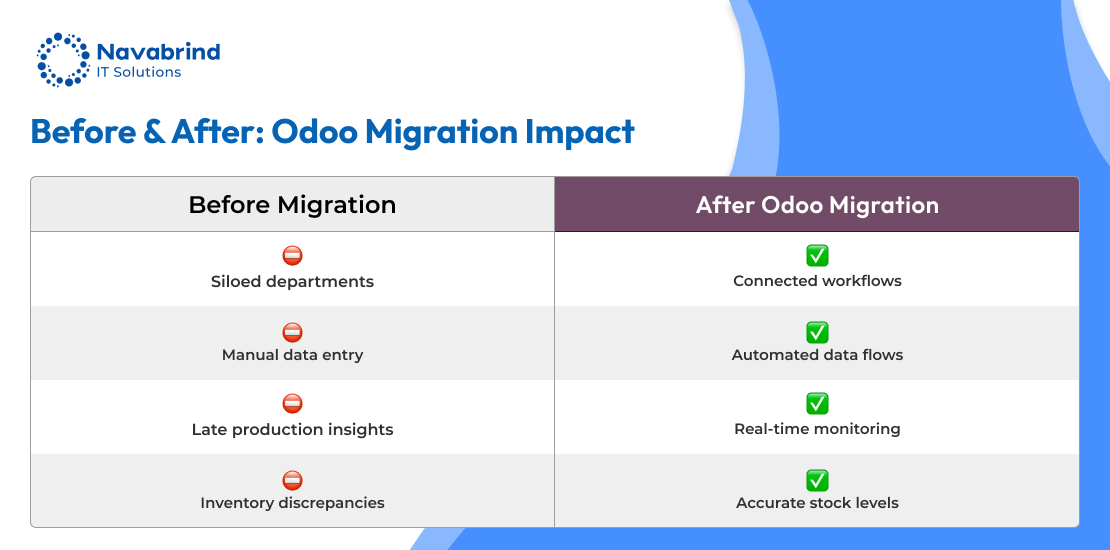
US companies face a growing technology strain: disconnected applications that perform individual tasks yet fracture business visibility. Teams juggle CRM, finance, eCommerce, inventory, logistics, and support platforms, each holding separate records. This fragmentation breaks continuity across operations, creating conflicting numbers across departments and slowing execution.
In this environment, Odoo ERP integration reshapes how systems communicate. Instead of isolated platforms, ERP integration connects workflows so data flows across systems with consistency. Salesforce ERP integration aligns sales pipelines with finance and fulfillment. Shopify ERP integration and Magento ERP integration connect storefront activity with inventory and accounting. Ecommerce ERP integration ensures orders, payments, and stock levels remain aligned across channels. ERP and CRM integration bridges customer interactions with operational execution.
The financial impact of disconnected systems runs deeper than visible inefficiencies. Teams spend hours reconciling mismatched records, correcting errors, and compiling reports that lose relevance by the time leadership reviews them. Delayed insights weaken forecasting, slow response time, and reduce revenue capture.
Odoo ERP integration addresses this challenge without forcing companies to abandon existing platforms. This guide explains integration options, timelines, cost expectations, and how data transitions during go-live, equipping decision-makers to regain control over operations and drive measurable business outcomes.
What Is ERP Integration and Why Does It Matter for US Businesses in 2026?
ERP integration connects an ERP system with business applications so information moves across platforms without re-entry or batch uploads. For US companies running multi-tool environments, ERP integration shifts operations from fragmented records to synchronized workflows. Odoo ERP integration enables continuity across sales, finance, inventory, and fulfillment, eliminating gaps that slow execution.
Disconnected systems create isolated data silos, each holding a conflicting version of business activity. ERP and CRM integration removes this divide by linking customer interactions with order processing and financial records. Without integration, teams transfer data between platforms, introducing errors, delays, and inconsistencies that compound over time. Reporting suffers as leadership relies on outdated numbers pulled from disconnected sources.
These silos create measurable risk. Decision cycles stretch as reports lose relevance during consolidation. Compliance exposure increases when sales tax, revenue recognition, and financial data fail to align across systems. Ecommerce ERP integration, including Shopify ERP integration and Magento ERP integration, ensures transactions, payments, and inventory records remain consistent across channels. Salesforce ERP integration connects pipeline visibility with operational execution, strengthening forecasting accuracy.
US businesses rely on three integration approaches. System-to-system connections link Odoo with external platforms for synchronized data exchange. Data migration transfers historical records into Odoo during consolidation. API-driven ERP integration connects proprietary tools through custom development. Odoo ERP integration stands apart through open API architecture, pre-configured connectors, and a centralized database that eliminates fragmented data layers.
What Systems Can Odoo ERP Integrate With?
Odoo ERP integration includes a wide ecosystem of native and third-party apps that connect business applications without custom coding. These connectors link platforms through configuration, enabling ERP integration across sales, finance, logistics, and communication with speed and lower implementation effort.
- In eCommerce, Shopify ERP integration synchronizes products, inventory, orders, and customer records across platforms with bidirectional data flow. Magento ERP integration and WooCommerce connections support businesses running diverse storefronts. Ecommerce ERP integration extends further through Odoo’s own eCommerce module, delivering the deepest alignment between storefront activity and backend operations.
- Financial operations connect through payment gateways such as Stripe, PayPal, Authorize.net, and Amazon Pay. These integrations align transaction data with accounting workflows, reducing reconciliation gaps and strengthening financial visibility.
- Logistics systems integrate through carriers including FedEx, UPS, DHL, and USPS, enabling rate calculation, shipment tracking, and label generation within Odoo. ShipStation expands this capability for businesses managing multi-carrier shipping environments.
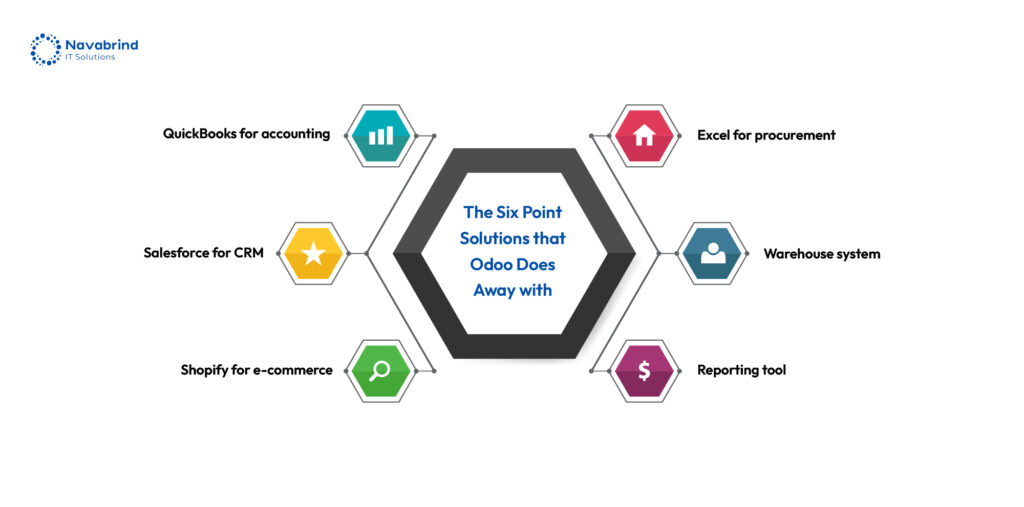
- Accounting workflows connect through QuickBooks during transition phases, supporting parallel system operation. Stripe Connect supports marketplace payment distribution models.
- Communication and productivity tools integrate through Google Workspace, Microsoft 365, and Slack, aligning internal collaboration with operational data. Sales and marketing platforms such as Mailchimp and LinkedIn connect through ERP and CRM integration, ensuring lead and customer data remains synchronized.
- Out-of-the-box Odoo ERP integration requires configuration, not development, offering faster deployment with defined functional boundaries.
Salesforce ERP Integration: Connecting Odoo and Salesforce
US companies run Salesforce alongside Odoo because each platform dominates a different layer of operations. Salesforce drives pipeline visibility and relationship management across sales teams. Odoo manages inventory, procurement, production, and finance with stronger cost control. Replacing Salesforce disrupts revenue teams; replacing Odoo limits operational control. Salesforce ERP integration resolves this divide through ERP and CRM integration that aligns revenue activity with execution.
With Salesforce ERP integration, closed deals convert into sales orders inside Odoo without re-entry. Inventory levels from Odoo appear during quote creation, allowing sales teams to commit to delivery timelines with confidence. Invoices generated in Odoo sync back into Salesforce, giving account managers full financial visibility. Customer records update across both systems, ensuring consistency. Order progress, fulfillment status, and delivery updates from Odoo surface inside Salesforce, keeping sales teams aligned with operations.
Odoo ERP integration with Salesforce uses native connectors available through the Odoo ecosystem, enabling rapid deployment. For complex workflows or large transaction volumes, API-driven ERP integration provides control over data mapping and synchronization logic. Middleware tools like Zapier, Make, or MuleSoft support edge-case workflows where connector capabilities reach limits.
Challenges include mismatched data structures, duplicate record risks, and sync timing decisions. These are resolved through defined data ownership rules, mapping strategies, and prioritization of critical workflows.
Salesforce ERP integration delivers the highest impact for US B2B firms, manufacturing companies with distributed sales teams, and subscription businesses managing long-term customer relationships alongside operational delivery.
Shopify ERP Integration: Connecting Odoo and Shopify
Shopify dominates US direct-to-consumer commerce, yet operational gaps emerge as order volume and warehouse complexity increase. Odoo fills these gaps through Shopify ERP integration, making Odoo ERP integration one of the highest-demand use cases for eCommerce brands scaling beyond basic storefront management.
Shopify ERP integration connects storefront activity with backend execution through Ecommerce ERP integration. Inventory updates in Odoo sync with Shopify, preventing overselling and aligning stock visibility across channels. Orders placed in Shopify convert into sales orders in Odoo, triggering fulfillment workflows across picking, packing, and shipping without re-entry. Product data managed in Odoo syncs with Shopify, creating a single source for catalog control. Customer records flow into Odoo through ERP and CRM integration, enabling lifecycle marketing and support alignment. Financial transactions from Shopify map into Odoo accounting, reducing reconciliation effort and strengthening reporting accuracy. Returns initiated in Shopify trigger inventory and financial adjustments within Odoo.
Odoo ERP integration with Shopify uses native connectors that handle standard workflows through configuration. Product variants align with Odoo templates, tax rules map across US jurisdictions, and inventory logic defines warehouse allocation. Multi-store environments connect into one Odoo instance with store-level reporting and inventory controls.
After Shopify ERP integration, businesses reduce overselling, accelerate order processing, shorten reconciliation cycles, and gain accurate cost visibility per transaction, including shipping and fulfillment expenses.
Magento ERP Integration: Connecting Odoo and Magento
Adobe Commerce drives complex US eCommerce operations with multi-storefront control and flexible catalog design. Odoo complements this strength through Magento ERP integration, closing the operational gap between storefront activity and backend execution. For mid-size and enterprise brands, Odoo ERP integration becomes critical as transaction volume and catalog complexity increase beyond what Magento can manage alone.
Magento ERP integration enables Ecommerce ERP integration across product, inventory, order, and financial workflows. Product data managed in Odoo attributes, variants, pricing tiers, and category structures syncs with Magento across storefronts. Inventory movements in Odoo update Magento availability instantly, aligning warehouse activity with online visibility. Orders placed in Magento convert into Odoo sales orders, triggering fulfillment, shipping, and invoicing without delays. Multi-storefront environments connect into one Odoo instance with store-level pricing and inventory rules. ERP and CRM integration aligns Magento B2B accounts with Odoo customer records and pricing logic. Financial data, including revenue, refunds, and settlements, flows into Odoo accounting for consolidated reporting.
Magento ERP integration uses certified connectors for standard workflows. Enterprise deployments rely on API-driven ERP integration to manage high transaction loads and custom extensions that influence data structures.
Compared to Shopify ERP integration, Magento integrations demand deeper configuration due to customization layers. This impacts timeline, resource allocation, and cost, yet delivers stronger control for complex eCommerce operations.
Can Odoo ERP Integrate With Shopify, Salesforce, and Magento at the Same Time?
US businesses running complex stacks ask whether Odoo can connect with Shopify, Salesforce, and Adobe Commerce at the same time. The answer is yes, with critical architectural discipline. Odoo ERP integration positions Odoo as the central hub, enabling ERP integration across multiple platforms without overlap or data conflict.
Each connection Shopify ERP integration, Salesforce ERP integration, and Magento ERP integration runs independently inside Odoo. These integrations do not interfere with one another because each follows its own connector or API-based ERP integration logic. Data from all systems converges into a single Odoo database, creating a unified operational view that disconnected platforms cannot deliver.
In practice, an eCommerce company may run Shopify for direct sales, Salesforce for B2B relationships, and Odoo for inventory, procurement, and finance. Ecommerce ERP integration ensures orders from Shopify and Salesforce flow into Odoo, where inventory updates, fulfillment workflows, and financial records align. ERP and CRM integration connects customer activity with backend execution, eliminating gaps between sales and operations. Replacing standalone accounting tools with Odoo removes redundant systems and reduces integration overhead.
Multi-platform ERP integration relies on defined data mapping, controlled sync frequency, and conflict resolution rules when updates occur across systems. Governance plays a decisive role by assigning system ownership for customer, product, and inventory data ensures consistency. Monitoring and alerting frameworks detect integration failures early, protecting operational continuity and revenue flow.
How Does Odoo ERP Eliminate Third-Party Tool Chaos for US eCommerce Businesses?
US eCommerce teams recognize third-party tool chaos through fragmented operations. Orders arrive from multiple channels, each handled in a different platform. Inventory sits in spreadsheets with no shared visibility. Finance teams export data from several systems to build a P&L. Customer service checks multiple tools to answer a single query. Marketing works with outdated customer lists due to delayed synchronization.
Odoo ERP integration restructures this environment through ERP integration that connects all operational layers. With Ecommerce ERP integration, inventory becomes centralized in Odoo, ensuring stock levels stay consistent across channels such as Shopify and Adobe Commerce. Orders from these platforms, along with pipelines from Salesforce, flow into Odoo, where fulfillment, invoicing, and shipping take place in one system. Shopify ERP integration and Magento ERP integration remove channel-level silos, aligning storefront activity with backend execution.
ERP and CRM integration creates a complete customer record, combining order history, payments, and engagement into one view. Finance operations shift from fragmented exports to consolidated reporting within Odoo, where revenue, cost, and margins align across channels. Procurement responds to stock movement across the business, triggering replenishment based on unified inventory data.
This shift removes reconciliation work, eliminates duplicate records, and prevents overselling caused by inconsistent stock visibility. As Odoo ERP integration replaces disconnected workflows, teams operate with shared data, faster execution cycles, and reliable reporting by turning operational clarity into measurable revenue impact.
What Happens to Existing Data When Integrating Odoo ERP With Current Software?
Data continuity drives ERP decisions for US companies evaluating Odoo ERP integration. The concern is valid as the data loss or corruption can disrupt revenue, reporting, and compliance. ERP integration with Odoo addresses this through defined transition models that protect data across systems such as Shopify, Salesforce, and Adobe Commerce.
Three integration scenarios shape how data is handled. In live integration, systems remain active and only forward-moving data syncs through Shopify ERP integration, Salesforce ERP integration, or Magento ERP integration. Historical records stay in source platforms. In partial migration, master data of the customers, products, vendors that moves into Odoo, while Ecommerce ERP integration and ERP and CRM integration manage ongoing transactions. In full migration, historical and active data consolidate into Odoo, replacing legacy systems for operations and reporting.
Platform-level decisions depend on business goals. Shopify data may remain with forward sync or move into Odoo for consolidated reporting. Salesforce data can stay with bidirectional ERP and CRM integration or migrate if CRM consolidation is planned. Magento data typically migrates when businesses seek full eCommerce and operational alignment.
Data integrity depends on disciplined execution. Navabrind IT Solutions conducts pre-integration audits, detailed data mapping, sandbox testing, and parallel system validation before cutover. A rollback framework safeguards business continuity. Deduplication controls prevent record conflicts, ensuring Odoo ERP integration delivers a consistent, reliable data foundation for growth.
How Much Does Odoo ERP Integration Cost for a US Business With Multiple Tools?
Odoo ERP integration cost varies widely because no two system landscapes share the same structure. US businesses running multiple platforms like Shopify, Salesforce, and Adobe Commerce that require tailored ERP integration based on data flow, sync logic, and operational scope.
Four variables shape investment. The number of platforms influences connector setup, mapping, and testing effort. Integration complexity impacts pricing being bi-directional sync with layered data relationships demands deeper configuration than one-way data flow. Data migration scope adds effort when historical records move into Odoo for reporting continuity. Custom API-driven ERP integration increases cost when proprietary systems or non-standard workflows are involved.
Ongoing costs include connector updates, Odoo version upgrade validation, and support retainers between $2,000 and $5,000 per month. ROI evaluation should focus on labor hours spent on reconciliation, revenue loss from inventory mismatch, finance workload during close cycles, and service inefficiencies. In most cases, these losses exceed integration investment within the first year.
How Long Does It Take to Integrate Odoo ERP With Shopify or Salesforce?
Integration timelines depend on architecture clarity, data quality, and decision speed, not just the platforms involved. Odoo ERP integration connects systems like Shopify, Salesforce, and Adobe Commerce through structured ERP integration planning, not quick configuration alone.
For Shopify ERP integration, connecting products, inventory, and orders into Odoo takes 3 to 6 weeks when using standard connectors. Salesforce ERP integration with ERP and CRM integration by covering accounts, contacts, and opportunities that takes 6 to 12 weeks due to bidirectional data flow and mapping complexity. Magento ERP integration requires 8 to 16 weeks because of catalog depth, customization layers, and multi-storefront logic. Multi-platform Ecommerce ERP integration across Shopify, Salesforce, and Magento takes 12 to 24 weeks when sequenced, tested, and validated across systems.
Time investment concentrates in data mapping and architecture design, where field-level relationships across systems are defined. Sandbox testing validates workflows before production deployment. Data migration extends timelines when historical records require cleanup and validation. User acceptance testing ensures business workflows align with integration logic before go-live.
Delays arise from inconsistent source data, custom extensions that alter data structures, scope expansion during mapping, and slow governance decisions around data ownership. Timelines improve with clean datasets, a decisive internal project owner, phased rollout strategy, and an experienced partner familiar with Odoo ERP integration patterns.
Frequently Asked Questions
1.Can Odoo ERP integrate with Shopify, Salesforce, and Magento at the same time
Yes. Odoo acts as a central hub connecting Shopify, Salesforce, and Adobe Commerce through Odoo ERP integration. Each connection operates independently, yet all data converges into one system. Shopify ERP integration, Salesforce ERP integration, and Magento ERP integration work together through ERP and CRM integration, creating a unified operational view without system conflict.
2.How does Odoo ERP eliminate third-party tool chaos for US ecommerce businesses
Odoo ERP integration replaces disconnected workflows with centralized control. Ecommerce ERP integration connects sales channels, inventory, finance, and customer data inside one system. Inventory stays consistent across platforms, orders flow into one workflow, and reporting aligns across channels. ERP and CRM integration ensures teams work from a shared dataset, removing reconciliation effort and reducing operational delays
3.What systems can Odoo ERP integrate with out of the box
Odoo ERP integration supports a wide ecosystem including Shopify ERP integration, Magento ERP integration, Salesforce ERP integration, payment gateways, shipping carriers, accounting tools, and collaboration platforms. These integrations rely on native connectors configured without custom coding, enabling faster ERP integration across business functions.
4.How much does Odoo ERP integration cost for a US business with multiple tools
Cost depends on platform count, integration complexity, migration scope, and customization. Shopify ERP integration ranges from $3,000 to $8,000. Salesforce ERP integration with ERP and CRM integration ranges from $8,000 to $25,000. Magento ERP integration ranges from $10,000 to $30,000. Multi-platform Odoo ERP integration can reach $25,000 to $75,000, with ongoing support costs based on system complexity.
5.What happens to existing data when integrating Odoo ERP with current software
Data handling depends on integration strategy. Businesses can sync forward data only, migrate key master data, or move complete historical records into Odoo. ERP integration ensures continuity across platforms, while validation, mapping, and testing protect data integrity during transition.
6.How long does it take to integrate Odoo ERP with Shopify or Salesforce
Timelines depend on complexity and data readiness. Shopify ERP integration takes 3 to 6 weeks for standard workflows. Salesforce ERP integration takes 6 to 12 weeks due to bidirectional ERP and CRM integration. Multi-platform Ecommerce ERP integration requires longer timelines based on scope, testing, and data migration requirements.
Schedule a conversation with us now!
Related Articles









 Post
Post Post
Post