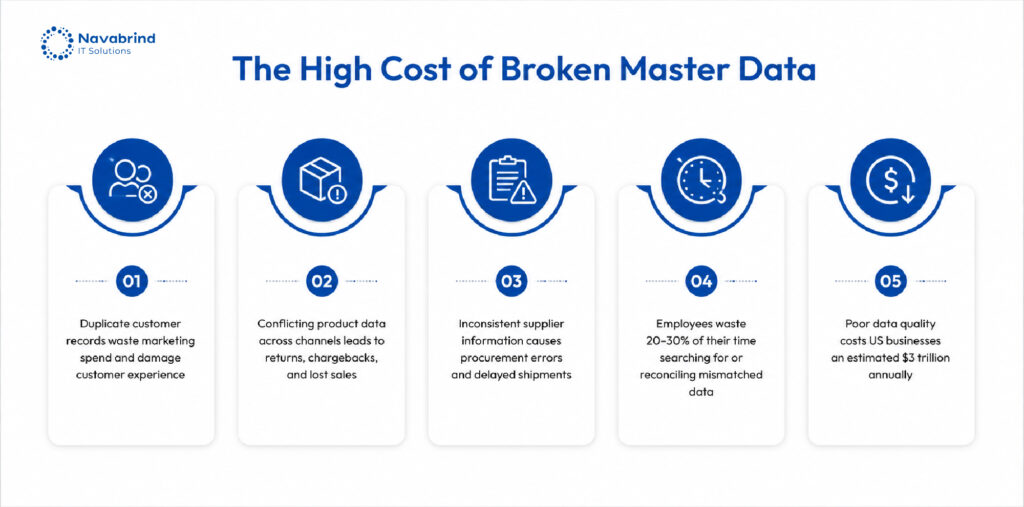
Retail brands no longer struggle with product availability alone. Revenue loss now begins with disconnected information like the duplicate customer profiles, mismatched pricing, inaccurate inventory counts, and fragmented supplier records. A shopper sees one price online, another in-store, and abandons the purchase instantly. Teams waste hours correcting catalog errors instead of driving growth. This is the hidden cost of poor master data management in retail industry operations.
Retail expansion has shifted from managing shelves to controlling data across ecommerce platforms, marketplaces, warehouses, POS systems, mobile apps, and supply chains. Without disciplined retail data management, decision-making slows, operational expenses rise, and customer trust declines.
This is why master data management has become a business-critical investment. Retailers adopting MDM software with strong data governance gain consistency across channels, cleaner reporting, sharper forecasting, and stronger profitability. Platforms such as Odoo ERP retail create a connected environment that keeps product, supplier, inventory, and customer information aligned across business functions.
Learn more about profit and loss reporting in Odoo
What Is Master Data Management And Why Retail Can't Ignore It
Master data management creates one trusted source for business-critical information used across retail operations. Instead of scattered spreadsheets, disconnected applications, and duplicate records, retailers gain controlled, consistent data that supports sales, procurement, inventory, finance, and customer engagement. In the master data management in retail industry landscape, this foundation shapes operational accuracy and commercial growth.
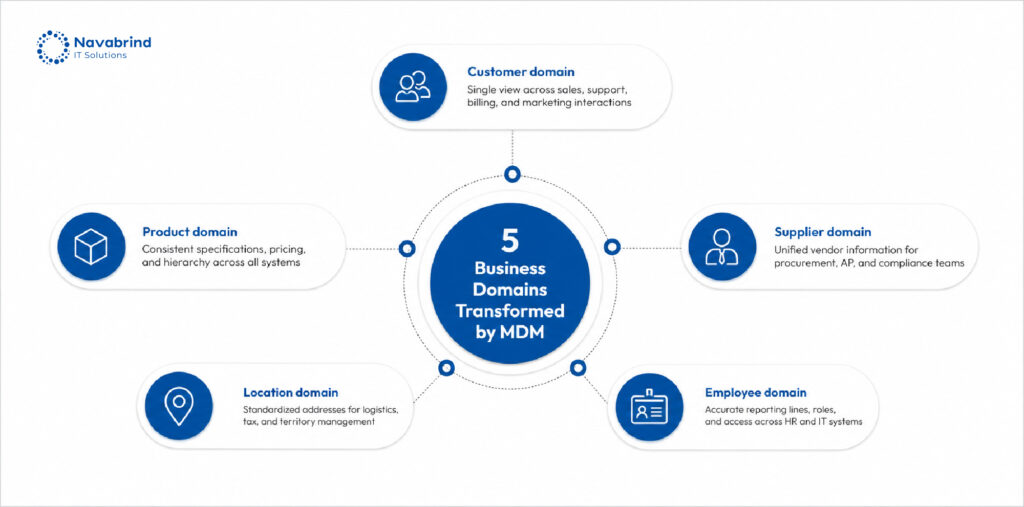
Retail master data revolves around five business domains: product information, customer profiles, supplier records, store or warehouse locations, and pricing structures. When these datasets remain aligned, teams avoid catalog confusion, pricing conflicts, fulfillment delays, and reporting errors.
Transactional data captures activity such as purchases, returns, or shipments. Master data acts as the reference layer behind those transactions. Without disciplined retail data management, transaction records lose reliability.
This makes MDM software far beyond a technical deployment. Successful data governance connects leadership, workflows, and digital systems into one operational framework. Platforms like Odoo ERP retail support this alignment across departments and sales channels.
Master Data Management in the Retail Industry Core Use Cases
Master data management in retail industry operations creates consistency across products, customers, suppliers, and store networks. Retailers rely on connected information to maintain pricing accuracy, inventory visibility, supplier coordination, and personalized shopping experiences. Without disciplined retail data management, disconnected systems create operational friction that damages profitability and customer confidence.
Product master data brings SKUs, specifications, pricing structures, descriptions, and digital assets into one controlled environment. MDM software helps retailers maintain consistency across POS platforms, ecommerce stores, mobile apps, and marketplace listings. Product variants, promotional bundles, and seasonal catalog updates remain aligned without confusion.
Customer master data connects interactions from stores, websites, support teams, and loyalty platforms into one reliable customer profile. This improves segmentation, retention campaigns, and CRM performance.
Supplier and vendor master data standardizes procurement records, reducing invoicing conflicts and onboarding delays. Location master data supports multi-store retail operations through synchronized tax structures, warehouse mapping, regional pricing, and logistics coordination. Odoo ERP retail strengthens this data governance framework across distributed retail ecosystems.
Data Governance in Retail: The Framework That Makes MDM Work
Master data management delivers business value only when data governance creates accountability around how information is created, updated, validated, and shared. Without governance, retail systems fill with duplicate records, pricing conflicts, inconsistent product descriptions, and unreliable reporting. In the master data management in retail industry environment, governance acts as the operational discipline behind trusted data.
Retail organizations need defined ownership across product catalogs, customer records, supplier information, and pricing structures. Teams must understand who controls approvals, who validates updates, and who maintains accuracy across systems. MDM software supports this process through validation policies, approval chains, audit tracking, and controlled access management.
A retail data management framework also requires governance leadership. Retailers establish governance councils that connect operations, merchandising, finance, ecommerce, compliance, and IT teams under shared data standards.
Overly relaxed governance creates confusion. Excessive restrictions slow execution and delay catalog updates. Successful data governance balances operational speed with data reliability. Odoo ERP retail helps retailers maintain compliance with GDPR, CCPA, and consumer data protection requirements across retail ecosystems.
MDM Software: What to Look for and What to Avoid
Selecting the right MDM software shapes how retailers control product accuracy, customer records, supplier coordination, and operational reporting. In the master data management in retail industry landscape, weak platforms create fragmented workflows, unreliable analytics, and rising operational costs.
An effective master data management solution requires a centralized repository that creates a trusted golden record across retail systems. Data quality engines must identify duplicates, incomplete records, inconsistent attributes, and pricing conflicts before inaccuracies spread across channels. Role-based permissions and workflow controls strengthen data governance by regulating approvals, edits, and publishing rights.
Retailers also require API-driven connectivity with ecommerce platforms, ERP environments, POS applications, warehouses, and marketplace integrations. Odoo ERP retail supports connected retail data management through integrated operational workflows and synchronized information exchange.
Scalability remains critical for retailers managing large SKU catalogs, regional pricing structures, and expanding customer databases. During vendor evaluation, businesses should avoid platforms with weak audit visibility, limited retail data structures, and restricted integration capabilities. Enterprise retailers must carefully assess long-term operational value before choosing between custom development and commercial MDM platforms.
Retail Data Management in the Age of Omnichannel
Omnichannel retail depends on one factor above all else consistent data across customer touchpoints. A pricing mismatch between a mobile app and store shelf damages trust instantly. Incorrect inventory visibility leads to canceled orders, delayed fulfillment, and abandoned carts. This is why master data management in retail industry operations has become a commercial necessity rather than a technical upgrade.
Retail data management now extends across physical stores, POS platforms, ecommerce websites, online marketplaces, mobile applications, self-service kiosks, warehouses, and logistics providers. Without centralized coordination, disconnected systems create conflicting product information, fragmented customer records, and unreliable reporting.
Modern shoppers expect inventory visibility, accurate pricing, product availability, and order tracking without delays. MDM software supports this expectation through synchronized data exchange across operational systems. Fast-moving retail environments can no longer depend entirely on delayed batch updates that create outdated information across channels.
Master data management strengthens omnichannel execution by supporting BOPIS operations, returns processing, loyalty programs, and cross-channel fulfillment. Platforms like Odoo ERP retail help retailers maintain aligned operations, stronger data governance, and consistent customer experiences across distributed retail ecosystems.
Odoo ERP Retail: MDM Capabilities Built for Retail Operations
Retailers no longer want disconnected software environments that create duplicate records, reporting conflicts, and operational delays. This shift has pushed ERP and master data management closer together, especially for growing retail businesses seeking tighter operational control without fragmented systems.
Odoo ERP retail supports major master data management functions through connected retail workflows. Retail teams can manage product catalogs, variants, pricing structures, supplier records, customer information, warehouses, and store operations from one connected platform. This reduces dependency on disconnected applications that weaken retail data management accuracy.
The platform supports centralized pricing policies, fiscal configurations, inventory coordination, and supplier management across distributed retail operations. As data moves through procurement, warehousing, ecommerce, and POS systems, Odoo maintains aligned information across departments.
Its modular architecture allows retailers to introduce MDM software capabilities in phases rather than through disruptive system overhauls. A retailer can begin with inventory and product management, then expand into CRM, procurement, ecommerce, and analytics.
Odoo ERP retail fits organizations seeking operational consolidation and stronger data governance. Retailers managing massive enterprise-scale ecosystems or complex external integrations may still require dedicated MDM platforms alongside ERP infrastructure.
Building a Retail MDM Strategy: A Practical Roadmap
A successful master data management initiative starts with visibility. Retailers must first identify data sources, operational systems, spreadsheet dependencies, and ownership gaps across procurement, ecommerce, inventory, finance, marketing, and store operations. This audit exposes inconsistencies that weaken retail data management performance.
The next stage focuses on prioritization. Some retailers struggle with fragmented product catalogs, others face duplicate customer records or supplier inconsistencies. Identifying the highest operational pain point helps businesses deliver measurable ROI faster.
Once priorities are identified, organizations must establish data governance policies covering ownership, validation standards, approval workflows, and accountability structures. MDM software selection should align with operational scale, integration requirements, and retail complexity. Platforms like Odoo ERP retail support connected workflows across inventory, CRM, procurement, POS, and ecommerce environments.
Integration planning connects master data management with retail applications and transactional systems. Before deployment, businesses must cleanse existing records, remove duplicates, validate attributes, and standardize formats.
Long-term success depends on ongoing stewardship. Retailers need assigned data owners, recurring audits, performance tracking, and governance reviews to maintain data reliability across evolving retail operations.
Measuring the ROI of Master Data Management in Retail
Retailers investing in master data management need measurable outcomes tied to operational performance, revenue growth, and customer retention. Strong ROI begins with data accuracy across ecommerce platforms, POS systems, warehouses, supplier portals, and CRM environments. When information remains aligned, retail operations move with consistency and fewer disruptions.
Key performance indicators reveal the effectiveness of retail data management initiatives. Faster supplier onboarding, shorter product launch cycles, improved inventory accuracy, and lower product return rates indicate stronger data reliability. Customer deduplication metrics help retailers measure how successfully MDM software eliminates fragmented profiles that weaken personalization and marketing performance.
Short-term gains appear through reduced operational corrections, fewer catalog errors, and smoother order fulfillment. Long-term value compounds through stronger forecasting, cleaner analytics, improved merchandising decisions, and stronger customer loyalty.
Master data management in retail industry environments also creates the foundation for AI adoption and predictive analytics. Recommendation engines, demand forecasting, pricing optimization, and personalized campaigns rely on governed, trustworthy datasets. Platforms like Odoo ERP retail support this transition by connecting operational data into one controlled ecosystem supported by disciplined data governance.
Frequently Asked Questions
1.What is master data management and why is it important for retail?
Master data management creates one trusted source for business-critical retail information such as products, customers, suppliers, pricing, and store records. In the master data management in retail industry environment, disconnected systems create inventory mismatches, duplicate customer profiles, reporting errors, and pricing inconsistencies. MDM software helps retailers maintain controlled, reliable information across ecommerce platforms, POS systems, warehouses, marketplaces, and CRM applications. Strong data governance improves operational accuracy, reduces revenue leakage, and strengthens customer trust.
2.How does master data management improve customer experience in retail?
Master data management improves shopping experiences through accurate pricing, inventory visibility, faster fulfillment, and personalized engagement. Retail data management keeps customer records, loyalty information, product descriptions, and order histories aligned across sales channels. This consistency reduces cart abandonment, order cancellations, and support complaints. Retailers using Odoo ERP retail with disciplined data governance create smoother omnichannel interactions that strengthen retention and customer satisfaction.
3.What is the difference between MDM and PIM in retail?
MDM software manages multiple business data domains, including products, customers, suppliers, locations, and pricing structures. Product Information Management focuses mainly on product-related content such as descriptions, specifications, images, and catalog enrichment. In retail operations, PIM acts as one component within a broader master data management framework. Retailers combining PIM with master data management gain stronger control across operational and commercial workflows.
4.How does master data management help retailers manage omnichannel data?
Master data management synchronizes information across physical stores, ecommerce websites, marketplaces, mobile applications, warehouses, and logistics partners. Retail data management prevents inconsistent pricing, inventory conflicts, and fragmented customer records across channels. MDM software creates standardized information flows that support BOPIS operations, returns management, loyalty programs, and cross-channel fulfillment. Odoo ERP retail strengthens omnichannel coordination by connecting operational systems within one governed ecosystem.
5.What are the common challenges of master data management in the retail industry?
Retailers commonly struggle with disconnected legacy systems, duplicate records, inconsistent product attributes, weak data governance, and fragmented ownership across departments. Rapid catalog expansion, marketplace selling, regional pricing models, and supplier coordination increase data complexity. Another challenge involves integrating MDM software with ERP, POS, CRM, and ecommerce platforms without disrupting operations. Successful master data management in retail industry environments requires governance accountability, process alignment, and long-term stewardship across retail functions.
Related Articles










 Post
Post