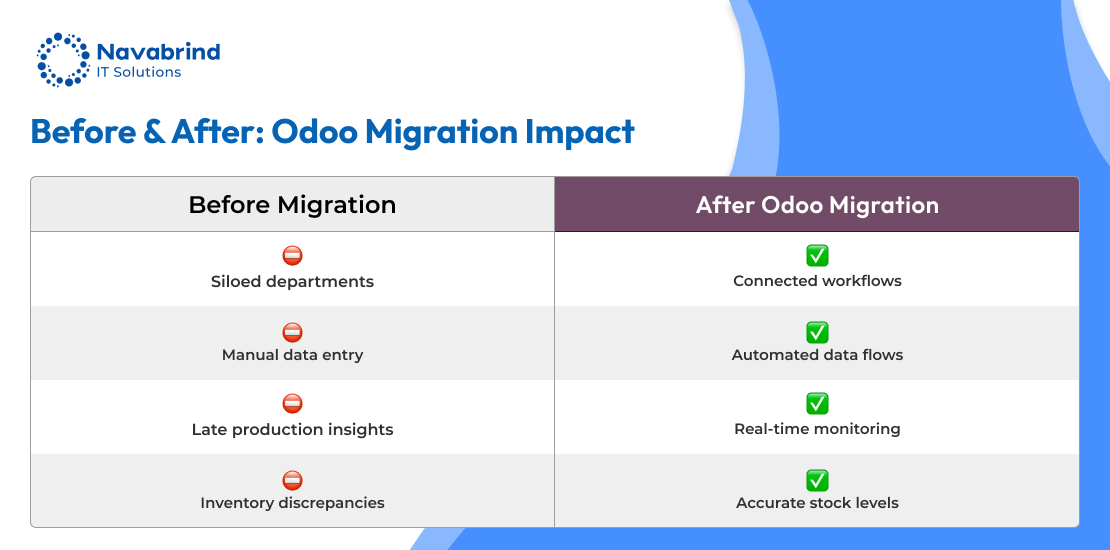
Indian manufacturers are facing a widening disconnect between operational demands and the tools they rely on. Spreadsheets, disconnected applications, and reactive workflows limit visibility across procurement, production, inventory, and delivery. As order volumes fluctuate and customer expectations tighten, this gap begins to impact margins, timelines, and decision-making.
This is where manufacturing ERP software changes the equation. Instead of fragmented systems, businesses gain a connected environment that aligns procurement, production planning, inventory control, and financial tracking. For companies evaluating ERP software for the manufacturing industry in India, the shift is no longer an optional competitive requirement.
Breaking the myth: Manufacturing ERP is not out of reach:
A common hesitation among business owners is the assumption that manufacturing enterprise resource planning software is complex to deploy and expensive to maintain. This perception is outdated. Solutions like Odoo have redefined accessibility by offering scalable capabilities that align with business growth stages. Companies can begin with essential functions like inventory, production tracking, procurement and expand as operations evolve. This approach reduces upfront investment pressure and ensures that the system grows alongside the business. For those searching for the best manufacturing ERP software, the focus should not be on size or brand perception, but on adaptability, usability, and alignment with actual production workflows.
What Is Manufacturing ERP Software and How Does It Work?
Manufacturing enterprise resource planning software acts as the digital backbone of a factory. It connects procurement, production, inventory, quality control, sales, and finance into one environment tracking a product’s journey from raw material intake to final delivery. Instead of isolated data sitting in different tools, manufacturing ERP software creates continuity across operations. Each action either purchase, production update, stock movement, or dispatch feeds into a shared system that reflects the current state of the business.
The top 6 operational loops managed by production ERP software:
At the heart of production ERP software lies a continuous operational cycle. Each stage feeds the next, creating a controlled and traceable flow:
1. Customer order initiates demand:
A confirmed order triggers demand signals within the system, setting production planning in motion.
2. Production planning defines requirements:
Bill of materials and routing data determine what needs to be produced, in what quantity, and within what timeline.
3. Material planning drives procurement:
The system identifies shortages and generates purchase requirements to maintain production continuity.
4. Procurement updates inventory:
Incoming materials are recorded into stock, ensuring accurate availability for production.
5. Inventory supports shop floor execution:
Materials move to the shop floor, where work orders guide operations step by step.
6. Production progress is tracked:
Work orders capture output, labor input, and time spent across each stage of manufacturing.
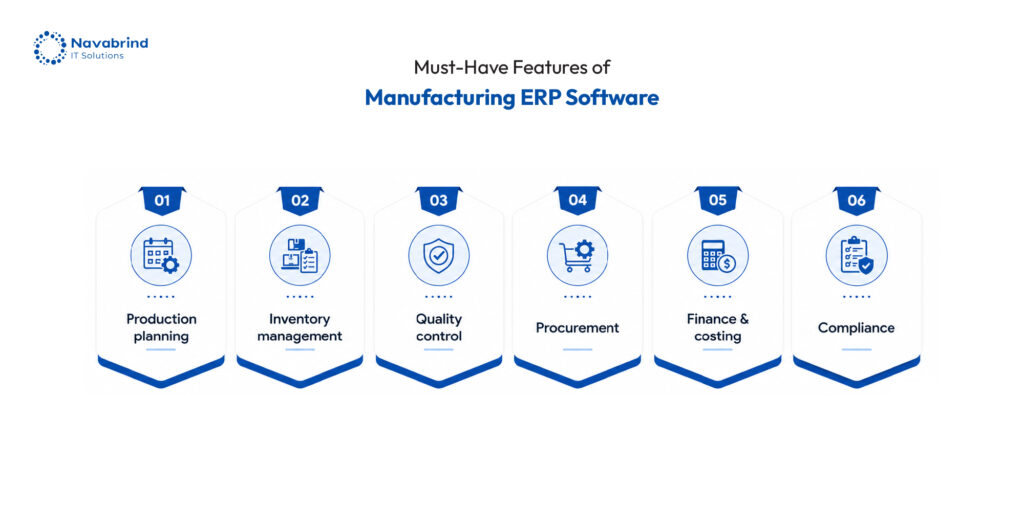
What Are the Must-Have Features of Manufacturing ERP Software?
Selecting the best manufacturing ERP software requires a close look at the capabilities that drive control across production, inventory, procurement, and finance. The goal is not feature overload with operational clarity, traceability, and cost control.
Here’s what manufacturing ERP software must deliver to support growing manufacturers in India.
1.Bill of Materials (BOM) Management
A robust BOM framework forms the foundation of manufacturing enterprise resource planning software.
- Multi-level BOMs to manage complex product structures
- Configurable BOMs to handle variations across product lines
- Variant management for product families with shared components
- Engineering change order tracking with version control
This ensures production teams always work with the latest product definitions, reducing errors and rework.
2.Production Planning and Scheduling
Strong planning capabilities define the effectiveness of production ERP software.
- Material Requirements Planning to align procurement with production demand
- Capacity planning across workcenters and shifts
- Work order creation with task allocation and progress tracking
This layer keeps production aligned with demand, avoiding idle time and missed delivery commitments.
3.Inventory and Warehouse Management
Inventory accuracy directly impacts production continuity.
- Stock visibility across raw materials, work-in-progress, and finished goods
- Lot and serial number tracking for full traceability
- Reorder rules and safety stock logic to prevent stockouts
- Multi-warehouse and multi-location management
For companies adopting manufacturing ERP software for small businesses, this capability removes dependency on spreadsheets and guesswork.
4.Quality Management
Quality control must be embedded within production but not treated as a separate activity.
- In-process quality checks aligned with production steps
- Non-conformance tracking with corrective action workflows
- Supplier quality monitoring with incoming inspection control
This ensures defects are identified early, reducing downstream losses.
5.Procurement and Vendor Management
Procurement efficiency influences production timelines and cost control.
- Purchase requisition workflows with approval layers
- Approved vendor lists for consistent sourcing
- Automated purchase order generation based on demand
- Landed cost tracking for imported materials
These features make manufacturing ERP software a central system for sourcing decisions.
6.Shop Floor Control
Execution visibility on the shop floor is critical for performance tracking.
- Work order tracking with operator-level time logging
- Workcenter utilization insights and bottleneck identification
- Scrap and rework recording at the point of occurrence
This enables faster response to production issues and tighter control over output.
7.Finance and Costing
Financial accuracy depends on capturing production costs at each stage.
- Standard and actual cost tracking per production order
- Variance analysis between planned and actual performance
- Integration with accounts payable, receivable, and general ledger
For businesses evaluating the best manufacturing ERP software, this integration ensures financial data reflects operational reality.
8.India-Specific Compliance Features
For companies using ERP software for the manufacturing industry in India, regulatory alignment is non-negotiable.
- GST return preparation and e-filing integration
- E-invoicing with IRN generation
- E-way bill automation for goods movement
- TDS and TCS management
- Multi-currency support for export-focused manufacturers
Best Manufacturing ERP Software in India 2026: Top Platforms Reviewed
Here’s how the leading platforms compare for ERP software for the manufacturing industry in India:
Platform 1: Odoo Manufacturing ERP
Odoo stands out as a flexible and scalable manufacturing ERP software designed for growing businesses.
- App-based structure allows companies to activate only the required capabilities
- Strong coverage across production, inventory, and quality workflows
- India-focused capabilities support GST and compliance needs
- Competitive pricing aligns with mid-market budgets
- Wide partner network ensures implementation support across India
Best fit:
Platform 2: SAP Business One and SAP S/4HANA
SAP Business One and SAP S/4HANA represent globally established manufacturing enterprise resource planning software platforms.
- SAP Business One caters to mid-market manufacturers
- SAP S/4HANA supports large enterprises with complex operations
- Strong production capabilities and multi-plant management
- Reliable GST compliance tools for Indian businesses
Consideration:
Implementation requires significant investment and longer timelines.
Best fit:
Large manufacturers with multi-location operations and enterprise-scale budgets evaluating the best manufacturing ERP software.
Platform 3: Microsoft Dynamics 365 Business Central
Microsoft Dynamics 365 Business Central delivers a balanced approach to production ERP software for mid-sized companies.
- Integration with Microsoft tools like Excel, Outlook, and Teams
- GST, TDS, and financial compliance tailored for India
- Familiar interface reduces onboarding time
Best fit:
Mid-sized manufacturers are already using Microsoft ecosystems and seeking structured manufacturing ERP software without steep learning curves.
How to choose the right platform
The decision is not about brand recognition rather about operational alignment.
- Small and mid-sized businesses should prioritize flexibility and cost control through manufacturing ERP software for small businesses
- Larger enterprises should focus on scalability, multi-plant coordination, and financial consolidation
- Export-driven companies need strong compliance and multi-currency capabilities
The best manufacturing ERP software is the one that maps closely to your production workflows, supports growth without complexity, and delivers visibility across procurement, production, and finance without gaps.
Manufacturing ERP Software for Small Businesses: What You Actually Need
Why small manufacturers were left behind:
ERP vendors traditionally focused on large deals, leaving smaller operations with limited options.
- Enterprise-grade manufacturing enterprise resource planning software comes with high costs and complex rollout requirements
- Accounting tools handle finance but fall short in production tracking
- Implementation partners prioritize large projects with higher margins
The outcome: small manufacturers rely on fragmented systems that cannot support growth.
Daily operational challenges on the shop floor:
Without a connected system, small manufacturers face recurring issues that impact revenue and customer trust.
- Lack of visibility into stock levels leads to production delays
- BOM management through spreadsheets creates costing errors and material wastage
- Sales and production teams operate in isolation, causing missed delivery timelines
- Finance teams work with data that does not reflect actual production activity
- GST filing consumes time due to scattered and inconsistent records
These are not isolated problems, they are systemic gaps that manufacturing ERP software is designed to eliminate.
Which modules to activate first and what can wait
A phased approach ensures faster adoption and better ROI from manufacturing ERP software for small businesses.
Start with Manufacturing, Inventory, Purchase, Accounting, and Sales. These modules establish control over production flow, stock movement, and financial tracking.
Add next as operations expand, quality management, HR, CRM, and Project management. These enhance operational visibility and team coordination.
Cloud vs. on-premise: the practical choice
For small manufacturers, cloud-based manufacturing ERP software offers a clear advantage.
- Lower initial investment compared to on-premise systems
- No dependency on internal IT infrastructure
- Access from multiple locations, including factory and office
- Automatic updates without operational disruption
This model aligns with the needs of businesses seeking ERP software for the manufacturing industry in India without infrastructure burden.
Competing with larger manufacturers using ERP
Small manufacturers are no longer at a disadvantage. With the right production ERP software, they can match larger players in execution and reliability.
- Accurate production planning improves delivery commitments
- Inventory visibility reduces stockouts and excess holding
- Cost tracking enables better pricing decisions
- Compliance processes become faster and less error-prone
The shift is clear for manufacturing ERP software for small businesses is no longer a support tool. It is a growth engine that enables smaller companies to compete on delivery performance, cost control, and operational discipline.
Production ERP Software: How It Transforms the Shop Floor
The shop floor visibility gap:
In the absence of a connected system, production teams face recurring blind spots:
- Work order progress remains unclear across workcenters
- Scrap and rework get recorded at shift end, distorting cost insights
- Bottlenecks surface after production timelines are already impacted
- Decisions rely on fragmented updates rather than live data
For businesses evaluating ERP software for the manufacturing industry in India, this lack of visibility directly impacts delivery performance and margins.
How production ERP software reshapes execution:
- Production ERP software:
Introduces structure and traceability into day-to-day operations.
- Digital work orders replace paper-based tracking:
Production instructions move into the system, allowing teams to track status across stages without relying on physical job cards.
- Workcenter dashboards bring live visibility:
Supervisors can view queued, in-progress, and completed work orders across all stations in one interface.
- Operator-level time tracking captures labour input:
Actual time spent at each production step is recorded, allowing comparison with planned effort.
- Scrap and rework captured at source:
Defects are logged at the point of occurrence, feeding quality and cost data without delay.
- Machine downtime linked to maintenance workflows:
Equipment issues are recorded and connected to maintenance planning, reducing unplanned interruptions. This level of control is what separates basic tools from the best manufacturing ERP software.
From static planning to dynamic scheduling:
Traditional production planning relies on weekly schedules that struggle to adapt. Manufacturing enterprise resource planning software introduces flexibility backed by data.
- Material Requirements Planning aligns procurement with production demand
- Daily scheduling adjusts based on material availability and shop floor conditions
- Rescheduling tools allow quick adjustments when priorities change
- Capacity planning ensures workcenters are not overloaded
Turning production data into business decisions:
The value of manufacturing ERP software extends beyond execution that transforms how decisions are made.
- On-time delivery rates tracked by product, customer, and production line
- Cost per unit calculated using actual material and labour consumption
- Yield and scrap rates measured across products and workcenters
- Capacity utilization insights guiding investment in machines and workforce
ERP Software for the Manufacturing Industry in India: Addressing Local Realities
Indian manufacturing operates within a regulatory and operational landscape that demands accuracy, traceability, and adaptability. From GST compliance to multi-location production and export documentation, businesses need systems that align with these realities. This is where ERP software for the manufacturing industry in India plays a critical role bringing compliance, production control, and financial tracking into one connected framework.
1.Managing GST complexity with confidence
GST compliance is not limited to filing returns and touches procurement, production costing, and sales.
Manufacturing ERP software supports:
- Multi-rate GST calculations across different product categories
- Input tax credit tracking with reconciliation against purchase data
- Automated preparation of GSTR reports for filing
This reduces dependency on external reconciliation and minimizes errors that can lead to penalties.
2.E-invoicing and IRN generation without delays
The e-invoicing mandate requires businesses to generate Invoice Reference Numbers (IRN) for B2B transactions.
With manufacturing enterprise resource planning software:
- IRN generation is integrated within the invoicing process
- QR codes are embedded automatically into invoices
- Data flows from sales to compliance without duplication
This ensures faster billing cycles and eliminates manual intervention.
3.E-way bill automation for logistics compliance
Goods movement across states requires accurate e-way bill documentation.
Production ERP software connects dispatch processes with compliance workflows:
- E-way bills are generated when dispatch orders are created
- Transport details are linked with shipment records
- Documentation stays aligned with actual goods movement
This reduces delays at checkpoints and simplifies logistics operations.
4.Managing multi-plant operations
Manufacturers operating across multiple locations require visibility beyond a single facility.
Manufacturing ERP software enables:
- Production tracking across multiple plants
- Inventory visibility at each location
- Inter-plant stock transfers with proper accounting
This ensures coordination between units without data gaps.
5.Job work and subcontracting under GST
Subcontracting is common in Indian manufacturing, especially for specialized processes.
Manufacturing ERP software for small businesses and mid-sized firms supports:
- Tracking materials sent to job workers
- Monitoring returns and consumption
- Maintaining compliance with GST job work regulations
This ensures accountability across outsourced production stages.
6.Supporting export-oriented manufacturers
Export businesses face additional compliance and financial tracking requirements.
With manufacturing ERP software:
- Shipping bill data is linked with sales and dispatch
- IGST refund tracking is integrated into financial workflows
- Multi-currency invoicing supports international transactions
This enables export manufacturers to manage global operations with accuracy.
How to Compare Manufacturing ERP Software: A Framework for Indian Manufacturers
ERP selection goes wrong when decisions rely on long feature lists instead of operational fit. A platform may look impressive on paper yet fail on the shop floor. The focus must shift to alignment with production flow, compliance needs, and growth plans. This framework helps you evaluate manufacturing ERP software with clarity and business impact in mind.
The seven dimensions that define the right fit:
1. Manufacturing depth
Not every system can handle real production complexity. Assess whether the platform supports your manufacturing model of discrete, process, or job shop. The best manufacturing ERP software should map your BOM structure, routing logic, and production stages without forcing workarounds.
2. India localization
Compliance cannot depend on external add-ons.
Evaluate whether ERP software for the manufacturing industry in India includes:
- GST handling across transactions
- E-invoicing with IRN generation
- E-way bill workflows linked to dispatch
Native support ensures compliance stays aligned with operations.
3. Total cost of ownership
Licensing is only one part of the investment.
Calculate the full cost of manufacturing enterprise resource planning software over three years:
- Implementation
- Customization
- Training
- Ongoing support
This gives a realistic view of ROI rather than a misleading entry price.
4. Implementation ecosystem
Execution depends on the partner, not just the software. Check whether experienced partners for manufacturing ERP software are available in your region and whether they have handled projects in your manufacturing segment.
5. Scalability
Your ERP should support expansion without disruption.
A suitable production ERP software must handle:
- Growth from one plant to multiple facilities
- Increased transaction volume
- Expanded product lines
Re-implementation during growth is a costly mistake.
6. Ease of adoption
Adoption determines success. Production supervisors, store managers, and finance teams must be able to use the system daily without friction. This is especially critical for companies adopting manufacturing ERP software for small businesses, where teams operate with limited technical support.
7. Vendor stability
ERP is a long-term commitment. Choose platforms with active development, a strong customer base, and financial stability. The best manufacturing ERP software continues to evolve with changing business and compliance needs.
How to structure your shortlisting process
A disciplined evaluation process leads to better decisions.
- Define requirements first
List your top operational needs, production tracking, inventory control, procurement flow, compliance before engaging with vendors.
- Demand contextual demos
Ask vendors to demonstrate workflows using your products, BOMs, and production scenarios. Generic demos rarely reflect real challenges.
- Check industry references
Request case studies or client references from Indian manufacturers within your size range and sector.
- Run a pilot evaluation
Test the system in a controlled environment before full rollout. This reveals usability gaps and configuration challenges early.
Implementing Manufacturing ERP Software — What Indian Manufacturers Should Expect
ERP outcomes are determined less by brand choice and more by execution discipline. A well-managed rollout of manufacturing ERP software delivers control, visibility, and measurable ROI. A rushed rollout creates confusion, delays, and cost overruns. For manufacturers evaluating ERP software for the manufacturing industry in India, understanding the implementation journey is critical before committing to any platform.
Realistic implementation timelines:
Timelines vary based on operational complexity, number of plants, and data readiness.
- Small manufacturers (single plant, straightforward operations): 8–14 weeks
- Mid-size manufacturers (multiple product lines): 14–24 weeks
- Large manufacturers (multi-plant, complex supply chains): 24–40 weeks
These timelines apply across leading manufacturing enterprise resource planning software platforms when projects follow a disciplined approach.
The five phases of a successful ERP rollout:
1. Discovery
This phase defines the foundation. Teams map current workflows across procurement, production, inventory, and finance. Compliance needs such as GST and e-invoicing are documented. A strong discovery phase ensures the selected manufacturing ERP software aligns with actual operations.
2. Configuration
The system is set up to reflect business workflows.
- Production processes and routing
- Inventory structures and warehouse logic
- GST rules and tax configurations
- User roles and access controls
3. Data migration
Data quality determines system accuracy.
- Item masters and BOMs are cleaned and standardized
- Vendor and customer data is validated
- Opening balances are prepared for finance
4. Testing
Each workflow is validated using real scenarios.
- Purchase to production to dispatch cycles
- Inventory movements across locations
- GST calculations and invoice generation
5. Training and go-live
Teams are trained based on roles—production, warehouse, finance, and management. After go-live, a stabilization period allows issues to be resolved with implementation partner support. This phase determines how quickly teams adopt the system in daily operations.
Conclusion
Manufacturing ERP software in India has reached a point where access is no longer limited to large enterprises. In 2026, businesses across scale by emerging workshops to multi-plant manufacturers can adopt systems that bring production, inventory, procurement, and finance into one connected flow. For small manufacturers, the priority is practical impact. The right production ERP software should resolve your top operational challenges with stock visibility, production tracking, costing accuracy, compliance without stretching budgets or adding complexity. Equally important, the platform must scale as your business expands, eliminating the need for a system change later. This is where manufacturing ERP software for small businesses delivers measurable value.
For larger manufacturers, selection criteria shift toward depth and execution. The focus should be on how well the system handles production complexity, how accurately it supports ERP software for the manufacturing industry in India from a compliance standpoint, and whether the implementation partner has proven experience in similar environments. Brand recognition alone does not guarantee operational success. The best manufacturing ERP software is not defined by the number of features listed in a brochure. It is defined by adoption. When teams across production, warehouse, and finance rely on the system daily when decisions are based on system data rather than assumptions, the ERP becomes a foundation for consistent performance and controlled growth.
Frequently Asked Questions
1. What is manufacturing ERP software and why is it important for Indian manufacturers?
Manufacturing ERP software connects production, inventory, procurement, sales, and finance into one system. For Indian manufacturers, it plays a critical role in improving production visibility, maintaining GST compliance, reducing material wastage, and ensuring on-time delivery. Without it, businesses rely on disconnected tools that limit control and accuracy.
2. How do I choose the best manufacturing ERP software for my business?
The best manufacturing ERP software depends on your operational needs, not brand popularity. Evaluate platforms based on manufacturing depth, India compliance features, total cost over time, ease of use for your team, and availability of experienced implementation partners. A system that aligns with your workflows will deliver better ROI than one with excessive features.
3. Is manufacturing ERP software suitable for small businesses in India?
Yes. Manufacturing ERP software for small businesses is designed to address core challenges such as inventory tracking, production planning, and GST compliance without requiring large investments. With cloud-based options, small manufacturers can start with essential modules and expand as their operations grow.
4. How long does it take to implement production ERP software?
Implementation timelines vary based on business size and complexity.
- Small manufacturers: 8–14 weeks
- Mid-sized manufacturers: 14–24 weeks
- Large multi-plant operations: 24–40 weeks
A structured approach by offering discovery, configuration, data migration, testing, and training that ensures smooth deployment of production ERP software.
5. What are the key benefits of using ERP software for the manufacturing industry in India?
ERP software for the manufacturing industry in India helps businesses:
- Gain visibility into production and inventory
- Improve delivery timelines through better planning
- Track costs accurately across materials and labour
- Simplify GST, e-invoicing, and compliance processes
- Reduce dependency on spreadsheets and disconnected tools
These improvements lead to stronger operational control and profitability.
6. What common mistakes should manufacturers avoid during ERP implementation?
Common mistakes include poor data preparation, expanding project scope during implementation, limited user training, and switching all modules on at once without phased rollout. Successful adoption of manufacturing enterprise resource planning software depends on clean data, disciplined execution, and strong internal ownership.
Schedule a conversation with us now!
Related Articles









 Post
Post Post
Post