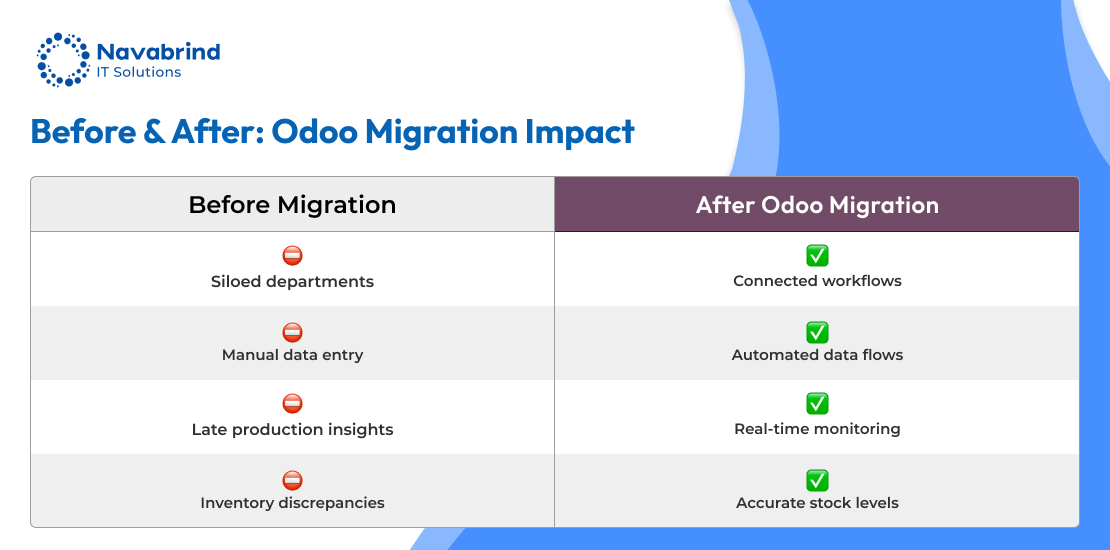
ERP software for manufacturing connects production, inventory, procurement, and finance into one operational system. Instead of juggling disconnected tools, teams gain a continuous flow of information across the shop floor and back office. Orders move faster, stock levels stay aligned with demand, and production planning reflects actual capacity. This level of coordination reduces delays, avoids stockouts, and improves margin control. For growing firms, ERP systems for manufacturing act as the control layer that keeps operations predictable and scalable.
Odoo ERP for manufacturing delivers this capability through a flexible architecture designed for expanding SMEs and mid-size plants. Companies can start with essential functions such as inventory and production, then extend into quality, maintenance, and procurement as operations grow. This approach makes manufacturing ERP software small business adoption practical without heavy upfront investment. With unified workflows and visibility across departments, ERP for manufacturing industry users gain tighter cost control, faster order fulfillment, and stronger decision-making. For firms evaluating the best ERP for manufacturing, Odoo stands out as a practical choice that aligns performance with growth goals, making manufacturing resource planning software accessible and results-driven.
ERP systems for manufacturing: What to look for
Choosing ERP systems for manufacturing starts with evaluating capabilities that keep production predictable and profitable. Production planning must align demand, capacity, and material availability to avoid delays and idle time. Bill of Materials (BOM) management should handle multi-level assemblies, version control, and engineering changes without confusion. Inventory control needs accurate tracking across warehouses, work-in-progress, and finished goods to prevent shortages or excess stock. Shop-floor integration is equally critical, connecting machines, operators, and production data so decisions reflect actual conditions on the ground. Together, these elements define how well ERP software for manufacturing supports operational flow and cost control.
For growing firms, manufacturing ERP software small business adoption depends on balancing capability with cost and usability. A system overloaded with complexity slows teams and delays returns. At the same time, limited functionality restricts growth. The goal is a solution that scales with operations without requiring heavy investment or extensive training. Odoo ERP for manufacturing meets this need by offering flexible adoption, allowing businesses to start with essential functions and expand as demand increases. This makes it a strong contender among options considered the best ERP for manufacturing, delivering measurable value without operational strain in the ERP for manufacturing industry.
Odoo ERP for the manufacturing industry
Odoo ERP for manufacturing brings production control and operational visibility into one connected environment. The Manufacturing (MRP) module covers work orders, routings, and production planning with accuracy. Teams can define operations step by step, assign resources, and track execution across the shop floor. Work orders reflect actual progress, helping managers respond to delays and capacity constraints without guesswork. Routings standardize processes, ensuring consistency in output and cost control. Production planning aligns demand with available materials and resources, supporting predictable delivery timelines. With continuous tracking, ERP software for manufacturing gains visibility across work-in-progress, finished goods, and production performance, strengthening decision-making across the ERP for the manufacturing industry.
Beyond production, Odoo ERP for manufacturing connects manufacturing with sales, purchasing, and accounting. Sales orders trigger production requirements, procurement ensures material availability, and financial records update alongside operations. This level of coordination allows ERP systems for manufacturing to deliver complete visibility from order confirmation to final delivery and invoicing. For growing firms adopting manufacturing ERP software for small businesses, this integration removes data gaps between departments and supports consistent execution. As a result, companies evaluating the best ERP for manufacturing gain a system that aligns operations, finance, and supply chain within one scalable manufacturing resource planning software environment.
Best ERP for manufacturing: Where Odoo fits
Shortlisting the best ERP for manufacturing means comparing flexibility, cost control, and adoption speed across leading platforms. Solutions like ERPNext, SAP Business One, and NetSuite serve different operational needs. ERPNext appeals to teams seeking open-source control with limited upfront cost. SAP Business One delivers structured processes suited to established operations. NetSuite focuses on cloud-based scalability with strong financial management. Each option addresses ERP systems for manufacturing, yet trade-offs appear in complexity, cost, and adaptability for growing firms.
Shortlisting the best ERP for manufacturing means comparing flexibility, cost control, and adoption speed across leading platforms. Solutions like ERPNext, SAP Business One, and NetSuite serve different operational needs. ERPNext appeals to teams seeking open-source control with limited upfront cost. SAP Business One delivers structured processes suited to established operations. NetSuite focuses on cloud-based scalability with strong financial management. Each option addresses ERP systems for manufacturing, yet trade-offs appear in complexity, cost, and adaptability for growing firms.
Odoo ERP for manufacturing stands out by offering a flexible, open-core model that supports gradual adoption without operational strain. Companies can begin with production, inventory, and procurement, then extend into maintenance, quality, and finance as operations expand. This approach aligns well with manufacturing ERP software small business needs, where budget control and usability drive decisions. For small and mid-sized manufacturers in the US, Odoo delivers a balanced mix of capability and cost efficiency without locking teams into rigid processes. Within the ERP for manufacturing industry, this positions Odoo as a practical choice for companies seeking growth without disruption, supported by scalable manufacturing resource planning software that evolves alongside operational demand.
Using Odoo ERP to solve production planning problems
Odoo ERP for manufacturing addresses the three questions that define production success: what to produce, when to produce, and how much to produce. Demand-driven planning links sales orders and forecasts with manufacturing requirements, ensuring production reflects actual demand instead of assumptions. The MRP engine calculates material needs, triggers procurement, and aligns inventory with production schedules. Scheduling tools allocate work orders based on capacity, resource availability, and operation sequences, bringing control to shop-floor execution. This makes ERP software for manufacturing a decision system rather than a record-keeping tool, strengthening outcomes across the ERP for the manufacturing industry.
In practice, this approach reduces overproduction by matching output with confirmed demand and forecast trends. Excess inventory drops, freeing up working capital and storage space. Lead times shrink as materials, work orders, and resources stay synchronized, removing delays caused by stock gaps or poor planning. Shop-floor activity aligns with sales forecasts, ensuring production teams focus on high-priority orders instead of reacting to last-minute changes. For firms adopting manufacturing ERP software small business, these gains translate into predictable delivery timelines and improved cost control. Among ERP systems for manufacturing, Odoo delivers measurable impact through connected manufacturing resource planning software that keeps production aligned with business demand.
How Odoo handles BOM errors and inventory mismatches
Odoo ERP for manufacturing reduces design time errors through a structured Bill of Materials framework that supports multi-level assemblies and controlled revisions. Multi-level BOMs map complex product structures with clarity, ensuring sub-assemblies and components align with production requirements. Version control tracks engineering changes, so teams work with the latest configuration instead of outdated data. Validation workflows enforce checks before BOM approval, preventing incorrect components, quantities, or routing steps from reaching the shop floor. This level of control strengthens data accuracy within ERP systems for manufacturing, reducing costly rework across the ERP for the manufacturing industry.
On the inventory side, Odoo ERP for manufacturing maintains accuracy through continuous tracking and production-linked consumption. Inventory updates reflect material movement across raw stock, work-in-progress, and finished goods as production progresses. Auto-consumption during work order execution ensures material usage aligns with BOM definitions, limiting discrepancies between planned and actual usage. Reconciliation workflows help teams identify and correct variances quickly, keeping stock records aligned with physical inventory. For companies using manufacturing ERP software small business, this reduces shrinkage, avoids production delays, and supports tighter cost control. As part of ERP software for manufacturing, Odoo delivers dependable manufacturing resource planning software that keeps BOM integrity and inventory data aligned with operational reality.
ERP for US manufacturing companies: Top systems overview
Manufacturers evaluating ERP systems for manufacturing in the US typically compare platforms such as Odoo, ERPNext, SAP Business One, NetSuite, and Microsoft Dynamics 365. SAP and Oracle solutions dominate large enterprises with complex compliance and multi-entity operations. NetSuite targets cloud-first mid-market companies scaling across locations. ERPNext attracts cost-sensitive firms seeking open-source flexibility. In this landscape, Odoo ERP for manufacturing positions itself as a balanced option for growing companies that need flexibility without operational complexity.
The deployment model shapes how these systems perform in real business conditions. NetSuite operates as a cloud-native platform, delivering SaaS-based access and continuous updates. SAP Business One supports on-premise and cloud setups, giving companies control over infrastructure at the cost of higher maintenance. Odoo and ERPNext support cloud and self-hosted deployment, allowing businesses to choose based on cost and control preferences. Cloud ERP reduces upfront investment and speeds rollout, whereas on-premise setups demand infrastructure, IT teams, and ongoing maintenance.
Scalability and total cost of ownership define long-term ROI. Cloud-based ERP software for manufacturing scales without hardware expansion, supporting growth with predictable subscription costs. In contrast, on-premise systems require server upgrades, IT staffing, and capital investment as operations expand. Odoo ERP for manufacturing fits small and mid-sized US manufacturers by combining flexible deployment, lower ownership cost, and scalable architecture within one manufacturing resource planning software environment, making it a practical choice in the ERP for manufacturing industry.
Odoo ERP implementation time for a manufacturing company
Odoo ERP for manufacturing deployments for small to mid-sized companies move from kickoff to go-live within a few weeks to a couple of months. The timeline depends on process clarity, data readiness, and scope selection. Companies that begin with production, inventory, and procurement experience faster rollouts, allowing teams to start using ERP software for manufacturing without long disruption cycles. This phased approach helps businesses gain early operational control and measurable returns within the ERP for the manufacturing industry.
Timeline expansion occurs when requirements extend beyond standard workflows. Customization of reports, workflows, or shop-floor processes increases configuration time. Legacy data migration by covering BOMs, inventory records, suppliers, and historical transactions that requires validation and cleanup before import into ERP systems for manufacturing. Integration with existing shop-floor systems, such as machines or external tracking tools, adds another layer of technical alignment. For firms adopting manufacturing ERP software for small business, these factors must be planned early to avoid delays.
With the right scope and preparation, Odoo ERP for manufacturing delivers a controlled implementation path, enabling companies to activate manufacturing resource planning software quickly while keeping timelines predictable and aligned with business priorities.
Cost of Odoo ERP for a small US manufacturing business
Odoo ERP for manufacturing follows a per-user subscription model combined with implementation and operational costs. The platform offers three main tiers. A free entry plan allows one application. The Standard plan (around $24–31 per user/month) includes full access to apps like inventory, MRP, and accounting on Odoo’s cloud. The Custom (Enterprise) plan (around $49–61 per user/month) adds customization tools, API access, multi-company support, and flexible hosting (cloud, Odoo.sh, or on-premise). Add-ons such as hosting (Odoo.sh), third-party integrations, and advanced modules influence the total spend.
For small manufacturing firms using ERP software, the actual investment goes beyond licenses. A typical setup with 10–30 users, manufacturing modules (MRP, inventory, purchase, accounting), and partner-led implementation ranges from $15,000 to $80,000+ depending on scope. Annual subscription and support may fall between $10,000 and $100,000, influenced by user count and deployment model. Implementation, data migration, and customization usually account for the largest share of cost, not licensing.
Compared to legacy ERP suites like SAP or NetSuite, Odoo ERP for manufacturing delivers lower total cost of ownership due to its per-user pricing, open-source foundation, and ability to start with selected modules instead of a full-suite commitment. This makes ERP software for manufacturing accessible for growing US manufacturers seeking scalable manufacturing resource planning software without heavy upfront capital.
Why Odoo is a strong choice for small US manufacturers
Odoo ERP for manufacturing gives small manufacturers a practical path to control production, inventory, and costs without heavy upfront spend. The pricing model allows companies to start with essential functions and expand as operations grow, keeping investment aligned with business needs. This makes manufacturing ERP software small business adoption achievable without financial strain.
The system supports flexible adoption through a modular structure, enabling companies to activate production, inventory, quality, and maintenance in phases. This approach ensures ERP systems for manufacturing remain aligned with operational maturity instead of forcing unnecessary complexity. On the shop floor, Odoo delivers robust capabilities such as MRP, work orders, BOM control, and production tracking, giving teams the tools required to run consistent and predictable operations across the ERP for the manufacturing industry.
An active ecosystem of implementation partners, developers, and integrations strengthens long-term value. Businesses gain access to continuous improvements, support, and extensions tailored to evolving requirements. For companies evaluating the best ERP for manufacturing, Odoo combines cost control, operational depth, and scalability within one manufacturing resource planning software platform.
Frequently Asked Questions
1.What ERP system is best for small US manufacturing companies?
The right choice depends on budget, growth plans, and operational complexity. Common options include Odoo, ERPNext, SAP Business One, and Oracle NetSuite. Industry comparisons show that Odoo and ERPNext suit cost-conscious small manufacturers, while SAP and NetSuite target companies with larger budgets and complex requirements.
2.How does Odoo ERP solve production planning problems in manufacturing?
Odoo ERP for manufacturing uses demand-driven planning and MRP logic to align production with actual orders and forecasts. It calculates material needs, schedules work orders based on capacity, and ensures resources are available at the right time. This answers what to produce, when, and how much by reducing delays and excess inventory.
3.Can Odoo ERP handle BOM errors and inventory mismatches?
Yes. Odoo supports multi-level BOMs, revision control, and validation workflows that prevent incorrect configurations from reaching production. Inventory tracking updates material movement across raw stock, work-in-progress, and finished goods, keeping records aligned with physical stock and reducing mismatches.
4.How much does Odoo ERP cost for a small manufacturing business in the US?
A typical setup for small manufacturers includes subscription, implementation, and support. Industry estimates place first-year investment between $24,000 and $43,000 for a 20-user setup, depending on scope and services. This is lower than traditional ERP suites due to flexible pricing and phased adoption.
5.What are the top ERP systems used in the US manufacturing industry?
Leading platforms include SAP S/4HANA, Microsoft Dynamics 365, Infor CloudSuite Industrial, Epicor Kinetic, Oracle NetSuite, and Odoo. These systems vary by company size, with enterprise tools serving large manufacturers and platforms like Odoo supporting small to mid-sized firms.
6.How long does Odoo ERP implementation take for a manufacturing company?
Small to mid-sized manufacturers complete implementation in a few weeks to a couple of months, depending on scope. Timelines extend when projects include customization, legacy data migration, or integration with shop-floor systems.
Schedule a conversation with us now!
Related Articles








 Post
Post Post
Post