The cost of a failing Odoo implementation is not just measured in the money already spent with an underperforming partner. It runs deeper and wider than most businesses realize. Productivity collapses when teams are forced to operate on a broken new system and the old manual processes they were supposed to leave behind. The finance team cannot close the month because opening balances were migrated inaccurately. The production floor ignores the system entirely because work orders do not reflecting actual BOMs. Management loses confidence in the data and stops using the dashboards the system was supposed to provide. And underneath the operational disruption is a team that invested time, energy, and organizational goodwill into an ERP transition and now feel skeptical of the platform, technology vendors, and uncertain whether their investment was a mistake.
Here is what you should know. Most failed or failing Odoo implementations are recoverable. What is needed is not a new project, it is a different team, a clear-eyed diagnosis of what went wrong, a structured remediation plan, and the technical and functional expertise to execute it without repeating the mistakes that created the problem in the first place. That is what Navabrind IT Solutions does. We have stepped into stalled projects where go-live dates had been missed. We have taken over live-but-broken systems where the original partner had stopped responding. We have rescued abandoned implementations where businesses believed they had lost everything they had invested.
The starting point was an honest, independent assessment of where the project stands followed by a clear, realistic plan to get it to where it should have been from the beginning.
This post covers the common reasons Odoo implementations go wrong, the warning signs that your project is heading toward failure, and how Navabrind IT Solutions intervenes to rescue, stabilize, and deliver the operational outcomes your business invested in.
The Scale of the Problem — How Common Are Failed Odoo Implementations?
ERP implementation failure is not a niche problem affecting a handful of unlucky businesses, it is a systemic industry challenge that has persisted for decades across every platform and business size. Studies and analyst reports how that between 50 and 75 percent of ERP implementations experience significant overruns in cost, timeline, or delivered scope. Odoo projects are not immune to these statistics.
Unfortunately, Odoos’ appealing qualities also create conditions that attract troubled projects. Odoo’s accessibility and comparatively lower entry cost democratized ERP adoption for SMEs. But that same accessibility also lowered the barrier to entry for implementation partners who win projects on competitive pricing without possessing the functional depth to handle real-world business complexity.
The open-source nature of Odoo Community creates a second and distinct category of implementation risk. Every year, businesses — manufacturers, distributors, or retail operations with limited technology budgets — attempt to self-implement Odoo Community without engaging a certified partner. The logic is understandable: the software is free, there is extensive online documentation, and the YouTube tutorial ecosystem for Odoo is impressive. What self-implementers consistently underestimate is the gap between understanding how Odoo works in a generic demonstration environment and configuring it to a messy, exception-filled reality of an actual operating business. GST configuration with its multi-rate structure, e-invoicing requirements, reverse charge mechanisms, and job work compliance is enough to derail a self-implementation that did not account for its complexity. Add multi-location inventory, manufacturing routing, and opening balance migration from Tally, and the self-implementation that seemed like a money-saving decision becomes a six-month time sink that ends with an incomplete system.
A third pattern that consistently generates troubled Odoo projects is the temptation to implement everything at once. Odoo’s module ecosystem is one of its greatest strengths. Manufacturing, inventory, accounting, CRM, HR, payroll, eCommerce, project management, maintenance, quality, and PLM. The breadth of what Odoo covers in a single platform is remarkable. But that breadth becomes a liability when a business attempts to go live on eight modules without the project governance, internal capacity, or implementation resource to manage that level of complexity in parallel. Scope that is too broad stretches configuration quality thin, compresses testing timelines, overwhelms end users with too much change at once, and creates a go-live event that is more of a controlled crisis than a managed transition.
The 3 Types of Failed Odoo Projects — And the Warning Signs
Type 1 — The Stalled Project
- The go-live date has moved more than once.
- Partner responses are getting slower and vaguer.
- Modules that should be ready are still not configured.
- The project has lost momentum and nobody knows how to recover it.
Type 2 — The Live But Broken System
- The system went live but critical workflows are wrong.
- Financial reports cannot be reconciled against reality.
- Users have reverted to spreadsheets alongside the ERP.
- Management has stopped trusting the data the system produces.
Type 3 — The Abandoned Project
- The original partner has gone silent or ceased trading.
- The system is partially configured with no documentation.
- No support agreement is in place.
- The business does not know what has been built or what remains.
The Most Common Reasons Odoo Implementations Fail
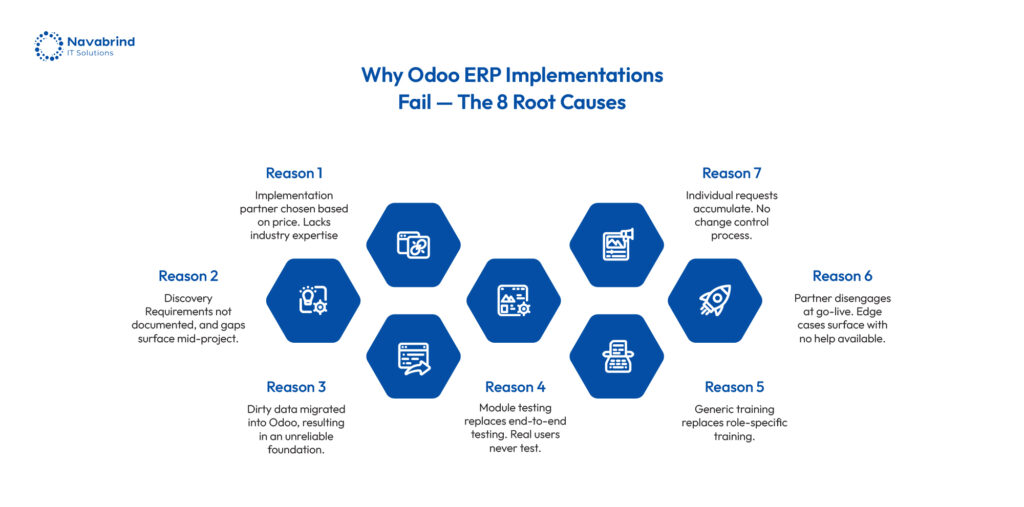
Reason 1: The Wrong Implementation Partner
If there is one factor that explains more failed Odoo implementations it is that the wrong partner was chosen for the wrong reasons, and the problem was not discovered until much time and money had already been spent.
Get partner selection right and even a complex, multi-module project has a strong chance of success.
The most common version of this mistake is choosing a partner primarily on price. Odoo’s competitive licensing cost attracts businesses who are already budget-conscious. When three partners quote for the same project and one comes in below the others, the temptation to choose the lowest bid is understandable. What that decision rarely accounts for is why the lowest bidder is the lowest bidder. In most cases, it is not because they have found a more efficient way to deliver the same quality of work. It is because they are underestimating the scope, underpricing to win the business, or planning to resource the project with junior team members who will learn on your time and at your expense.
A partner who wins a manufacturing ERP project on a price that would not cover the discovery phase of a properly scoped engagement is not going to deliver a properly scoped engagement. They are going to deliver whatever they can within the budget they quoted.
Reason 2: Poor Requirements Gathering and Discovery
Discovery is the phase of an ERP project where the implementation team invests time understanding the client’s business: how it operates today, what it needs the new system to do, where the current processes are broken, and what constraints. When discovery is done well, it produces a detailed requirements document that both the client and partner can refer to throughout the project as the definitive source of truth for what is being built.
The fundamental damage that poor discovery inflicts on an Odoo project is not immediately visible. In the early weeks of configuration, everything can appear to be progressing normally. Modules are being set up. Workflows are being configured. The system is taking shape. What is not visible is that the partner is configuring based on their generic understanding of how businesses like yours operate. And then the gaps appear. A manufacturing configuration that handles straightforward production orders cannot accommodate the subcontracting and job work workflows that represent thirty percent of the client’s production volume.
Reason 3: Underestimated Data Migration Complexity
Ask any experienced Odoo implementation consultant which project phase is most consistently underestimated. The answer is almost always the same: data migration. Data migration is the process of extracting business data from existing systems, cleaning it, and importing it accurately into Odoo. It is the phase that receives the least attention during project planning. It is also the phase that causes the most damage when it goes wrong. Most projects treat it as a technical task to be handled toward the end.
Historical transaction data migration from legacy systems adds a layer of complexity. Data migration cannot be rushed, when data mapping is done carelessly, the historical data that arrives in Odoo is technically present but operationally unreliable. Reports referencing historical periods produce incorrect figures. Audit trails that should provide a clear financial history instead produce a confusing mixture of correctly and incorrectly migrated transactions. The finance team cannot confidently stand behind the numbers. That is a serious problem for any business facing a GST audit or investor review.
Bad data migrated into Odoo does not stay contained in the records where the errors originated. It propagates forward through every transaction that references those records. Every report that aggregates those transactions is affected. Every operational decision made on the basis of those reports is built on an unreliable foundation.
Reason 4: Excessive and Uncontrolled Customization
Odoo’s capacity for customization is one of its strengths. Odoo’s open architecture allows certified partners to build tailored workflows, custom reports, and industry-specific extensions. When customization is approached thoughtfully, it gives Odoo implementations a degree of operational fit.
The customization trap begins almost always at the same point. It starts the moment a client’s team first sees the standard Odoo workflows during the configuration review phase. They compare them to the way things are currently done in the old system. When a new system does something differently from the established way the instinct is to request that the new system be made to match the old one.
The partner’s response to these requests is the critical variable. A strong implementation partner will challenge each request before agreeing to build anything. They will demonstrate how the standard Odoo workflow addresses the underlying business need. They will explain the maintenance and upgrade implications of building a custom alternative. They will help the client distinguish between customizations that are genuinely necessary and those that are simply about comfort with the familiar.
Reason 5: Inadequate Testing Before Go-Live
The go-live date has already moved twice. The partner is under pressure. And so testing gets compressed, rushed, or quietly skipped. The reasoning feels logical in the moment. The configuration looks correct. There is not enough time to test everything thoroughly without pushing the go-live date again. And so the business goes live. And within days, sometimes within hours, the workflow errors begin to surface. Not in a controlled testing environment where they can be fixed calmly. In a live operational system. With real customer orders, real supplier invoices, real inventory movements, and real financial transactions depending on a system that was never properly validated before it was trusted with them.
The most damaging testing failure in Odoo projects is the substitution of module-by-module testing for end-to-end workflow testing. These are fundamentally different activities and they catch fundamentally different problems. Module-by-module testing validates that each individual module works correctly in isolation.
Performance testing is the final testing failure that haunts go-lives handled carelessly. A system that has been built and tested with a small volume of test data can behave very differently when it is processing the actual transaction volumes of a live business. Inventory reports that generated in seconds during testing take minutes to load when the system holds twelve months of real stock movements.
The cumulative effect of inadequate testing is a go-live that feels less like a controlled launch and more like a public stress test of an unvalidated system. Every error the business discovers after go-live is an error that testing should have caught. Every workflow correction made under operational pressure is more expensive, more disruptive, and more damaging to user confidence than the same correction made in a controlled pre-go-live environment. And every day the business operates on a system with unresolved workflow errors is a day of decisions, transactions, and records being built on a foundation that has not been validated as correct.
Reason 6: Insufficient User Training and Change Management
The most widespread training failure in troubled Odoo projects is the delivery of generic system training in place of role-specific workflow training. Generic system training shows users what Odoo can do. It walks through module features, demonstrates standard screens, and explains system concepts.
Training delivered three or four weeks before go-live is training that most users will have substantially forgotten by the time the system is live. Adults retain a fraction of what they learn in a classroom or demonstration setting. Retention drops further when the knowledge has no immediate practical application. Users who are trained on a system they will not use for another month are being asked to remember abstract workflows in a software environment they have not yet made part of their daily routine.
Users sit down at a system they were trained on weeks ago. The confidence they had at the end of the training session has faded. The specific steps they need to follow are no longer clear. Training delivered in the week immediately before go-live, reinforced with supervised practice sessions on real business scenarios, produces dramatically better retention and dramatically less go-live disruption.
Reason 7: No Post Go-Live Support Plan
Go-live day is not the finish line. The post go-live period is when an Odoo implementation is truly tested for the first time. Not against test scripts. Not against partner-controlled demonstrations. Against the full, unpredictable, exception-filled reality of a live business operating under daily pressure. Edge cases that never appeared during testing surface immediately.
Partners who disengage immediately after go-live leave their clients facing these situations alone.
A proper post go-live support plan requires a named support contact who responds within agreed timeframes. It requires a structured process for logging, prioritizing, and resolving issues. It requires scheduled check-in calls in the first four to six weeks where the implementation partner reviews what is working, what is not, and what needs to be adjusted. It requires a clear escalation path for critical issues that are affecting operations. And it requires a formal handover process at the end of the intensive support period documentation of how the system has been configured, what issues were encountered and how they were resolved, and what the client’s internal team needs to know to manage the system going forward.
Reason 8: Scope Creep Without Governance
Scope creep in Odoo projects originates from three distinct sources. The first is discovery gaps. They are genuine requirements that belong in the project scope. The problem is that they are being raised without any formal process for assessing their impact on the project plan and adjusting the timeline and budget accordingly. They get absorbed into the existing scope as if they cost nothing because nobody has built a governance mechanism that makes the cost visible before the work begins.
The second source is business stakeholder additions. Mid-project, as different members of the client’s team become aware of what is being built, new voices enter the conversation with new requirements. Each of their requests may be genuinely valuable. But without a formal process for evaluating and approving scope additions, their requests flow directly into the project workload without any corresponding adjustment to the timeline or budget — and the project absorbs the impact silently until it can no longer do so.
The third source is partners who accept scope additions without formal documentation. They accept additions to maintain relationship harmony, absorbing the cost into their own margins until the project becomes unviable.
Implementing change control does not require a sophisticated project management methodology. It requires a simple written template, a clear approval authority and a shared commitment from both the client and the partner that no scope addition will be actioned without a signed change request.
Warning Signs Your Odoo Implementation Is in Trouble
- Your go-live date has moved more than once without a clear, documented reason for the delay
- Your implementation partner is unresponsive to queries for days at a time
- Modules that were supposed to be configured weeks ago are still not ready for review
- Your team has been asked to test the system but there is nothing coherent to test
- The system went live but critical reports are producing incorrect data
- Your finance team cannot reconcile Odoo’s financial output with your actual bank and ledger position
- Users have stopped using the system and reverted to spreadsheets within weeks of go-live
- Your partner has invoiced you for work that does not appear to have been completed
- You have received no documentation, no training materials, and no clear picture of what has been configured and what remains
- Your original implementation partner has stopped responding entirely
How Navabrind IT Solutions Rescues Failing Odoo Projects
Step 1 — Rapid Assessment and Honest Diagnosis
- Before we touch a single configuration, we conduct a thorough independent assessment of your Odoo environment
- We review what has been built, what is missing, what is incorrectly configured, and what is broken
- We assess your data quality: are your item masters, BOMs, vendor records, and financial balances accurate and complete?
- We review your customizations: are they necessary, well-built, and maintainable, or are they technical debt that will cause ongoing problems?
- We talk to your internal team: what is working from their perspective, what is frustrating them, and what do they need the system to do that it currently cannot?
- Within two weeks of engagement, we deliver an honest, written assessment of the project’s current state and a clear remediation plan with timeline and cost
Step 2 — Stabilization — Stop the Bleeding First
- If your system is live but broken, the first priority is stabilization not new development
- We identify the critical workflow failures causing the most operational damage and fix those first
- We correct data errors in the live system that are producing incorrect reports and transactions
- We implement temporary workarounds where permanent fixes require development time, so your team can operate while we work on the underlying issues
- We restore confidence in the system by demonstrating visible, rapid improvement in the areas causing the most pain
Step 3 — Data Remediation
- Bad data is almost always at the root of a troubled Odoo implementation
- We conduct a full data audit: identifying duplicates, incomplete records, incorrect mappings, and financial imbalances
- We build and execute a data remediation plan: cleaning, correcting, and where necessary re-migrating data from source systems
- We validate every critical data set chart of accounts, opening balances, item masters, BOMs, and vendor and customer records before signing off on data integrity
Step 4 — Configuration Completion and Correction
- We complete unfinished module configuration to the standard your business requires
- We correct misconfigured workflows that are producing incorrect operational or financial outcomes
- We review all existing customizations and make an honest recommendation: retain, rebuild, or replace with standard Odoo functionality
- We ensure India-specific compliance configuration GST, e-invoicing, e-way bill, TDS, and TCS is accurate and fully operational
Step 5 — Structured Testing
- We conduct end-to-end workflow testing using your real business scenarios not generic test scripts
- We involve your actual end users in testing: the people who will use the system daily are the best judges of whether it works correctly
- We test every integration: between Odoo modules, and between Odoo and any third-party systems connected to your environment
- We document and resolve every issue identified in testing before signing off on any module as production-ready
Step 6 — Training and Re-Onboarding
- A rescue project is not complete until your team is genuinely confident using the system
- We deliver role-specific training built around your actual configured workflows not generic Odoo training
- We create documentation and quick reference guides tailored to your business processes
- We conduct refresher sessions for teams who went through training during the original failed implementation but lost confidence during the disruption
- We ensure management and senior stakeholders are trained: ERP adoption starts at the top
Step 7 — Ongoing Support and Partnership
- We do not disengage after the rescue is complete
- We establish a structured post-rescue support arrangement covering system monitoring, issue resolution, compliance updates, and continuous improvement
- We provide a named support contact your team can reach when they need help not a generic helpdesk ticket system
- We conduct quarterly reviews of your Odoo environment: identifying optimization opportunities, planning new module rollouts, and ensuring the system continues to evolve with your business
What Makes Navabrind IT Solutions Different as a Rescue Partner
- We have seen the inside of enough troubled Odoo implementations to know that the diagnosis phase is where most rescue attempts go wrong we take the time to understand the full picture before recommending or executing anything
- We are honest about what can be saved and what needs to be rebuilt our goal is the best outcome for your business, not the largest possible project scope for ourselves
- Our team combines deep Odoo technical expertise with genuine industry knowledge across manufacturing, distribution, retail, healthcare, and eCommerce we configure Odoo for how your business actually operates
- We have successfully rescued Odoo implementations that clients had been told were beyond recovery stalled projects, live-but-broken systems, and abandoned implementations where the original partner had completely disengaged
- We work transparently: you receive regular written updates on progress, clear documentation of everything we build or correct, and honest communication when timelines or scope need to change
How to Avoid Needing a Rescue
- Choose your implementation partner based on industry experience and verified references not on price alone
- Insist on a detailed discovery phase before any configuration begins if a partner wants to skip straight to building, that is a warning sign
- Demand a detailed statement of work with clear deliverables, milestones, and acceptance criteria before signing any contract
- Build a realistic budget that includes data migration, training, and post go-live support not just configuration
- Appoint a dedicated internal project lead who owns the implementation from your side and is empowered to make decisions
- Insist on end-to-end user acceptance testing with real business scenarios before approving go-live
- Establish a formal change control process before the project starts every scope addition must be documented, costed, and approved in writing
The Platform Is Not the Problem. The Implementation Is.
After working through every failure pattern in this post, one conclusion stands out clearly. Odoo is a powerful ERP platform. It is flexible. It is comprehensive. It is actively developed. And for businesses be it in India, USA, Europe or the Middle East, across manufacturing, distribution, retail, and healthcare, it represents a compelling value propositions in the ERP market today. The businesses that come to us with troubled implementations are victims of flawed execution.
This distinction matters because it changes the perspective. A wrong partner can be replaced. Inadequate discovery can be completed retrospectively. Poor data can be cleaned and re-migrated. Uncontrolled customization can be rationalized and rebuilt on a more sustainable foundation. Insufficient training can be delivered properly, even after go-live. Scope creep can be brought under control with the right governance structure. None of these problems are permanent. They require honest diagnosis, structured remediation, and a team that has the expertise to execute without making the situation worse.
If your Odoo project is stalled do not wait for the situation to resolve itself. Contact Navabrind IT Solutions, an Odoo Gold Partner. The first conversation costs nothing. We will listen to where the project stands. We will ask the right questions. And we will give you an honest assessment of what it would take to rescue, stabilize, and complete what was started without the false optimism that got the project into trouble in the first place, and without the unnecessary pessimism that makes a recoverable situation feel hopeless. Odoo can deliver everything it promised your business. Getting there just requires the right team. We are that team.
Frequently Asked Questions
1. How do I know if my Odoo implementation has failed or is just going through normal implementation challenges?
Most implementations hit delays and rough patches. A troubled implementation shows a distinct pattern: go-live dates that keep moving without credible explanation, a partner who is increasingly unresponsive, modules that were supposed to be ready weeks ago still not functioning correctly, and a team that has quietly stopped believing the project will deliver what was promised. If more than two of those descriptions apply to your project, you are not experiencing normal implementation friction. You are experiencing a project in distress — and the right response is an independent assessment, not continued patience.
2 Can a failed Odoo implementation be rescued, or is it better to start from scratch?
In the majority of cases, a rescue is both possible and more cost-effective than starting from scratch. Most troubled implementations have more salvageable work than the client realizes at the point of crisis. Configuration that appears chaotic often has a workable foundation. Data that looks hopelessly incorrect can be cleaned and corrected. The decision between rescue and restart should be made after an independent technical assessment — not based on the frustration of the moment. Navabrind IT Solutions has recovered implementations that clients had already written off as total losses. Starting from scratch should be the last resort, not the first instinct.
3. How long does an Odoo rescue project typically take?
It depends on what needs to be fixed. A stabilization exercise for a live-but-broken system — fixing critical workflow errors and restoring operational confidence — can show meaningful results within two to four weeks. A full rescue of a stalled or abandoned implementation covering configuration completion, data remediation, testing, and training typically takes eight to sixteen weeks depending on the complexity of the original scope. The first step is always a rapid assessment that gives both parties a clear, honest picture of the remediation timeline before any rescue work begins.
4. How much does an Odoo rescue project cost?
Rescue project costs vary based on the extent of the damage, the complexity of the original implementation scope, and how much configuration work needs to be completed or corrected. What we can say with confidence is that the cost of a properly executed rescue is consistently lower than the combined cost of continuing to absorb operational disruption from a broken system and eventually re-implementing from scratch. Every rescue engagement begins with a free independent assessment that gives the client a clear cost estimate before committing to any remediation work.
5. My original Odoo implementation partner has disappeared. Have I lost everything that was built?
Certainly not. The work that was completed configuration, customization, data that was migrated lives in your Odoo database and is accessible regardless of what happened to the original partner. What you have lost is the institutional knowledge of how that work was structured, which is a real problem but not an insurmountable one. An experienced rescue partner can audit your existing Odoo environment, document what has been built, identify what is missing or incorrect, and build a completion plan from that foundation. The absence of your original partner is a complication. It is not a reason to start over.
6. We went live on Odoo but our team has stopped using it and reverted to spreadsheets. Is it too late to fix this?
It is not too late but the longer this pattern continues, the harder it becomes to reverse. When users revert to spreadsheets after go-live, it is almost always because the system failed them in the early weeks: workflows that did not work correctly, questions that went unanswered, and frustrations that were not resolved quickly enough. Recovering user confidence requires fixing the underlying system issues that caused the reversion, delivering proper role-specific training on the corrected system, and critically having visible senior management commitment to the system that makes it clear spreadsheet alternatives are no longer acceptable. Navabrind IT Solutions has re-onboarded teams that had completely abandoned their Odoo system and recovered full adoption within eight to twelve weeks.
7. How do we make sure our Odoo rescue project does not fail the same way the original implementation did?
The answer lies in doing the things the original implementation skipped or rushed. Thorough discovery before any configuration is touched. Honest assessment of what customization is genuinely necessary versus what is preference. Rigorous data cleaning before migration rather than after. End-to-end testing with real users working through real business scenarios. Role-specific training delivered close to go-live rather than weeks before it. And a structured post go-live support arrangement that does not end the day the system goes live. Navabrind IT Solutions builds all of these disciplines into every rescue engagement because the rescue that produces a system requiring another rescue in twelve months is not a rescue. It is a repetition.
8. We are mid-implementation and things are going wrong. Should we wait until the project completely fails before seeking help?
No. A mid-implementation intervention is almost always less expensive, less disruptive, and less damaging than waiting for full project failure. If your current implementation is showing warning signs, missed milestones, unresponsive partner, configuration that does not match your business requirements, data migration that has not been properly planned the right time to seek an independent assessment is now. Not after go-live on a broken system. Not after the partner has disengaged completely. Now. The earlier Navabrind IT Solutions can assess a troubled project, the more options are available and the lower the cost of getting the project back on track.
Schedule a conversation with us now!
Related Articles









 Post
Post Post
Post