



Why Healthcare Providers Are Choosing Odoo ERP for Hospital Management
- March 24, 2026
- Posted by: Sumit Sinha
- Categories: Blog, Odoo ERP for Hospital Management
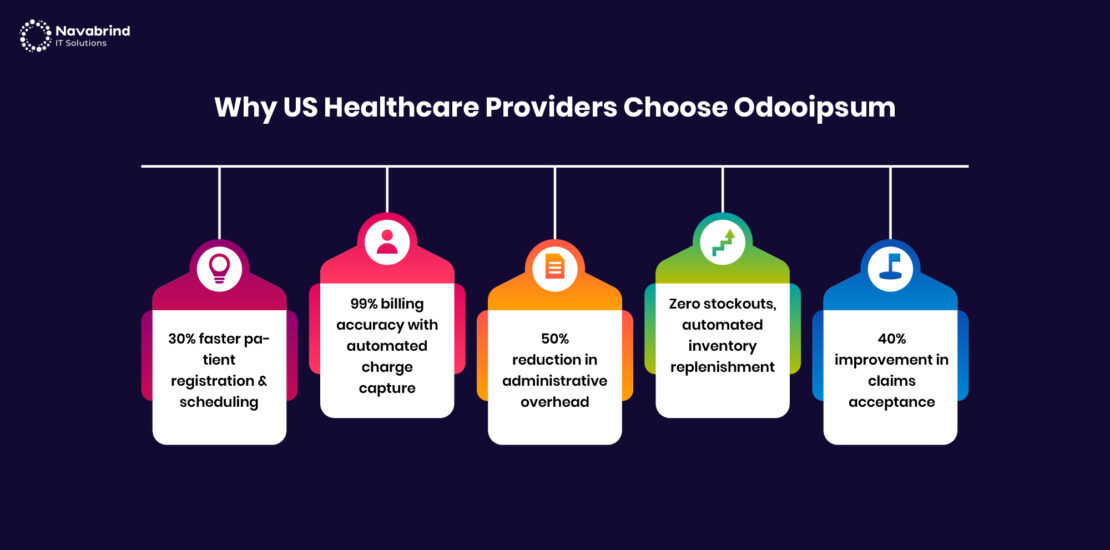
US hospitals are under immense pressure, rising costs, complex HIPAA compliance, staffing shortages, and constant demand for better patient experiences. Managing these challenges with disconnected software systems is no longer viable. When patient records live in one system, billing in another, and inventory in spreadsheets, errors multiply, and efficiency collapses. ERP for the healthcare industry addresses this fragmentation by integrating every function into a single operational foundation.
ERP software for hospitals in the US provides a strategic solution, one platform where financial data, supply chain, and patient management communicate in real time. Imagine registration updating automatically when supplies are consumed. Imagine billing pulling from clinical documentation without manual entry. This integration transforms disconnected departments into coordinated operations.
This post explores ERP for the healthcare industry, why it’s becoming essential for modern hospitals, and how it functions as the central nervous system for improving operational efficiency and patient care. Healthcare management software that unifies clinical and administrative functions delivers what fragmented systems cannot, complete visibility, accurate data, and the ability to focus on patients rather than paperwork. Hospital ERP solutions are no longer optional; they’re the foundation of sustainable operations.
What is ERP in the Healthcare Industry?
Defining Healthcare ERP:
- ERP for the healthcare industry is a unified platform integrating clinical, financial, and administrative functions into a single source of truth. Unlike healthcare management software like EHRs that focus on clinical data, ERP manages the business of healthcare, finance, supply chain, HR, compliance. ERP software for hospitals in the US handles operations, while EHR manages patient care.
- This integration means when a procedure happens, inventory updates, billing generates, and supply orders without manual entry. Hospital ERP solutions connect every department through shared data, eliminating the reconciliations that consume administrative hours. The ERP becomes the central nervous system coordinating non-clinical operations while supporting clinical workflows.
ERP vs. Other Hospital Software Systems:
- Hospital ERP solutions differ from Hospital Management Systems (HMS) or Practice Management Software. HMS handles patient registration, scheduling, and basic administration. Practice Management focuses on billing and appointments. ERP encompasses all of this plus finance, supply chain, HR, compliance, and analytics across the enterprise. It’s the broader, comprehensive backbone that connects every specialized system. ERP software for hospitals in the US doesn’t replace your EHR, it integrates with it, ensuring clinical and operational data align perfectly.

Why Do Hospitals Need ERP Software? The Case for Integration
The Problem with Silos:
- Your billing software doesn’t talk to inventory, and inventory doesn’t talk to patient scheduling. A procedure happens, supplies get consumed, but nobody tracks costs. Claims process late because clinical documentation never reaches billing automatically. ERP for the healthcare industry eliminates these disconnects by making every department work from the same data. When systems integrate, revenue leakage stops and efficiency improves.
Driving Forces for Adoption in the US:
- Financial Pressures: Hospitals must protect margins, reduce administrative waste, and manage complex insurance claim cycles. ERP software for hospitals in the US automates revenue cycle management and provides real cost visibility.
- Regulatory Compliance: HIPAA security, price transparency mandates, and accurate reporting require integrated systems. Fragmented data cannot satisfy regulators efficiently.
- Operational Complexity: Multi-location health systems, outpatient clinics, and large workforces demand real-time visibility. Hospital ERP solutions deliver enterprise-wide coordination.
- Value-Based Care: Understanding cost per procedure requires connecting clinical and financial data. Healthcare management software alone cannot provide this integrated view essential for value-based contract success.
How Does ERP Help Manage Hospital Operations? Key Areas of Impact
Financial Management & Revenue Cycle:
- ERP for the healthcare industry automates billing, claims management, and insurance workflows, reducing denials and accelerating reimbursement. Real-time dashboards let CFOs monitor financial health, shorten monthly closes, and gain insights into service line profitability. ERP software for hospitals in the US transforms fragmented revenue cycles into streamlined operations. Claims process faster because clinical documentation flows to billing without manual handoffs.
Supply Chain & Inventory Management:
- Critical medical supplies and pharmaceuticals stay stocked without overstocking, reducing waste through automated replenishment. Lot and expiration date tracking ensures patient safety and enables efficient recalls when issues arise. Hospital ERP solutions leverage system-wide data for bulk purchasing and contract compliance, driving significant cost reductions. Inventory never goes missing because every usage connects to patient procedures automatically.
Human Capital Management (HCM):
- Staff scheduling aligns with patient volume, payroll processes are accurate, and certifications are tracked continuously for compliance. Healthcare management software alone cannot provide this operational integration. ERP software for hospitals in the US reduces administrative burden on clinical staff, letting them focus on patient care while improving quality of life through predictable schedules and reduced paperwork.

What Are the Benefits of ERP for Healthcare Providers?
For the C-Suite & Administrators:
- ERP for the healthcare industry delivers data-driven decisions for accurate reporting and scenario planning, like evaluating new clinic openings with real cost models. Cost control becomes visible, with major health systems generating millions in first-year savings by identifying waste. ERP software for hospitals in the US provides scalability, allowing acquisitions and new facilities without IT chaos.
For Clinical Staff (Doctors & Nurses):
- Hospital ERP solutions improve workflows by eliminating time wasted searching for supplies or entering redundant data across systems. Better collaboration emerges from integrated data, allergies from EHRs feeding pharmacy workflows, which automatically enhances patient safety. Healthcare management software alone cannot provide the operational integration needed to let clinicians focus on patients rather than paperwork.
For Patients:
- ERP for the healthcare industry creates smooth experiences through smoother check-in, accurate billing, and shorter wait times. When operations optimize, patients notice the difference. ERP software for hospitals in the US ensures every department works together, so patients never feel the friction of disconnected systems behind the scenes.
How Does ERP Improve Patient Management in Hospitals?
Centralized Patient View:
- ERP for the healthcare industry provides a 360-degree view of each patient, including medical history, insurance coverage, payment status, and advance directives. ERP software for hospitals in the US consolidates information that otherwise lives in disconnected systems. Registration staff sees coverage details while clinicians access clinical records and billing teams view payment history, all from the same source.
Streamlined Patient Flow:
- Hospital ERP solutions manage the complete patient journey from admission and bed allocation through discharge and follow-up scheduling. Real-time data predicts patient volume, enabling proactive staffing adjustments and bed-availability planning. Healthcare management software alone cannot provide the enterprise-wide visibility needed to keep operations flowing smoothly during unpredictable census fluctuations.
Enhanced Patient Engagement:
- Patient portals integrated with ERP for the healthcare industry let individuals book appointments, view lab results, and pay bills from any device. This self-service capability improves satisfaction while reducing administrative calls. ERP software for hospitals in the US turns patient engagement from manual coordination into automated convenience.

Can ERP Systems Manage Hospital Billing and Appointments? Yes, and More
Unified Billing Engine:
- ERP for the healthcare industry handles the complexity of US healthcare billing, private insurance, Medicare, Medicaid, and self-pay, within a single system. ERP software for hospitals in the US automates charge capture from appointment scheduling through procedure and discharge. No revenue is lost because clinical activities trigger billing workflows. Claims process faster with fewer denials when documentation flows.
Intelligent Scheduling:
- Hospital ERP solutions move beyond simple appointment booking to rule-based scheduling that matches patients with the right physician, facility, and equipment. Automated reminders reduce no-shows while optimized schedules maximize physician time. Healthcare management software alone cannot coordinate this level of resource alignment. ERP for the healthcare industry ensures that every appointment is assigned to the right provider, room, and equipment.
What Features Should a Healthcare ERP System Have? A Buyer's Checklist
Non-Negotiable Requirements for US Providers:
- Robust Compliance: Built-in HIPAA and HITECH security features, comprehensive audit trails, and role-based access controls that enforce minimum necessary access. ERP for the healthcare industry must satisfy regulators without manual workarounds.
- Smooth Interoperability: Pre-built APIs and integration capabilities with major EHR systems like Epic and Cerner. ERP software for hospitals in the US cannot exist in isolation; it must connect with clinical systems.
- Comprehensive Financials: Core accounting, cost accounting for per-procedure costing, and grants management. Healthcare management software alone cannot provide this financial depth.
- Advanced Analytics & AI: Real-time dashboards, predictive analytics for supply chain and patient volume, and AI-driven billing automation. Hospital ERP solutions should reveal insights, not just record transactions.
- Supply Chain Depth: Perpetual inventory, lot tracking, and procurement management that prevent stockouts while minimizing carrying costs.
- Cloud-Based Architecture: Scalability, lower IT costs, and real-time data access across multiple sites. ERP software for hospitals in the US must support multi-location operations.

The Future of Healthcare ERP
AI-Powered Operations:
- ERP for the healthcare industry will embed generative AI and machine learning to automate complex tasks, detect billing anomalies, and optimize resource allocation in real time. ERP software for hospitals in the US will shift from recording what happened to predicting what will happen. AI agents will handle routine workflows while humans focus on exceptions.
Interoperability as Standard:
- The line between clinical and business systems continues to blur. Hospital ERP solutions and EHR data will flow smoothly across the care continuum. Healthcare management software will no longer exist in silos; integration becomes the baseline requirement rather than a competitive differentiator.
Real-World Data for Research:
- Aggregated, de-identified data within ERP for the healthcare industry becomes a valuable asset for medical research and population health management. ERP software for hospitals in the US will power insights that improve care beyond individual institutions. The same systems that manage operations will help advance medical knowledge.

Need a Technology Partner to Implement Odoo ERP for Your Healthcare Facility? Navabrind IT Solutions Can Help
Implementing ERP for the healthcare industry requires more than technical expertise; it demands understanding how hospitals operate. Navabrind IT Solutions brings both. As certified Odoo partners with healthcare domain experience, we’ve helped hospitals across the US replace fragmented systems with unified ERP software for hospitals in the US. Our approach combines technical implementation with operational understanding.
We don’t just install software. We map your clinical workflows, configure hospital ERP solutions to match your unique requirements, and ensure your team adopts the system successfully. From patient registration through revenue cycle management, we make healthcare management software work for your facility. Our healthcare practice focuses exclusively on organizations like yours.
Ready to transform disconnected operations into coordinated care delivery? Navabrind specializes in ERP for healthcare industry implementations that deliver measurable results, faster billing, better supply chain visibility, and reduced administrative burden. Contact us to discuss your facility’s needs. Let’s build the foundation that lets your clinicians focus on patients while your operations run smoothly.
Frequently Asked Questions
1. What is ERP in the healthcare industry?
ERP for the healthcare industry is a unified software platform integrating clinical, financial, and administrative functions into a single source of truth. Unlike healthcare management software that focuses primarily on clinical data, ERP manages the business of healthcare, finance, supply chain, HR, and compliance. ERP software for hospitals in the US connects patient records to billing, inventory to procedures, and staffing to patient volume. It serves as the central nervous system, coordinating non-clinical operations while supporting clinical workflows. Hospital ERP solutions eliminate data silos, ensuring every department works from the same real-time information.
2. Why do hospitals need ERP software?
Hospitals need ERP software for hospitals in the US because disconnected systems create inefficiencies and revenue loss. When billing doesn’t talk to inventory and inventory doesn’t talk to scheduling, errors multiply. ERP for the healthcare industry addresses financial pressures by automating revenue cycles, manages regulatory compliance through built-in HIPAA controls, and handling operational complexity across multi-location health systems. Hospital ERP solutions enable value-based care by connecting clinical and financial data to reveal the cost per procedure. Without integrated healthcare management software, hospitals cannot scale efficiently or compete effectively.
3. How does ERP help manage hospital operations?
ERP for the healthcare industry manages hospital operations by integrating financial management, supply chain, and human capital into one system. ERP software for hospitals in the US automates billing and claims to accelerate reimbursement while providing CFOs with real-time dashboards for financial visibility. Supply chain modules ensure critical supplies stay stocked with lot tracking for patient safety. Human capital management streamlines staff scheduling to match patient volume. Hospital ERP solutions connect every operational function, eliminating manual reconciliations and providing leadership with complete visibility across the enterprise, all within a single healthcare management software platform.
4. What are the benefits of ERP for healthcare providers?
ERP for the healthcare industry delivers data-driven decisions through a single source of truth, enabling accurate reporting and scenario planning. For the C-Suite, ERP software for hospitals in the US provides cost control visibility that generates millions in savings. Clinical staff benefit from improved workflows, less time searching for supplies or entering redundant data. Patients experience seamless check-in, accurate billing, and shorter wait times. Hospital ERP solutions scale with growth, allowing health systems to acquire practices without IT chaos. Healthcare management software alone cannot provide this enterprise-wide integration that benefits administrators, clinicians, and patients simultaneously.
5. How does ERP improve patient management in hospitals?
ERP for the healthcare industry improves patient management through a centralized 360-degree view that includes medical history, insurance coverage, payment status, and advance directives. ERP software for hospitals in the US streamlines patient flow from admission and bed allocation through discharge and follow-up scheduling. Real-time data predicts patient volume, enabling proactive staffing and bed availability adjustments. Patient portals integrated with hospital ERP solutions let individuals book appointments, view lab results, and pay bills, improving satisfaction. Healthcare management software alone cannot provide this comprehensive view that coordinates every touchpoint of the patient journey.
6. Can ERP systems manage hospital billing and appointments?
ERP for the healthcare industry manages hospital billing and appointments while handling far more. ERP software for hospitals in the US unifies billing across private insurance, Medicare, Medicaid, and self-pay within a single engine. Charge capture automates from appointment scheduling through procedure and discharge, ensuring no revenue leaks. Intelligent scheduling moves beyond simple booking to rule-based matching of patients with the right physician, facility, and equipment. Automated reminders reduce no-shows while optimized schedules maximize physician time. Hospital ERP solutions integrate these functions with clinical workflows, unlike standalone healthcare management software that operates in isolation.
7. What features should a healthcare ERP system have?
A healthcare ERP system must include robust compliance features, built-in HIPAA security, audit trails, and role-based access controls. ERP for the healthcare industry requires interoperability with major EHR systems such as Epic and Cerner via pre-built APIs. ERP software for hospitals in the US needs financials, including core accounting, cost accounting for per-procedure costing, and grants management. Advanced analytics with real-time dashboards and predictive AI capabilities are essential. Supply chain depth with perpetual inventory, lot tracking, and procurement management matters. Hospital ERP solutions should offer a cloud-based architecture for scalability across multiple sites. Healthcare management software alone rarely provides this complete feature set.
written by

Sumit Sinha
Associate Lead, Odoo
Sumit Sinha is an Associate Lead with over a decade of experience in enterprise software implementation. At Navabrind IT Solutions, he leads large and complex Odoo projects, consistently delivering world‑class Odoo implementations and integrations. He is recognized for his meticulous attention to detail, commitment to excellence, and dedication to going the extra mile to ensure successful project outcomes.
How can we help you?
Get in touch with a solutions consultant that can share best practices and help solve specific challenges.