Chemical manufacturers operate under constant pressure, strict regulatory frameworks, detailed traceability requirements, complex batch production cycles, and uncompromising safety standards. In this environment, operational gaps are not minor inconveniences; they translate into compliance risks, financial leakage, and production inefficiencies.
This is where manufacturing ERP software becomes a critical business driver. The right system does not just manage operations that bring control, visibility, and consistency across the production lifecycle. For businesses evaluating ERP for the manufacturing industry, the decision shapes cost structures, compliance readiness, and scalability. Generic business tools fail to meet the demands of chemical manufacturing software. They lack formulation tracking, batch-level traceability, regulatory documentation, and integrated quality controls. As a result, teams rely on fragmented processes that increase errors, slow down audits, and limit operational visibility.
A dedicated chemical manufacturing ERP addresses these challenges with capabilities tailored to process manufacturing by covering formulations, batch production, quality checks, compliance tracking, and inventory control in one connected system. This guide breaks down the Odoo vs SAP debate with a practical lens. It explores how leading manufacturing ERP software options, especially SAP ERP software and Odoo, handle the realities of chemical manufacturing. From feature depth to cost impact and implementation approach, you’ll gain the clarity needed to choose the right ERP for the manufacturing industry in 2026.
What Features Should ERP Software for Chemical Manufacturing Include?
Choosing the right manufacturing ERP software for chemical operations comes down to capability depth. A generic system may cover basic workflows, yet chemical production demands far tighter control over formulations, compliance, and traceability. The sections below outline what a high-performing chemical manufacturing ERP must deliver to support operational discipline and financial performance.
Batch and Process Manufacturing Management
Chemical production relies on batch execution and process flows, not discrete unit assembly. A capable ERP for manufacturing industry must support:
- Batch scaling and adjustments
- Process routing across multiple stages
- Yield tracking across production cycles
This forms the foundation of any reliable chemical manufacturing software, ensuring consistency across production runs.
Formula and Recipe Management with Version Control
Formulations define product quality and compliance. A strong chemical manufacturing ERP must include:
- Centralized formula management
- Version control for formulation changes
- Controlled approvals before production release
This ensures that production teams work with approved compositions, reducing deviation risks.
Hazardous Materials Tracking and SDS Management
Handling hazardous substances requires strict documentation and monitoring. Manufacturing ERP software must support:
- Hazard classification and storage rules
- Safety Data Sheet (SDS) management
- Risk labeling and handling instructions
These capabilities help maintain regulatory alignment and workplace safety.
Lot and Batch Traceability
Traceability is non-negotiable in chemical production. A robust ERP for manufacturing industry tracks:
- Raw material origin
- Batch movement across production stages
- Finished goods distribution
With full traceability, businesses can respond to audits and recalls with confidence.
Regulatory Compliance Management
Chemical manufacturers operate under multiple regulatory frameworks. A well-configured chemical manufacturing ERP supports compliance with:
For companies evaluating Odoo vs SAP, compliance handling often becomes a key decision factor, especially when comparing flexibility and configuration within SAP ERP software versus adaptable alternatives.
Quality Control and Lab Integration
Quality cannot be treated as a separate function. Effective chemical manufacturing software integrates:
- In-process quality checks
- Laboratory testing workflows
- Non-conformance tracking and corrective actions
This alignment ensures that quality standards are enforced throughout production.
Inventory Management for Bulk and Liquid Materials
Chemical inventory introduces unique challenges such as volume variability and storage constraints. A capable manufacturing ERP software must handle:
- Bulk storage tracking (tanks, silos, containers)
- Catch weight management
- Expiry and shelf-life monitoring
This improves material utilization and reduces losses.
Production Planning and Scheduling
Chemical plants operate with multi-stage production cycles and interdependencies. A strong ERP for manufacturing industry enables:
- Capacity planning across production units
- Scheduling based on resource availability
- Coordination between batches and processes
This leads to improved throughput and reduced downtime.
Advanced Costing Capabilities
Accurate costing drives profitability in chemical manufacturing. A reliable chemical manufacturing ERP includes:
- Batch-level costing
- By-product and co-product costing
- Yield variance tracking
These insights help identify inefficiencies and control production expenses.
Waste and Environmental Reporting
Environmental accountability is critical in chemical operations. Manufacturing ERP software should provide:
Integration with Equipment and IoT Systems
Operational accuracy improves when systems connect with production equipment. A capable chemical manufacturing software integrates with:
- Weighing and dispensing systems
- Laboratory instruments
- IoT sensors for process monitoring
In the Odoo vs SAP comparison, integration flexibility plays a significant role, especially for organizations looking to connect plant-floor data with enterprise-level insights through ERP for manufacturing industry platforms. A well-selected chemical manufacturing ERP does more than support operations, it establishes control, reduces risk, and strengthens profitability. The difference lies in how effectively the system aligns these features with real-world chemical production demands.
How Does ERP Software Benefit the Chemical Industry?
Chemical operations demand control, accountability, and visibility at every stage. The right manufacturing ERP software delivers measurable impact across production, compliance, and profitability. For businesses evaluating ERP for the manufacturing industry, these benefits define long-term performance and risk reduction.
1.
End-to-End Traceability That Strengthens Recall Readiness
A robust chemical manufacturing ERP tracks materials from procurement to final delivery. Each batch, lot, and intermediate stage remains fully documented.
- Rapid identification of affected batches during recalls
- Complete audit trails for regulatory inspections
- Stronger customer confidence through transparent tracking
This level of traceability positions chemical manufacturing software as a critical safeguard against compliance exposure.
2.Tighter Inventory Control That Cuts Waste
Inventory inaccuracies lead to material loss, expired stock, and production delays. Manufacturing ERP software introduces disciplined inventory management:
- Accurate tracking of raw materials, intermediates, and finished goods
- Reduced spoilage through shelf-life monitoring
- Optimized stock levels aligned with production demand
For organizations comparing Odoo vs SAP, inventory handling within SAP ERP software and alternative platforms often becomes a key evaluation area.
3.Compliance Reporting That Reduces Risk and Effort
Regulatory documentation in chemical manufacturing demands consistency and accuracy. A well-implemented chemical manufacturing ERP delivers:
- Automated generation of compliance reports
- Standardized documentation aligned with REACH, GHS, EPA, and OSHA
- Reduced dependency on error-prone processes
This strengthens regulatory alignment without adding operational burden.
4.Production Scheduling That Minimizes Downtime
Unplanned delays and bottlenecks disrupt output and increase costs. ERP for manufacturing industry enhances production flow through:
- Coordinated scheduling across multi-stage processes
- Resource allocation based on plant capacity
- Improved sequencing of batch operations
This leads to stable production cycles and improved throughput.
5.Visibility Into Batch Performance, Quality, and Cost
Operational clarity drives better decisions. Manufacturing ERP software provides:
- Live tracking of batch progress
- Immediate visibility into quality test results
- Accurate cost monitoring at each production stage
This transparency allows teams to act on issues before they escalate.
6.
Stronger Collaboration Across Departments
Disconnected teams create delays and inconsistencies. A centralized chemical manufacturing ERP connects:
- R&D for formulation updates
- Production for execution
- Quality for validation
- Finance for cost tracking and reporting
This alignment ensures that business functions operate with shared data and consistent objectives.
7.Faster Order Fulfillment Through Demand Accuracy
Meeting customer timelines requires accurate planning. Chemical manufacturing software supports:
- Demand forecasting based on historical and current data
- Production alignment with order pipelines
- Reduced delays in order processing and delivery
This improves customer satisfaction and strengthens business relationships.
8.Scalable Operations Across Sites and Product Lines
Growth introduces complexity to multiple plants, varied product lines, and expanding compliance requirements. A scalable ERP for the manufacturing industry enables:
- Centralized control across locations
- Standardized processes across product categories
- Consistent reporting and performance tracking
In the Odoo vs SAP landscape, scalability often drives decision-making, especially when assessing how SAP ERP software compares with flexible alternatives in multi-site environments. A well-chosen chemical manufacturing ERP transforms operations from reactive to controlled, enabling businesses to reduce risk, control costs, and scale with confidence.
How to Choose the Right ERP Software for the Chemical Industry
Selecting the right manufacturing ERP software requires a structured evaluation. Chemical operations demand far greater control than generic systems can deliver. The steps below guide decision-makers toward a solution that aligns with production complexity, compliance demands, and long-term growth.
Step 1: Map Your Process Type
Start with a clear understanding of how production runs within your organization:
- Batch processing
- Continuous manufacturing
- Hybrid models combining both
A suitable chemical manufacturing ERP must align with your process structure. Without this alignment, production tracking and costing lose accuracy.
Step 2: Identify Compliance Requirements
Regulatory expectations vary based on geography and product type.
Define:
- Applicable standards (REACH, GHS, EPA, OSHA)
- Documentation and reporting obligations
- Safety and environmental requirements
A capable ERP for the manufacturing industry must support these mandates without reliance on external workarounds.
Step 3: Assess Integration Needs
Chemical operations rely on multiple systems beyond ERP. Evaluate how well the manufacturing ERP software connects with:
- Laboratory systems (LIMS)
- Weighing and dispensing equipment
- IoT sensors for process monitoring
- Customer and supplier portals
In the Odoo vs SAP comparison, integration flexibility often separates rigid deployments from adaptable chemical manufacturing software environments.
Step 4: Define Scalability Requirements
Your ERP decision should support operational growth without system limitations. Consider:
- Single plant operations
- Multi-site manufacturing setups
- Expansion into new product lines or regions
A scalable chemical manufacturing ERP ensures consistent performance as complexity increases.
Step 5: Evaluate Vendor Expertise in Chemical Manufacturing
Not all ERP vendors understand chemical production.
Focus on:
- Proven experience with process manufacturing
- Demonstrated capability in handling formulations and batch traceability
- Case studies within chemical sectors
Even when assessing established platforms like SAP ERP software, industry expertise and implementation approach play a critical role.
Step 6: Analyze Total Cost of Ownership
Initial pricing does not reflect long-term investment.
Evaluate:
- Licensing fees
- Implementation costs
- Training and onboarding
- Maintenance and support
A clear cost structure helps avoid financial surprises and ensures the selected ERP for the manufacturing industry delivers measurable return.
Step 7: Run Scenario-Based Demonstrations
Shortlist vendors and request demonstrations tailored to your operations:
- Real batch production scenarios
- Compliance reporting workflows
- Inventory and traceability use cases
This approach reveals how well the chemical manufacturing ERP performs under real conditions rather than generic presentations.
Red Flags to Watch For
During evaluation, watch for warning signs that indicate potential risk:
- Overpromising on customization without proven delivery
- Weak compliance capabilities within the system
- Limited batch and lot traceability features
- Heavy dependence on external tools to fill capability gaps
These gaps can lead to operational inefficiencies even within well-known platforms in the Odoo vs SAP landscape. A structured selection process ensures that your manufacturing ERP software aligns with chemical production realities. The right decision strengthens compliance, improves operational control, and supports scalable growth within the ERP for the manufacturing industry ecosystem.
What Makes a Good Chemical Industry ERP: Odoo or SAP?
Why This Comparison Matters
For chemical manufacturers evaluating manufacturing ERP software, the decision often narrows down to Odoo vs SAP. These platforms dominate discussions within the ERP for the manufacturing industry, yet they serve different business profiles. The right choice impacts compliance control, operational visibility, and long-term cost structure. A clear comparison helps decision-makers align technology with production complexity and growth plans.
Overview of SAP ERP Software in Chemical Manufacturing
SAP ERP software has a long-standing presence in process manufacturing. Large chemical enterprises rely on SAP to manage complex operations across multiple locations and regulatory environments.
Key Strengths
- Mature compliance frameworks aligned with global regulations
- Strong batch management and traceability capabilities
- Multi-site coordination across global operations
- Proven track record in large-scale chemical environments
Considerations
- High implementation investment
- Extended deployment cycles
- Operational complexity that can slow adoption for mid-sized companies
For enterprises with heavy compliance demands and global operations, SAP ERP software remains a dominant force within chemical manufacturing ERP solutions.
Overview of Odoo in Chemical Manufacturing
Odoo has gained traction as a flexible alternative within manufacturing ERP software, especially for growing chemical businesses seeking adaptability without enterprise-level overhead.
Key Strengths
- Flexible architecture that adapts to business workflows
- Lower entry cost compared to traditional enterprise platforms
- Faster deployment cycles
- Strong partner ecosystem supporting customization and extensions
Considerations
- Certain chemical manufacturing software capabilities may require add-ons
- Compliance features depend on configuration and implementation expertise
Within the Odoo vs SAP debate, Odoo appeals to organizations looking for control and flexibility without the complexity associated with large enterprise systems.
Head-to-Head Comparison: Odoo vs SAP
Batch and Formula Management
- SAP ERP software delivers mature batch processing with established frameworks for complex production environments
- Odoo supports batch workflows and formulations, with flexibility to adapt processes through configuration
Regulatory Compliance Tools
- SAP ERP software includes extensive compliance capabilities aligned with global chemical regulations.
- Odoo supports compliance through configuration and partner-driven extensions within chemical manufacturing ERP setups.
Scalability and Multi-Site Support
- SAP ERP software handles global, multi-entity operations with structured control
- Odoo supports multi-site operations with flexibility, making it suitable for expanding businesses.
Implementation Time and Cost
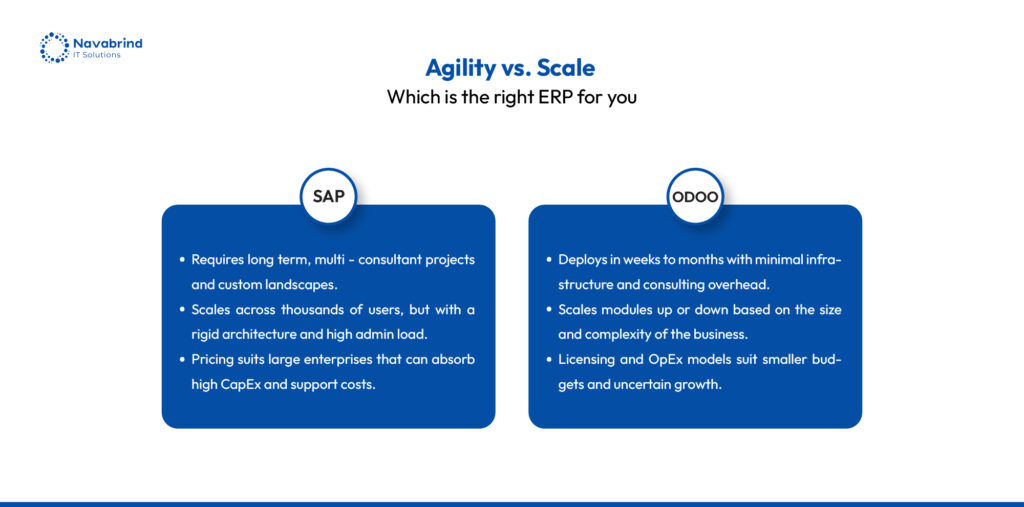
- SAP involves higher investment and longer deployment cycles
- Odoo offers quicker rollout and lower initial cost, making it attractive for mid-market companies evaluating ERP for manufacturing industry.
Ease of Use and User Adoption
- SAP environments require extensive training due to system complexity
- Odoo provides a cleaner user experience, supporting faster adoption across teams.
Integration and Customization Flexibility
- SAP offers integration through established frameworks, though changes can require significant effort
- Odoo allows easier customization and integration with third-party tools, making it adaptable for evolving chemical manufacturing software needs.
Which Platform Fits Your Business?
Choose SAP ERP Software If:
- Your organization operates across multiple global sites
- Compliance requirements dominate operational priorities
- You require enterprise-grade control across complex production networks
Choose Odoo If:
- Your business is scaling within the mid-market segment
- You need flexibility to adapt workflows and processes
- You want faster deployment with controlled investment
- You are evaluating alternatives within Odoo vs SAP for a cost-conscious yet capable chemical manufacturing ERP
Final Perspective
There is no universal winner in the Odoo vs SAP comparison. The right manufacturing ERP software depends on business size, regulatory exposure, and operational complexity. SAP ERP software fits enterprises demanding strict compliance and global coordination. Odoo aligns with growing chemical manufacturers seeking flexibility, faster deployment, and controlled investment within the ERP for the manufacturing industry. A well-matched chemical manufacturing ERP does not just support operations—it strengthens control, reduces risk, and improves profitability across the production lifecycle.
What Is the Best ERP for Chemical Manufacturing in 2026?
Why There Is No Universal Answer because,
The search for the “best” manufacturing ERP software often leads to misleading conclusions. Chemical manufacturing operates across diverse process types, regulatory environments, and production scales. A platform that fits one organization may fail in another. For decision-makers evaluating ERP for the manufacturing industry, the focus must shift from brand comparison to operational fit. The right chemical manufacturing ERP aligns with how your plant runs, how your compliance is managed, and how your teams execute daily tasks.
How the ERP Landscape Has Evolved
The expectations from chemical manufacturing software have shifted significantly. Traditional systems focused on transaction management. Today’s platforms are expected to deliver:
- Cloud-based deployment for accessibility and scalability
- AI-driven planning for demand and production optimization
- Continuous compliance monitoring aligned with regulatory frameworks
- Connected ecosystems linking production, quality, and finance
In the ongoing Odoo vs SAP discussion, these shifts influence how organizations evaluate both established platforms like SAP ERP software and flexible alternatives.
What Leading Chemical Manufacturers Prioritize in 2026
Forward-looking companies selecting manufacturing ERP software are prioritizing capabilities that extend beyond operational control:
- Cloud-based deployment for faster access and reduced infrastructure dependency
- Mobile accessibility for plant-floor and management teams
- Sustainability reporting to track emissions, waste, and environmental impact
- Predictive analytics to anticipate production issues and demand fluctuations
These priorities redefine how chemical manufacturing ERP systems are evaluated within the broader ERP for manufacturing industry landscape.
Learn more : How does Odoo support quality control in chemical manufacturing
A Practical Evaluation Framework
Before comparing platforms like Odoo vs SAP, organizations should define non-negotiable requirements. This ensures the selection process remains grounded in business needs rather than vendor positioning.
Evaluate each chemical manufacturing ERP against:
- Process compatibility (batch, continuous, hybrid)
- Compliance coverage across regions and product categories
- Traceability depth across materials and production stages
- Integration capability with lab systems, equipment, and external platforms
- Cost structure across implementation, training, and long-term use
This framework filters out misaligned options early and brings clarity to the selection process.
Platforms Worth Evaluating Beyond Odoo and SAP
The manufacturing ERP software market includes several platforms tailored for process manufacturing:
- Microsoft Dynamics 365
Offers strong integration across business functions with flexibility for mid-to-large chemical manufacturers.
- Infor CloudSuite Chemicals
Designed for chemical production with built-in capabilities for formulation, compliance, and batch management.
- Epicor Kinetic
Supports manufacturing operations with a focus on usability and production control across various industries.
These platforms expand the evaluation landscape beyond SAP ERP software and Odoo, giving businesses broader options within ERP for the manufacturing industry.
Final Guidance
The effectiveness of any chemical manufacturing ERP depends on adoption and execution. A system with extensive features delivers no value if teams struggle to use it correctly.
The right manufacturing ERP software is the one that:
- Aligns with your production processes
- Supports compliance without added complexity
- Fits your operational scale and growth plans
- Gains consistent usage across teams
In the end, the Odoo vs SAP debate and any broader comparison should lead to one outcome: selecting a system that your organization can rely on daily to maintain control, reduce risk, and sustain profitability within the chemical manufacturing software ecosystem.
Deploying manufacturing ERP software in a chemical environment demands planning, discipline, and domain expertise. Unlike generic implementations, a chemical manufacturing ERP must align with formulations, batch workflows, and regulatory frameworks from day one. Understanding what lies ahead reduces risk and protects your investment.
A structured rollout of chemical manufacturing software follows a sequence that ensures operational alignment:
1. Discovery
Map production workflows, formulations, compliance requirements, and reporting needs. This stage defines how the ERP for the manufacturing industry will support your business.
2. Configuration
Set up batch processes, inventory rules, compliance workflows, and financial structures within the system.
3. Data Migration
Transfer formulations, material masters, batch records, supplier data, and compliance documentation into the new environment. Accuracy here determines system reliability.
4. Testing
Validate production scenarios, traceability, compliance reporting, and financial outputs. This ensures the chemical manufacturing ERP performs as expected under real conditions.
5. Training
Equip teams across production, quality, finance, and operations with the knowledge required to use the system confidently.
6. Go-Live
Transition operations into the new manufacturing ERP software, with support in place to stabilize early-stage execution.
Common Implementation Pitfalls in Chemical Manufacturing
Even well-planned projects can fail without attention to key risks:
- Poor data quality
Incomplete or inconsistent data leads to production errors and unreliable reporting
- Underestimating compliance setup
Regulatory requirements demand detailed configuration within the chemical manufacturing ERP
- Inadequate user training
Without proper training, teams revert to old processes, reducing system effectiveness
In the Odoo vs SAP landscape, these challenges apply to both platforms. Even established systems like SAP ERP software require careful execution to avoid operational disruption.
Phased Rollout vs. Big-Bang Approach
Deployment strategy plays a major role in success.
- Phased rollout
Introduces the system in stages by function, plant, or module by reducing risk and allowing teams to adapt gradually
- Big-bang approach
Switches all operations at once, which can increase pressure on teams and expose the business to higher disruption
For most chemical manufacturers, a phased rollout aligns better with the complexity of ERP for manufacturing industry implementations.
Measuring Implementation Success
Success goes beyond system activation. A well-executed chemical manufacturing ERP delivers measurable outcomes early:
- Go-live stability with minimal disruption to production
- User adoption rates across departments
- Early KPI improvements such as reduced waste, improved traceability, and better inventory control
Tracking these indicators ensures the manufacturing ERP software delivers tangible business value.
Choosing the Right Implementation Partner
Technology alone does not guarantee success. The implementation partner must understand chemical operations in depth.
Look for partners who bring:
- Experience with chemical manufacturing software deployments
- Knowledge of batch processing, formulations, and compliance requirements
- Proven execution within ERP for manufacturing industry projects
When evaluating Odoo vs SAP, the expertise of the implementation partner often determines how effectively the system performs in a real chemical production environment. A well-managed implementation transforms manufacturing ERP software from a technical project into a business advantage. With the right approach, your chemical manufacturing ERP becomes a foundation for operational control, compliance readiness, and sustained profitability.
Final Thoughts
In 2026, manufacturing ERP software stands as a requirement for chemical businesses aiming to maintain control, meet regulatory expectations, and protect margins. Operating without a connected chemical manufacturing ERP exposes organizations to compliance gaps, traceability risks, and rising operational costs. There is no one-size-fits-all answer in the Odoo vs SAP debate. The right ERP for the manufacturing industry depends on your production scale, regulatory exposure, and expansion plans. SAP ERP software aligns with large enterprises managing complex, multi-location operations, whereas flexible platforms like Odoo suit growing chemical businesses seeking adaptability and faster deployment. The selection process should begin with a well-defined requirements list. Focus on process compatibility, compliance coverage, and traceability depth. Run scenario-based demonstrations using real production workflows. This approach ensures your chosen chemical manufacturing software aligns with day-to-day operations rather than theoretical capabilities.
Take the Next Step
Audit your current systems and identify operational gaps:
- Where does traceability break down?
- Which compliance processes rely on disconnected tools?
- How much time is lost due to data inconsistencies?
These insights will highlight where an integrated chemical manufacturing ERP can deliver immediate impact. The right manufacturing ERP software does not just support your business, it strengthens control, reduces risk, and positions your organization for sustainable growth within the ERP for the manufacturing industry.
Frequently Asked Questions
1.What is the best ERP for chemical manufacturing in 2026?
There is no universal winner in manufacturing ERP software. The right choice depends on process complexity, regulatory exposure, and expansion plans. Large enterprises with global operations often lean toward SAP ERP software, while growing businesses prefer flexible platforms in the Odoo vs SAP comparison. The key is selecting a chemical manufacturing ERP that aligns with batch control, compliance tracking, and operational scale within the ERP for the manufacturing industry.
2.What features should ERP software for chemical manufacturing include?
A reliable chemical manufacturing software solution must support:
- Batch and process manufacturing management
- Formula and recipe control with version tracking
- Lot and batch traceability across the production lifecycle
- Compliance tools aligned with REACH, GHS, EPA, and OSHA
- Quality control and lab integration
- Inventory tracking for bulk and liquid materials
- Production planning and scheduling
- Costing models including batch and yield variance
- Waste tracking and environmental reporting
These capabilities define whether a manufacturing ERP software can handle real chemical production demands.
3.How does ERP software benefit the chemical industry?
A well-implemented chemical manufacturing ERP delivers measurable outcomes:
- End-to-end traceability that strengthens recall readiness
- Inventory control that reduces waste and spoilage
- Compliance reporting that reduces risk and saves time
- Production scheduling that limits downtime
- Visibility into batch progress, quality results, and cost structures
- Improved coordination across R&D, production, quality, and finance
These advantages position ERP for the manufacturing industry as a critical driver of operational control and profitability.
4.What is chemical manufacturing ERP software, and why does your business need it?
Chemical manufacturing ERP is a specialized form of manufacturing ERP software designed to manage formulations, batch processing, compliance, and traceability within chemical operations.
Without a connected system, businesses face:
- Data inconsistencies across departments
- Compliance risks during audits
- Material waste due to poor inventory control
- Limited traceability during recalls
Adopting chemical manufacturing software replaces fragmented processes with a unified operational framework that supports growth and regulatory alignment.
5.How to choose the right ERP software for the chemical industry?
Selecting the right ERP for the manufacturing industry requires a structured approach:
- Map your production type (batch, continuous, hybrid)
- Identify compliance requirements by region and product category
- Evaluate integration needs with lab systems and equipment
- Define scalability across sites and product lines
- Assess vendor experience in chemical manufacturing
- Analyze the total cost of ownership
- Run scenario-based demos using real workflows
This ensures your chosen chemical manufacturing ERP aligns with operational needs rather than vendor claims.
6.What makes a good chemical industry ERP software: Odoo or SAP?
The Odoo vs SAP comparison highlights two different approaches within manufacturing ERP software:
- SAP ERP software suits large enterprises requiring strict compliance control, global coordination, and mature batch management
- Odoo fits growing businesses seeking flexibility, faster deployment, and controlled investment
A strong chemical manufacturing ERP, regardless of platform, must deliver traceability, compliance support, and production control. The right choice depends on how well the system fits your business model within the ERP for the manufacturing industry.
Schedule a conversation with us now!
Related Articles








 Post
Post Post
Post