Why the Retail Industry Runs Better on Odoo ERP
Retail runs on dozens of disconnected apps. One tool for sales, another for stock, a third for loyalty. None speak to each other. The result? Data silos, frequent stockouts, and customer experiences that feel disjointed across channels.
Retailers need more than patches. They need a unified backbone. Odoo ERP for the retail industry delivers that. As a complete retail ERP solution, it connects Odoo POS for retail with eCommerce, Odoo inventory management for retail, and CRM in one platform. No clunky integrations. No manual reconciliation.
Odoo retail management system replaces fragmented software. This ERP software for retail businesses gives store managers real-time visibility, buyers accurate forecasts, and marketers unified customer profiles. Odoo ERP for retail industry bridges physical stores and digital commerce.
Odoo ERP for Retail Industry Unifies Every Selling Channel
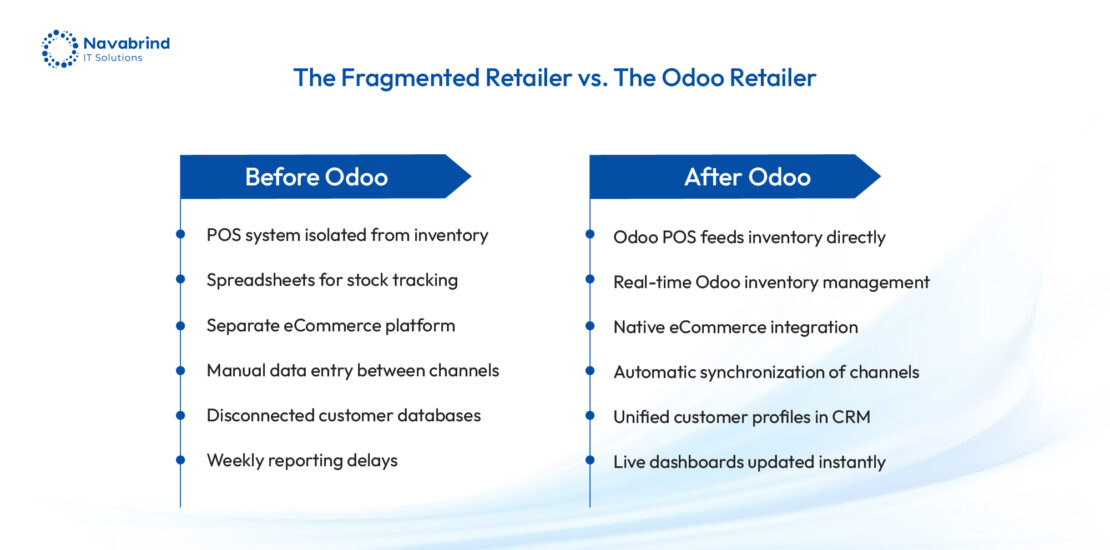
Retailers operate two separate businesses, the physical store and the website. They run on different systems, different databases, and different teams. Odoo ERP for retail industry demolishes this divide. The platform connects Odoo POS for retail with eCommerce channels, whether native Odoo storefront or third-party platforms like Magento and Shopify. Every transaction, regardless of origin, flows into the backend.
This retail ERP solution eliminates manual export-import routines. A sale on the website deducts inventory in real time. A return at the physical store updates stock and customer records instantly. Odoo retail management system treats wholesale orders, in-store purchases, and online checkouts as equal citizens in one unified order pool.
For customers, this translates to flexibility. Buy online, pick up in store. Purchase in-store, return by mail. The system tracks entitlement across touchpoints without spreadsheets or manager overrides. ERP software for retail businesses promises integration but delivers middleware headaches. Odoo inventory management for retail comes built-in. Odoo ERP for the retail industry does not bridge channels. It refuses to recognize them as separate.
Odoo ERP for Retail Industry Kills Inventory Guesswork
Retail inventory decisions default to instinct. Buyers guess quantities. Store managers beg for transfers. Finance holds excess stock that drains cash. Odoo ERP for the retail industry replaces guesswork with deterministic rules. The Odoo POS for retail transactions adjusts available quantities. Every return, transfer, and receiving document triggers recomputation across the network.
Odoo inventory management for retail analyzes daily, weekly, and seasonal velocities. The system generates purchase orders when stock hits predefined thresholds. It suggests transfer quantities between locations based on local demand profiles. Buyers approve; Odoo executes.
Multi-location retailers gain centralized command. A dashboard displays stock levels for downtown boutiques, suburban stores, and regional warehouses simultaneously. Inventory managers transfer excess from slow locations to high-traffic stores without email chains or spreadsheets. ERP software for retail businesses requires expensive third-party warehouse modules. Odoo retail management system includes multi-warehouse controls at no premium.
The financial impact compounds. Reduced safety stock frees working capital. Fewer markdowns protect margins. Stockout prevention retains revenue otherwise lost to competitors. Odoo ERP for the retail industry transforms inventory from a cost center into a competitive weapon.
Deep Business Process Automation with Odoo ERP for Large Enterprises
Most POS systems go dark when the network drops. Transactions stop. Sales vanish. Odoo POS for retail operates fully offline. Cashiers process returns, apply discounts, and complete sales during connectivity failures. The terminal syncs the transaction automatically once the connection restores. No data loss. No frustrated customers abandoned at checkout.
Odoo retail management system prioritizes staff adoption through deliberate interface design. The touchscreen presents products visually. Cashiers tap category images rather than memorizing alphanumeric SKUs. Payment splitting, exchanges, and price overrides require three taps maximum. New hires complete competent transactions after fifteen minutes of exposure. Training overhead collapses.
Odoo ERP for retail industry connects to standard USB barcode scanners, off-the-shelf receipt printers, and generic cash drawers. Retailers deploy existing equipment or source from any office supply vendor. No expensive certified hardware catalog required.
Speed compounds these advantages. Transaction times drop below thirty seconds. Queues shorten during peak hours. Staff maintain composure rather than rushing. ERP software for retail businesses, complicates the checkout process. Odoo inventory management for retail runs invisibly behind a POS interface engineered for velocity. Odoo ERP for the retail industry treats the checkout line as customer experience, not operational bottleneck.
Odoo ERP for Retail Industry Replaces Anonymity With Intelligence
Retailers recognize customers at the moment of tender. A credit card swipe. Then the customer vanishes until the next transaction. Odoo ERP for the retail industry terminates this anonymity. Every interaction, online browse, in-store purchase, email click, support call, attaches to a customer profile. Odoo POS for retail captures identity at checkout. The eCommerce channel logs browsing behavior. The system merges these fragments into complete portraits.
This retail ERP solution bakes loyalty mechanics into the transaction flow. Odoo retail management system issues points, tracks redemptions, and manages gift card balances without third-party plugins or API fees. Cashiers apply membership discounts when the customer scans a loyalty card or enters a phone number. No paper stamp cards. No manual verification.
ERP software for retail businesses separate CRM from transaction data. Odoo inventory management for retail shares the same database as marketing automation. A buyer who purchased winter boots receives care instructions three weeks later. A lapsed high-value customer triggers a reactivation workflow with a personalized discount. Campaigns execute against real purchase histories, not inferred segments.
Odoo ERP for the retail industry transforms customer data into revenue. Retention displaces acquisition. Average order value climbs as the system understands preferences. The platform treats channels as a relationship opportunity, not a transaction terminal.
Odoo ERP for Retail Industry Replaces Instinct With Evidence
Spreadsheets arrive weekly. Historical context requires manual lookup. Decisions default to intuition because facts remain buried. Odoo ERP for retail industry surfaces actionable intelligence continuously. Dashboards refresh in real time. A store manager opens the morning view and sees yesterday’s sales versus target, today’s forecast, and current inventory bottlenecks.
This retail ERP solution delivers different views for different roles. The executive examines consolidated P&L across banners. The district manager compares store performance side by side. The buyer analyzes inventory turnover ratios by category and vendor. Odoo retail management system does not restrict users to generic reports. Any user builds views with drag-and-drop simplicity.
Odoo POS for retail feeds transaction data into these analytical models. Margins calculate when cost data meets sale price. Slow movers flag themselves before they become clearance disasters. ERP software for retail businesses charges separately for business intelligence modules. Odoo inventory management for retail includes multidimensional reporting at no additional cost.
Odoo ERP for the retail industry shifts organizational culture. Merchandisers defend allocations with sell-through evidence. Markdown decisions follow velocity data, not calendar proximity. The platform transforms reporting from retrospective accounting into forward-looking competitive intelligence.
Odoo ERP for Retail Industry Expands Without Replacement
A startup POS cannot handle multi-location inventory. A homegrown ERP often lacks eCommerce integration. Enterprise systems can be rigid for niche requirements. Odoo ERP for the retail industry eliminates this upgrade treadmill. A single-store operation deploys Odoo POS for retail and Odoo inventory management for retail exclusively. No accounting. No manufacturing. No unused modules cluttering the interface.
Growth triggers capability expansion, not platform migration. When a second location opens, the retailer activates multi-warehouse controls. Wholesale distribution begins. The team switches on customer portals and advanced pricing rules, and private label production starts. Manufacturing, quality control, and barcode generation activate with clicks. This retail ERP solution grows because the architecture is by design, not retrofitted for modularity.
ERP software for retail businesses accommodates niche differentiation. A grocery retailer requires lot tracking and expiration alerts. A fashion retailer needs product variants by size and color. An electronics retailer demands serial number traceability. Odoo retail management system supports three models within the same instance. The open-source framework permits customization without forking from the upgrade path.
Odoo ERP for the retail industry rewards long-term thinking. Retailers never confront the impossible choice between stagnation and forklift replacement. The system scales to each operational milestone and no further.
Odoo ERP for Retail Industry Delivers What Fragmented Systems Cannot
Odoo ERP modules drive significant productivity gains for SMEs by streamlining workflows, reducing errors, and improving team collaboration.
It is manufactured by vendors selling disconnected point solutions. One system for transactions. Another for stock. A third for customers. Fourth for reporting. Fifth for loyalty. Retailers assemble these pieces and wonder why operations remain chaotic. Odoo ERP for the retail industry consolidates what was never meant to be separated. This retail ERP solution treats sales, inventory, customers, and finance as expressions of a single business reality.
Odoo retail management system eliminates the friction between selling floor and back office. Odoo POS for retail records transactions. Odoo inventory management for retail adjusts stock. The CRM logs customer behavior. The accounting engine posts revenue. ERP software for retail businesses requires middleware, scripting, and reconciliation. Odoo requires none of these because fragmentation was never the starting premise.
Customer experience separates market leaders from also-rans. Shoppers detect disjointed systems instantly. They feel the friction when an online return fails at a physical store. They sense the indifference when loyalty history disappears between channels. Odoo ERP for retail industry arms retailers with omnichannel competence. Agility becomes operational reality, not marketing language.
If you’re facing challenges like disconnected sales channels, manual inventory reconciliation, or difficulty scaling operations across locations, Odoo ERP can be the backbone that aligns the people, processes, and data in your retail business.
Navabrind IT Solutions helps you answer the real question: Is your business ready, and is Odoo the right fit? We start by understanding your current workflows, pain points, and growth plans, then map them to Odoo’s capabilities, such as their POS, inventory, e‑commerce, CRM, and other modules, so you adopt only what you need, when you need it.
As an Odoo Gold Partner with over a decade of experience and 500+ implementations, we don’t just install software; we design a tailored Odoo environment that grows with you. From initial assessment and phased rollout to integration with Shopify, Magento, WooCommerce, and OdooPIM, data migration, customization, maintenance and support, our certified Odoo engineers ensure a robust secure implementation and a smooth transition.
If you’re evaluating Odoo for the retail industry, Navabrind IT Solutions becomes your strategic partner, bringing along cross industry best practices and guiding you from readiness to realization, so your move to Odoo is not a project, but a step toward sustainable growth.
Frequently Asked Questions
1. How Odoo benefits the retail industry compared to traditional POS systems?
Traditional POS systems function as cash registers with memory. They record transactions but isolate that data from other operational functions. Inventory counts require manual adjustment. Customer purchase history lives in a separate database. Sales reports must be exported and emailed. Odoo ERP for the retail industry eliminates this fragmentation. Odoo POS for retail operates as a component of a complete operational platform.
The transaction processed through Odoo POS for retail updates Odoo inventory management for retail. Stock levels adjust across channels simultaneously. Customer profiles capture preferences and purchase patterns. Accounting entries post automatically. This retail ERP solution transforms checkout from an endpoint into a data source that enriches the business. ERP software for retail businesses cannot match this integration. Odoo retail management system delivers what traditional POS vendors promise but never achieve.
2. What benefits of Odoo ERP for retail businesses justify the investment?
Working capital releases as Odoo inventory management for retail reduces safety stock requirements by matching supply to velocity. Labor costs decline when automated reconciliation replaces manual data entry between sales channels, warehouses, and accounting systems. Revenue protection occurs through stockout prevention algorithms that trigger replenishment before shelves are empty. Customer lifetime value expands as unified CRM data enables targeted retention campaigns.
Odoo ERP for the retail industry delivers these gains at approximately one-third the total cost of competing retail ERP solutions. The Odoo retail management system permits businesses to deploy only necessary functions. A startup deploys Odoo POS for retail and inventory modules exclusively. An enterprise activates manufacturing, rental, or subscription capabilities. ERP software for retail businesses charge for suites regardless of utilization. Odoo aligns cost with consumption.
3. How Odoo improves retail inventory management across multiple locations?
Odoo inventory management for retail provides real-time visibility across every store, warehouse, and distribution center simultaneously. A dashboard displays stock levels at downtown boutiques, suburban locations, regional warehouses, and third-party logistics partners. Inventory managers transfer excess stock from slow-moving locations to high-traffic stores without email chains, spreadsheets, or manual counting. The system executes transfers based on configurable demand signals.
This retail ERP solution replaces intuition with deterministic replenishment rules. Historical sales velocity, seasonal patterns, and lead time variability feed automated purchase proposal generation. Odoo ERP for retail industry alerts buyers when stock reaches reorder points and suggests order quantities based on consumption rates. Multi-location retailers eliminate duplicate safety stock because the system pools risk across the network. ERP software for retail businesses charges premium fees for multi-warehouse functionality. Odoo retail management system includes multi-location controls at no additional cost.
4. Which Odoo ERP features for retail stores deliver the fastest ROI?
Odoo POS for retail continues processing sales, returns, and exchanges without connectivity. Transactions sync when service restores. Zero revenue loss during infrastructure failures. Automated replenishment rules deliver ROI within weeks. Odoo inventory management for retail analyzes consumption patterns and generates purchase orders. Buyers approve rather than research. Safety stock reductions of twenty to thirty percent are routine.
ECommerce integration eliminates middleware and per-transaction connector fees. Odoo retail management system includes web storefront capabilities. Product catalogs, pricing rules, and customer databases synchronize without third-party plugins. Loyalty program management operates without subscription costs. ERP software for retail businesses charges separately for marketing automation and customer portals. Odoo ERP for the retail industry consolidates these functions into the base platform. No additional licenses. No surprise invoices.
5. Why do retailers choose Odoo ERP over other ERP software for retail businesses?
Odoo ERP for the retail industry costs eighty percent less than SAP, Oracle, or Microsoft Dynamics when comparing five-year implementation and maintenance expenses. Implementation speed is equally stark. Odoo retail management system deploys in weeks. Legacy projects consume months or years. Proprietary retail ERP solutions restrict customization. Users adapt processes to software limitations.
Odoo ERP for the retail industry reverses this relationship. The open-source architecture permits modification without forking from the upgrade path. A grocery retailer configures lot tracking and expiration alerts. A fashion retailer creates variant matrices for size and color. An electronics retailer implements serial number traceability. ERP software for retail businesses cannot accommodate this range within an instance. Odoo POS for retail and Odoo inventory management for retail function across these verticals while permitting unique operational rules.
6. Can small retailers implement Odoo ERP for the retail industry without IT staff?
Odoo retail management system offers cloud-hosted deployment requiring zero infrastructure or internal technical resources. A single-store operator downloads Odoo POS for retail from the app store onto standard iPad hardware. Guided setup wizards configure tax mappings, payment terminal integrations, and product catalogs without coding. Odoo inventory management for retail activities through checkbox selections rather than script writing. The platform includes preconfigured product categories, shipping methods, and accounting charts.
ERP software for retail businesses demanded database administrators and implementation consultants. Odoo ERP for the retail industry eliminates these requirements through interface simplification and vendor-managed infrastructure. Small retailers receive automatic updates, security patches, and backup management as part of the subscription. Support documentation includes video tutorials and searchable knowledge bases. Telephone and chat assistance connects users with product specialists who resolve configuration questions without technical jargon. Odoo retail management system makes enterprise-grade functionality accessible to Main Street operations.
Schedule a conversation with us now!
Related Articles






 Post
Post