The PLM Decision: Choosing Your Core System
A Product Lifecycle Management (PLM) module governs a products journey from concept to final product retirement, controlling data like designs, bills of materials, and change orders. Selecting a PLM platform is a foundational business decision. Often, the choice narrows to two distinct contenders: Arena PLM, a leader in cloud-based PLM software, and Odoo, an open-source ERP platform with an integrated Odoo PLM module. This Arena PLM comparison with Odoo’s Product Lifecycle Management will dissect their capabilities to help you decide.
Arena PLM is a cloud solution built explicitly for complex product development. Its features provide deep control over engineering change processes, quality management, and supply chain collaboration.
Odoo takes a different approach, embedding its PLM module within a broad suite of business applications, from CRM to inventory. The Odoo PLM integration with the Odoo manufacturing module promises a unified operational view. This integrated architecture is central to its value proposition.
Core Focus: Depth vs. Breadth
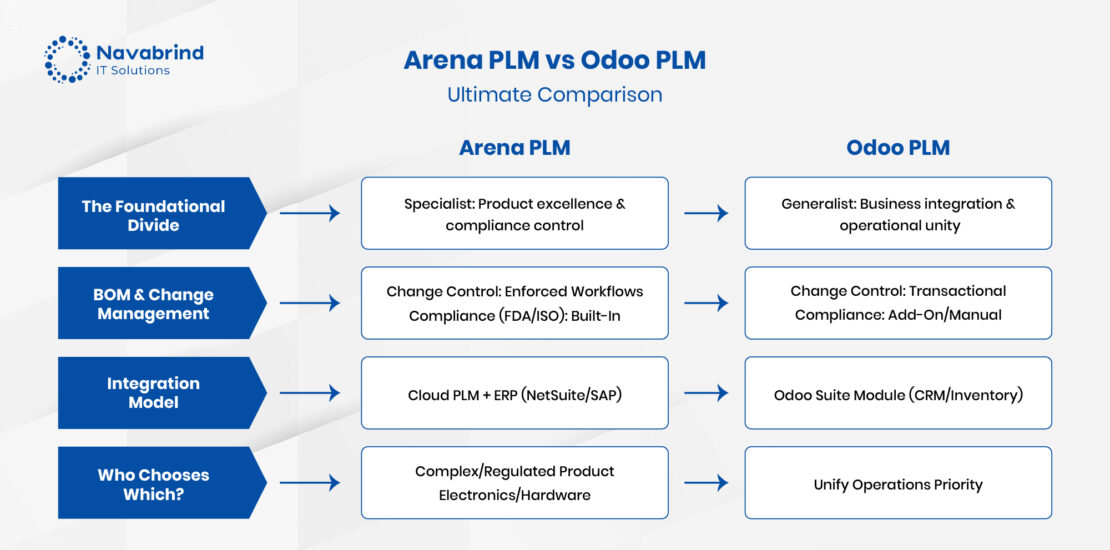
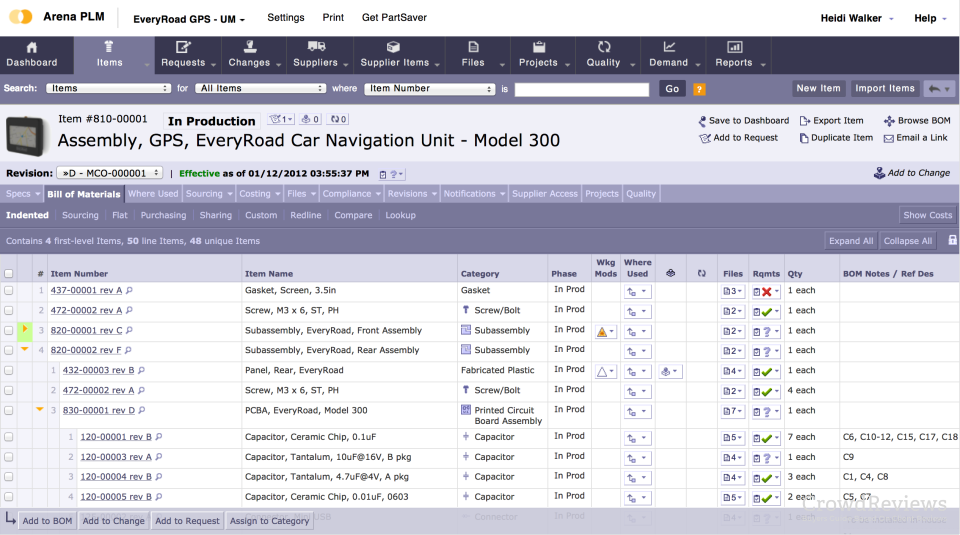
Arena delivers profound, specialized PLM functionality for managing sophisticated products and global supply chains. Odoo offers robust PLM tools as part of a comprehensive business management suite. When evaluating how Odoo compares to Arena PLM for BOM management, Arena offers more handling of multi-level BOMs, alternatives, and revisions. Arena PLM vs. Odoo for electronics and hardware companies: Arena PLM offers greater granular control.
Scale and Strategic Growth
Consider future needs when deciding whether Arena PLM or Odoo ERP is more scalable. Arena scales vertically within the product development domain, managing thousands of items and changing workflows. Odoo scales horizontally across business functions, adding users and operational modules like finance and HR.
Implementation and Investment
Arena’s focused scope enables faster, more predictable deployment within its domain. Arena PLM pricing is subscription-based to the PLM function. Odoo’s implementation can be broader and more variable, as costs accumulate across required modules and customizations, though its open-source model offers a cost advantage.
The Integrated System Question
Arena excels as a best-of-breed PLM and integrates with other systems, such as NetSuite and SAP. Odoo owns the suite model, where data flows between modules without integration bridges.
Making the Strategic Choice
For small businesses or those prioritizing a cohesive system for all operations, Odoo PLM module is a compelling start. For companies where product complexity, compliance, and change management are imperatives, Arena PLM software offers specialized strength.
Understanding the Contenders
Arena PLM Software Review: The Expert
- Arena PLM is a cloud-based PLM software solution. It offers rigorous change management with immutable audit trails, integrated quality processes, such as CAPA, PPAP, and supply chain collaboration portals. When examining Arena PLM software, you will notice a consistent theme: control. It provides a source of truth that withstands regulatory scrutiny and accelerates product time-to-market.
Product Lifecycle Management in Odoo: The Integrated Suite
- Odoo is an all-in-one business management suite, and the Odoo PLM module is one component of its vast ecosystem. The philosophy is to integrate centralized data and processes across departments, from sales and inventory to accounting and manufacturing.
- Exploring Product lifecycle management in Odoo requires viewing it as part of this connected whole. The Odoo PLM module handles revision control and BOM management, but its capabilities are intrinsically linked to the Odoo manufacturing, inventory, and procurement modules. This Odoo PLM integration means that a change to a BOM can trigger updates to material requirements, work orders, and purchase proposals. The value is holistic operational visibility, not deep lifecycle specialization.
Head-to-Head Comparison: Key Differences
- Core PLM Functions: Specialization vs. Sufficiency
- BOM Management: A PLM tool manages alternates, substitutes, and controlled references to external component libraries. Revision control is fully automated, preserving a complete audit trail of changes. When comparing Odoo and Arena PLM for BOM management, the Odoo PLM module offers functionality. It manages revisions and multi-level BOMs adequately for products.
- Change & Revision Control: In a PLM tool, change order process is a configurable workflow requiring approvals, impact assessments, and enforced synchronization across affected documents and BOMs. Product lifecycle management in Odoo offers a transactional change process. It is suitable for internal coordination but lacks the procedural weight and formality required in regulated or contract manufacturing environments.
- Quality & Compliance: Arena PLM features include built-in frameworks for CAPA, deviation management, and audit trails compliant with FDA 21 CFR Part 11. It is engineered for regulated industries. The Odoo manufacturing module and its quality app handle checks and non-conformities but do not provide a dedicated, controlled quality management system built into the product record.
- Integration & Ecosystem: Best-of-Breed vs. Monolithic Unity
- Arena PLM employs a best-of-breed strategy. It offers validated connectors to major ERPs like NetSuite and SAP, alongside an API for integrations. It excels as the authoritative product record, feeding data downstream to other systems.
- The Odoo PLM module shares a database with Odoo’s sales, inventory, MRP, and accounting apps. Data flows without interfaces, synchronization delays, or mapping complexity. The trade-off is ecosystem lock-in; you operate within Odoo’s universe.
- Scalability & Strategic Fit
- Growth Trajectory: Which is scalable: Arena PLM or Odoo ERP? The question addresses two types of scale. Arena scales in product complexity and compliance demand. It can manage tens of thousands of items with intricate relationships without performance degradation. Odoo ERP scales in business breadth and user count. It adds operational modules and users across departments as the company grows horizontally.
- Business Size & Sector: For businesses with straightforward products and a desire for an all-in-one system, the Odoo PLM module presents a lower cost and operational harmony.
- Arena PLM vs Odoo for electronics and hardware: Arena offers superior component management, firmware/software revision tracking, and inherent compliance structures.
- Implementation Reality: Arena’s focused deployment of a cloud-based PLM solution enables faster achievement of full PLM capability. Arena PLM pricing is predictable for that scope. Odoo’s total implementation can be longer and more variable, as value requires configuring and connecting multiple interdependent modules across the business.
Practical Considerations: Implementation & Cost
Implementation: Focused Deployment vs. Enterprise Transformation
Odoo PLM: Because the value Odoo PLM derives from its integration with the broader suite, a successful rollout often requires configuring PLM with the Odoo manufacturing, inventory, and purchasing modules. This transforms a PLM project into a broader business system implementation.
Arena: Scope is defined in Arena PLM. It establishes product record control, change processes, and supply chain collaboration. With a mature SaaS platform, a standard implementation for a mid-size company takes 2-4 months. Consulting is focused on configuring PLM workflows and integrations.
Pricing: Predictable Subscription vs. Modular Accumulation
Arena: You pay an annual subscription based on the number of users and optional modules. This cost includes hosting, security, and ongoing updates. The total is known upfront, with minimal hidden expenses.
The open-source version is free, but production-ready use of the Odoo PLM module requires paid enterprise subscriptions for each user, as well as subscriptions for any third-party apps you plan to integrate with. Product lifecycle management in Odoo ERP is not a standalone cost; it’s an entry point to a stack of licenses. Implementation, customization, and potential premium hosting or support create significant additional variables.
Total Cost of Ownership: The Long-Term Equation
- Arena PLM: Higher initial software subscription, but lower relative implementation cost due to focused scope. Ongoing costs are stable and predictable. Customization is limited to configuration within the platform’s framework, reducing long-term maintenance burden.
Odoo: Low-cost initially, especially for small teams. TCO increases with added modules, user, and customizations.
Decision Matrix: Which PLM is Right for You?
Choose Arena PLM if your product is your competitive and compliance battleground. Select this cloud-based PLM software when product complexity defines your business.
- Arena is built for regulated sectors like medical devices, aerospace, and complex electronics. Its architecture enforces audit trails and controlled processes essential for FDA, ISO, and other standards.
- Your supply chain and contract manufacturers need secure access to a controlled product record. Arena provides this without exposing your ERP.
- You operate a best-of-breed technology stack. If you have a strong existing ERP and need a PLM to integrate with it, Arena excels as that deep, connected expert system. This approach to PLM software with ERP integration prioritizes functional excellence over vendor unity.
- For electronics and hardware companies, where scalability means managing thousands of components and rigorous revisions, Arena’s focused power is essential. It grows with your product complexity, not just your user count.
Choose Odoo if your primary objective is business operations.
- Your key requirement is integrating ERP, CRM, accounting, and inventory. You accept good-enough PLM capabilities as a trade-off for data flow across departments. The value is in the Odoo PLM integration, not standalone depth.
- For businesses with minimal compliance requirements or simple multi-level BOMs, Odoo offers robust capabilities. The Odoo manufacturing module and PLM tools can suffice.
- You have limited IT resources and prefer to work with a single vendor. Managing a platform with support simplifies operations. The initial implementation time and cost may be lower for a setup.
- Customization and open-source access are strategic. You plan to make significant modifications to the system and value the ability to modify the codebase. Odoo provides this flexibility where Arena does not.
The Future-Proof Choice
It’s a choice between depth and breadth: a specialized system or an integrated suite. One platform is engineered for product excellence, the other for business unity. There is no universal “best,” only the correct fit for your industry, scale, and operational priorities. Your decision determines your competitive foundation. You cannot choose both. The future-proof system aligns with your business challenge.
To move forward, define your top three requirements. This clarity will make the path obvious:
- Requirement: Uncompromising Control Over Complex Product Data
How Odoo compares to Arena PLM for BOM management reveals a gap in control. For electronics and hardware companies, or manufacturers where the product record itself is an asset, Arena PLM is the engineered solution.
- Requirement: A System for Business Operations
If your needs are data flow from quote to cash, reduced integration complexity, and managing business growth, your priority is breadth. The Odoo PLM integration with sales, inventory, and manufacturing delivers this environment. For businesses scaling their operations, this cohesion can outweigh the value of PLM features.
- Requirement: Strategic Technology Architecture
Choose Arena PLM if you need a cloud-based PLM software to connect with other leading systems. Choose Odoo if you want one vendor, one database, and one support contract for your operations.
Frequently Asked Questions
1. Is Arena PLM better than Odoo PLM for electronics manufacturing?
For electronics manufacturing, Arena PLM is superior for companies, especially when product complexity, component management, and regulatory compliance are critical to success. Electronics companies manage intricate multi-level BOMs with alternates and substitutes, track firmware and software revisions linked to hardware, and require stringent compliance for markets, such as medical or automotive. Arena PLM features are engineered for these demands, offering control over component libraries, revision histories, and embedded quality processes like CAPA that are essential for audit trails.
The Odoo manufacturing module and PLM component can manage a BOM and revisions. The system slows on the parent-child relationships of PCB assemblies, advanced where-used tracking, and the rigorous change control that prevents errors.
2. Can Odoo PLM handle complex BOM management?
The Odoo PLM module allows for creating multi-level BOMs, managing revisions, and implementing simple change workflows. Its integration with the Odoo manufacturing module means a BOM change can update related work orders and purchase proposals, which is valuable for operational cohesion. For many small to mid-sized businesses producing less complex mechanical goods or assemblies, this functionality is adequate and streamlines production planning.
When evaluating how Odoo compares to Arena PLM for BOM management, the limitations become evident. Odoo is not designed for the extreme complexity seen in industries like aerospace, or medical devices. It has less features for managing alternates and substitutes at a level, handling configurable BOMs with rules, or preserving a complete history of component change across product versions. The revision control is more transactional than governance-focused.
For complex business processes, Odoo’s native integration is powerful. For complex product structures with deep hierarchies, external component references, and compliance needs, Odoo’s tools become insufficient.
3. What is the total cost of ownership for Arena PLM vs. Odoo?
The upfront software cost is higher, but it encompasses a complete, dedicated cloud-based PLM software solution with hosting, security, compliance, and updates. Implementation, while requiring expert consultation, is confined to the PLM domain, leading to a predictable and shorter project timeline. The long-term TCO is stable, with costs scaling with users and optional modules.
While entry costs for the Odoo PLM module and a few user licenses appear low, true operational value requires activating and integrating other apps like MRP, inventory, and accounting. Costs accumulate per app, per user. Arena PLM vs Odoo implementation time and cost favors Arena for a pure PLM rollout; Odoo’s implementation is a broader business transformation, requiring customization, integration work, and ongoing maintenance, especially if leveraging its core for heavy modifications.
4.Which is easier to implement—Arena PLM or Odoo PLM?
As a cloud-based PLM software, it has a defined scope: product record management, change control, and collaboration. Its configuration is focused within that domain. A standard Arena PLM implementation can be live in a matter of months, with consulting efforts targeted at optimizing PLM workflows and connecting to existing ERPs via pre-built connectors or APIs.
Its power derives from Odoo PLM integration with the suite. A meaningful implementation requires setup of the Odoo manufacturing module, inventory, purchasing, and potentially other apps. This transforms the project from a departmental software rollout into an enterprise business system implementation, which is inherently complex, time-consuming, and resource-intensive. Timelines can extend to twice that of a focused Arena deployment or longer.
If the goal is to establish professional, compliant PLM processes quickly, Arena PLM offers a more straightforward path. If the goal is to establish a business management platform and PLM is one component of that larger vision, then implementing Odoo ERP is the necessary path.
5. Does Odoo PLM integrate with other ERP systems, or is it only for the Odoo suite?
Its value proposition is data flow within Odoo’s own ecosystem, between sales, manufacturing, inventory, and accounting on a database. This pre-built Odoo PLM integration is its strength, eliminating the need for complex interfaces, data mapping, or synchronization delays between different vendor systems.
Odoo can integrate with external ERPs using its API, but this approach contradicts its design philosophy and creates major operational hurdles. You would be building complex integrations to replicate the data flows you’re paying for, resulting in a fragile, high-maintenance architecture. This setup dilutes Odoo’s benefit while introducing the very integration challenges it aims to solve.
6. Is Odoo PLM good enough for a small manufacturing business?
The appeal lies in obtaining PLM functionality, like BOM management, revision control, and change orders, within an affordable, all-in-one system that also handles CRM, accounting, and inventory. This Odoo PLM integration eliminates data silos and can be a powerful catalyst for a growing company with limited IT resources. The lower initial cost compared to a specialized PLM is a legitimate advantage.
The central question in Arena PLM vs Odoo for small businesses is about trajectory. If the business plans to develop complex products, enter regulated markets, or collaborate extensively with external contractors, the limitations of Product lifecycle management in Odoo will become a constraint. Its lighter-weight change control and less BOM management may not scale with increasing product sophistication, requiring a costly and disruptive system replacement later.
Odoo PLM is a starting point for a small business prioritizing broad operational integration over product lifecycle control, with an understanding of its functional ceilings. A small business whose competitive edge is tied to innovative, complex, or compliant product development should consider Odoo PLM from the outset.
Schedule a conversation with us now!
Related Articles






 Post
Post