Retail in 2026 doesn’t look anything like it did a few years ago. Today’s customers want brands to understand their preferences, predict their needs, and deliver exactly what they’re looking for, often before they even search for it. This shift has led to the rapid rise of AI ecommerce and AI in retail stores, transforming how businesses connect with their customers at every touchpoint.
From analyzing browsing behavior to predicting purchases, AI is enabling retailers to move from reactive selling to proactive engagement. Imagine walking into a store where the system already knows your style preferences, or browsing an online platform that curates products tailored just for you. That’s the impact of AI in retail stores and AI ecommerce working together.
One of the key drivers of this change is the adoption of AI sales tools. Whether through chatbots that recommend products in real time or systems that adjust pricing and offers based on customer behavior, AI sales tools are helping retailers boost conversions while enhancing customer satisfaction. Instead of a one-size-fits-all approach, businesses can now deliver personalized shopping journeys.
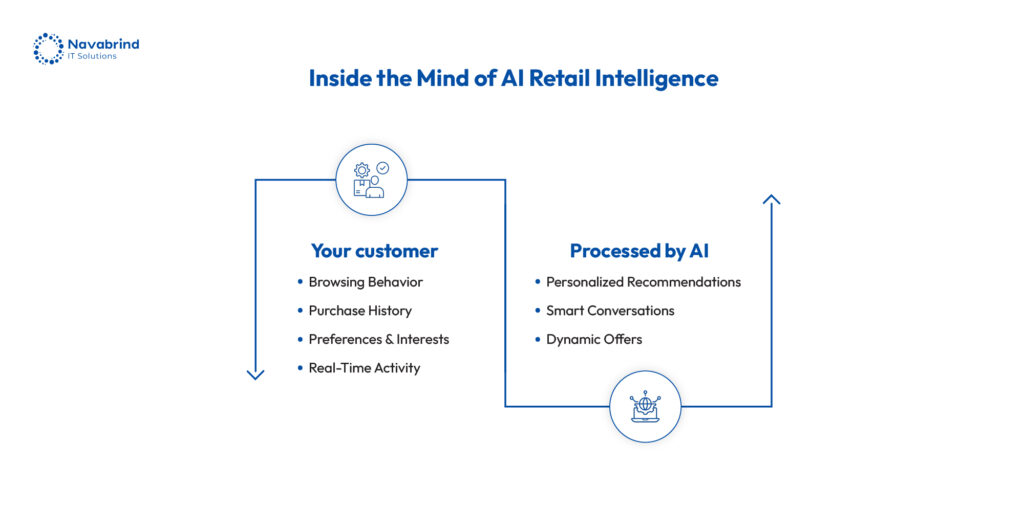
Another component shaping the future of retail is the recommendation engine, the brain behind personalized shopping experiences. By analyzing customer data such as past purchases, browsing history, and preferences, a recommendation engine suggests products that are relevant to each individual shopper. This makes customers feel understood and valued, turning casual browsers into loyal buyers. In 2026, a capable recommendation engine isn’t just an add-on; it is a core strategy for driving retail sales.
This blog post explores how platforms like Odoo ERP are redefining retail through personalized shopping powered by AI. We’ll dive into how AI ecommerce, AI in retail stores, and intelligent recommendation engines are transforming the customer journey. You’ll also discover how to choose the right AI sales tools and upgrade your retail software to meet current demands.
In a world where customers expect brands to “just get them,” the question is no longer whether to adopt AI but how quickly you can implement the right strategy. Because in 2026, personalization isn’t the future of retail present.
Understanding the AI Shopping Assistant: The New Face of Retail Customer Service
An AI shopping assistant is an intelligent, AI-powered virtual guide designed to make shopping easier, faster, and more personalized. It helps customers discover products, answer questions, and complete purchases with minimal effort. These assistants come in multiple forms, including chatbots, voice assistants, visual search tools, and personalized shopping interfaces. Unlike traditional FAQ bots that respond only to basic queries, an AI shopping assistant is proactive, context-aware, and capable of handling complex, human-like interactions. It understands customer intent, learns from behavior, and adapts responses to deliver a more engaging and relevant shopping experience.
For retail customers, an AI shopping assistant acts like a knowledgeable store associate available around the clock. It provides instant support without wait times, guiding users through their shopping journey at any hour. By analyzing browsing behavior, purchase history, and personal preferences, it offers tailored product recommendations that feel relevant. Through conversational commerce, customers can interact naturally, asking questions, comparing products, or seeking advice just as they would in a physical store. It also reduces friction by instantly answering common concerns around sizing, compatibility, and product availability, making the buying process smoother and more convenient.
From a business perspective, AI shopping assistants deliver measurable impact. They boost customer confidence by providing detailed, accurate product information, thereby reducing uncertainty and lowering return rates. Retailers benefit from higher conversion rates as customers are more likely to complete purchases when guided effectively.
Personalized recommendations often increase average order value. Businesses implementing AI shopping assistants see improved customer satisfaction, stronger engagement, and a more efficient, scalable way to deliver exceptional shopping experiences.
The Big Picture: How Artificial Intelligence Is Transforming E-Commerce in 2026
AI is redefining retail with data-driven systems that enhance customer experience. One impactful change is hyper-personalization, where AI enables real-time content, pricing, and product recommendations tailored to each customer’s behavior, preferences, and purchase history. This makes every interaction feel unique and relevant. Alongside this, visual commerce is gaining momentum, allowing customers to search for products using images and even experience virtual try-ons powered by advanced image recognition technology.
AI helps retailers anticipate demand before customers actively search for products, reducing stockouts and overstock situations. At the same time, dynamic pricing optimizes product prices in real time based on demand, competitor pricing, and customer segments, maximizing profitability while staying competitive. These capabilities allow businesses to respond to market changes without manual intervention.
AI also plays a role in improving customer support and content creation. Automated AI agents can handle 70–80% of routine customer inquiries, providing quick, consistent responses while reducing the workload for human teams. Additionally, generative AI enables the creation of product descriptions, marketing content, and personalized emails at scale, helping brands maintain consistency and relevance across all communication channels.
Behind the Scenes: How Artificial Intelligence Improves Retail Business Operations
AI’s impact on retail extends beyond customer-facing experiences, as reshaping backend retail software and business operations. One transformation is seen in inventory management and demand forecasting. AI-driven systems analyze historical data, seasonal trends, and real-time sales patterns to predict demand with greater accuracy than traditional methods. This reduces stockouts, which can lead to lost sales, and prevents overstock, which ties up capital and increases storage costs. With automated replenishment, retailers can ensure that inventory levels are continuously optimized based on real-time demand.
AI is also advancing supply chain optimization and workforce management. Intelligent systems can detect bottlenecks in logistics, predict potential delays, and recommend alternative routes or solutions before disruptions occur. This improves operational efficiency and strengthens collaboration with suppliers through data-driven insights. At the same time, AI-powered workforce management tools help businesses align staffing levels with predicted foot traffic and order volumes. By analyzing customer behavior patterns, these systems create optimized schedules that reduce labor costs while maintaining service standards.
Risk management and fraud detection have also become more advanced with the integration of AI. Machine learning models monitor transactions in real time, identifying unusual patterns or suspicious behavior that may indicate fraud. This proactive approach helps retailers minimize chargebacks, protect revenue, and maintain customer trust. Unlike traditional systems, AI can adapt and improve over time, making it increasingly effective at detecting new and evolving threats.
Finally, AI is transforming merchandising, assortment planning, and pricing optimization key drivers of profitability in retail. By analyzing sales data, customer preferences, and regional trends, AI enables retailers to curate product assortments that are tailored to specific locations and target audiences. This level of localized merchandising ensures that the right products are available at the right place and time. Dynamic pricing algorithms allow businesses to adjust prices in real time based on demand, competition, and customer segments.
The Platform Battle: How Does Odoo AI Compare to Shopify AI for Retail Personalization?
|
Comparison Dimension
|
Odoo AI
|
Shopify AI (Shopify Magic / Sidekick)
|
| |
|
|
|
Scope
|
Odoo AI is part of a full-scale, all-in-one business suite that connects e-commerce with backend operations like POS, inventory, CRM, accounting, marketing automation, and even manufacturing. This means AI is used not only for selling but also for managing the entire business lifecycle in a single system.
|
Shopify AI is built for e-commerce businesses, focusing on improving the online storefront experience. While it offers useful AI features, they are layered on top of the platform and do not extend deeply into backend operations like supply chain or manufacturing.
|
|
Personalization Depth
|
Odoo AI uses a unified database that connects all customer interactions, sales, service, marketing, and operations. This allows for end-to-end personalization such as tailored recommendations, targeted campaigns, and customized pricing based on complete customer profiles.
|
Shopify AI focuses on storefront personalization, such as product suggestions and content generation. However, personalization is limited to customer-facing interactions and lacks deeper integration with operational data.
|
|
Integration
|
Odoo offers native integration across its modules, meaning AI can work without third-party tools. Businesses can manage everything within one platform, reducing complexity, cost, and data silos.
|
Shopify provides built-in AI features, but for more advanced capabilities or integrations (like CRM or ERP-level workflows), businesses often rely on third-party apps, which can increase costs and create fragmented data systems.
|
|
Recommendation Engine
|
Odoo includes a built-in AI-powered recommendation engine that uses data from across the business, such as sales trends, inventory, and customer behavior, to deliver accurate and contextual product suggestions.
|
Shopify offers AI-driven recommendations, but advanced features often require Shopify Plus or third-party applications, making it less unified compared to Odoo’s native approach.
|
|
Pricing Model
|
Odoo follows a transparent subscription-based pricing model with no transaction fees. AI capabilities are included within the platform, making it cost-effective and predictable as the business scales.
|
Shopify uses a combination of monthly subscription fees and transaction-based charges. Advanced AI features may require additional paid apps, increasing the total cost of ownership over time.
|
|
Flexibility
|
Odoo’s open-source architecture allows businesses to customize workflows, extend AI models, and adapt the platform to specific industry needs. This makes it flexible for growing or complex businesses.
|
Shopify operates within a controlled ecosystem. While it is user-friendly, customization is limited to what the platform and its app marketplace allow, restricting flexibility for unique or complex requirements.
|
|
Best Fit
|
Best suited for businesses looking for a unified retail software solution that integrates e-commerce with backend operations, enabling end-to-end digital transformation powered by AI.
|
Ideal for small to mid-sized businesses that want a quick, easy-to-use e-commerce platform with AI enhancements, especially those focused on direct-to-consumer sales without complex backend needs.
|
The Revenue Engine: What Is the Role of AI in E-Commerce Sales Growth?
AI analyzes customer behavior across the shopping journey to identify friction points such as drop-offs, slow decision-making, or confusing navigation. By delivering personalized content, product recommendations, and real-time assistance, AI helps reduce bounce rates and guides customers toward checkout, significantly increasing conversion rates.
Another advantage of AI is its ability to boost average order value (AOV). Through intelligent cross-selling and upselling, AI sales tools recommend complementary or higher-value products based on a customer’s browsing and purchase history. It also enables smart product bundling, where items frequently bought together are suggested as a package, encouraging customers to spend more in a single transaction. At the same time, AI contributes to customer lifetime value (CLV) by identifying high-value customers and predicting future buying behavior. Retailers can then run personalized re-engagement campaigns, ensuring customers return more frequently and remain loyal over time.
AI also improves acquisition efficiency and reduces operational losses. By analyzing data from past campaigns, AI optimizes ad spend and targets the most likely-to-convert customer segments, lowering customer acquisition costs. On the post-purchase side, AI helps reduce return rates by providing accurate product information, sizing guidance, and even virtual try-on experiences. This minimizes mismatched expectations and enhances customer satisfaction. The results are measurable and impactful—retailers using AI sales tools report conversion rate increases of 15–30%, AOV growth of 10–20%, and return rate reductions of 25–40%, making AI a critical investment for sustainable retail growth.
The Power of Personalization: How Do AI Product Recommendations Increase E-Commerce Sales?
At its core, a recommendation engine uses machine learning to analyze customer behavior such as browsing history, past purchases, cart activity, and patterns from similar users. These systems continuously learn and evolve in real time, becoming more accurate with every interaction. Different types of recommendations enhance the shopping experience, including personalized suggestions tailored to individual preferences, contextual recommendations based on current session activity, collaborative filtering like “customers who bought this also bought,” and trend-based suggestions highlighting popular or in-demand products.
These recommendations are placed across multiple touchpoints to influence customer decisions. You’ll see them on product detail pages, where they suggest similar or complementary items, and in the shopping cart or checkout stage to encourage last-minute additions. They also appear in post-purchase emails, category pages, homepages, and personalized email campaigns, ensuring consistent engagement throughout the customer journey. By integrating into these moments, recommendation engines guide customers without being intrusive.
The revenue impact of recommendation engines is well-documented. For example, a large portion of Amazon’s revenue estimated at around 35% is driven by AI-powered recommendations. Across the industry, retailers report that 10–30% of their sales are influenced by these systems. They not only increase average order value (AOV) by suggesting higher-value or complementary products but also improve product discovery.
Beyond products, AI recommendation engines extend to content, bundles, services, and even replenishment timing for consumables or subscriptions. Successful strategies combine AI automation with human curation to ensure recommendations remain relevant while maintaining the brand’s voice and quality standards.
AI in Physical Retail: Bringing Digital Intelligence to Brick-and-Mortar
AI in retail stores is redefining the in-store experience, turning traditional shopping environments into smart, data-driven spaces that match the convenience of online shopping. One noticeable innovation is the use of computer vision and smart checkout systems. AI-powered cameras can identify the products customers pick up, enabling frictionless, cashierless checkout. What was once seen in Amazon Go stores is now becoming accessible to mainstream retailers.
Beyond checkout, AI is transforming how retailers understand customer behavior inside stores. Through in-store analytics, businesses can track foot traffic patterns, dwell time, and even generate heat maps that show which areas attract attention. These insights help retailers optimize store layouts, improve product placement, and design more engaging shopping experiences.
AI is also empowering store associates through assisted selling. With AI-powered devices like tablets, staff can instantly access customer purchase history, preferences, and real-time inventory data across store locations. This allows them to provide personalized recommendations and service, similar to the experience customers receive online. At the same time, inventory management is becoming more accurate with the use of RFID combined with AI, reducing stock discrepancies and enabling automated cycle counting.
Finally, AI enables unified commerce by connecting online and offline channels. Customers can buy online and return in-store, access endless aisle kiosks for out-of-stock items, and enjoy consistent loyalty programs across touchpoints. This convergence of AI in retail stores with AI ecommerce creates a smooth, omnichannel experience that customers expect where the line between digital and physical shopping no longer exists.
Implementation Roadmap: How to Integrate AI into Your Retail Business
Successfully implementing AI in retail requires a step-by-step approach that aligns technology with business goals.
Phase 1: Assessment and Strategy is the foundation. Retailers must first audit their existing retail software to understand current capabilities and gaps. This helps identify high-impact AI use cases such as personalization, inventory optimization, and automated customer service. At the same time, it’s essential to define clear success metrics like conversion rates, average order value (AOV), and operational efficiency.
Phase 2: Platform Selection focuses on choosing the right technology stack. Businesses need to evaluate whether a unified platform like Odoo, which integrates multiple functions into one system, is more suitable than a best-of-breed approach that combines separate tools. Key considerations include integration complexity, scalability, and total cost of ownership.
Phase 3: Data Foundation requires retailers to clean, organize, and consolidate their customer, product, and transaction data. Since AI models rely heavily on data quality, this step is critical.
Phase 4: Pilot and Scale involves starting small and scaling strategically. Instead of implementing multiple AI solutions at once, businesses should begin with a single high-impact application, such as a recommendation engine. By measuring performance, analyzing outcomes, and refining the model, retailers can build confidence before expanding AI across other areas.
Phase 5: Continuous Optimization ensures long-term success. AI is not a one-time implementation, it requires regular monitoring, retraining, and improvement. Businesses must continuously evaluate performance against defined goals and adapt strategies as market conditions and customer behaviors evolve.
The Future: What's Next for AI in Retail?
The next phase of AI in retail goes beyond automation to create deeply personalized, intelligent, and self-operating retail ecosystems. As we move beyond 2026, several emerging trends will redefine how businesses interact with customers and manage operations.
1. Generative AI for Personalization
Generative AI is set to take personalization to another level. Instead of simply recommending products, AI will create unique content, images, offers, and even entire shopping experiences tailored to each individual in real time. For example, customers may see dynamically generated product pages, personalized ads, or curated collections designed specifically for their tastes.
2. Autonomous Commerce
Autonomous commerce represents a shift where AI agents act on behalf of customers. These intelligent systems will be able to complete purchases, manage subscriptions, reorder products, and even handle returns without human intervention. For instance, an AI assistant could automatically reorder groceries when supplies run low or choose the best deals across platforms.
3. Emotion AI
Emotion AI focuses on understanding customer sentiment during interactions. By analyzing tone, text, facial expressions, or behavior, AI can detect emotions such as frustration, excitement, or hesitation. Retailers can then adjust responses in real time offering discounts, assistance, or alternative suggestions. This creates empathetic and human-like interactions.
4. AI-Powered Sustainability
Sustainability is becoming a priority, and AI canl play a role in achieving it. AI systems will optimize inventory, reduce overproduction, and streamline supply chains to minimize waste and carbon footprint. Retailers can predict demand accurately, avoid excess stock, and make environmentally responsible decisions.
5. Voice Commerce Maturity
Voice commerce is evolving from simple commands to complex, conversational shopping experiences. Advanced AI will enable customers to browse, compare, and purchase products through voice interactions. These systems will understand context, preferences, and intent, making conversations feel natural and intuitive. As voice assistants become more sophisticated, they will act as full-fledged shopping companions.
AI is transforming facets of retail from customer-facing experiences to backend operations creating a smarter, faster, and more personalized ecosystem. From AI shopping assistants that guide customers in real time to intelligent systems managing inventory and supply chains, the impact is both visible and behind the scenes. The question is no longer whether businesses should adopt AI, but how quickly and strategically they can implement it to stay competitive in an evolving market.
One advantage of AI lies in its ability to enhance customer engagement and drive revenue. AI shopping assistants provide personalized, around-the-clock support, improving customer satisfaction and reducing friction in the buying journey. At the same time, AI ecommerce capabilities help increase conversion rates, boost average order value (AOV), and maximize customer lifetime value through targeted recommendations and insights. Recommendation engines, in particular, have proven to be revenue drivers, enabling customers to discover relevant products while encouraging higher spending.
AI is also bridging the gap between physical and digital retail through innovations in AI in retail stores, creating omnichannel experiences. Unified platforms like Odoo take this a step further by integrating AI across the retail operation—from sales and marketing to inventory and customer management. This approach allows businesses to operate more efficiently while delivering consistent experiences across touchpoints. Retailers who treat AI as a strategic priority will not only keep up with change but will lead the next generation of commerce.
Frequently Asked Questions
1. What is an AI Shopping Assistant and How Does It Help Retail Customers?
An AI shopping assistant is a virtual, AI-powered tool that helps customers discover products, answer queries, and complete purchases through personalized, real-time interactions. It improves the shopping experience by offering around-the-clock support, understanding customer preferences, and providing tailored recommendations, while also reducing friction through instant answers on product details, sizing, and availability—making shopping faster, easier, and more engaging.
2. How is Artificial Intelligence Transforming E-Commerce in 2026?
In 2026, artificial intelligence is transforming e-commerce by enabling hyper-personalization, real-time recommendations, dynamic pricing, and automated customer interactions. AI helps businesses understand customer behavior, optimize marketing strategies, and deliver shopping experiences across channels.
3. How Does Artificial Intelligence Improve Retail Business Operations?
AI enhances retail operations by optimizing inventory management, improving demand forecasting, streamlining supply chains, and automating routine tasks. It reduces inefficiencies by accurately predicting demand, minimizing stock issues, and enabling better workforce planning.
4. How Does Odoo AI Compare to Shopify AI for Retail Personalization?
Odoo AI offers a integrated approach to retail personalization by leveraging unified data across sales, inventory, CRM, and operations, enabling end-to-end personalized experiences. In contrast, Shopify AI focuses on storefront personalization and often relies on third-party apps for deeper capabilities, making Odoo a better fit for businesses seeking an all-in-one AI-driven retail solution.
5. What is the Role of AI in E-Commerce Sales Growth?
AI plays a role in e-commerce sales growth by improving conversion rates, increasing average order value, and enhancing customer retention. It achieves this through personalized recommendations, targeted marketing campaigns, predictive analytics, and optimized pricing strategies, all of which help businesses attract, convert, and retain customers.
6. How Do AI Product Recommendations Increase E-Commerce Sales?
AI product recommendations increase e-commerce sales by suggesting relevant products based on customer behavior, preferences, and purchase history. These recommendations encourage cross-selling and upselling, improve product discovery, and create a personalized shopping experience, which leads to higher engagement, increased order values, and improved sales performance.
Schedule a conversation with us now!
Related Articles








 Post
Post Post
Post