Manufacturing in 2026 isn’t what it used to be, and that’s exactly why businesses are rethinking how they operate. Today’s factories are navigating a world of constant change, for example unpredictable supply chains, rising customer expectations, and the growing need for instant, data-driven decisions, which is no longer enough to simply produce goods efficiently; manufacturers must be agile, connected, and intelligent in how they plan, produce, and deliver.
Many companies are feeling the pressure because their legacy systems just can’t keep up. Outdated tools often operate in silos, lack real-time visibility, and require manual intervention, slowing down operations and increasing the risk of costly errors. In a fast-moving environment, these limitations can directly impact profitability and growth.
This is where the shift toward smarter, more integrated solutions comes in. The convergence of manufacturing resource planning (MRP), advanced manufacturing software, and artificial intelligence is redefining what’s possible on the factory floor. Platforms like Odoo enable manufacturers to bring everything from inventory and production to quality control and analytics into a single unified system. When combined with AI, these tools don’t just manage operations; they optimize them by predicting demand, identifying inefficiencies, and enabling proactive decision-making.
This blog post is designed to help you understand this transformation in a practical way. Whether you’re exploring ERP solutions for the first time or looking to upgrade your current system, we’ll walk you through what to consider, how to choose the right platform, and what implementation really looks like in today’s landscape. Importantly, we’ll show how AI-powered systems can turn your manufacturing processes into a competitive advantage.
Manufacturing Resource Planning:
Manufacturing Resource Planning (MRP II) is a step beyond basic inventory management as a system designed to plan, coordinate, and control all manufacturing processes. While basic inventory management focuses mainly on tracking stock levels and ensuring materials are available, MRP II connects inventory with production schedules, labor, machinery, and financial planning. It answers not just “what do we have?” but “what do we need, when do we need it, and how do we produce it efficiently?”
This evolution didn’t stop at MRP II. Over time, manufacturers realized they needed even broader visibility across their entire business. This led to the rise of Enterprise Resource Planning (ERP) systems, which integrate manufacturing with finance, procurement, sales, and human resources. In 2026, modern manufacturers rely on ERP platforms like Odoo to go beyond material planning and enable real-time, end-to-end decision-making. With AI layered on top, these systems can predict demand, optimize production schedules, and reduce waste turning operations into a strategic advantage.
At the core of MRP II and modern manufacturing systems are several key components. The Bill of Materials (BOM) defines the raw materials and components required to produce a product. Work orders manage and track production activities, while routing outlines the sequence of operations needed on the shop floor. Capacity planning ensures that machines and labor are utilized efficiently without bottlenecks, and shop floor control provides real-time visibility into production progress. Together, these elements create a synchronized workflow that minimizes delays and maximizes productivity.
What makes today’s manufacturing resource planning software truly powerful is its ability to integrate with other business functions. For example, production plans are directly linked to financial forecasts, helping businesses control costs and improve profitability. Supply chain integration ensures that procurement aligns with production needs, reducing delays and excess inventory. Quality management systems work alongside production to maintain standards and reduce defects, creating a more reliable and efficient operation overall.
Operating without an integrated MRP system can be costly. Manufacturers often face stockouts that halt production, or overproduction that ties up capital in unsold goods. Inefficient processes and a lack of visibility can erode margins over time. By adopting integrated, AI-driven solutions like Odoo, manufacturers in 2026 are not just managing resources, they are building smarter, more resilient factories.
See how Odoo helps furniture businesses manage suppliers and raw materials.
Why Manufacturers Are Moving to Cloud Manufacturing ERP
One of the biggest advantages of Odoo ERP is real-time visibility across multiple facilities and locations. Whether a company operates a single plant or a global network of factories, cloud ERP ensures that data from production, inventory, procurement, and sales is updated instantly. This allows decision-makers to track performance, identify bottlenecks, and make informed choices without delays. With AI integrated into platforms like Odoo, this visibility becomes even more powerful, offering predictive insights such as demand forecasting and production optimization.
Cost is another major factor driving the shift to the cloud. Traditional ERP systems often require significant upfront investments in hardware, infrastructure, and maintenance. In contrast, cloud-based ERP operates on a subscription model, reducing capital expenditure and lowering the total cost of ownership. There’s no need for in-house servers or large IT teams to manage updates and system health, making it especially beneficial for growing manufacturers.
Automatic updates are another key benefit. In a rapidly evolving regulatory and technological landscape, staying compliant and secure is critical. Cloud ERP providers handle regular updates, ensuring that the system is always aligned with the latest standards, security protocols, and features. This not only reduces risk but also allows businesses to continuously benefit from innovation without disruption.
Accessibility is equally important in today’s manufacturing ecosystem. Cloud ERP enables secure access from anywhere, allowing remote teams, suppliers, and field operators to collaborate seamlessly. For example, a production manager can monitor shop floor performance from a mobile device, while suppliers can stay updated on inventory requirements in real time. This level of connectivity enhances coordination and reduces delays across the value chain.
Scalability is where cloud ERP truly shines. As businesses grow from a single plant to multi-location or enterprise-wide operations the system can easily expand to accommodate increased data, users, and complexity. Odoo’s modular approach allows manufacturers to add functionalities as needed, ensuring the system evolves alongside the business.
From Hype to Reality
AI is rapidly transforming manufacturing operations in 2026, turning traditional factories into intelligent, data-driven environments. When combined with platforms like Odoo, AI doesn’t just support manufacturing, it actively enhances overall performance across the production lifecycle.
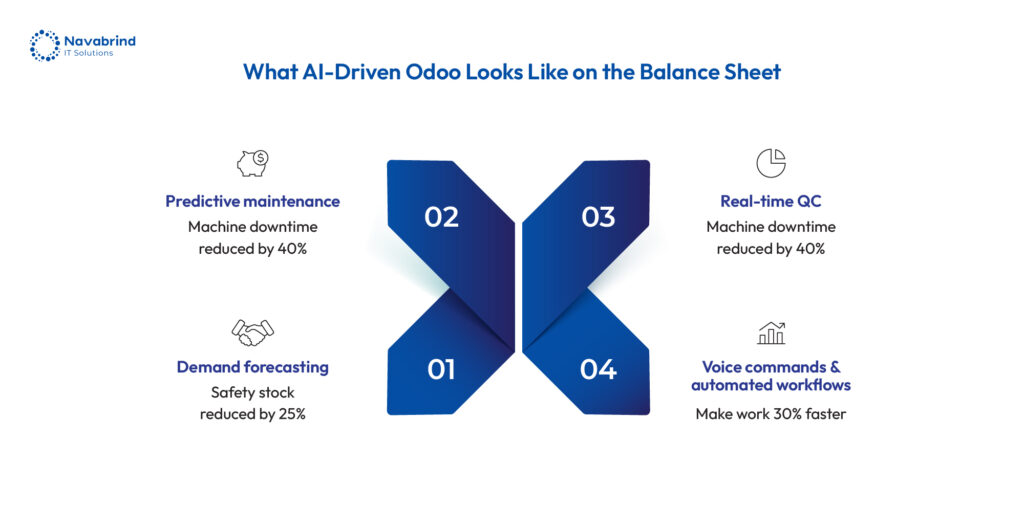
An impactful applications of AI is predictive maintenance. Instead of reacting to machine breakdowns, AI analyzes historical and real-time equipment data to predict when a failure is likely to occur. This allows manufacturers to schedule maintenance proactively, reducing unplanned downtime and avoiding costly production disruptions. With Odoo’s integrated system, these insights can be directly linked to maintenance schedules, spare parts inventory, and workforce planning.
Demand forecasting is another area where AI delivers significant value. By analyzing market trends, historical sales data, and external signals, AI helps manufacturers align production with actual demand. This reduces the risk of overproduction or stockouts, ensuring optimal inventory levels. In a volatile market, this level of precision enables businesses to remain agile while protecting margins.
Quality control has been transformed by AI technologies such as computer vision and anomaly detection. AI systems monitor production lines in real time, identify defects This not only improves product quality but also reduces waste and rework. Integrated with Odoo, quality alerts can trigger immediate corrective actions, ensuring consistent standards across operations.
Production scheduling becomes far more efficient with AI-powered optimization. Traditional scheduling methods often struggle with complex variables such as machine availability, workforce capacity, and order priorities. AI can process these variables generating optimized production plans
Beyond operations, AI is reshaping how products are designed and developed. Generative design tools allow manufacturers to input requirements, such as strength, weight, and material constraints, and let AI suggest the most efficient part geometries.
Digital twins take this a step further by creating virtual replicas of physical systems. Manufacturers can simulate entire production processes before implementing them on the shop floor, identifying potential inefficiencies or risks in advance. When integrated with Odoo, these simulations can be aligned with real-time data, creating a continuous feedback loop for improvement.
Generative AI is also streamlining documentation and workforce support. From automatically generating work instructions to assisting operators with real-time guidance, AI reduces dependency on manual processes and enhances productivity. This is especially valuable in complex manufacturing environments where accuracy and consistency are critical.
In the context of Odoo Manufacturing, AI acts as a powerful layer that transforms data into actionable intelligence. Together, they enable smart factories that are not only automated but also adaptive capable of learning, improving, and scaling in a rapidly evolving industrial landscape.
The Rise of Smart and Automated Factories
Smart manufacturing software in 2026 is defined by three core pillars: connectivity, data integration, and real-time decision making. Modern factories are no longer isolated production units they are digitally connected ecosystems where machines, systems, and people continuously exchange data. ERPs like Odoo play a central role in this transformation by unifying information from across the organization and enabling manufacturers to act instantly on what’s happening on the shop floor.
To understand the current landscape, it’s important to distinguish between factory automation software and production automation software. Factory automation operates at the machine level controlling equipment, sensors, and processes through systems like PLCs and SCADA. It focuses on executing tasks efficiently within a specific production environment. On the other hand, production automation software operates at a higher level, orchestrating workflows across departments, managing orders, and aligning production with business goals.
Modern automation platforms bring together a wide range of capabilities one such is SCADA integration and IoT device connectivity. By connecting machines and sensors to centralized systems, manufacturers can monitor performance in real time, detect anomalies, and make data-driven decisions.
Automated material tracking and traceability are other key features. From raw materials to finished goods, every movement can be tracked digitally, ensuring transparency and compliance. This is particularly valuable in industries with strict quality and regulatory standards. With Odoo, this data is integrated directly into inventory and production modules.
Workflow triggers based on production events enhance efficiency. For example, when a production stage is completed, the system can automatically trigger the next steps, such as quality checks, packaging, or inventory updates. This reduces manual intervention and ensures an uninterrupted workflow. AI can enhance these triggers by identifying patterns and optimizing processes over time.
The shift toward paperless shop floors is another defining trend. Digital work instructions replace traditional paper-based processes, providing operators with clear, real-time guidance. With mobile and tablet access, operators can interact with the system directly on the shop floor.
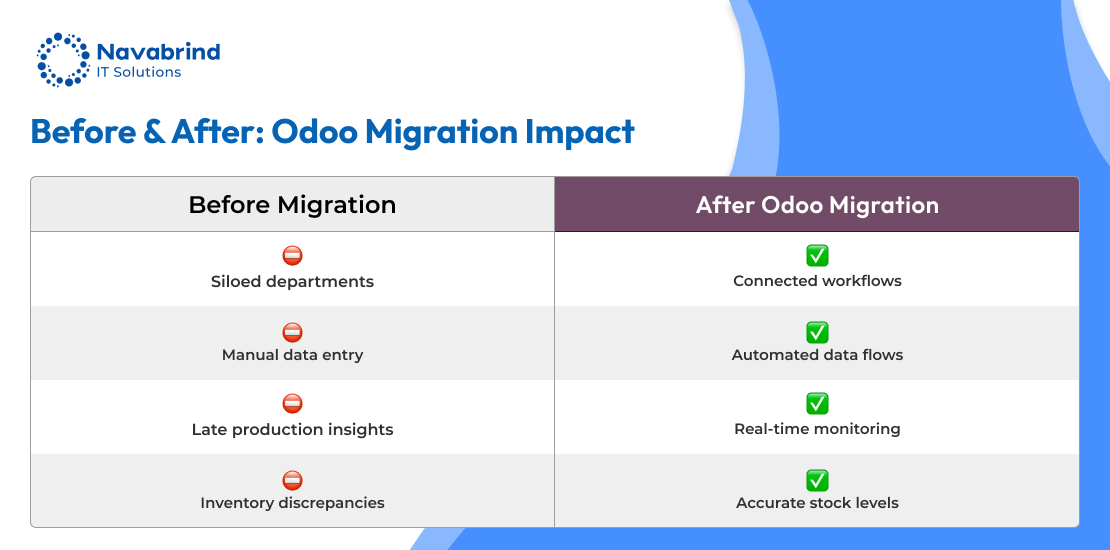
Despite these advancements, many manufacturers still struggle with “automation islands”, disconnected systems that operate independently without sharing data. This is where integrated ERP systems like Odoo become essential. By bridging the gap between machine-level automation and enterprise-level visibility, Odoo creates a unified platform where all data flows smoothly. Production data feeds into financial reports, inventory updates align with procurement, and quality insights inform strategic decisions.
Deep Dive: What Does the Odoo Manufacturing Module Offer?
In 2026, Odoo emerged as a powerful, unified platform that goes far beyond traditional manufacturing resource planning software. It brings together critical functions, such as production, inventory, quality, maintenance, and finance, into a single, connected ecosystem. For manufacturers moving toward smart factory models, Odoo serves as the digital backbone, ensuring data flow and enabling real-time decision-making. When combined with AI, it transforms from a management tool into an intelligent system that actively optimizes operations.
At the core of Odoo’s manufacturing capabilities are robust and flexible features. Work Orders allow manufacturers to create, manage, and track production activities with real-time status updates. This ensures complete visibility on the shop floor, enabling teams to monitor progress and quickly respond to delays or issues.
The Bill of Materials (BOM) feature supports multi-level structures, making it ideal for complex products. With version control, alternative components, and engineering change management, manufacturers can adapt quickly to design updates without disrupting production.
Routing in Odoo helps define the exact sequence of operations, work centers, and time required for each step. This not only improves production planning but also ensures accurate costing by tracking labor and machine usage.
MRP calculations are automated, taking into account demand forecasts, lead times, and current inventory levels. Odoo generates procurement suggestions, ensuring that materials are available when needed without overstocking.
Quality control is fully integrated into the system, with checkpoints at every stage from raw material receipt to in-process checks and final inspection. This ensures consistent product quality and reduces the risk of defects reaching customers.
Odoo also integrates Product Lifecycle Management (PLM), enabling complete traceability from design to manufacturing. This ensures that engineering changes are reflected instantly in production processes. IoT integration further enhances capabilities by connecting machines directly to the system, allowing automatic data collection, real-time monitoring of Overall Equipment Effectiveness (OEE), and even triggering work orders based on machine activity.
Maintenance features support both preventive and corrective scheduling, linked directly to equipment usage. This helps reduce downtime and extend machine life.
Odoo serves as smart manufacturing software and a complete business management platform. By unifying operations and integrating AI-driven insights, it empowers manufacturers to build smarter, more agile factories that can adapt, scale, and thrive in a competitive landscape.
The Critical Question: What Is the Best ERP for Manufacturing in 2026?
Choosing the “BEST” ERP for manufacturing in 2026 isn’t about picking the most well-known name in the market, but about finding the right fit for a company’s size, operational complexity, and future growth plans. What works for a global enterprise with complex processes may not suit a mid-sized manufacturer aiming for agility, as smart factories become the norm, businesses are prioritizing flexibility, scalability, and real-time intelligence
Traditionally, ERP solutions have been grouped into tiers. Tier 1 platforms like SAP and Oracle are known for their extensive capabilities and global reach. They are often chosen by large enterprises with complex, multi-country operations. Tier 2 providers such as Infor and Epicor cater to mid-sized businesses, offering industry-specific solutions with relatively lower complexity. However, both tiers can pose challenges, namely high implementation costs, long deployment timelines, and limited flexibility to adapt to rapidly changing business needs.
This is where open source, cloud-native platforms like Odoo gain significant traction. Odoo emerges as a preferred choice for both mid-market and enterprise manufacturers because it aligns closely with the needs of smart manufacturing in 2026.
One of Odoo’s biggest strengths is its flexibility. Its modular architecture allows manufacturers to start with core functionalities, such as MRP, and gradually expand into areas such as inventory, quality, maintenance, finance, and more. This means businesses can implement what they need while keeping the door open for future growth.
Another key advantage is the TCO. Unlike traditional ERPs that often rely on expensive per-user licensing models, Odoo offers a cost-effective structure. Combined with faster implementation timelines and reduced dependency on heavy customization, this results in quicker time-to-value.
Odoo also stands out with its technology stack. Built as a API-first platform, it integrates with other systems and supports emerging technologies like AI and IoT. This makes it an ideal foundation for smart factory initiatives, where real-time data, automation, and predictive insights are essential.
Odoo benefits from a strong community and ecosystem. With a vast library of third-party connectors and industry-specific modules, manufacturers can tailor the platform to their requirements without building everything from scratch.
In the era of Odoo Manufacturing + AI, the best ERP is one that evolves with the business. Odoo’s combination of flexibility, affordability, and modern capabilities positions it as a powerful enabler for manufacturers looking to build smarter, more connected, and future-ready operations
The Implementation Reality: Timelines, Risks, and Success Factors
ERP implementation timelines in manufacturing vary depending on the scope, level of customization, and data complexity. In 2026, with the rise of smart manufacturing and AI-driven systems like Odoo, the focus is not just on implementation speed, but also on how quickly businesses can start seeing real value.
The process begins with Phase 1: Discovery and Requirements, which takes around 4–6 weeks. During this stage, businesses define their goals, map existing processes, and identify gaps. This phase is critical because a clear roadmap ensures smoother execution in later stages.
Phase 2: Configuration and Data Migration, Here, the ERP system is configured to meet business needs, and existing data, including inventory, suppliers, and production records, is cleaned and migrated. Data quality plays a huge role at this stage.
Phase 3: Testing and User Training, This is where the system is tested, and employees are trained to use it effectively. Strong user adoption is essential without it, even the best ERP system can fail to deliver results.
Finally, Phase 4: Go-Live and Hypercare, involves launching the system and providing immediate support to resolve any issues. This ensures a smooth transition with minimal disruption to operations.
Several factors can either accelerate or delay implementation. Clean and well-structured data speeds things up, while poor data quality creates bottlenecks. Scope creep, adding too many features mid-project, can extend timelines, and weak change management often leads to resistance from employees working with experienced implementation partners makes a significant difference.
Companies like Navabrind IT Solutions specialize in Odoo implementations and follow proven methodologies to deliver faster time-to-value. We are also a certified Odoo Gold partner with a presence in the US, UK, and India. Our expertise helps small, large, and medium-sized companies, adopt the latest version of Odoo and implement AI-powered workflows.
The Partner Difference: Why Implementation Expertise Matters
In any ERP journey, the real difference between success and failure isn’t just the software, it is the implementation partner. Even a powerful ERP, such as Odoo, can fall short if it is are not aligned properly with business processes. The gap between what the software can do and the outcomes a business actually achieves is filled by the expertise, strategy, and execution of a certified implementation partner, such as Navabrind IT Solutions.
One of the first things to look for in an implementation partner is manufacturing domain expertise. Manufacturing has different production models such as discrete, batch, and repetitive processes. A partner who understands these nuances can design a system that fits operational realities rather than forcing a generic setup.
Another key factor is a proven methodology for data migration and change management. Data is the backbone of any ERP system, and accurate migration, especially of transactional data is essential for smooth operations. At the same time, ERP implementation is not just a technical shift, but a cultural one. Employees need to adapt to new workflows, and a structured change management approach ensures higher adoption and minimal resistance.
Post-go-live support and continuous improvement are equally important. ERP implementation doesn’t end at launch; in fact, that’s where optimization begins. A reliable partner will provide ongoing support, monitor system performance, and help businesses refine processes over time.
This is where Navabrind IT Solutions stands out. With deep experience across various manufacturing environments, including discrete, batch, and repetitive production, we bring practical insights that go beyond theory. Our approach ensures Odoo is configured to align with real-world manufacturing challenges.
Navabrind IT Solutions offers end-to-end services, covering everything from initial requirements gathering to system configuration, deployment, and post-go-live support. Our approach eliminates gaps across implementation phases and ensures consistency throughout the project lifecycle.
A key strength of our methodology is our focus on minimizing disruption to ongoing production. Manufacturing businesses cannot afford downtime, and we at Navabrind IT Solutions plan migrations to ensure continuity. This allows our clients to transition smoothly without impacting daily operations.
We emphasize tailored configurations balancing industry best practices with each company’s operational needs. Instead of over-customizing or forcing rigid templates, we create solutions that are both efficient and adaptable.
In the context of Odoo Manufacturing + AI, the right implementation partner transforms technology into tangible business value, helping manufacturers build smarter, more resilient, and future-ready operations
The Future: What's Next for Manufacturing Technology?
In 2026, manufacturing is undergoing a major transformation as traditional systems converge into unified digital platforms. What were once separate layers of manufacturing resource planning, smart manufacturing software, and factory automation are now tightly integrated into a single ecosystem. ERPs like Odoo are at the center of this shift, connecting everything from shop floor machines to enterprise-level decision-making. With AI embedded into these systems, manufacturers are moving from reactive operations to predictive and autonomous environments.
One of the most exciting trends shaping the future is the rise of autonomous supply chains. AI-driven systems can now predict demand fluctuations, automatically adjust procurement, and optimize logistics without constant human intervention. This reduces delays, minimizes costs, and creates a more resilient supply chain.
Another key advancement is edge computing, which enables real-time data processing directly at the source such as machines and sensors on the shop floor. Instead of relying solely on centralized systems, manufacturers can make instant production decisions, improving speed and efficiency while reducing latency.
Sustainability tracking is also becoming a core part of ERP systems. Manufacturers are under increasing pressure to monitor their environmental impact, from energy consumption to waste management. Modern platforms integrate sustainability metrics into daily operations, helping businesses meet regulatory requirements and align with global ESG goals.
Augmented reality (AR) is transforming maintenance and workforce training. Technicians can use AR tools to visualize machine components, follow step-by-step repair instructions, and reduce downtime. For operators, AR-based training improves learning speed and accuracy, especially in complex production environments.
To prepare for this next wave of innovation, manufacturing organizations must adopt a forward-thinking approach. This includes investing in cloud-based ERPs embracing AI-driven insights, and fostering a culture of continuous learning and adaptability. The future of manufacturing isn’t just automated, it is evolving as the intelligent, connected, and constantly improving.
From Isolated Systems to Intelligent Integration: A Blueprint for 2026
Modern manufacturing in 2026 demands more than isolated systems it requires a fully integrated approach that combines ERP, AI-driven insights, and automation-ready infrastructure. Businesses that succeed today are those that can connect their operations end-to-end, gain real-time visibility, and make faster, data-backed decisions. Platforms like Odoo enable this transformation by unifying production, inventory, quality, and finance into a single, intelligent system.
Cloud manufacturing ERP is no longer a “nice-to-have” it has become the foundation for staying competitive. It offers the flexibility, scalability, and accessibility needed to adapt to changing market demands, while also supporting advanced technologies like AI and IoT. Without it, manufacturers risk falling behind in efficiency, responsiveness, and innovation.
However, choosing the best ERP for manufacturing in 2026 goes beyond just comparing features. Success depends on selecting the right implementation partner and approach. A well-executed implementation ensures that the system aligns with your business goals and delivers measurable value.
The next step is simple: assess your current systems, identify gaps, and define your priorities. With the right strategy and support from experts like Navabrind IT Solutions, you can unlock the full potential of Odoo and build a smarter, future-ready manufacturing operation
Frequently Asked Questions
1.What is the best ERP for manufacturing in 2026?
The best ERP for manufacturing in 2026 depends on your business size, complexity, and future growth plans. Enterprise solutions such as SAP and Oracle are well-suited to large-scale operations, while flexible ERPs like Odoo are ideal for growing manufacturers.
Cloud-based, AI-enabled ERP systems are now essential for real-time visibility and smarter decision-making. Odoo stands out for its modular approach, affordability, and easy integration with AI and IoT. The best ERP is one that fits your needs and is implemented effectively for long-term value
2.How does cloud-based ERP benefit manufacturing companies?
Cloud-based ERPs empower manufacturing companies with agility and scalability. Unlike rigid on-premise systems that require high capital expenditure and lengthy implementation cycles, cloud ERP allows manufacturers to quickly deploy new modules to respond to fluctuating demand or supply chain disruptions. The cloud architecture enables real-time data synchronization across multiple plants, warehouses, and sales channels, ensuring that a production manager in one country and a procurement officer in another are working from the same single source of truth. Manufacturers can scale operations up or down without worrying about server capacity, allowing them to experiment with new business models like “mass customization” or “direct-to-consumer” fulfillment with minimal financial risk.
By leveraging the cloud’s computational power, Cloud-based ERPs can integrate AI & ML to analyze historical production data alongside real-time sensor inputs. This facilitates true predictive maintenance, alerting teams to potential machine failures before they cause downtime. A cloud ERP enhances supply chain resilience through enhanced visibility. Manufacturers can identify bottlenecks and simulate “what-if” scenarios to mitigate risks like material shortages. For industries facing tight margins, this shift from siloed data to interconnected intelligence results in lower operational costs, higher equipment uptime, and the ability to deliver higher-quality products through stricter, digitally enforced quality-control protocols.
3.How does AI software improve manufacturing operations?
AI software improves manufacturing operations by shifting the paradigm from reactive problem-solving to autonomous, predictive optimization across the entire production lifecycle. Unlike traditional automation that follows static instructions, AI continuously ingests data from IoT sensors, historical production records, and supply chain inputs to dynamically optimize machine parameters, detect microscopic quality defects that elude the human eye, and orchestrate complex production schedules in real-time to accommodate machine downtime or raw material delays. This intelligence enables self-correcting factories where equipment predicts its own maintenance needs to eliminate unplanned stoppages, computer vision systems automatically reject defective units before value is added downstream, and generative AI accelerates product design by simulating thousands of material and structural variations in days rather than months. AI transforms manufacturing from a fixed set of processes into an adaptive, learning system that delivers higher throughput, lower scrap rates, and the flexibility to economically produce smaller batch sizes.
4.What features does the Odoo manufacturing module offer?
The Odoo manufacturing module comprises end-to-end production management features.
It includes work orders, Bills of Materials (BOM), and routing for structured production planning. While offering MRP tools for automated procurement, scheduling, and inventory alignment.Integrated quality control, maintenance, and IoT ensure smooth and efficient operations.While connected seamlessly with inventory, sales, and finance for complete business management.
5.How is artificial intelligence used in design and manufacturing?
AI is reshaping design and manufacturing by closing the loop between conceptual creation and physical production, transforming what was once a linear, siloed workflow into an integrated, generative ecosystem.
In design, AI-powered generative design algorithms act as “co-creators,” ingesting engineering constraints like materials, manufacturing methods, and performance requirements to autonomously generate thousands of optimized geometries, often producing organic, lattice-based structures that reduce weight by 50% or more while exceeding strength specifications that human engineers alone would never conceive.
These AI-generated designs then flow into manufacturing, where computer vision systems and reinforcement learning algorithms guide CNC machines, robotic arms, and additive manufacturing printers to execute with microscopic precision, automatically adjusting toolpaths in real-time to compensate for material inconsistencies or thermal distortion.
This convergence creates a digital thread where insights from the factory floor, such as a recurring defect or machining bottleneck, feed back into the design phase, enabling continuous learning loops that progressively optimize both form and fabrication.
6.How long does ERP implementation take in a manufacturing company?
ERP implementation in a manufacturing company could take anywhere from 3 to 12 months, depending on the scope and complexity of the need. Implementation starts with discovery and requirement planning, followed by system configuration and data migration.Testing and user training ensure the system works effectively before launch. The go-live phase includes initial support (hypercare) to resolve issues quickly. With platforms like Odoo and the right partner, timelines can be faster and more efficient
Schedule a conversation with us now!
Related Articles







 Post
Post Post
Post