European distribution in 2026 demands sharper control than before. Brexit aftershocks continue to influence customs handling, documentation, and supplier relationships. Eurozone inflation pressures margins, forcing distributors to rethink procurement and pricing models. Cross-border operations require instant visibility across inventory, logistics, taxation, and financials without delays or fragmented systems slowing decisions.
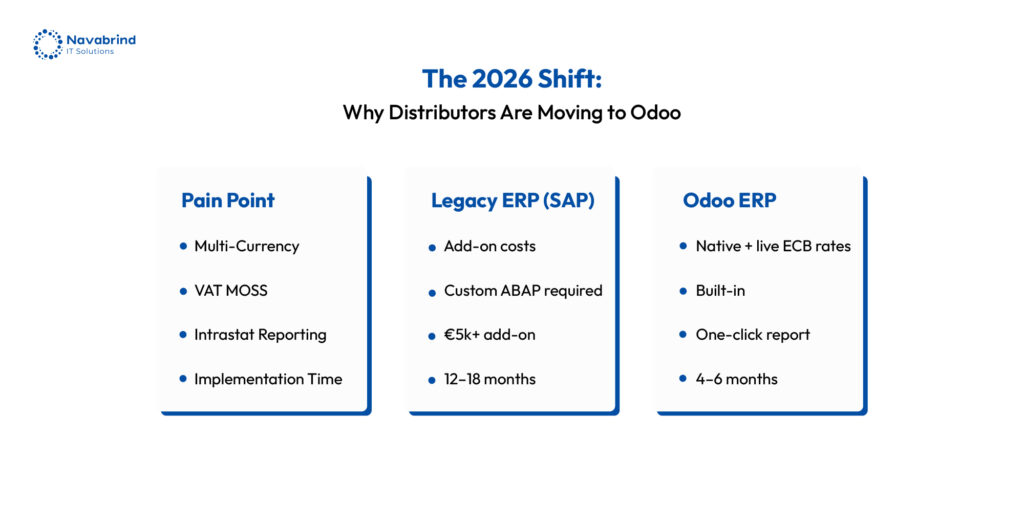
ERPs like SAP struggle to keep pace with this environment. Lengthy deployment cycles, rigid configurations, and escalating costs create friction instead of control. For distributors managing EU and non-EU trade flows, these systems introduce operational bottlenecks. Scaling across regions becomes a costly exercise.
This is where Odoo distribution management in Europe is redefining expectations. Businesses are shifting toward a flexible ERP environment that adapts to multi-country demands without excessive overhead. With integrated capabilities across inventory, accounting, logistics, and compliance, Odoo provides a cohesive operational framework that aligns with how European distributors operate today.
Odoo ERP for distributors in Europe stands out not just on cost but on technical capability. Its support for multi-currency transactions, multi-warehouse coordination, and cross-border compliance positions it as a strong fit for wholesalers managing complex regional networks. Whether handling VAT variations, localized invoicing, or intercompany transfers, Odoo simplifies operations that legacy systems complicate.
The shift is clear as distributors are moving away from systems that delay execution toward platforms that enable faster, informed decisions. Odoo multi-country operations allow businesses to manage subsidiaries, warehouses, and financials across borders within a single ecosystem eliminating fragmentation and improving control.
Why are European distributors choosing Odoo ERP for their operations in 2026?
Because it delivers cross-border inventory visibility, financial clarity, and operational control without the 18-month deployment timelines associated with legacy platforms. With Odoo ERP implementation in Europe, companies gain speed, flexibility, and scalability, these three factors that now define success in European distribution.
Odoo vs. SAP in Europe: The 2026 Tipping Point
European distributors are reassessing long-held ERP choices. What once worked for static, single-country operations no longer holds up under cross-border pressure, regulatory variation, and margin sensitivity. The comparison between SAP and Odoo ERP for distributors in Europe has shifted from preference to performance and the gap is now measurable.
Localization That Works Without Add-Ons
Compliance across Europe demands alignment with frameworks like PEPPOL and ZUGFeRD. SAP approaches this through add-ons, external integrations, and consulting-heavy deployments. Each requirement introduces cost, dependency, and delays. Odoo distribution management Europe addresses this at the system level. Localization modules for invoicing, taxation, and reporting are available within the platform, allowing distributors to operate across countries without layering external tools. This reduces risk and accelerates compliance readiness across EU jurisdictions.
Total Cost of Ownership That Supports Growth
SAP’s cost structure extends far beyond licensing. Annual maintenance, upgrade cycles, and consulting expenses create a long-term financial burden especially for mid-sized distributors scaling across regions. With Odoo ERP for wholesale Europe, the cost model aligns with business expansion. Companies invest in what they use, expand capabilities as operations grow, and avoid the recurring overhead tied to legacy platforms. In many cases, SAP’s yearly maintenance alone surpasses the full annual investment in Odoo.
Flexibility That Matches Business Reality
SAP enforces rigid process alignment. Distributors are required to reshape workflows to match system constraints, leading to inefficiencies at the operational level. Odoo multi-country operations take the opposite approach. The platform adapts to existing business models whether managing diverse warehouse structures, regional pricing strategies, or country-level tax rules. This flexibility allows distributors to retain operational logic that already works, rather than rebuilding it around software limitations.
What the Market Is Saying
A 2026 European survey revealed a decisive shift: 68% of mid-market distributors moving away from SAP identified “inflexibility for multi-country rules” as the primary driver. This reflects a broader pattern. Businesses are prioritizing systems that support regional complexity without slowing execution.
Verdict
The distributors with 10–500 employees, the decision is no longer balanced. Odoo ERP implementation in Europe delivers faster deployment, lower financial exposure, and stronger alignment with cross-border operations. When evaluated against cost, compliance readiness, and operational adaptability, Odoo supply chain management Europe positions itself as the ERP platform that matches how European distribution functions in 2026 not how it operated a decade ago.
Mastering Multi-Country Operations: Odoo’s Secret Weapon
European distributors operate within a fragmented landscape varying VAT structures, multiple languages, fluctuating currencies, and country-level logistics partners. Managing this complexity through disconnected systems leads to reporting gaps, compliance risks, and operational delays. Odoo ERP for distributors in Europe addresses this challenge with a unified framework that treats cross-border operations as a connected ecosystem rather than isolated entities.
The Core Challenge
Each country introduces its own operational layer:
- VAT differences across EU states
- Local language requirements for documentation
- Currency conversions and exchange rate impact
- Country-level shipping providers and fulfillment rules
Without a centralized system, these variables create inconsistencies across finance, inventory, and order management.
How Odoo Solves It
Per-Company Configuration Within One Environment
With Odoo multi-country operations, distributors can create separate legal entities for each country like Germany, France, Poland, or any other region within a single platform. Each entity maintains its own accounting, tax rules, and compliance structure, yet remains connected at the group level. Leadership gains full visibility across operations through one interface, eliminating the need to switch between systems.
Inter-Company Transactions Without Friction
Stock transfers and invoicing between warehouses across countries are handled through automated intercompany workflows. When goods move from a German warehouse to a French entity, the system generates corresponding transactions without manual journal entries. This ensures financial accuracy and traceability across borders, strengthening Odoo supply chain management Europe capabilities.
Country-Level Tax and Compliance Logic
Odoo applies tax rules based on transaction context. For example, orders shipped within Germany follow a 19% VAT structure, whereas shipments to France apply a 20% rate without user intervention. This built-in logic reduces compliance risk and ensures accurate invoicing across regions.
The Strategic Advantage
Odoo treats each country as an independent legal entity, then brings financials, inventory data, and performance metrics together at the group level.
This means:
- Country-level control without operational silos
- Group-wide reporting without reconciliation delays
- Faster decision-making backed by consistent data
How does Odoo ERP help distributors manage multi-country operations in Europe?
By structuring each country as a distinct legal entity within one system, then consolidating financials, inventory, and reporting at the group level. With Odoo ERP implementation in Europe, distributors gain operational clarity across borders turning complexity into a controlled, scalable advantage.
Financial Power: Multi-Currency & Multi-Lingual Operations
Cross-border distribution in Europe demands financial control that adapts to currency volatility and regional communication standards. Distributors dealing with CHF, GBP, PLN, and EUR transactions require accuracy in valuation, reporting, and customer interactions without relying on disconnected tools.Odoo ERP for distributors in Europe brings financial operations, currency management, and language localization into one connected environment.
Currency Management Without Gaps:
- Live Exchange Rate Integration
Through Odoo supply chain management Europe, exchange rates are synchronized with the European Central Bank. This ensures that transactions reflect current market values, supporting accurate pricing, invoicing, and financial reporting across currencies.
- Automated Gain and Loss Recognition
When invoices are issued in CHF, GBP, or PLN and settled later, currency fluctuations impact actual revenue. Odoo captures these differences by recording unrealized gains or losses within the accounting system.
Banking Integration Across Europe
- Connected Bank Feeds
Odoo integrates with major European banks. Transactions are imported into the system, enabling faster reconciliation and improved cash visibility.
- Streamlined Reconciliation Process
Incoming and outgoing payments are matched with invoices within the platform, reducing reconciliation delays and strengthening financial accuracy across entities.
Multi-Currency Transactions Across Stakeholders
With Odoo ERP for wholesale Europe, distributors can:
- Invoice a Swiss client in CHF
- Bill a UK customer in GBP
- Pay a German supplier in EUR
All within the same operational flow. This flexibility supports regional business relationships without requiring separate systems or currency workarounds.
Multi-Lingual Communication That Aligns with Customers
- Localized Invoicing: Odoo ERP generates PDF invoices in the customer’s preferred language. A distributor can send an Italian-language invoice to a client in Milan, while internal teams continue working in English. This enhances communication clarity and strengthens customer relationships across regions.
- The Outcome: By combining currency accuracy, banking integration, and language localization, Odoo distribution management Europe enables distributors to operate across financial boundaries without complexity.
With Odoo ERP implementation in Europe, businesses gain financial control that aligns with cross-border operations supporting growth, compliance, and stronger international relationships.
Supply Chain Excellence: Odoo Supply Chain Management Europe
European distribution networks span multiple countries, ports, and regulatory zones. Managing inventory across Rotterdam, Hamburg, Lyon, and beyond requires more than visibility by demanding the control over movement, cost allocation, and compliance at each stage. Odoo supply chain management Europe equips distributors with a connected logistics environment that aligns warehousing, transportation, and financial impact across borders.
Cross-Border Warehousing Without Fragmentation:
Distributors operating multiple hubs can manage inventory flows through automated replenishment rules. Stock levels, demand patterns, and lead times drive replenishment decisions across locations, ensuring availability without overstocking. With Odoo ERP for distributors in Europe, warehouses in different countries operate as part of a coordinated network rather than isolated units by supporting faster fulfillment and better stock utilization.
Brexit-Ready Inventory and Compliance Workflows:
Post-Brexit operations require a clear separation between UK and EU stock, along with accurate customs handling. Odoo enables distributors to define distinct inventory locations for each region and generate the required documentation for cross-border shipments. This structure supports compliant trade between the UK and EU without disrupting internal processes, strengthening Odoo multi-country operations across regulatory boundaries.
Landed Cost Allocation That Protects Margins:
Importers face layered costs in shipping, insurance, customs duties that impact product profitability. Odoo distributes these costs across inventory automatically, ensuring that product valuation reflects actual landed expenses. This capability within Odoo ERP for wholesale Europe allows distributors to maintain accurate margins, price products correctly, and avoid financial blind spots.
Carrier Integration Across Europe:
Odoo connects with major logistics providers including DHL, UPS, FedEx, DPD, GLS, and Chronopost. Distributors can compare shipping options, select cost-effective routes, and generate shipping labels within the same system removing the need for external tools.
Real-World Use Case:
A distributor based in Spain receives an order from a customer in Ireland.
With Odoo distribution management Europe:
- VAT is calculated using MOSS rules based on the destination
- The system selects a cost-effective carrier from available options
- An invoice aligned with Irish compliance standards is generated instantly
This level of coordination across taxation, logistics, and documentation reflects how Odoo ERP implementation in Europe supports day-to-day distribution challenges.
The Outcome:
By connecting warehousing, transportation, and cost control, Odoo supply chain management Europe enables distributors to operate with accuracy across borders. The result is a logistics network that supports growth, protects margins, and maintains compliance without operational friction.
The Implementation Timeline: Europe-Specific Realities
Rolling out an ERP across European distribution networks requires alignment with tax structures, logistics frameworks, and multi-entity operations. Speed matters but so does accuracy. Distributors adopting Odoo ERP for distributors in Europe are choosing structured rollouts that deliver operational value early, then expand across regions without disruption.
Phased Rollout Designed for European Operations (1–20 Weeks)
Weeks 1–4: Master Data Foundation
The implementation begins with product catalogs, multi-currency price lists, supplier data, and customer records. This stage defines how transactions will flow across countries and sets the base for Odoo distribution management Europe.
Weeks 5–8: First Country Go-Live (e.g., Germany)
A single country entity is configured with tax rules, accounting structure, and invoicing logic. Teams begin operating within Odoo, validating workflows in a live environment.
Weeks 9–12: Second Country Expansion (e.g., France)
A second entity is introduced with intercompany transactions enabled. Stock transfers, cross-border invoicing, and financial consolidation begin to take shape under Odoo multi-country operations.
Weeks 13–16: Logistics and Compliance Integration
Carrier connections, customs handling, and warehouse coordination are configured. This stage strengthens Odoo supply chain management Europe, aligning transportation and inventory flows across borders.
Weeks 17–20: Training and Stabilization
Teams are trained across departments in finance, operations, and logistics. Post-go-live support ensures stability, adoption, and process alignment across entities.
Timeline Expectations
How long does it take to implement Odoo ERP for a distribution company in Europe?
- 4–5 months for a single-country rollout
- 6–8 months for multi-country operations (Germany, France, Poland, and beyond)
This timeline reflects a structured deployment approach that balances speed with operational readiness.
Critical Success Factor
The outcome of Odoo ERP implementation in Europe depends heavily on execution expertise. Distributors gain faster adoption and fewer disruptions when working with partners experienced in EU multi-country environments by covering VAT structures, intercompany workflows, and cross-border logistics. Choosing a generic implementation provider increases risk.Choosing a partner with regional expertise ensures alignment with how European distribution operates.
The Takeaway
A well-planned rollout transforms ERP from a technical project into a business advantage. With Odoo ERP for wholesale Europe, distributors move from fragmented systems to a connected operational model within months not years.
Top Features of Odoo ERP for European Distribution Companies
European distributors operate under strict regulatory frameworks and complex logistics networks. Success depends on accurate reporting, traceability, and coordination across warehouses and partners. Odoo ERP for distributors in Europe delivers the functionality required to manage these demands within a connected system.
- Intrastat Reporting Without Delays:
Cross-border trade within the EU requires detailed declarations. Odoo distribution management Europe enables automatic generation of Intrastat reports based on transaction data. This removes dependency on external tools and ensures compliance with EU reporting standards.
- VAT Reverse Charge Handling
For B2B transactions across EU member states, VAT reverse charge rules must be applied correctly. Odoo manages this within the invoicing process, ensuring that tax treatment aligns with EU regulations.
- Lot and Serial Traceability
Industries such as pharmaceuticals, automotive parts, and food distribution require end-to-end traceability. Odoo tracks products by lot and serial number across procurement, storage, and delivery. This supports compliance, recall management, and quality control across Odoo supply chain management Europe.
- Demand Forecasting Across Warehouses
Inventory imbalances across regions can impact revenue and customer satisfaction. Odoo’s automated scheduler forecasts demand across multiple warehouses, enabling distributors to balance stock levels between locations such as Milan and Munich. This improves availability while reducing excess inventory under Odoo multi-country operations.
- EDI for European Retail Networks
European retailers rely on EDIFACT standards for electronic data interchange. Odoo supports this format, enabling distributors to exchange orders, invoices, and shipment data with retail partners without additional systems.
- 3PL Integration Across Europe
Logistics partnerships play a critical role in distribution. Odoo connects with third-party logistics providers such as Picnic and Zalando Logistics, along with regional forwarders. This integration enables synchronized inventory, order fulfillment, and delivery tracking.
Learn how Odoo supports multi-currency transactions for global retail
The Outcome
These capabilities position Odoo ERP implementation in Europe as a practical choice for distributors seeking control over compliance, inventory, and logistics. With Odoo ERP for distributors in Europe, businesses gain the operational depth required to manage cross-border trade, maintain regulatory alignment, and scale distribution networks across the region.
Implementation Pitfalls to Avoid in Europe
Rolling out an ERP across European distribution networks involves regulatory nuance, financial structure alignment, and ongoing compliance oversight. Even with Odoo ERP for distributors in Europe, missteps during implementation can lead to reporting errors, compliance exposure, and operational friction. Avoiding these pitfalls is critical for long-term success.
Mistake #1: One Chart of Accounts Across All Countries
A single chart of accounts does not work across Europe. Each country follows its own accounting framework and reporting standards. For example, France mandates a different structure compared to Germany, with variations in account classifications and statutory requirements.
With Odoo ERP for wholesale Europe, each country entity should maintain its own chart of accounts aligned with local regulations. This ensures accurate financial reporting, audit readiness, and compliance with national authorities. Attempting to standardize accounting across countries leads to reconciliation challenges and regulatory risks.
Mistake #2: Overlooking Data Privacy Regulations
Data protection in Europe extends beyond GDPR. Switzerland enforces the Federal Act on Data Protection (FADP), and the UK operates under UK GDPR. Each framework introduces requirements around data storage, access control, and processing.
Odoo multi-country operations must be configured with these regulations in mind. This includes defining user access levels, securing customer and financial data, and aligning data handling practices with country-level requirements. Ignoring these factors exposes distributors to penalties and reputational damage.
Mistake #3: Treating Odoo as a DIY Project
Odoo offers flexibility, but European distribution demands ongoing alignment with tax rules, compliance updates, and localization requirements. Attempting a self-managed implementation without regional expertise creates gaps in VAT handling, reporting, and cross-border transactions.
Successful Odoo ERP implementation in Europe depends on working with a partner experienced in EU multi-country environments. Such partners maintain localization modules, adapt to regulatory updates, and ensure that the system continues to align with changing tax laws and reporting standards.
The Takeaway
Avoiding these pitfalls strengthens the foundation of Odoo distribution management Europe. Distributors that align accounting structures, respect regional data regulations, and engage experienced implementation partners position themselves for stable operations and scalable growth across European markets.
The 2026 Verdict for European Distributors
European distribution has reached a decisive shift. Cost pressure, regulatory complexity, and cross-border coordination have exposed the limitations of legacy ERP systems. Businesses are no longer investing in platforms that slow execution or inflate operational overhead.
Odoo ERP for distributors in Europe stands out as the pragmatic choice for companies seeking enterprise-grade capability without the burden associated with traditional systems. From multi-entity financial control to cross-border inventory visibility, Odoo delivers the functionality required to manage European operations with speed and accuracy.
Final Answer
Odoo has become the preferred ERP for distributors that require multi-country capability comparable to SAP without the cost structure and implementation burden.
With Odoo distribution management Europe, businesses gain:
- Control over multi-entity operations across EU and non-EU regions
- Financial accuracy across currencies, tax structures, and reporting frameworks
- Integrated logistics and inventory coordination across warehouses
- Faster deployment timelines aligned with business priorities
This combination positions Odoo ERP for wholesale Europe as a solution that supports growth without operational drag.
Who Should Still Choose SAP?
SAP remains relevant for a narrow segment of the market:
- Distributors exceeding €500M in annual revenue
- Organizations operating with 50+ legal entities
- Businesses requiring extreme levels of customization tied to niche compliance frameworks
For these enterprises, the scale and complexity may justify the investment.
The Bottom Line
For the majority of distributors, the decision is clear. Odoo ERP implementation in Europe provides the balance of capability, flexibility, and cost control required to operate across borders. With Odoo multi-country operations and Odoo supply chain management Europe, distributors gain a system that aligns with how European trade functions today, delivering control, visibility, and scalability without compromise.
Frequently Asked Questions
1.Why are European distributors choosing Odoo ERP for their operations in 2026?
European distributors are moving toward Odoo ERP for distributors in Europe to gain control over cross-border inventory, financials, and compliance without long deployment cycles. The platform supports multi-entity operations, VAT variations, and warehouse coordination within one system. This allows businesses to respond faster to market changes, reduce operational friction, and maintain visibility across EU and non-EU regions.
2.Why is Odoo ERP better than SAP for distribution companies in Europe?
The shift comes down to flexibility, cost structure, and deployment speed. SAP introduces rigid workflows, long timelines, and high maintenance costs. In contrast, Odoo ERP for wholesale Europe adapts to existing business processes, supports localization without heavy add-ons, and allows phased rollouts across countries. Distributors gain operational control without restructuring their entire business around the software.
3.How long does it take to implement Odoo ERP for a distribution company in Europe?
Odoo ERP implementation in Europe follows a phased rollout model:
4.How does Odoo ERP support multi-currency operations for European distributors?
With Odoo distribution management Europe, distributors can manage transactions across EUR, GBP, CHF, PLN, and other currencies within one system. Exchange rates are synchronized with the European Central Bank, ensuring accurate financial reporting. The system records currency gains and losses automatically and supports invoicing, payments, and reconciliation across multiple currencies without external tools.
5.How does Odoo ERP help distributors manage multi-country operations in Europe?
Odoo multi-country operations allow each country to function as a separate legal entity within one platform. Each entity maintains its own tax rules, accounting structure, and compliance setup, while leadership retains consolidated visibility at the group level. Intercompany transactions, cross-border inventory transfers, and financial reporting are handled within the system, eliminating fragmentation.
6.What are the top features of Odoo ERP for distribution companies in Europe?
Odoo supply chain management Europe delivers key capabilities required for cross-border distribution:
- Intrastat reporting for EU trade compliance
- VAT reverse charge handling for B2B transactions
- Lot and serial traceability for regulated industries
- Demand forecasting across multiple warehouses
- EDIFACT-based EDI for European retail partners
- Integration with logistics providers and 3PL networks
Schedule a conversation with us now!
Related Articles







 Post
Post