The D2C E-commerce Boom in India
India’s D2C E-commerce market is expanding at an unmatched pace. Fashion labels, skincare startups, food brands, electronics sellers, and lifestyle companies are shifting toward direct online sales to control margins, brand positioning, and buyer relationships. Yet revenue growth alone does not guarantee business stability. As order volumes increase across marketplaces, websites, retail outlets, and social commerce channels, operational gaps begin affecting profitability.
Without ERP and E-commerce integration, Indian D2C brands struggle with inventory mismatches, delayed dispatches, refund confusion, inaccurate stock visibility, and disconnected financial records. These issues damage customer trust and reduce repeat purchases. An E-commerce ERP platform connects inventory, procurement, warehousing, accounting, fulfillment, and sales into one connected business environment.
Platforms such as Odoo E-commerce integration, Shopify Odoo integration, and Woocommerce ERP integration help brands gain tighter operational control and faster order execution. For scaling businesses, D2C ERP software is no longer optional. Revenue retention now depends on connected commerce operations, faster fulfillment cycles, and data-driven decision-making across the E-commerce ecosystem.
Understanding ERP and E-commerce Platform Integration
ERP and E-commerce integration connects online sales channels with inventory, finance, procurement, warehousing, fulfillment, CRM, and reporting functions inside one connected system. Instead of managing disconnected applications and spreadsheets, businesses operate through a centralized E-commerce ERP platform that keeps business activities aligned across departments.
When a customer places an order through Shopify, WooCommerce, marketplaces, or a branded website, the ERP system updates stock levels, invoice records, payment status, shipping workflows, and purchase data instantly across operations. This connection removes data duplication, stock inconsistencies, delayed dispatches, and revenue leakage caused by disconnected systems.
Odoo E-commerce integration helps Indian D2C brands control high transaction volumes without operational confusion. Shopify Odoo integration creates stronger coordination between online storefronts and backend business functions. Woocommerce ERP integration supports faster inventory movement and accurate order processing across growing E-commercebrands.For scaling businesses, D2C ERP software creates operational visibility that supports customer retention, margin control, and revenue expansion without operational bottlenecks slowing growth.
How Indian D2C Brands Lose Sales Without Integration
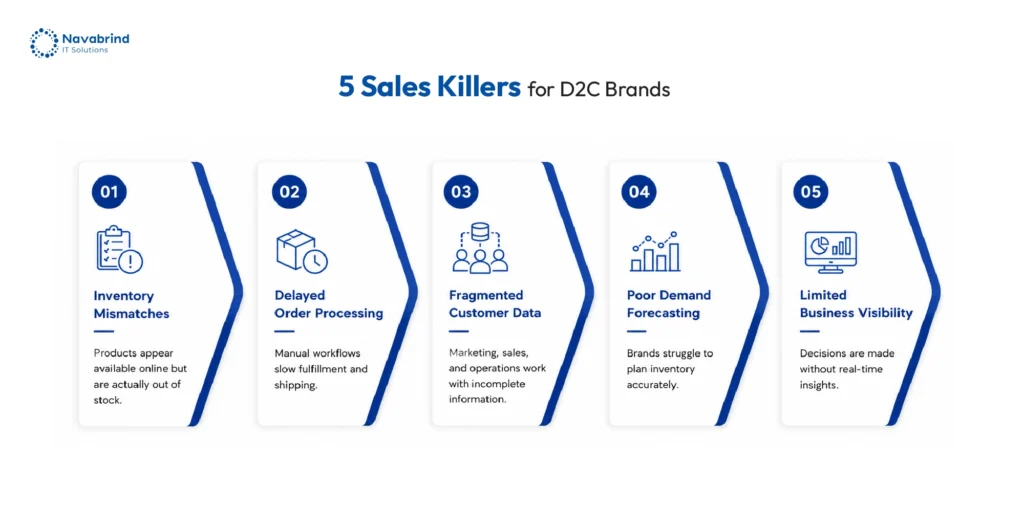
Indian D2C brands lose revenue when disconnected systems create operational gaps across inventory, fulfillment, finance, and E-commerce channels. Without ERP and E-commerce integration, stock updates fail to sync between warehouses and online stores, leading to overselling, cancelled orders, refund disputes, and negative customer reviews. These issues damage buyer confidence and reduce repeat purchases.
Delayed order processing creates another revenue challenge. Teams spend hours transferring order details between systems, checking stock availability, updating invoices, and coordinating shipments. Slow fulfillment increases cart abandonment and weakens brand credibility in competitive E-commerce markets.
Pricing inconsistencies across marketplaces, Shopify stores, and websites create confusion for buyers and impact conversion rates. Data silos prevent leadership teams from tracking sales performance, inventory movement, and profit margins accurately across channels.
Odoo E-commerce integration solves these operational gaps through connected workflows across sales, warehousing, accounting, and fulfillment. Shopify Odoo integration and woocommerce ERP integration help D2C brands maintain stock accuracy, faster order execution, and stronger customer retention through a centralized ecommerceERP platform backed by scalable D2C ERP software.
Operational Challenges Faced by Non-Integrated D2C Brands
D2C brands without ERP and E-commerce integration face operational inefficiencies that directly impact revenue. Handling orders across multiple marketplaces, Shopify stores, or WooCommerce websites becomes chaotic without a connected system, leading to delayed shipments, missed orders, and inconsistent fulfillment.
Tracking inventory in real time is nearly impossible when stock levels are maintained separately for each sales channel. Overstocking, understocking, and stockouts become common, affecting both sales and working capital. Fragmented sales and customer data further restrict insights into buyer behavior, purchase trends, and revenue opportunities.
Procurement and supply chain planning suffer as manual forecasting errors increase, delaying replenishment and driving unnecessary costs. Reliance on spreadsheets and offline processes magnifies errors and slows decision-making, putting growing brands at a disadvantage in a competitive market.
Platforms like Odoo E-commerce integration, Shopify Odoo integration, and Woocommerce ERP integration streamline operations, giving D2C brands a unified E-commerce ERP platform that improves inventory accuracy, order fulfillment, and procurement efficiency while reducing manual workload.
Benefits of Integrating ERP with E-commerce Platforms
ERP and E-commerce integration gives D2C brands operational control that supports faster scaling and stronger profitability. When online stores connect with ERP systems, inventory updates, order status, invoices, payments, procurement, and shipping activities stay aligned across business functions without operational delays.
An E-commerce ERP platform improves stock visibility across warehouses, marketplaces, Shopify stores, and WooCommerce websites. This reduces overselling, stock shortages, cancelled orders, and fulfillment confusion that impact customer trust. Faster order processing and shipment execution help brands improve delivery timelines and increase repeat purchases.
Centralized product, sales, and customer information gives leadership teams stronger visibility into purchasing trends, revenue performance, and inventory movement. Financial reporting becomes faster and revenue tracking gains higher accuracy across channels.
Odoo E-commerce integration supports connected operations across sales, warehousing, accounting, procurement, and fulfillment. Shopify Odoo integration and woocommerce ERP integration help D2C brands improve order accuracy, strengthen customer retention, and increase operational scalability through connected D2C ERP software designed for growing E-commerce businesses.
ERP Modules That Help Indian D2C Brands Scale
Growing D2C brands require connected business functions to manage rising order volumes, expanding product catalogs, and multi-channel E-commerce operations. ERP and E-commerce integration supports this growth through specialized ERP modules that improve operational visibility and business coordination.
Inventory and warehouse management modules help brands track stock movement across warehouses, retail outlets, marketplaces, and online stores. CRM modules organize customer interactions, purchase history, support requests, and engagement data, helping businesses improve retention and repeat sales.
Accounting and finance modules simplify invoicing, GST management, payment reconciliation, expense tracking, and revenue analysis. Procurement and vendor management modules support supplier coordination, purchase planning, stock replenishment, and cost control across the supply chain.
Ecommerce integration modules connect Shopify, WooCommerce, Amazon, and branded websites with backend ERP operations. Odoo E-commerce integration enables D2C businesses to manage orders, inventory, shipping, accounting, and customer data from one E-commerce ERP platform. Shopify Odoo integration and woocommerce ERP integration strengthen operational accuracy and help D2C ERP software support long-term E-commerce expansion.
Why Odoo ERP Is Popular Among Indian D2C Brands
Indian D2C brands are adopting Odoo because growing E-commerce businesses require connected operations without the complexity and cost burden associated with legacy ERP systems. Odoo supportsERP and E-commerce integration through a connected environment that links inventory, sales, accounting, procurement, CRM, warehousing, and fulfillment into one business platform.
Odoo E-commerce integration helps brands manage Shopify stores, WooCommerce websites, marketplaces, POS operations, and payment gateways from a centralized ecommerceERP platform. This reduces operational fragmentation and improves visibility across sales channels, inventory movement, and financial performance.
For scaling D2C businesses, Shopify Odoo integration and Woocommerce ERP integration create stronger coordination between frontend E-commerce operations and backend business functions. Brands gain faster order execution, inventory accuracy, revenue tracking, and customer management without relying on disconnected software applications.
Odoo’s customization flexibility makes the platform suitable for Indian retail and E-commerce brands with unique workflows, taxation structures, warehouse models, and fulfillment processes. As sales channels expand, D2C ERP software powered by Odoo supports operational scalability without disrupting business continuity.
Common Mistakes D2C Brands Make Without ERP Integration
One of the largest mistakes Indian D2C brands make is relying on disconnected software for inventory, accounting, order management, CRM, and E-commerce operations. This fragmented setup creates operational confusion, duplicate data entries, fulfillment delays, and revenue leakage across sales channels.
Without ERP and E-commerce integration, inventory updates fail to reflect across Shopify stores, WooCommerce websites, marketplaces, and warehouses. This leads to stock inconsistencies, cancelled orders, customer complaints, and lost sales opportunities. Poor demand forecasting creates another challenge, as brands struggle to predict purchasing patterns, replenish inventory accurately, and control warehouse costs.
Limited business visibility prevents leadership teams from tracking sales performance, margins, inventory movement, and financial health from one platform. As order volumes increase, spreadsheet-based operations become unsustainable and slow down business expansion.
Odoo E-commerce integration helps D2C brands replace disconnected workflows with a centralized E-commerce ERP platform. Shopify Odoo integration and woocommerceERP integration improve inventory coordination, order management, financial tracking, and operational scalability through connected D2C ERP software designed for growing E-commerce businesses.
Best Practices for ERP and E-commerce Integration
Successful ERP and E-commerce integration starts with selecting an ERP platform that supports long-term D2C growth, multi-channel commerce, inventory visibility, financial management, and operational coordination. Businesses should choose an E-commerce ERP platform capable of connecting online stores, marketplaces, warehouses, POS systems, logistics, and accounting within one connected ecosystem.
Automating inventory updates, order processing, invoicing, shipping workflows, and procurement activities helps brands reduce operational delays and improve fulfillment accuracy. Connected workflows strengthen stock control and prevent revenue loss caused by overselling or delayed dispatches.
Integrating Shopify, WooCommerce, marketplaces, retail outlets, and payment gateways creates stronger synchronization across sales channels. Shopify Odoo integration and woocommerce ERP integration help D2C brands maintain inventory consistency, faster order movement, and stronger financial tracking across operations.
Unified dashboards inside D2C ERP software help leadership teams monitor sales performance, inventory turnover, customer retention, warehouse activity, and profitability from one environment. Odoo ecommerce integration supports scalable omnichannel commerce operations that improve customer satisfaction and long-term revenue growth.
The Evolution of ERP-Driven D2C E-commerce in India
ERP-driven D2C commerce in India is transforming operations as brands seek faster growth, stronger margins, and seamless multi-channel coordination. AI-enabled inventory and demand forecasting allows businesses to predict trends, optimize stock, and reduce operational costs while preventing lost sales.
Omnichannel retail expansion is creating pressure on brands to synchronize online stores, marketplaces, and physical outlets. ERP and E-commerce integration ensures that Shopify, WooCommerce, marketplaces, and warehouses operate in a unified workflow, eliminating delays, stock discrepancies, and order errors.
Automation extends beyond inventory and order management to fulfillment, invoicing, and customer communication, delivering a consistent experience at scale. Headless commerce models, powered by platforms like Odoo E-commerce integration, allow brands to customize storefronts while keeping backend ERP operations coordinated.
Shopify Odoo integration and woocommerce ERP integration enable D2C brands to scale confidently, retain revenue, and improve operational agility. Connected D2C ERP software is now essential for Indian brands to manage growth efficiently and maximize profitability across E-commerce channels.
Frequently Asked Questions
1.What is ERP integration in ecommerce?
ERP integration in E-commerce connects online stores with backend operations such as inventory, procurement, finance, fulfillment, and customer data. This integration ensures order, stock, and financial information flows seamlessly across the business, reducing errors and improving operational control.
2.How does ERP integration help online stores?
By linking E-commerce platforms with ERP systems, online stores maintain accurate inventory, faster order processing, synchronized pricing, and consistent fulfillment. Platforms like Shopify, WooCommerce, and marketplaces stay aligned with backend operations, improving efficiency and customer satisfaction.
3.Why do D2C brands need ERP software?
D2C brands require D2C ERP software to manage multi-channel orders, track inventory in real time, streamline procurement, and unify financial and sales data. This reduces revenue loss, strengthens customer retention, and supports scalable growth.
4.What is the best ERP for E-commerce in India?
Odoo stands out for Indian E-commerce brands due to its E-commerce ERP platform capabilities, supporting Shopify, WooCommerce, marketplaces, inventory, accounting, and fulfillment from a centralized system, while remaining cost-effective and customizable.
5.How to integrate Odoo with an E-commerce platform?
Odoo E-commerce integration can be implemented with Shopify, WooCommerce, marketplaces, or custom storefronts. Integration connects orders, inventory, shipping, payments, and customer data to create one connected E-commerce ERP platform, eliminating manual workflows and improving operational visibility.
Schedule a conversation with us now!
Related Articles









 Post
Post