Odoo has always been the go-to ERP for small and medium-sized businesses. In the last couple of years, the annual Odoo versions have seen an increasing infusion of AI-powered chatbots, which enable manufacturers to automate processes and get more work done without increasing costs.
Just like Odoo 19, Odoo 20, released on 24 September 2026 at Odoo Experience Brussels, offers additional AI capabilities and the opportunity to connect the shop floor with the rest of the business, be it Purchase, Accounting, Inventory, Sales, Manufacturing, and more.
In this blog post, let’s review the several new features introduced in the Manufacturing module of Odoo 20 and check out their potential benefits. This blog post will help you determine if you need to upgrade to Odoo 20 or continue leveraging your Odoo 19 instance.
AI and Automation: A Smarter Layer Across Manufacturing
AI agents in Odoo 20 understand natural-language requests, tap into information already available in the ERP, and use workflow automation to assist with an increasing set of tasks.
For instance, when an order comes in by email, instead of typing it up by hand, you instruct your AI agent to create the sales order, send the client a confirmation, and flag it to you for review. The agent can then tell you exactly what you need to do, and thus the process is live and runs on its own. This automation can work for any process, be it the creation of complex quotes or raising a PO when inventory drops below a certain level.
Another example is sales, where an AI agent can auto-assign leads to the right salesperson based on availability and expertise, or create a project with the right tasks immediately after a contract is signed.
Faster backorder planning
Production does not always get completed in the quantities originally planned. Material shortages, capacity constraints, quality issues, and changing priorities can result in part of a Manufacturing Order being moved to a backorder.
Odoo 20 makes managing these situations easier by extending production planning to backorders as well. Backorders of planned production are now also planned automatically upon their creation. This helps keep outstanding production quantities visible in the production plan without requiring planners to manually reschedule newly created backorders.
Improved Bill of Materials
As products become complex, manufacturers need a way to understand not just what goes into a product, but also how quantities, sub-assemblies, and additional costs affect production. Odoo 20 has introduced several improvements to Bill of Materials management, giving production teams better visibility into product structures, costs, and component availability directly from the BoM.
Key improvements include the option to compare BoMs based on the product quantities used. In Odoo 20, users can now view the Status and Availability columns in the BoMs overview forecast and see how they have been merged. They can also update the BoM with the extra costs incurred in fulfilling an order using a dedicated field.
Managing complex BoMs becomes easier when components and sub-assemblies are located in one place. Odoo 20 lets manufacturers view and manage BoMs directly from the Bill of Materials form, reducing the need to navigate between multiple screens.
Component Replacement
Replacing a component in a manufacturing unit can be complicated when the same part is used across multiple products and the BoMs. Before making a change, manufacturers need to understand where that component is being used to avoid unintended changes to production. A new feature in Odoo 20 simplifies this process by making component usage easier to identify and manage. The “Used In” smart button on the product form now displays the respective BoMs component lines. The action to display component lines is also available from the BoMs list and form views.
Continuous Production: Keep Work Moving
In multi-stage manufacturing, waiting for an entire production quantity to complete one operation before starting the next can create unnecessary idle time.
With continuous production, manufacturers can:
Reduce waiting time between production stages
- Keep downstream Work Centers productive
- Shorten overall manufacturing cycle times
- Improve utilization of available production capacity
- Reduce unnecessary work-in-progress delays
- Move finished quantities through production faster
In Odoo 20, a new feature allows manufacturers to record produced quantities in Work Orders. If Continuous Production is enabled on the Bill of Materials, subsequent operations start as soon as some quantities are ready.
Draft versus Confirmed Manufacturing Orders
Manufacturers differ on how much control they want before a production requirement becomes an active Manufacturing Order (MO). Odoo 20 gives production teams flexibility by allowing them to decide whether procurement-generated MOs should be created as drafts for review or confirmed automatically for execution.
On the Manufacturing operation type, users can choose whether procurement creates draft or confirmed Manufacturing Orders.
Flexible Consumption
In a typical manufacturing environment, actual material consumption does not always match the quantities originally specified in the BoM. Production teams may need to consume slightly more or less depending on scrap, process variations, or other shop-floor conditions.
Odoo 20 enables manufacturers to record this difference by making flexible consumption the standard behavior for MOs and removing the need to configure it separately on individual BoMs.
The flexible consumption setting on Bills of Materials has been removed. All MOs use flexible consumption by default, regardless of whether or not a Bill of Materials is selected.
Generate Lots and Serial Numbers When Closing Manufacturing Orders
Accurate lot and serial number tracking is essential for manufacturers that need to trace finished products to specific production runs. It is important for businesses managing warranty claims, quality investigations, regulated products, or product recalls.
Odoo 20 makes this process consistent by automatically generating lot and serial numbers when MOs are closed. This reduces the manual effort required for assigning traceability information and ensures completed products have lot or serial identification.
With the new Odoo 20 feature, lot and serial numbers are automatically generated when closing Manufacturing Orders.
Precise Lot and Serial Number Transfers
When a quality issue occurs, manufacturers need to quickly determine where the affected products went. Looking at a warehouse transfer can make this difficult, especially when the transfer contains products from multiple lots or serial numbers.
Odoo 20 provides visibility into specific delivery move lines associated with a lot or serial number rather than displaying the complete transfer. The “Transfers” smart button on lots and serial numbers now shows delivery move lines instead of the entire transfer.
The ‘Lot and Serial Number’ feature gives manufacturers an exact view of where a lot or serialized product was delivered, making it easier to identify affected movements during a quality investigation or recall.
Manufacturing Order (MO) Kanban View
Production managers need to see more than a list of open MOs. They need to quickly understand what is scheduled, whether materials are available, where production is happening, and how much work remains.
Odoo 20 redesigns the MO Kanban view to give planners a clear picture of production status and workload. Cards are now grouped by scheduled date in weeks and display useful information such as component status, active Work Center, deadline, and remaining production time.
The total remaining time for all Manufacturing Orders is also displayed across “Group By” searches. This makes it easier for planners to assess workloads, spot potential scheduling pressures, and prioritize production.
Manufacturing Orders Planned ASAP
When several Manufacturing Orders are waiting to be scheduled, production teams need a predictable way to determine which orders should be planned first.
Odoo 20 plans MOs by default. When multiple orders are being planned, the list determines scheduling priority. This feature gives production planners a straightforward way to influence which MOs should be taken up first while enabling available production capacity to get scheduled sooner.
Better Visibility into Manufacturing Order Costs
Knowing the expected cost of production is useful, but manufacturers also need visibility into how that cost develops while production is underway and what the final Manufacturing Order (MO) costs.
Odoo 20 improves MO cost visibility by making the MO Overview reflect the stage of production. The “MO Cost” field displays the provisional cost while the Manufacturing Order is in progress and the real cost once production is complete.
Odoo 20 also improves the costing of subcontracted product replenishments in the MO Overview by taking component costs into account. Together, these improvements give manufacturers a clearer view of production costs across internal and subcontracted manufacturing.
A Simpler Produce Workflow
Small interface improvements can make a key difference when the same action is performed repeatedly by production and warehouse teams. In Odoo 20, the separate “Produce” and “Produce All” buttons have been consolidated into a single “Produce” button across Manufacturing, Shop Floor, and Barcode.
This creates a consistent production workflow in the different interfaces and simplifies the actions operators use to register production.
Put in Pack from Manufacturing Orders
For manufacturers that pack finished products immediately after production, manually assigning completed goods to destination packages adds another step to the inventory process.
Odoo 20 simplifies this workflow by connecting production completion with packaging. If a destination package is specified on the MO, the finished product is automatically added to that package when it is produced.
This can streamline the transition from production to packaging, and then inventory/fulfillment in environments where finished goods follow predefined packing processes.
Reset Manufacturing Orders to Draft
Production requirements can change even after a MO has been validated or canceled. Previously, correcting or revisiting such orders was problematic.
Now, Odoo 20 lets users reset validated or canceled MOs to draft. This gives production teams the flexibility to review and make changes when production plans or requirements change.
Shop Floor Demo Sheet
Barcode-driven operations can make shop-floor transactions faster, but manufacturers evaluating the functionality may want to see how it works before configuring a complete barcode workflow.
Odoo 20 makes testing easier with a downloadable Shop Floor demo sheet. Teams can use it to test the app’s barcode capabilities and understand how operators can interact with Shop Floor using barcode scanning.
This feature is useful when manufacturers are testing and designing their future shop-floor processes.
Split Manufacturing Orders
Production does not always need or manage to complete the entire planned quantity in one run. Material shortages, capacity constraints, equipment availability, or changing production priorities may require the remaining quantity to be completed later.
Odoo 20 provides flexibility by allowing ongoing MOs to be split. Manufacturers can complete part of an order now and separate the remaining quantity for production at a later stage.
Better Visibility for Subcontracting Manufacturing Orders
Outsourcing production does not remove the need for material visibility. Manufacturers still need to know whether the components required by a subcontractor are available and what needs to be purchased.
Odoo 20 extends Component Status and the MO Overview to subcontracting production. This allows teams to identify missing components and order them directly.
For manufacturers combining internal production with outsourced manufacturing, this provides visibility into whether subcontracted orders have the materials required to proceed.
Accurate valuation can become difficult when subcontracted products are received without a linked Purchase Order (PO).
Odoo 20 allows for assigning the subcontractor cost at product reception based on the vendor price list when no PO is linked.
The new feature ensures that the cost associated with subcontracted production is captured even when the receipt is not connected to a PO, providing consistent product valuation.
“To Replenish” Filter
Material shortages can disrupt a production schedule, so planners need an easy way to identify components that require replenishment.
Odoo 20 adds a “To Replenish” filter to the MO Overview, making it easier to focus on materials that need attention.
Expiration Dates in the Traceability Report
Traceability is not only about knowing which lot or serial number was used. It is also crucial to know whether tracked materials are approaching or have reached their expiration dates.
Odoo 20 now has a feature that allows users to add expiration dates to the Traceability Report, giving them additional information when following materials and products through their supply chain and production history.
This feature is useful for manufacturers handling perishable, shelf-life-sensitive, or expiration- controlled materials.
Visualize and Confirm Work Orders
Production planners often need to review and organize Work Orders before releasing them to the shop floor.
Odoo 20 makes this process flexible by allowing Work Orders to be confirmed directly from the Work Order Planning Gantt view, even when they contain draft Work Orders. This brings planning and confirmation closer together and can reduce the need to move between different screens when organizing upcoming production.
Improved Work Order and Manufacturing Order Reporting
Manufacturers need reliable production data to understand whether operations are running according to plan and where performance is falling short.
Odoo 20 improves reporting for both Work Orders and Manufacturing Orders, with key metrics updated to provide better production analysis. For production managers, improved reporting makes it easier to evaluate manufacturing activity and use operational data to support planning and performance reviews.
New Kanban and Gantt Views for Work Orders
One useful Odoo 20 improvement is the flexibility in how production teams visualize and manage their Work Orders. The new Work Order Kanban view provides another way to visualize production activities and adapt Work Order planning.
For detailed scheduling, the enhanced Gantt view allows planners to organize Work Orders using drag-and-drop functionality. Improved color coding makes the schedule easier to interpret, while the ability to view planning by employees provides another level of resource visibility.
Completed Work Orders are also displayed by default in the Gantt view, giving planners additional context when reviewing production activity. These features make Work Order planning more visual and interactive.
Updated Work Center Overview
Work Centers sit at the heart of production execution. Planners need quick access to upcoming work and the maintenance activities that could affect capacity. Odoo 20 updates the Work Center Overview with quick links to Work Orders and maintenance planning.
This feature closes the gap between production and equipment availability, helps teams move between the work scheduled for a Work Center and the maintenance activities that influence its availability.
Process Work Orders in Blocked Work Centers
A blocked Work Center does not necessarily mean that every Work Order associated with it must come to a complete stop. Odoo 20 now allows Work Orders to be processed in blocked Work Centers. This feature provides production teams with operational flexibility when a Work Center is marked as blocked. But specific Work Orders still need to be handled.
The change gives manufacturers more control over how they respond to real production conditions instead of making the blocked status an absolute restriction on Work Order processing.
The Real Value of Odoo 20 for Manufacturing
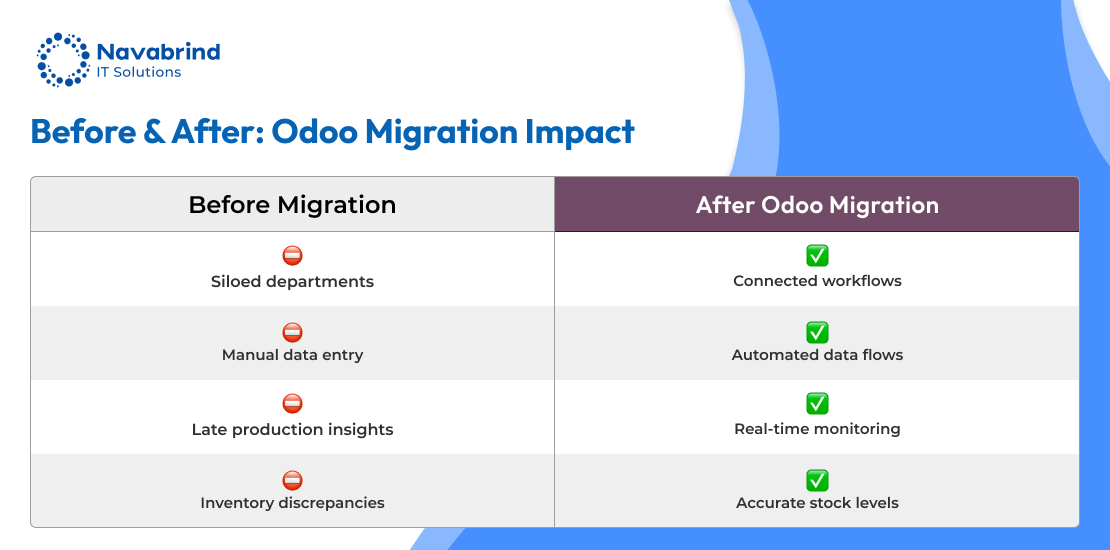
As you have just read, Odoo 20 has introduced several changes in the Manufacturing modules. The strongest reason to consider Odoo 20, however, is its ability to connect the entire manufacturing business, from the first customer opportunity through procurement, production, and delivery to the final financial transaction.
For small and mid-sized manufacturers trying to move beyond spreadsheets, disconnected applications, and manual integrations, a connected operating model can be far more beneficial than simply replacing one production system with another.
Odoo 20 for the manufacturing industry is not just about running production better. It is about connecting production with the rest of the business so the entire organization can operate as one system.
Who Should Consider Odoo 20 for Manufacturing?
Not every manufacturer needs to replace their current systems or upgrade to Odoo 20. But as production becomes complex, spreadsheets and disconnected applications can start creating more work than they eliminate.
Odoo 20 is relevant for growing manufacturers that need better control over production while connecting manufacturing with inventory, purchasing, sales, accounting, quality, and other business processes.
You may want to evaluate Odoo 20 if your business is experiencing several of the following challenges.
Your BoMs Have Become Complex
As products become sophisticated, manufacturers need to manage multi-level BoMs, subassemblies, variants, operations, and by-products.
If your team is maintaining complex product structures through spreadsheets or multiple systems, Odoo 20 can help.
You Operate Multiple Work Centers
Production planners need visibility into workload, availability, expected production time, and potential bottlenecks.
The planning and Work Center capabilities available in Odoo 20 for Manufacturing can help manufacturers understand where capacity is available and where production constraints are developing.
Production Scheduling Still Depends on Spreadsheets
Spreadsheets are flexible, but they become difficult to maintain when production priorities change throughout the day.
If production planners constantly update spreadsheets and manually communicate schedule changes to the shop floor, it may be time to move toward an integrated production-planning environment.
You Discover Material Shortages Late
Production should not reach the shop floor before someone discovers that a critical component is unavailable.
An important advantage of Odoo 20 is the connection between Manufacturing, Inventory, and Purchase, helping production teams understand component availability while allowing material requirements to feed into replenishment and procurement processes.
Engineering Changes Are Difficult to Control
If engineering changes are communicated through emails, spreadsheets, or revised documents, there is always a risk that production will use the wrong product specification or BoM.
Manufacturers dealing with frequent product revisions benefit from connecting PLM, Engineering Change Orders, BoM revisions, and production within the same environment.
This is important when engineering, procurement, and manufacturing teams all need to work from the latest approved product information.
You Need Stronger Lot or Serial Traceability
Manufacturers in regulated industries or businesses with strict customer, warranty, or quality requirements may need to trace materials throughout the production process.
Is Your Manufacturing Operation Ready for Odoo 20?
Navabrind IT Solutions can assess your current ERP, manufacturing workflows, customizations, and integrations and identify where Odoo 20 can improve production planning, shop-floor control, inventory, costing, and automation.
With over 12 years of experience implementing and upgrading Odoo, we have successfully completed 1000+ projects. We have extensive experience in manufacturing, distribution, retail, and e-commerce industries, and are happy to give you a ‘no-commitment’ assessment.
Reach us for Odoo consulting, implementation, data migration, customization, integration, and support services. We also specialize in Odoo project rescues.
Schedule a conversation with us now!
Related Articles









 Post
Post Post
Post