What Is Odoo API Integration?
Odoo API integration connects Odoo ERP with external business applications, allowing secure data exchange across finance, sales, inventory, manufacturing, logistics, HR, and eCommerce platforms. Rather than transferring information through spreadsheets or duplicate data entry, Odoo integration establishes a connected digital ecosystem where applications communicate through standardized APIs. Organizations gain faster transaction processing, consistent business records, improved reporting accuracy, and tighter operational control.
Odoo ERP integration supports expansion without replacing existing software, allowing businesses to retain preferred platforms and connect them with Odoo through scalable architecture. Combined with Odoo automation and Odoo workflow automation, API-driven connectivity reduces administrative effort, shortens processing cycles, strengthens customer experiences, and supports informed decision-making across departments.
REST API vs. Webhooks vs. Middleware
Successful Odoo API integration relies on selecting an integration approach that matches business requirements, transaction volume, and operational complexity. REST APIs enable applications to request and exchange data whenever required, making them suitable for product catalogs, customer records, invoices, and inventory synchronization. Webhooks transmit instant event notifications whenever defined business activities occur, allowing rapid updates without continuous polling.
Middleware acts as an integration layer that connects multiple platforms, converts data formats, manages routing logic, and coordinates communication across enterprise systems. Businesses managing numerous applications frequently adopt middleware to simplify maintenance and reduce integration complexity. Combining REST APIs, webhooks, and middleware creates a flexible Odoo integration framework that strengthens Odoo ERP integration.
Common Odoo Integration Patterns
Organizations deploy Odoo API integration across business functions to establish uninterrupted data exchange between business platforms. Integration patterns differ according to operational goals, transaction frequency, and application architecture. Sales platforms synchronize customer activity, finance applications exchange invoices and payments, logistics systems update shipment information, and CRM platforms maintain synchronized customer interactions.
Selecting an appropriate Odoo integration approach reduces duplicate records, improves operational visibility, and strengthens business continuity. Through Odoo ERP integration, companies connect cloud applications, legacy software, marketplaces, payment providers, and third-party services without disrupting existing business processes. Combined with Odoo automation and Odoo workflow automation, these integration patterns support faster business execution.
eCommerce
Retail businesses depend on Odoo API integration to synchronize online stores with ERP operations, allowing products, inventory, pricing, customer information, and order status to remain synchronized across connected platforms. Integration connects Shopify, Magento, WooCommerce, Amazon, eBay, and custom commerce applications with Odoo, reducing duplicate work and minimizing order processing delays. Inventory availability updates promptly, shipping information flows across fulfillment systems, and customer records remain consistent throughout purchasing journeys. Odoo ERP integration strengthens operational coordination between warehouse management, sales, finance, and customer service teams. Combined with Odoo automation and Odoo workflow automation, eCommerce businesses accelerate order fulfillment.
CRM
Sales organizations rely on Odoo API integration to synchronize customer information between CRM platforms and ERP operations without duplicate record creation. Customer profiles, quotations, opportunities, contact details, purchase history, invoices, and communication records remain synchronized across connected applications, allowing sales representatives and operational teams to work from consistent business information. Odoo integration strengthens collaboration across sales, finance, customer support, and marketing by maintaining updated records throughout the customer lifecycle. Odoo ERP integration reduces administrative workloads, shortens sales cycles, and strengthens forecasting accuracy. Supported by Odoo automation and Odoo workflow automation, lead qualification, quotation approval, customer onboarding, invoice generation, and follow-up communication progress through predefined business rules.
Accounting & Payment Gateways
Financial operations benefit from Odoo API integration through secure connectivity with accounting software, banking platforms, payment gateways, tax solutions, and financial reporting applications. Customer payments, invoices, refunds, journal entries, reconciliation data, and transaction confirmations flow across connected systems without duplicate processing. Odoo ERP integration strengthens financial visibility by maintaining synchronized accounting records and reducing reconciliation discrepancies. Integration with Stripe, PayPal, Authorize.Net, payment processors, banking APIs, and taxation platforms supports reliable financial operations across domestic and international transactions. Supported by Odoo automation and Odoo workflow automation, invoice generation, payment confirmation, collection reminders, reconciliation activities, and financial approvals progress through predefined workflows, helping finance teams accelerate cash flow.
Odoo Automation Rules vs. API Integration, What’s the Difference?
Odoo automation and Odoo API integration solve different business challenges despite working together within connected ERP environments. Odoo automation executes predefined business actions inside Odoo, such as invoice creation, approval routing, email notifications, inventory updates, purchase requests, or workflow progression after selected business events occur. Odoo API integration focuses on exchanging information between Odoo and external software platforms, allowing applications to communicate continuously across the business ecosystem. Odoo ERP integration expands organizational connectivity beyond ERP boundaries, whereas Odoo workflow automation streamlines operational activities within business processes. Organizations that combine internal automation with external integration achieve faster operations.
Real-World Use Case
A US wholesale distributor operating across multiple states connected Shopify, Salesforce, Stripe, FedEx, and warehouse management software through Odoo API integration to eliminate disconnected business operations. Customer orders entered through the online store synchronized with inventory, finance, shipping, and CRM applications without duplicate processing. Payment confirmations updated accounting records, shipment tracking reached customers immediately after fulfillment, and sales representatives accessed synchronized customer information across departments. Odoo ERP integration reduced order processing delays, strengthened inventory accuracy, improved invoice management, and supported operational visibility across distribution centers. Combined with Odoo automation and Odoo workflow automation, purchase approvals, replenishment requests, customer notifications, shipping updates, and financial reconciliation progressed through predefined business logic, allowing leadership teams to improve profitability, customer satisfaction, operational efficiency, and organizational scalability.
How Navabrind IT Solutions Handles Odoo Integration Projects
Navabrind IT Solutions delivers Odoo API integration services through a disciplined implementation approach focused on business objectives, application compatibility, security, scalability, and operational continuity. Each engagement begins with business process assessment, system architecture evaluation, integration planning, API mapping, and validation of operational requirements before development begins. Integration specialists connect ERP applications with CRM platforms, eCommerce solutions, accounting software, logistics providers, manufacturing systems, payment gateways, and third-party business applications using reliable integration practices. Rigorous testing validates data accuracy, transaction consistency, application performance, and security before deployment. Following implementation, continuous monitoring, optimization, and technical support sustain operational stability. Combined with Odoo ERP integration, Odoo automation, and Odoo workflow automation, Navabrind IT Solutions helps organizations establish connected business operations that improve productivity.
Frequently Asked Questions
1.What is Odoo API integration and how does it work?
Odoo API integration connects Odoo with external business applications through secure APIs that exchange information between systems. Data such as customers, products, orders, invoices, inventory, and payments moves across connected platforms without duplicate entry. Businesses use Odoo ERP integration to connect CRM, eCommerce, accounting, logistics, and payment solutions, creating connected operations supported by Odoo automation and Odoo workflow automation.
2.Is Odoo API integration available on Odoo Cloud, or only on-premise?
Yes. Odoo API integration is available for Odoo Cloud and on-premise deployments. Businesses using Odoo Online, Odoo.sh, or self-hosted environments can connect external applications through supported APIs. Available integration methods depend on the hosting environment, security requirements, and application architecture, allowing organizations to implement Odoo integration across a wide range of business systems.
3.What’s the difference between Odoo automation rules and API integration?
Odoo automation executes predefined business actions within the Odoo platform, such as generating invoices, sending notifications, or approving requests. Odoo API integration exchanges information between Odoo and external applications like Shopify, Salesforce, Stripe, or QuickBooks. Businesses frequently combine Odoo workflow automation with Odoo ERP integration to create connected processes that reduce administrative effort and maintain consistent business data.
4.Can I integrate Odoo with third-party apps without custom code?
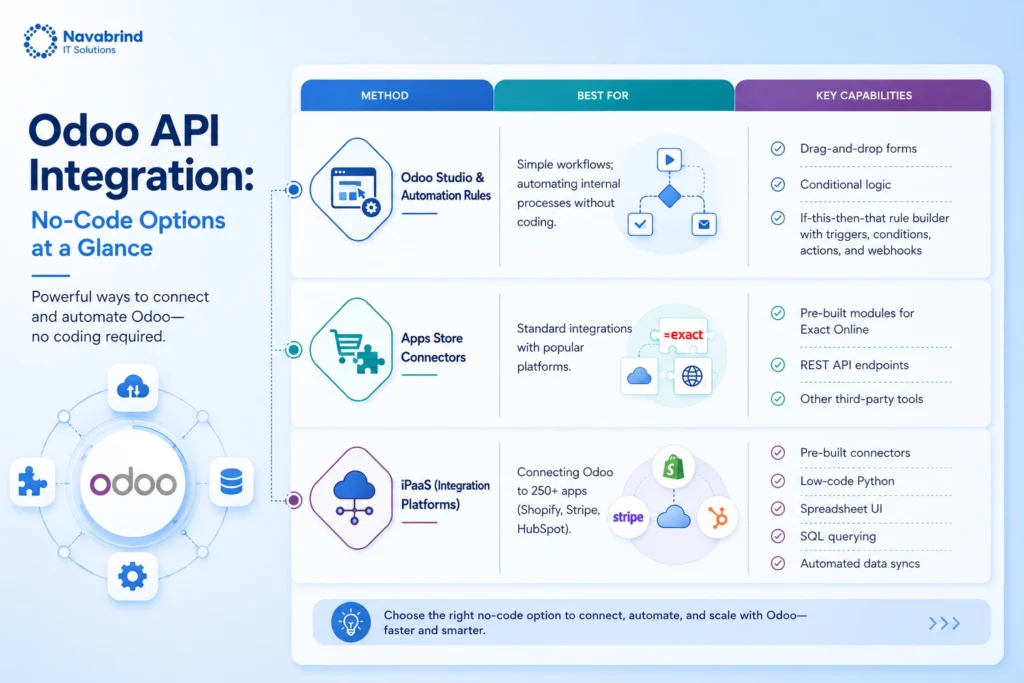
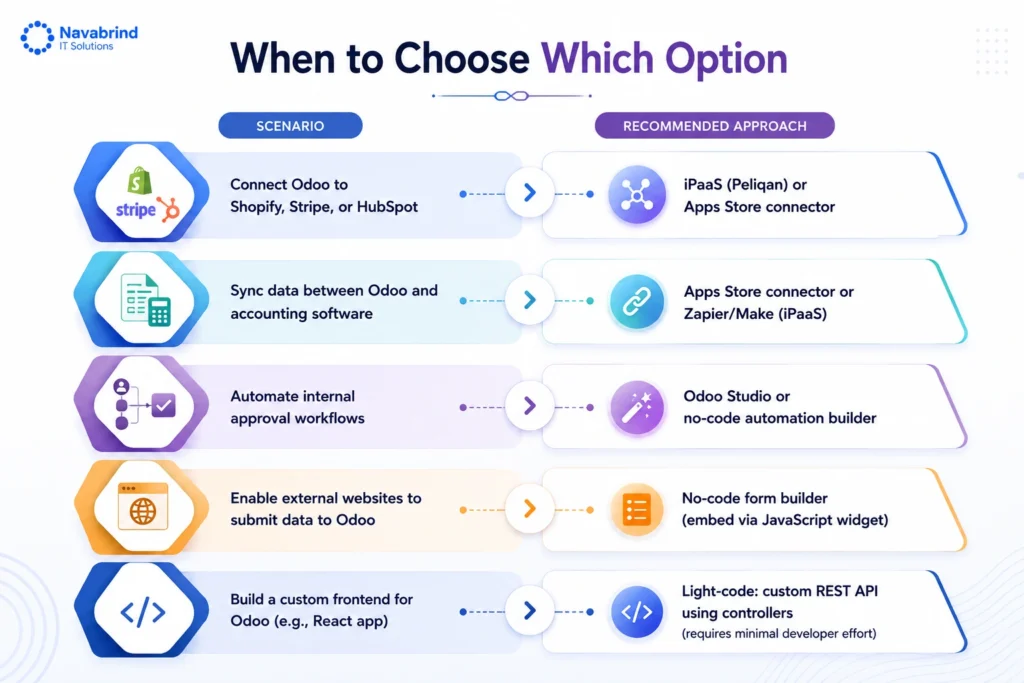
Yes. Numerous third-party applications provide ready-made connectors that support Odoo API integration without custom development. Platforms such as Shopify, WooCommerce, payment gateways, shipping carriers, and accounting solutions can connect through certified connectors, middleware, or integration platforms. When unique business requirements exist, custom Odoo integration delivers greater flexibility and supports specialized business workflows.
5.How much does Odoo integration typically cost for a mid-size US business?
The cost of Odoo API integration depends on the number of connected applications, data complexity, business processes, security requirements, and customization needs. A mid-size US business can expect project costs ranging from $5,000 to $50,000 or more, with enterprise-scale integrations exceeding that range. A detailed technical assessment helps define the project scope, implementation timeline, and investment required for successful Odoo ERP integration, Odoo automation, and Odoo workflow automation.
Schedule a conversation with us now!
Related Articles










 Post
Post Post
Post