The gap between process design and execution is where the P2P process breaks down. Frameworks like DMAIC define what should happen; execution demands a system that enforces discipline across the procure to pay process without gaps. This is where Odoo ERP becomes the operational layer that converts methodology into consistent action across the P2P business process.
Requisition to PO Automation: Eliminating Entry-Point Errors
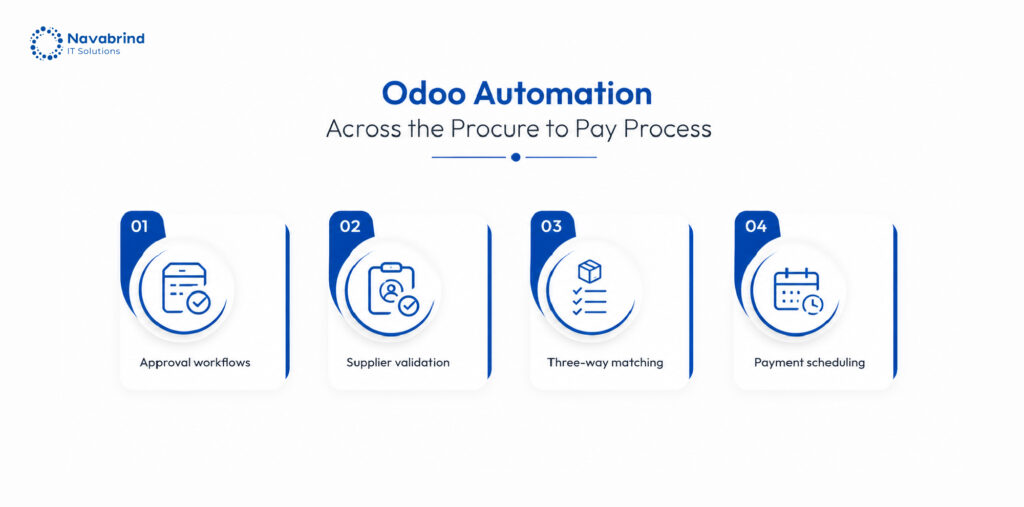
The first breakdown in the procure to pay process begins at requisition. Unapproved requests, missing budget checks, and inconsistent data create downstream disruption. Odoo’s purchase module enforces approval hierarchies, applies budget validation, and converts approved requests into purchase orders without re-entry of data. This removes a major source of defects in the procurement to payment flow and brings control at the very start of the P2P process.
Supplier Management and Qualification: Controlling the Source
Supplier inconsistency introduces risk across the P2P cycle. Disconnected vendor records, unverified suppliers, and contract deviations lead to pricing errors and compliance exposure. Odoo centralises vendor master data, ensuring that only approved and contracted suppliers participate in the procurement to payment workflow. This strengthens governance within the P2P business process and reduces maverick spend before it begins.
Three-Way Matching: The Critical Control Point
Mismatch between purchase orders, goods receipts, and invoices remains the largest source of friction in the procure to pay process.
Odoo enforces automated three-way matching, validating:
- Purchase order details
- Received quantities
- Supplier invoice data
This control mechanism protects the integrity of the P2P process, preventing overpayments, duplicate invoices, and reconciliation delays across the procurement to payment lifecycle.
Invoice Processing and Exception Handling: Keeping the P2P Cycle Moving
Invoice handling slows down the P2P business process when validation depends on human intervention. Errors, delays, and missed approvals create financial bottlenecks. Odoo captures invoice data, routes approvals based on predefined logic, and flags exceptions instantly. This ensures that discrepancies are addressed at the right stage, keeping the P2P cycle aligned with expected timelines.
Payment Scheduling and Execution: Closing the Loop
The final stage of the procure to pay process determines supplier trust and financial control. Missed deadlines lead to penalties, while delayed approvals block cash flow planning.
Odoo connects procurement with accounting, aligning payment execution with agreed terms. This enables organisations to:
- Honour supplier commitments
- Capture early payment discounts
- Maintain predictable cash flow across the procurement to payment journey
The Six Sigma Metrics Every Procurement Pro Should Track in Their P2P Cycle
In the P2P process, improvement starts with visibility. Six Sigma enforces a non-negotiable rule: if a process cannot be measured, it cannot be improved. The procure to pay business process demands quantifiable indicators that expose inefficiencies, highlight risk, and guide corrective action across the P2P cycle.
Here are the six KPIs that define a high-performing P2P business process:
Purchase Order Cycle Time: Speed of Procurement Execution
This metric tracks the time taken from requisition to approved purchase order. A prolonged cycle signals approval delays, unclear ownership, or fragmented workflows within the procure to pay process. Shorter cycle time reflects faster decision-making and stronger control across the P2P cycle.
Invoice Exception Rate: Quality of the P2P Process
This measures the percentage of invoices requiring intervention due to mismatches or missing data. A high exception rate points to defects in the procurement to payment flow incorrect purchase orders, supplier inconsistencies, or goods receipt gaps. This KPI serves as a direct indicator of quality within the P2P business process.
Three-Way Match Rate: Automation Maturity Indicator
This tracks the percentage of invoices matched against purchase orders and goods receipts without human involvement. A high match rate reflects a disciplined P2P process with minimal friction. It represents the benchmark for automation within the procure to pay business process, reducing delays and eliminating reconciliation effort.
On-Time Payment Rate: Supplier Trust and Financial Discipline
This KPI measures adherence to agreed payment timelines. Low performance affects supplier relationships, weakens negotiation leverage, and leads to missed discount opportunities. A stable on-time payment rate signals reliability across the procurement to payment lifecycle.
Maverick Spend Percentage: Control Over Procurement Channels
This tracks spend that bypasses approved procurement pathways. A high percentage indicates weak enforcement within the P2P cycle, exposing the organization to pricing inconsistencies and compliance risks. Reducing maverick spend strengthens governance in the procure to pay business process.
Cost Per Invoice: Efficiency Benchmark
This metric calculates the total cost incurred to process a single invoice from receipt to payment.
It captures labour, system overhead, and error correction effort across the P2P process. Lower cost per invoice reflects a streamlined procurement to payment flow with minimal rework.
Turning Metrics into Action with Odoo:
Tracking these KPIs requires continuous visibility across the P2P business process. Odoo ERP delivers integrated reporting and analytics that surface each of these metrics as transactions occur.
- Purchase order timelines are tracked across approval stages
- Invoice discrepancies are flagged and quantified
- Three-way match performance is monitored across suppliers
- Payment adherence is visible against agreed terms
- Spend patterns reveal off-contract purchases
- Processing cost indicators highlight inefficiencies
This eliminates reliance on disconnected spreadsheets and delayed reporting. Procurement teams gain immediate insight into the P2P cycle, enabling DMAIC’s “Measure” and “Control” phases to operate with accuracy and consistency.
Common P2P Process Defects: And How Six Sigma + Odoo Eliminates Them
A high-performing P2P process is defined by how effectively it prevents defects. In the procure to pay business process, defects are not isolated errors they are repeatable breakdowns that increase cost, delay execution, and weaken control across the P2P cycle. Below is a practical, defect-by-defect view of where the procurement to payment flow fails and how Six Sigma discipline, executed through Odoo ERP, removes these failure points.
Defect 1: Duplicate Invoices
Root Cause:
No validation mechanism to detect repeated invoice submissions from suppliers.
Impact on the P2P Process:
Duplicate payments, financial leakage, and reconciliation effort across the P2P cycle.
Six Sigma + Odoo Fix:
Odoo validates invoice numbers and vendor combinations before posting. Duplicate entries are flagged instantly, preventing errors from entering the procure to pay process.
Root Cause:
Requisition bypass and informal buying outside defined workflows.
Impact on the P2P Business Process:
Maverick spend, budget overruns, and lack of accountability in the procurement to payment chain.
Six Sigma + Odoo Fix:
Odoo enforces multi-level approval workflows tied to spend thresholds and budget availability. No transaction progresses within the P2P process without validation.
Defect 3: Mismatched Purchase Orders
Root Cause:
Manual purchase order creation with inconsistent or incomplete data.
Impact on the Procure to Pay Process:
Invoice mismatches, supplier disputes, and delays in the P2P cycle.
Six Sigma + Odoo Fix:
Purchase orders are generated from approved requisitions, removing data re-entry. This standardization strengthens accuracy across the procure to pay business process.
Defect 4: Late Payments and Penalty Charges
Root Cause:
Invoice processing delays and lack of visibility into due dates.
Impact on the P2P Process:
Penalty charges, missed discounts, and strained supplier relationships within the procurement to payment flow.
Six Sigma + Odoo Fix:
Odoo schedules payments based on due dates and triggers alerts for upcoming obligations. This ensures consistency across the P2P cycle and protects financial discipline.
Defect 5: Supplier Data Errors
Root Cause:
Decentralised and unvalidated vendor master data.
Impact on the P2P Business Process:
Incorrect purchase orders, invoice mismatches, and compliance risks across the procure to pay process.
Six Sigma + Odoo Fix:
Supplier records are centralised with validation rules that enforce data accuracy. Clean data flows across each stage of the procurement to payment lifecycle.
Defect 6: Lack of Audit Trail
Root Cause:
Email-based approvals and offline decision-making.
Impact on the P2P Process:
Limited traceability, audit risk, and weak governance within the P2P cycle.
Six Sigma + Odoo Fix:
Each action within Odoo is timestamped and linked to user activity. This creates a verifiable audit trail across the procure to pay business process, strengthening compliance and accountability.
Building Your Six Sigma P2P Roadmap: A Practical Starter Playbook
Transforming the P2P process does not demand a large-scale overhaul. It requires focused execution across the procure to pay business process, backed by measurement, accountability, and the right system. This 90-day playbook outlines how procurement teams can stabilise and optimise the P2P cycle using Six Sigma principles and Odoo ERP.
Month 1: Define and Measure
Start by mapping your current procure to pay process from requisition to payment. Document how transactions move across teams, where approvals occur, and where delays surface within the P2P cycle. Identify the top three defect categories impacting your P2P business process with duplicate invoices, approval gaps, mismatched purchase orders, or supplier inconsistencies.
Next, establish baseline performance across the six critical KPIs:
- Purchase order cycle time
- Invoice exception rate
- Three-way match rate
- On-time payment rate
- Maverick spend percentage
- Cost per invoice
Odoo’s reporting layer captures these metrics across the procurement to payment flow, giving procurement teams immediate visibility into current performance levels.
Month 2: Analyse and Improve
With baseline data in place, shift focus to root cause analysis. Examine high-frequency defects within the P2P process and trace them back to process gaps, data inconsistencies, or approval breakdowns.
Configure Odoo to address these issues through:
- Approval workflows aligned with spend thresholds
- Validation rules for supplier and invoice data
- Automated three-way matching controls
- Workflow adjustments that remove redundant steps
Run a pilot within one procurement category or business unit. This controlled rollout allows teams to test improvements within a defined scope of the procure to pay business process before wider adoption.
Month 3: Control and Scale
Sustaining improvements requires visibility and governance across the P2P cycle.
Set up dashboards in Odoo to monitor KPI performance continuously. Track deviations in the P2P business process, identify emerging risks, and act before defects spread.
Establish a monthly governance review focused on:
- KPI performance trends
- Defect recurrence
- Supplier performance within the procurement to payment flow
With controls in place, extend the improved procure to pay process across the organisation. Standardisation ensures that gains achieved in the pilot phase translate into consistent execution at scale.
Key Takeaway
The P2P process is not just an operational requirement—it is a direct lever for financial control and business performance. When the procure to pay process is engineered with Six Sigma discipline and executed through Odoo ERP, it moves beyond transaction handling and becomes a driver of consistency, cost control, and supplier accountability across the P2P business process.
Procurement professionals who adopt this playbook shift their focus away from constant issue resolution. Instead of chasing invoice mismatches or approval delays, they gain the ability to strengthen supplier relationships, reduce cost leakage, and influence outcomes across the procurement to payment lifecycle. The P2P cycle evolves into a controlled environment where performance is measurable, deviations are contained, and decisions are data-backed.
Looking ahead, the procure to pay business process will continue to evolve as AI and predictive analytics mature within platforms like Odoo. The shift is clear—from reactive correction to anticipatory execution. Organisations that establish Six Sigma maturity within their P2P process today will lead this transition, operating with foresight, control, and sustained competitive advantage across the P2P cycle.
Schedule a conversation with us now!
Related Articles







 Post
Post Post
Post