PIM integration in Modern Ecommerce
As ecommerce businesses expand across marketplaces, websites, mobile applications, supplier networks, and digital sales channels, managing product information becomes increasingly challenging. PIM integration addresses this challenge by creating a connected ecosystem that gathers, enriches, governs, and distributes product data from a centralized location. Without PIM integration, organizations face inconsistent product descriptions, inaccurate specifications, duplicate records, delayed catalog updates, and lost revenue opportunities. Growing product assortments, multilingual content requirements, digital assets, pricing updates, and channel-based variations make it difficult to manage disconnected systems. PIM-ERP integration strengthens data consistency by linking operational information with product content, enabling smoother workflows across procurement, inventory, and merchandising teams. PIM E-commerce integration ensures that enriched product information reaches online storefronts, marketplaces, and customer touchpoints with accuracy and speed. PIM and DAM integration connect digital assets such as images, videos, technical documents, and marketing materials to product records, improving content quality across channels. Through effective PIMCore implementation and adherence to PIM integration best practices, businesses establish a trusted source for product information, enhance customer experiences, reduce operational bottlenecks, and create a scalable foundation for sustained ecommerce growth.
Understanding the Role of PIM in Digital Commerce
Product Information Management serves as the foundation of digital commerce by organizing, enriching, governing, and distributing product content across sales channels, supplier networks, marketplaces, mobile applications, and commerce platforms. As organizations expand product portfolios and enter additional markets, PIM integration enables consistent product experiences regardless of where buyers engage with a brand. A robust PIM platform manages attributes, specifications, translations, digital assets, pricing references, product relationships, and content governance from a centralized environment. PIM ERP integration connects operational records with enriched product content, creating alignment between inventory, procurement, merchandising, and sales functions. PIM E-commerce integration delivers accurate product information to online stores, helping shoppers make confident purchasing decisions that contribute to higher conversion rates and reduced returns. PIM and DAM integration links product records with images, videos, certifications, and marketing assets, strengthening catalog quality across touchpoints. Through disciplined PIM core implementation and adherence to PIM integration best practices, businesses establish data consistency, accelerate product launches, reduce administrative overhead, improve channel performance, and create measurable revenue opportunities through superior product experiences.
PIM ERP integration: Connecting Business Operations with Product Data
PIM ERP integration creates a connected framework that links operational business data with enriched product information, enabling organizations to manage product lifecycles with greater control and consistency. In this model, ERP systems handle inventory, procurement, supplier records, pricing structures, production data, and order management, whereas PIM integration governs product attributes, descriptions, specifications, classifications, digital content, and channel-ready information. When these platforms work together, manufacturers, retailers, and distributors gain a dependable flow of product data across departments, reducing duplication and preventing information gaps. PIM ERP integration strengthens collaboration between merchandising, operations, sales, and supply chain teams by ensuring product updates originate from a trusted source and reach connected systems without delays. This approach minimizes repetitive data handling, reduces catalog errors, and supports accurate inventory visibility and pricing governance across sales channels. Combined with PIM E-commerce integration and PIM and DAM integration, organizations can publish enriched product experiences at scale. Successful PIM core implementation supported by PIM integration best practices drives operational excellence, faster product launches, stronger data governance, and measurable commercial growth.
PIM E-commerce Integration: Powering Seamless Customer Experiences
PIM E-commerce integration enables businesses to distribute enriched, accurate, and channel-ready product information across e-commerce platforms, marketplaces, mobile commerce applications, and digital sales ecosystems from a centralized product data environment. As brands expand across Shopify, Magento, WooCommerce, Amazon, eBay, and other commerce channels, maintaining consistency becomes a significant challenge without a connected framework. PIM integration solves this challenge by synchronizing product attributes, descriptions, specifications, categories, pricing references, and digital assets across touchpoints, ensuring shoppers receive dependable information regardless of where they interact with a product. This consistency strengthens buyer confidence, improves conversion performance, and reduces product-related returns. PIM ERP integration complements this process by aligning operational records with catalog content, creating stronger coordination between inventory management and online merchandising. PIM and DAM integration enriches product experiences through organized images, videos, user guides, and marketing assets. Through disciplined PIM core implementation and adherence to PIM integration best practices, organizations accelerate product introductions, strengthen search visibility, improve product discoverability, maintain catalog accuracy across channels, and create revenue opportunities through exceptional digital commerce experiences.
PIM and DAM integration: Managing Product Data and Digital Assets Together
PIM and DAM integration creates a connected environment where product information and digital assets are managed from a centralized source, enabling organizations to maintain consistency across ecommerce channels, marketplaces, catalogs, partner portals, and marketing initiatives. Product data alone is not enough to influence purchasing decisions; buyers expect high-quality images, demonstration videos, technical documents, specification sheets, certifications, brochures, and brand content that support product evaluation. Through PIM integration, these assets remain linked to the correct products, preventing content fragmentation and reducing the risk of outdated or misplaced files appearing across sales channels. PIM and DAM integration strengthens product storytelling by ensuring marketing teams, merchandising teams, and channel managers access approved assets from a controlled repository. This approach eliminates duplicate content, improves asset governance, and simplifies content distribution across digital touchpoints. PIM ERP integration contributes operational accuracy, whereas PIM E-commerce integration ensures enriched content reaches storefronts and marketplaces with consistency. Supported by effective PIM core implementation and PIM integration best practices, businesses achieve stronger brand presentation, faster catalog enrichment, improved content quality, and greater revenue potential through engaging product experiences.
Pimcore Implementation as a Unified Commerce Ecosystem
Pimcore Implementation enables organizations to establish a connected commerce ecosystem by bringing product information, digital assets, content management, e-commerce operations, and enterprise data into a centralized environment. As businesses manage expanding product catalogs, multiple sales channels, supplier networks, and growing customer expectations, disconnected applications create operational challenges that impact growth and profitability. Pimcore serves as a robust foundation for PIM integration by connecting ERP platforms, CMS environments, e-commerce storefronts, marketplaces, and digital asset repositories within a unified data framework. Through PIM ERP integration, organizations align inventory records, procurement data, pricing structures, and product content, creating consistency across departments. PIM E-commerce integration ensures enriched product information reaches digital commerce channels with accuracy and consistency, strengthening customer engagement and conversion performance. PIM and DAM integration associates product records with images, videos, technical documentation, and marketing resources, creating richer buying experiences. Effective Pimcore Implementation centralizes governance, simplifies data management, supports business expansion, and reduces operational complexity across retail, manufacturing, and B2B commerce environments. Combined with PIM integration best practices, businesses gain stronger control over product information, faster catalog updates, improved channel performance, and sustained commercial growth.
Common Challenges Businesses Face During PIM Integration
PIM integration delivers substantial business value, yet organizations frequently encounter challenges during implementation when product information exists across disconnected departments, spreadsheets, supplier databases, ecommerce platforms, ERP environments, and marketing systems. Data silos create conflicting records that make product governance difficult and increase the likelihood of inaccurate content reaching customers. Inconsistent descriptions, specifications, pricing references, and categorization standards across channels can weaken brand credibility and impact conversion performance. Integration complexity becomes another obstacle when businesses rely on legacy applications that were not designed to exchange information with contemporary commerce ecosystems. As product catalogs expand, managing thousands of attributes, variants, classifications, images, videos, technical documents, and marketing assets requires disciplined governance and well-defined workflows. PIM ERP integration and PIM E-commerce integration demand careful planning to maintain data consistency throughout connected systems, whereas PIM and DAM integration requires organized asset structures and content ownership. Successful PIM core implementation depends on strong stakeholder alignment, user training, process standardization, and adherence to PIM integration best practices, ensuring teams embrace the platform and maximize long-term business value, operational control, and revenue growth.
PIM integration best practices for Long-Term Success
Long-term success with PIM integration depends on establishing a disciplined framework that governs how product information is created, enriched, approved, distributed, and maintained across the organization. A well-defined product data governance strategy assigns ownership, accountability, and validation processes that protect data accuracy as catalogs grow. Standardized attributes, classifications, naming conventions, and taxonomies create consistency across product categories, making information easier to manage and distribute through multiple channels. PIM ERP integration becomes significantly stronger when operational records and product content adhere to shared data standards, reducing discrepancies across business systems. PIM and DAM integration benefits from organized asset structures that connect images, videos, technical documentation, and marketing resources to the appropriate product records. PIM E-commerce integration performs at a higher level when APIs and middleware solutions support reliable data exchange between commerce platforms, marketplaces, and enterprise applications. Continuous monitoring of data quality, synchronization accuracy, content completeness, and integration performance helps identify issues before they impact customer experiences. Through disciplined PIM core implementation and adherence to PIM integration best practices, organizations eliminate data silos, strengthen governance, support expansion initiatives, and create a sustainable foundation for revenue growth and operational excellence.
Business Benefits of End-to-End PIM integration
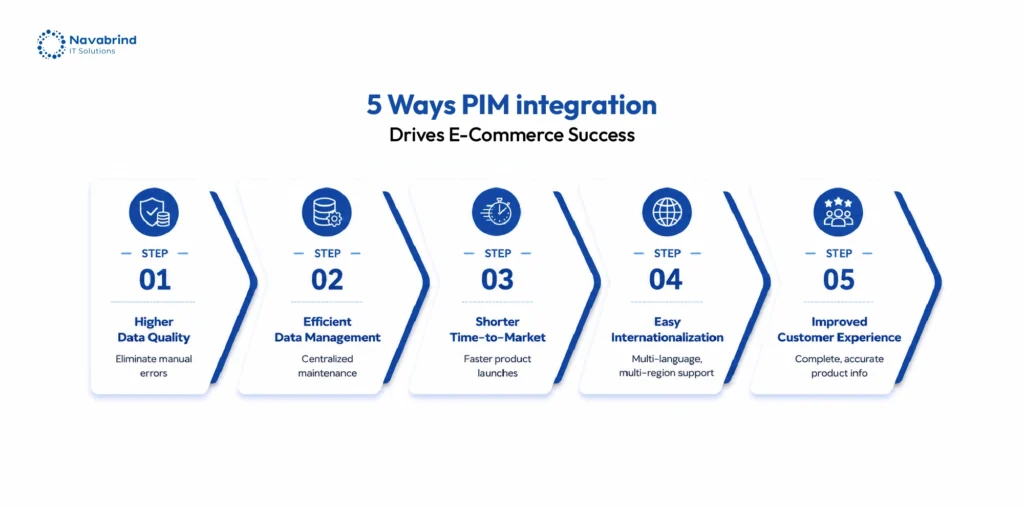
End-to-end PIM integration delivers measurable business value by creating a connected product information ecosystem that supports consistent experiences across websites, marketplaces, mobile applications, partner portals, and digital commerce channels. When product data flows through a centralized framework, customers gain access to accurate descriptions, specifications, images, pricing information, and supporting content throughout their buying journey, strengthening trust and purchase confidence. Organizations benefit from faster catalog updates and accelerated product launch cycles because information can be enriched, approved, and distributed from a single source rather than managed across disconnected platforms. PIM ERP integration strengthens operational alignment by connecting inventory, procurement, and product content, reducing administrative effort and lowering operational expenses. PIM E-commerce integration ensures product information reaches commerce channels with consistency, supporting multichannel and global expansion initiatives. PIM and DAM integration enriches product experiences by connecting digital assets with catalog data, enabling stronger storytelling and engagement. Through effective PIM core implementation and adherence to PIM integration best practices, businesses improve data quality, support personalization initiatives, enable AI-driven commerce experiences, increase workforce productivity, and create sustainable revenue growth through superior product information management.
The Future of PIM Integration in Ecommerce
The evolution of ecommerce is accelerating the demand for connected data ecosystems that can support growing product catalogs, expanding sales channels, and rising customer expectations. PIM integration is positioned at the center of this transformation, enabling organizations to manage, enrich, and distribute product information across increasingly complex digital environments. Artificial intelligence and automation are reshaping Product Information Management by assisting with content enrichment, product classification, attribute mapping, data validation, translation, and catalog optimization, allowing businesses to manage product information with greater consistency and speed. Headless commerce architectures and API-driven connectivity are creating flexible commerce ecosystems where product data can flow across websites, mobile applications, marketplaces, customer portals, and emerging digital touchpoints without operational bottlenecks. PIM ERP integration, PIM E-commerce integration, and PIM and DAM integration work together to create a connected framework that supports business expansion and channel growth. Through disciplined PIM core implementation and adherence to PIM integration best practices, organizations establish a trusted product information foundation that supports innovation, strengthens customer experiences, improves operational performance, and creates a scalable path for long-term e-commerce growth and commercial success.
Frequently Asked Questions
1.What is the difference between PIM ERP integration and PIM e-commerce integration?
PIM ERP integration connects product information management with enterprise resource planning systems that manage inventory, procurement, pricing, supplier data, production records, and operational processes. PIM E-commerce integration focuses on distributing enriched product information to e-commerce websites, marketplaces, mobile commerce applications, and digital sales channels. Together, they create a connected framework where operational data and customer-facing product content remain aligned across the business.
2.How long does PIM integration implementation take for an ecommerce business?
The timeline for PIM integration depends on factors such as catalog size, product complexity, number of connected systems, data quality, customization requirements, and migration scope. Small ecommerce projects may take a few weeks, whereas enterprise-level PIM core implementations involving ERP, DAM, CMS, and multiple commerce channels can take several months. Proper planning, data preparation, and adherence to PIM integration best practices help accelerate deployment and reduce implementation risks.
3.How does integrating PIM with DAM improve product content and digital asset management?
PIM and DAM integration connects product information with images, videos, brochures, technical documents, certifications, and marketing resources from a centralized repository. This approach ensures that digital assets remain linked to the correct product records, improving content consistency across channels. Organizations benefit from stronger product storytelling, reduced asset duplication, improved governance, and faster content distribution throughout ecommerce ecosystems.
4.What are the best practices for PIM integration to avoid data silos across channels?
Successful PIM integration best practices include establishing data governance policies, standardizing product attributes and taxonomies, defining ownership responsibilities, implementing validation workflows, maintaining data quality controls, and creating reliable connections between ERP, DAM, CMS, and ecommerce platforms. Continuous monitoring and performance reviews help prevent disconnected information from developing across channels and departments.
5.How does Pimcore implementation help connect ERP, CMS, and ecommerce platforms in one ecosystem?
Pimcore Implementation acts as a centralized platform that unifies product information, digital assets, content management, and commerce operations. Through PIM ERP integration, PIM E-commerce integration, and PIM and DAM integration, Pimcore enables data exchange between business systems, creating consistency across departments and customer touchpoints. This connected environment supports catalog management, content governance, channel expansion, operational efficiency, and scalable business growth from a single source of product information.
Schedule a conversation with us now!
Related Articles









 Post
Post