Why B2B Ecommerce Is a Different Beast
B2B transactions carry layers of operational demands that standard retail platforms fail to support. Purchasing decisions move through procurement teams, finance departments, regional managers, and approval chains before an order reaches checkout. A Magento B2B ecosystem handles this buying cycle through company accounts, role-based access, quotation workflows, and negotiated catalog pricing that match enterprise procurement behavior.
Unlike retail ecommerce, B2B Magento development focuses on volume purchasing, recurring orders, tax structures, credit limits, and contract-led pricing models. Buyers expect fast reordering, account-level permissions, invoice management, and catalog visibility tied to commercial agreements. Without these capabilities, sales teams depend on spreadsheets, email approvals, and disconnected systems that slow revenue movement.
Businesses operating on retail-first platforms struggle with fragmented operations and delayed order processing. Magento B2B commerce addresses these gaps through scalable workflows, procurement controls, and Magento 2 B2B features designed for high-volume trade operations. A Magento B2B marketplace creates stronger purchasing experiences without operational friction or sales leakage.
Where Magento Software Sits in the B2B Landscape
Magento software evolved from an open-source ecommerce platform into a commerce ecosystem trusted by global manufacturers, distributors, wholesalers, and multi-brand enterprises. Following Adobe’s acquisition, Magento B2B commerce expanded its enterprise capabilities with procurement workflows, account management tools, advanced catalog handling, and scalable infrastructure suited for complex trading operations.
The strength of Magento B2B lies in its adaptable architecture. Businesses can shape purchasing journeys, pricing models, approval flows, and integrations around operational requirements instead of reshaping processes to fit platform limitations. This flexibility makes B2B Magento development valuable for organizations managing custom pricing agreements, regional catalogs, distributor networks, or large SKU inventories.
Compared with rigid SaaS commerce platforms, Magento ecommerce website development supports stronger customization freedom and broader system integration capabilities. The platform serves mid-sized companies, enterprise manufacturers, industrial suppliers, and wholesale brands seeking operational control without platform restrictions. Magento 2 B2B features and B2B module Magento 2 extensions give businesses the scalability required to support expansion across markets, product lines, and procurement channels.
The Native Magento 2 B2B Features Worth Understanding
- Magento B2B commerce includes procurement capabilities designed for account-driven purchasing environments. Company accounts allow organizations to assign departments, purchasing teams, finance users, and approval authorities within one business profile. These Magento 2 B2B features mirror enterprise buying structures, giving organizations tighter control over procurement activity and spending visibility.
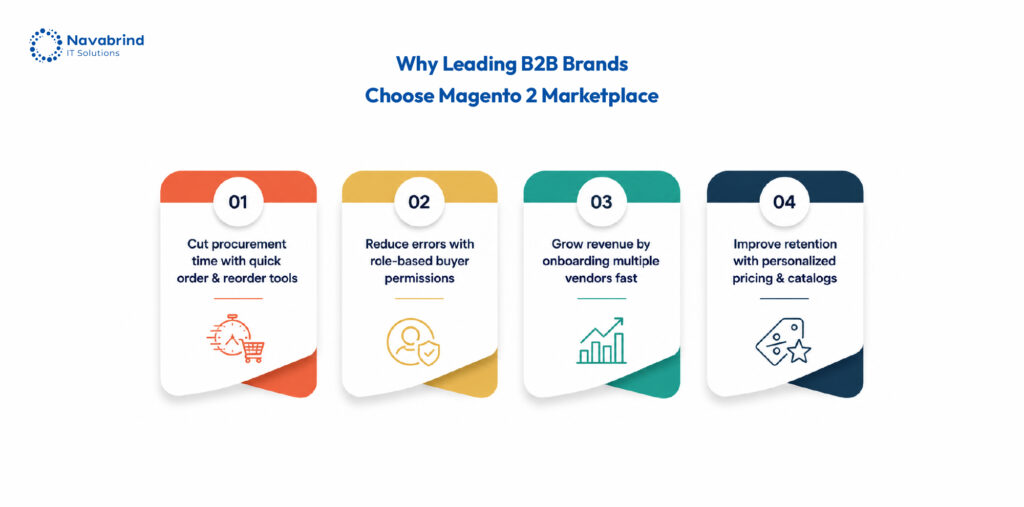
- Shared catalogs allow businesses to present customer-level pricing, curated product access, and contract-based assortments across different buyer groups. This capability strengthens account retention and supports relationship-led selling strategies across a Magento B2B marketplace.
- Requisition lists and quick-order tools simplify repeat purchasing for wholesalers and distributors managing recurring orders. Buyers can upload SKUs, duplicate previous purchases, and process high-volume transactions with reduced purchasing friction.
- Negotiated quotation workflows support procurement-led transactions involving pricing discussions, purchase approvals, and invoice-based ordering. Through B2B Magento development, businesses can configure approval chains aligned with internal procurement policies.
- Adobe Commerce extends Magento software with enterprise-grade B2B functionality, stronger scalability, advanced segmentation, and expanded operational control beyond the open-source ecosystem.
The B2B Module Magento 2 Ecosystem: Extending the Native Capability
- Magento B2B commerce delivers a strong operational foundation, though enterprise procurement environments frequently require functionality beyond the standard feature stack. This is where the B2B module Magento 2 ecosystem becomes valuable. Extensions expand platform capability across procurement automation, account management, pricing governance, and backend connectivity.
- Businesses investing in Magento ecommerce website development frequently adopt modules for ERP synchronization, CRM connectivity, CPQ workflows, distributor portals, sales-agent management, and account self-service functionality. These additions strengthen operational consistency across purchasing, fulfillment, finance, and customer management processes inside a Magento B2B marketplace.
- Selecting extensions requires technical evaluation beyond feature checklists. Stable code architecture, version compatibility, security maintenance, vendor credibility, and release frequency influence long-term platform stability. Weak module quality can create operational conflicts, checkout failures, or upgrade complications that impact revenue continuity.
- B2B Magento development teams must assess whether operational requirements justify custom functionality or whether an extension delivers sufficient business value. Custom development suits proprietary workflows, enterprise procurement models, and differentiated purchasing experiences that standard modules cannot accommodate.
Magento B2B Marketplace Architecture: Multi-Vendor Considerations
A standard Magento B2B implementation focuses on transactions between one business and its buyers. A Magento B2B marketplace introduces a multi-vendor structure where suppliers, distributors, manufacturers, and procurement partners operate within one commerce environment. This shift increases operational complexity across catalog management, financial workflows, access control, and order orchestration.
Vendor onboarding requires structured approval systems for supplier registration, product uploads, compliance validation, and account verification. B2B Magento development teams must create governance models that maintain catalog accuracy across large supplier networks without slowing marketplace expansion.
Managing catalog consistency across multiple sellers becomes critical for buyer trust. Magento 2 B2B features combined with marketplace extensions help standardize product attributes, pricing visibility, SKU structures, technical documentation, and procurement classifications across vendor submissions.
Operational infrastructure extends beyond storefront functionality. A Magento B2B marketplace requires commission handling, invoice distribution, vendor settlements, shipment routing, tax allocation, and multi-party order tracking. Businesses evaluating marketplace expansion through Magento software must balance extension-based deployment against custom marketplace architecture based on transaction complexity, supplier volume, and procurement requirements.
Magento Ecommerce Website Development for B2B: What the Build Involves
Magento ecommerce website development for B2B operations requires architectural planning far beyond storefront design. Product structures must support bulk purchasing, configurable catalogs, technical specifications, procurement filtering, and account-driven buying journeys. Category hierarchy, attribute mapping, and variant organization influence product discoverability, quotation speed, and procurement accuracy across a Magento B2B environment.
Customer segmentation forms another critical layer in B2B Magento development. Businesses require account-level pricing, contract-based discounts, regional catalogs, tax handling, credit terms, and purchasing permissions aligned with commercial agreements. Magento 2 B2B features support these workflows through customer groups and account governance structures.
Operational value depends heavily on ERP and CRM integration. Magento software must exchange inventory, invoices, order data, procurement records, and customer information across enterprise systems without synchronization gaps or duplicated workflows.
Large B2B catalogs demand optimized search infrastructure, database tuning, indexing strategies, and scalable caching architecture. Businesses selecting Magento B2B commerce partners should evaluate procurement experience, integration capability, marketplace expertise, and enterprise commerce execution across complex operational environments.
Total Cost of Ownership: What Magento B2B Commerce Costs
Magento B2B commerce investment extends far beyond platform installation. Businesses evaluating Magento software must account for licensing, infrastructure, development, integrations, operational support, and long-term platform management before estimating commercial viability.
Adobe Commerce licensing varies based on deployment model, annual revenue, and enterprise requirements. Open-source Magento reduces licensing expenditure, though businesses still require substantial investment in B2B Magento development, security management, integrations, and operational scalability.
Infrastructure requirements increase as catalog complexity, account segmentation, procurement workflows, and transaction volume expand. Magento ecommerce website development for B2B environments demands scalable hosting architecture, search infrastructure, database optimization, and performance monitoring capable of supporting high-volume procurement activity.
Development expenditure frequently includes ERP integration, CRM connectivity, custom approval workflows, quotation systems, account-level pricing logic, and B2B module Magento 2 extensions. Ongoing costs include platform upgrades, security patches, extension renewals, testing environments, and operational maintenance.
A realistic ownership model measures operational efficiency, procurement acceleration, revenue growth, and process consolidation instead of evaluating Magento B2B commerce through implementation cost alone.
Who Magento B2B Is and Is Not Right For
Magento B2B commerce delivers substantial commercial value for businesses managing complex procurement environments, large product catalogs, multi-location operations, distributor networks, and account-based pricing models. Manufacturers, wholesalers, industrial suppliers, automotive businesses, and enterprise distributors frequently choose Magento software because the platform supports operational customization across purchasing, fulfillment, and customer management workflows.
Businesses handling contract pricing, quotation-driven sales, procurement approvals, or multi-channel commerce operations gain stronger operational control through Magento 2 B2B features and B2B Magento development capabilities. Magento B2B marketplace models also suit organizations coordinating supplier ecosystems or multi-vendor procurement environments.
Smaller businesses with limited product catalogs, minimal customization needs, or lower transaction complexity may find Magento ecommerce website development financially demanding compared with lightweight commerce platforms. Infrastructure, integrations, and ongoing technical management require long-term operational commitment.
B2B Magento development remains well-established across manufacturing, industrial equipment, healthcare supply, electronics distribution, construction materials, and wholesale commerce sectors. Businesses evaluating Magento B2B commerce should understand that platform flexibility introduces implementation complexity requiring experienced technical leadership, integration planning, and operational discipline.
Getting the Implementation Right: Key Decisions Before You Build
Successful Magento B2B commerce implementation starts with platform alignment. Businesses must evaluate transaction complexity, procurement workflows, integration demands, scalability expectations, and operational ownership before selecting Adobe Commerce or open-source Magento software. Enterprise procurement environments with extensive account structures, negotiated pricing, and multi-channel operations frequently require the broader commerce capabilities available through Adobe Commerce.
Integration planning shapes long-term operational performance. ERP synchronization, inventory visibility, customer data management, invoicing, and procurement workflows should receive priority during early-stage B2B Magento development. Secondary integrations can follow phased deployment without disrupting operational continuity or creating fragmented processes.
Data migration requires disciplined planning across catalogs, pricing structures, customer accounts, historical orders, and procurement records. Poor migration governance creates catalog inconsistencies, account conflicts, and delayed launch timelines within Magento ecommerce website development projects.
Selecting a Magento B2B development partner requires evaluation beyond project pricing. Businesses should assess enterprise commerce experience, Magento B2B marketplace expertise, integration capability, testing methodology, and post-launch operational support. Implementation success should measure procurement speed, account retention, order accuracy, operational efficiency, and revenue expansion across the Magento B2B ecosystem.
Frequently Asked Questions
1.What is Magento B2B and how does it work?
Magento B2B is an enterprise commerce framework designed for wholesalers, manufacturers, distributors, and procurement-driven businesses. Magento B2B commerce supports company accounts, account-based pricing, quotation workflows, purchase approvals, bulk ordering, and procurement management. Magento software allows businesses to manage complex buying relationships through customizable workflows, integrations, and account structures aligned with commercial operations.
2.How to set up a B2B marketplace in Magento 2?
A Magento B2B marketplace requires vendor onboarding systems, multi-seller catalog management, commission handling, procurement workflows, and supplier dashboards. Businesses typically combine Magento 2 B2B features with marketplace extensions or custom B2B Magento development to support supplier management, catalog approvals, order routing, and settlement operations across multi-vendor commerce environments.
3.What are the key features of Magento 2 B2B?
Magento 2 B2B features include company accounts, shared catalogs, customer-group pricing, requisition lists, negotiated quotations, quick ordering, procurement approvals, purchase order workflows, and account-level permissions. These capabilities support enterprise procurement operations and high-volume purchasing environments.
4.How does Magento 2 B2B marketplace work for suppliers and buyers?
A Magento B2B marketplace connects suppliers, distributors, and procurement buyers within one commerce platform. Suppliers manage product catalogs, pricing, inventory, and order fulfillment through vendor portals. Buyers access account-based pricing, procurement approvals, bulk ordering tools, and quotation workflows through the marketplace interface.
5.What is the difference between Magento B2B and Magento B2C?
Magento B2B commerce focuses on procurement workflows, negotiated pricing, account hierarchies, bulk transactions, and long-term commercial relationships. B2C commerce centers around individual consumers, faster checkout journeys, promotional campaigns, and retail purchasing behavior. B2B Magento development requires stronger operational integration, procurement management, and account governance compared with standard retail ecommerce implementations.
Schedule a conversation with us now!
Related Articles









 Post
Post Post
Post