Indian manufacturers are no longer choosing ERP software based on brand recognition alone. The decision now shapes production control, inventory visibility, vendor coordination, compliance management, costing accuracy, and delivery performance. Business owners running factories between ₹5 crore and ₹500 crore face mounting pressure from GST-driven reporting demands, tighter margins, export expectations, and rising operational complexity. That is why the debate around Odoo vs SAP vs Tally has become one of the defining technology discussions across Indian manufacturing.
Some businesses continue relying on Tally because finance teams know the system well. Others look at SAP as the enterprise benchmark yet struggle with investment size and implementation complexity. A growing segment is exploring Odoo manufacturing India solutions as a practical middle path that connects production, inventory, sales, procurement, quality, and accounting within one ERP environment.
This blog post is written for manufacturers searching for the best ERP for Indian manufacturers, a reliable Tally alternative for manufacturing, or a practical SAP alternative India solution for factory growth. It explains where each platform fits within ERP for factory management India requirements.
Understanding the Contenders: What Each Platform Was Actually Built to Do
The debate around Odoo vs SAP vs Tally becomes confusing when manufacturers compare platforms created for completely different business environments. Tally entered the Indian market as an accounting-first system focused on bookkeeping, GST filing, vouchers, taxation, and financial reporting. Indian accountants trust it because the learning curve remains low and statutory workflows feel familiar. Yet manufacturers searching for ERP for factory management India requirements soon discover its limitations. Production scheduling, machine planning, quality checkpoints, multi-level BOM management, and plant coordination sit outside Tally’s original design philosophy, which is why businesses now seek a Tally alternative for manufacturing.
SAP approaches the market from the opposite direction. Large global enterprises adopted SAP to manage procurement, finance, supply chains, compliance, and multinational operations across complex structures. Its process depth attracts enterprise groups, though implementation cycles, consulting costs, and infrastructure investment place pressure on mid-sized Indian manufacturers exploring a SAP alternative India option.
Odoo manufacturing India adoption continues rising because the platform fits growth-stage factories seeking connected operations without enterprise-scale overhead. Inventory, MRP, procurement, maintenance, sales, CRM, and finance operate within one ecosystem. The platform still depends heavily on implementation quality, and community editions lack several business-critical capabilities. The key insight is simple: the best ERP for Indian manufacturers depends less on software popularity and far more on operational maturity, scale, and business direction.
Is Odoo Better Than Tally for Manufacturing?
The question “Is Odoo better than Tally for manufacturing?” appears in almost every ERP discussion with Indian factory owners. Yet the comparison misses a larger point. Tally and Odoo were created for completely different operational demands. Tally earned its reputation through accounting reliability, GST compliance, TDS handling, payroll management, and accountant familiarity. For small businesses focused on finance entries and statutory reporting, the platform remains dependable and cost-conscious.
The challenge begins when manufacturing complexity increases. Tally cannot manage bill of materials structures, routing logic, production orders, machine-wise planning, or inspection workflows expected from ERP for factory management India environments. Inventory visibility remains limited to stock ledgers without lot traceability or multi-warehouse intelligence. As operations grow, manufacturers compensate through Excel sheets, WhatsApp coordination, phone calls, and disconnected approvals. That patchwork eventually slows production decisions and weakens inventory control.
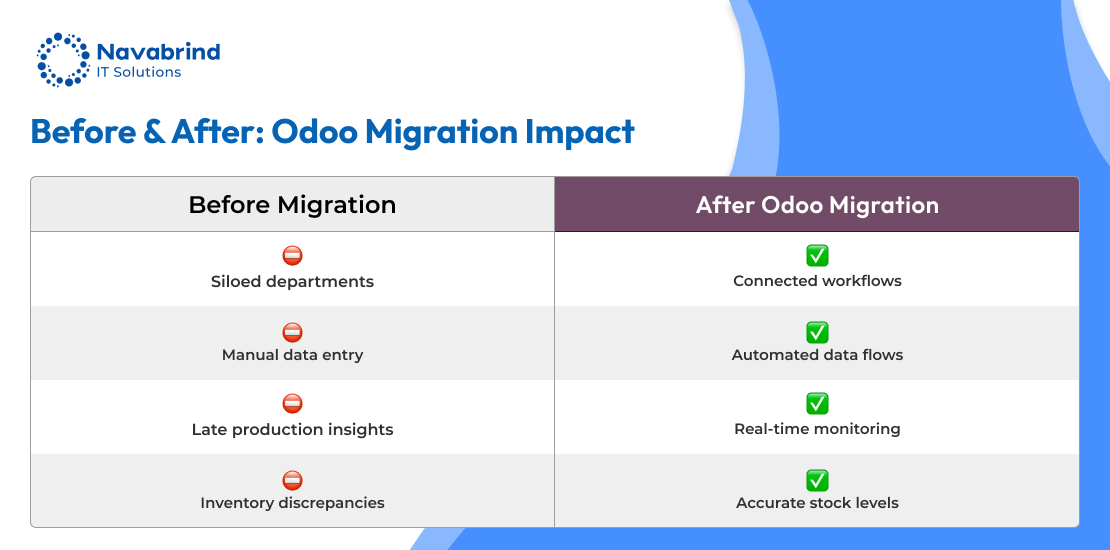
This is where Odoo manufacturing India adoption gains momentum. Odoo supports production planning, procurement, inventory movement, maintenance, quality checks, e-invoicing, e-way bills, and GSTR reporting within one connected ecosystem. Some businesses still retain Tally for accounting continuity during transition phases, which can make sense temporarily. Yet manufacturers searching for a Tally alternative for manufacturing rarely move back after experiencing plant-level visibility through Odoo. In the Odoo vs SAP vs Tally debate, the verdict becomes straightforward for growing factories. Tally supports accounting. Odoo supports manufacturing businesses.
Why Is SAP Too Expensive for Small Manufacturers in India?
- In the Odoo vs SAP vs Tally discussion, SAP carries unmatched brand prestige among Indian manufacturers. Many business owners view SAP as the final destination for operational maturity. The problem is that aspiration rarely matches operational readiness or financial practicality. Small and mid-sized factories discover this only after entering the evaluation stage.
- SAP licence pricing alone creates pressure, whether businesses consider SAP Business One or SAP S/4HANA. Implementation costs rise quickly because manufacturing workflows demand configuration, data migration, reporting structures, user training, and process mapping. Even modest SAP rollouts for Indian manufacturers frequently cross ₹30–40 lakh before stabilisation. Annual maintenance contracts, infrastructure expenses, and dedicated IT resources continue adding long after go-live.
- Another challenge comes from implementation timelines. SAP projects can stretch across 12–24 months, slowing operational momentum and increasing internal resistance. Indian SME manufacturers operating with evolving processes struggle because SAP expects process discipline, documentation maturity, and organisation-wide adoption readiness from day one. Customisation requirements create another cost layer since standard SAP environments rarely align with Indian factory workflows without intervention from expensive consulting partners.
- SAP still makes sense for enterprise groups above ₹500 crore, multi-entity operations, export-driven conglomerates, or manufacturers working under global OEM mandates. Yet for mid-sized factories searching for the best ERP for Indian manufacturers, the conversation is shifting toward practical execution rather than enterprise branding.
- This shift explains why Odoo manufacturing India adoption continues accelerating. Businesses searching for a SAP alternative India solution increasingly recognise that Odoo delivers production management, inventory control, procurement, quality tracking, maintenance, finance, and ERP for factory management India capabilities without enterprise-scale implementation burden.
What Is the Difference Between Odoo and SAP for Manufacturing?
- The Odoo vs SAP vs Tally conversation becomes far more practical when manufacturers compare operational fit instead of brand perception. SAP delivers exceptional depth for multinational enterprises managing multi-plant coordination, layered approvals, global procurement structures, and complex financial consolidation. Odoo manufacturing India deployments focus on operational visibility, production control, inventory movement, procurement, maintenance, and accounting without enterprise-scale overhead.
- For production planning and MRP, Odoo performs exceptionally well for small and mid-sized factories. SAP moves ahead in environments involving multi-country manufacturing networks, heavy engineering complexity, or advanced supply chain orchestration. Warehouse management follows a similar pattern. Odoo supports barcode operations, lot tracking, replenishment, and multi-location inventory management effectively, whereas SAP handles large-scale warehousing ecosystems with broader configuration depth.
- Quality management presents another dividing line. Odoo supports inspection checkpoints, rejection handling, traceability, and manufacturing quality workflows suitable for the majority of Indian factories. SAP becomes valuable for heavily regulated sectors requiring layered compliance structures and enterprise governance.
- From a financial perspective, SAP remains stronger for multi-entity consolidation and multinational reporting. Yet Odoo comfortably satisfies the needs of businesses searching for the best ERP for Indian manufacturers in the ₹10–250 crore segment. India localisation becomes another critical factor. Odoo supports GST, e-invoicing, and Indian business workflows with far less complexity compared to SAP localisation layers.
- User adoption creates one of the sharpest differences. SAP environments demand extensive training and process discipline. Odoo’s interface encourages faster operational acceptance across procurement teams, warehouse staff, production managers, and finance users.
- Cost remains the deciding factor for manufacturers exploring a SAP alternative India solution. Over three years, Odoo delivers significantly lower ownership costs across licensing, implementation, infrastructure, training, and support. For businesses seeking ERP for factory management India capabilities without enterprise-scale expenditure, Odoo closes far more capability gaps than manufacturers initially expect.
Is Odoo Affordable for Medium Manufacturers in India?
- For Indian manufacturing businesses between ₹50 crore and ₹500 crore in revenue, the ERP conversation changes completely. These companies manage multiple product categories, larger vendor networks, growing compliance pressure, warehouse expansion, and in many cases, multiple plants. At this stage, the question is no longer whether ERP investment feels expensive. The real question is whether operational inefficiency costs far exceed ERP ownership.
- In the Odoo vs SAP vs Tally discussion, Odoo manufacturing India adoption stands out because the platform balances manufacturing capability with financially practical implementation. Odoo Enterprise pricing depends on user count, modules, hosting structure, and operational complexity, though medium manufacturers typically enter projects within manageable investment ranges compared to enterprise ERP environments.
- Implementation costs vary by operational scope. Single-plant manufacturers with standard production workflows may invest between ₹10–20 lakh. Businesses handling multi-plant operations, routing logic, quality checkpoints, maintenance planning, and advanced inventory structures may require ₹20–40 lakh. OEM integrations, portal connectivity, or government-linked workflows can increase investment further.
- What matters is the operational return. Manufacturers implementing ERP for factory management India environments through Odoo frequently target inventory carrying cost reduction, stronger production utilisation, lower rejection losses, faster procurement coordination, and reduced finance workload tied to GST compliance and reporting. Unlike legacy systems that require platform replacement during growth phases, Odoo scales by adding plants, users, warehouses, and manufacturing modules without forcing disruptive migration projects.
- For a ₹100 crore manufacturer evaluating a SAP alternative India option, the ownership gap becomes substantial over five years. SAP introduces heavier licensing, consulting, infrastructure, maintenance, and administration costs. Odoo delivers manufacturing depth that satisfies the operational requirements of the majority of Indian mid-sized factories without enterprise-scale financial pressure. For businesses searching for the best ERP for Indian manufacturers or a capable Tally alternative for manufacturing, Odoo offers a commercially practical path toward operational maturity.
Which ERP Is Best for a Small Factory in India?
- Small factory owners in India rarely struggle because of lack of demand. The larger problem comes from disconnected operations, inventory confusion, delayed production visibility, compliance pressure, and uncontrolled wastage. Yet many businesses evaluating ERP systems are pushed toward accounting software disguised as manufacturing management platforms. In the Odoo vs SAP vs Tally conversation, this confusion creates expensive mistakes.
- The best ERP for Indian manufacturers at the small factory stage must satisfy five operational requirements from day one: GST compliance, bill of materials management, production order tracking, inventory visibility across raw material and finished goods, quality inspection workflows, and financially practical ownership. Tally succeeds in accounting and statutory reporting but falls short in manufacturing execution. SAP Business One delivers strong capability yet exceeds the budget range and operational maturity of many smaller factories.
- Odoo manufacturing India adoption continues growing because the platform balances manufacturing control with manageable implementation cost. Small factories gain access to procurement, MRP, warehouse tracking, quality checks, maintenance planning, and finance within one ERP for factory management India environment. That combination makes Odoo a strong Tally alternative for manufacturing and a practical SAP alternative India option for growing businesses.
- Other platforms still deserve consideration. ERPNext appeals to cost-sensitive businesses comfortable with smaller implementation ecosystems. Zoho works well for trading operations with limited production activity. Vyapar supports accounting needs but lacks manufacturing depth.
- Factory type also influences ERP selection. Job shops and custom manufacturing businesses benefit significantly from Odoo’s routing and production flexibility. Discrete manufacturing companies producing standardised products can evaluate Odoo or ERPNext. Process manufacturers in food, chemical, or pharma sectors require configurable workflows, where Odoo performs effectively with experienced implementation guidance.
How to Make the Switch: Moving From Tally or SAP to Odoo
For Indian manufacturers, ERP migration feels risky because operational continuity sits at stake. Finance teams fear compliance disruption, production teams fear downtime, and leadership worries about failed implementation stories. In the Odoo vs SAP vs Tally conversation, these concerns delay decisions far longer than required. In reality, migration problems rarely come from software capability. They come from weak planning, poor implementation guidance, and unrealistic expectations.
The largest migration wave in India involves businesses moving from Tally to Odoo. Manufacturers typically migrate masters, ledgers, inventory balances, supplier records, customer databases, open orders, and financial opening balances. Historical accounting archives do not always require full migration, which reduces complexity significantly. Many businesses continue running Tally temporarily during transition phases for familiarity and compliance reassurance before moving fully into Odoo manufacturing India operations.
Migration timelines depend on plant complexity, process discipline, and data quality. Small factories may transition within weeks, whereas multi-plant ERP for factory management India projects require phased rollouts and structured user adoption planning.
SAP to Odoo migration represents a different challenge. Manufacturers shifting away from SAP generally cite rising maintenance costs, consulting dependency, slower operational adaptability, and limited local responsiveness. Successful migrations preserve critical master data, reporting logic, inventory structures, and finance workflows while removing unnecessary process layers accumulated during SAP customisation cycles.
The difficult part is never technology. The difficult part is organisational acceptance. Accounts teams remain emotionally attached to Tally familiarity. Leadership teams sometimes view SAP as a status benchmark. Shop floor operators may never have interacted with digital production systems before implementation begins.
This is why implementation partners matter enormously. Manufacturers searching for the best ERP for Indian manufacturers or a dependable SAP alternative India solution should evaluate partners based on manufacturing expertise, migration methodology, post-go-live support capability, GST understanding, and plant-level process knowledge, not just software demonstrations.
The Decision Framework: How to Choose Between Odoo, SAP, and Tally
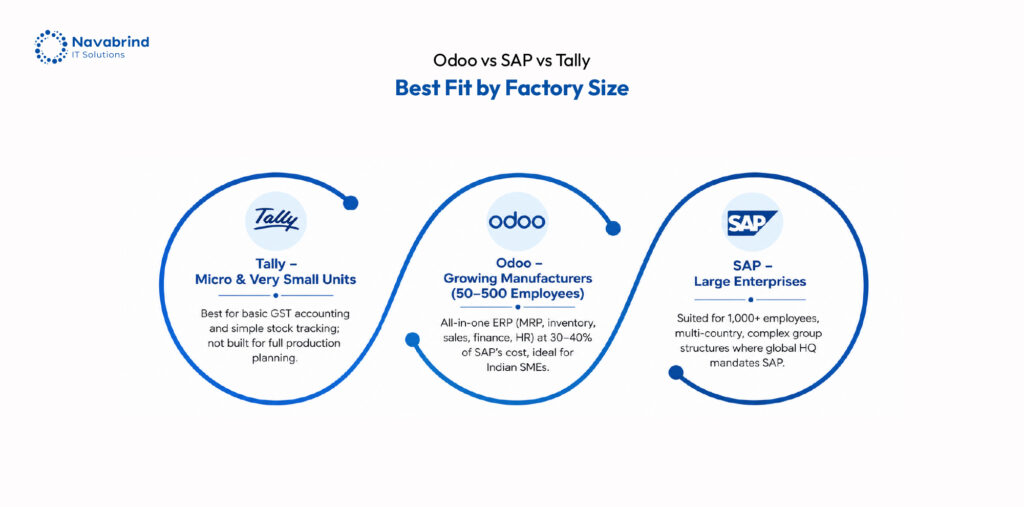
- The Odoo vs SAP vs Tally decision becomes far easier when manufacturers stop evaluating software through branding alone and start evaluating operational fit. ERP success depends on business complexity, manufacturing maturity, internal process discipline, and long-term growth direction.
- For businesses below ₹10 crore with limited manufacturing coordination, Tally remains practical for accounting, GST, payroll, and compliance. Yet once production planning, inventory coordination, vendor management, and plant visibility start becoming operational pain points, manufacturers begin searching for a Tally alternative for manufacturing that supports factory operations instead of accounting alone.
- For manufacturers between ₹10 crore and ₹500 crore managing production complexity, warehouse movement, procurement planning, quality tracking, and multi-department coordination, Odoo manufacturing India deployments offer the strongest balance between capability and commercial practicality. This segment represents the largest demand base for ERP for factory management India solutions today.
- SAP enters the conversation when businesses exceed ₹500 crore, operate across multiple entities or countries, face global OEM mandates, or require enterprise-scale governance structures. In these environments, SAP’s depth justifies its implementation burden.
- Before selecting any platform, manufacturers should answer five operational questions honestly. Does the business require production control or only finance management? What will operational complexity look like within three years? What ownership cost will the business carry across licensing, implementation, support, and upgrades? Does leadership possess the organisational capacity required for ERP adoption? Is there a capable implementation ecosystem available locally?
- The best ERP for Indian manufacturers is never the platform with the longest feature list. The winning system is the one production teams, warehouse staff, finance departments, and leadership consistently use without resistance.
- Indecision carries its own financial penalty. Another year on disconnected systems, Excel coordination, delayed inventory visibility, and reactive production planning quietly erodes margins, slows growth, and increases operational instability far faster than many manufacturers realise.
- The Odoo vs SAP vs Tally debate becomes far less confusing once manufacturers understand the original role of each platform. Tally serves accounting and statutory compliance. SAP serves enterprise-scale global operations. Odoo manufacturing India solutions sit in the middle ground that thousands of Indian factories now require connected manufacturing management without enterprise-scale complexity or cost.
- This decision is not about choosing the platform with the largest brand value or the longest feature catalogue. The best ERP for Indian manufacturers depends on operational maturity, manufacturing complexity, growth direction, internal adoption capacity, and financial practicality. A small factory managing accounting workflows has different priorities from a multi-plant manufacturer handling procurement coordination, quality tracking, inventory movement, and production planning across departments.
- That is why manufacturers searching for a Tally alternative for manufacturing or a practical SAP alternative India solution increasingly evaluate Odoo as the operational bridge between disconnected systems and enterprise-level process control. ERP for factory management India requirements now demand far more than bookkeeping and reporting.
- The competitive gap between digitised manufacturers and operationally fragmented businesses is widening rapidly. Factories investing in connected production, inventory visibility, procurement control, and data-driven decision-making today will compound operational advantages year after year. Manufacturers that delay transformation risk losing margins, delivery reliability, scalability, and market responsiveness to competitors already building digitally connected operations.
Frequently Asked Questions
1.Is Odoo better than Tally for manufacturing?
Yes. In the Odoo vs SAP vs Tally comparison, Odoo delivers manufacturing functionality that Tally was never designed to handle. Tally performs well for accounting, GST filing, payroll, and statutory compliance, which explains why Indian finance teams continue relying on it. Manufacturing businesses, though, require production planning, bill of materials management, inventory traceability, procurement coordination, quality checks, and shop floor visibility. Odoo manufacturing India deployments support these operational requirements within one connected ERP environment. That is why manufacturers searching for a Tally alternative for manufacturing increasingly move toward Odoo once production complexity grows beyond basic accounting needs.
2.Why is SAP too expensive for small manufacturers in India?
SAP carries substantial ownership costs that many small manufacturers underestimate during evaluation. Licensing, implementation consulting, infrastructure, maintenance contracts, user training, and customisation expenses increase rapidly even in smaller projects. SAP implementations frequently require long deployment cycles and internal IT capability that many SMEs do not possess. In the Odoo vs SAP vs Tally discussion, manufacturers exploring a SAP alternative India option often discover that Odoo provides the operational depth they need without enterprise-scale financial pressure.
3.Can Odoo replace Tally for Indian manufacturers?
Yes, Odoo can replace Tally for manufacturers requiring integrated operational management. Odoo supports GST workflows, e-invoicing, inventory management, procurement, finance, manufacturing, maintenance, and quality processes within one ERP for the factory management India ecosystem. Some businesses continue using Tally temporarily during migration phases for accounting familiarity, though growing manufacturers frequently transition fully into Odoo after stabilisation.
4.Which ERP is best for a small factory in India?
The best ERP for Indian manufacturers depends on factory complexity, production type, and growth plans. Small factories managing production orders, inventory movement, procurement, and quality tracking generally benefit far more from Odoo manufacturing India solutions than accounting-first platforms. Tally works for compliance-focused operations with limited manufacturing coordination. SAP remains financially impractical for many small factories. Odoo balances manufacturing capability, scalability, and commercial practicality, making it one of the strongest ERP choices for growing Indian factories.
5.What is the difference between Odoo and SAP for manufacturing?
SAP targets enterprise organisations managing multinational operations, multi-entity consolidation, and highly complex supply chains. Odoo focuses on operational control for growing businesses seeking manufacturing visibility without enterprise-scale implementation burden. SAP delivers broader enterprise governance depth. Odoo delivers faster implementation, lower ownership cost, easier usability, and strong manufacturing capability for the majority of Indian SMEs. In the Odoo vs SAP vs Tally comparison, Odoo increasingly serves as the practical SAP alternative India manufacturers evaluate first.
6.Is Odoo affordable for medium manufacturers in India?
Yes. Medium manufacturers between ₹50 crore and ₹500 crore increasingly adopt Odoo because the platform delivers strong manufacturing capability without the ownership burden associated with enterprise ERP systems. Implementation investment varies based on plant count, workflow complexity, integrations, and user volume, though Odoo remains significantly lower in total cost compared to SAP over multi-year periods. For businesses seeking ERP for factory management India solutions with scalability, production control, inventory visibility, and compliance support, Odoo presents a commercially sustainable path toward operational growth.
Schedule a conversation with us now!
Related Articles









 Post
Post Post
Post