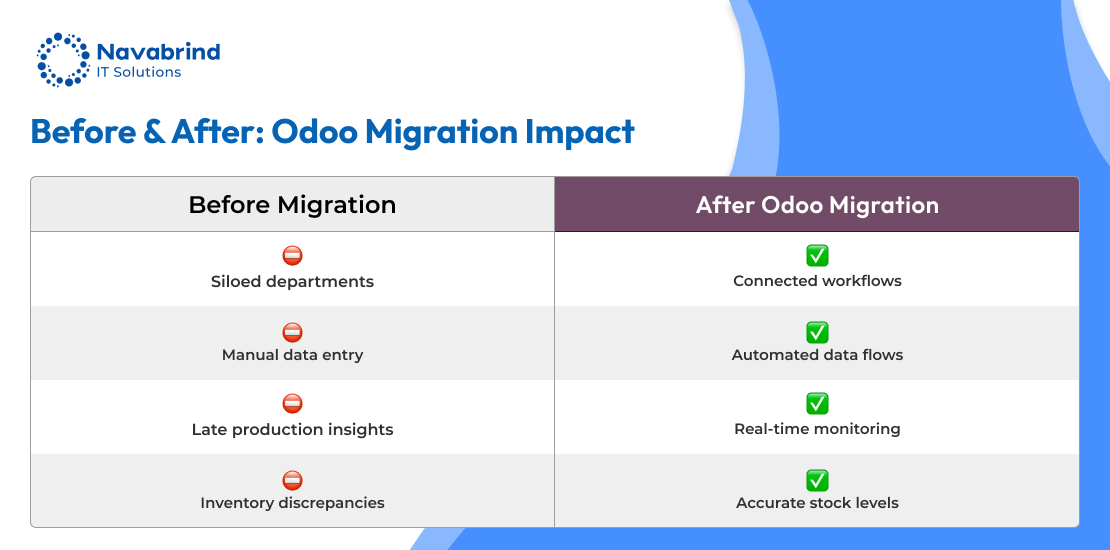
CNC job shops across India face rising expectations from clients who demand tighter turnaround, zero delays, and consistent quality. Batch sizes shift, priorities change mid-cycle, and machine availability becomes a daily constraint. Managing this with disconnected spreadsheets or aging systems creates blind spots across production, delaying decisions and weakening delivery commitments. As complexity increases, reliance on fragmented tools limits visibility across machining, inventory, and dispatch.
This is where Odoo ERP software reshapes operations. By connecting planning, execution, and delivery within one environment, CNC businesses gain control over workflows that once felt unpredictable. A connected factory management system aligns machine allocation, workforce planning, and material readiness without confusion. Integrated manufacturing execution system software captures shop-floor activity, ensuring work orders move without delays or miscommunication.
With manufacturing operations software embedded into daily processes, CNC shops gain accurate job progress updates, enabling a dependable order tracking system manufacturing environment. Teams respond faster to changes, reduce idle machine time, and maintain delivery commitments with confidence. These digital manufacturing solutions replace guesswork with visibility, helping businesses protect margins and strengthen client trust.
The Challenges CNC Machining Companies in India Face Today
Without a connected manufacturing operations software layer, production teams rely on fragmented updates, leading to missed priorities and idle machines. A major constraint lies in the absence of live shop floor visibility. Supervisors struggle to track job status, machine utilization, and bottlenecks in time to act. This disconnect weakens decision-making and slows response to changes. An integrated manufacturing execution system software eliminates this gap by capturing production activity as it happens, enabling faster interventions and tighter control.
Order tracking remains another critical issue. Inaccurate updates and delayed communication disrupt delivery commitments, affecting client confidence. A dependable order tracking system manufacturing framework within Odoo ERP software ensures that each job progresses with transparency, keeping teams aligned with deadlines.
Disconnected tools across inventory, production, and finance create data inconsistencies that impact planning and costing. Digital manufacturing solutions resolve this by linking operations into one environment. A unified factory management system replaces confusion with coordination, allowing CNC businesses to regain control over timelines, costs, and customer expectations.
What is Odoo ERP And Why Is It Built for Manufacturing?
Odoo ERP software brings manufacturing, inventory, sales, procurement, and finance into one connected system designed to run production-driven businesses without gaps. For CNC machining companies, this means work orders, material flow, costing, and dispatch operate in sync instead of across disconnected tools. As a result, teams gain control over operations that demand accuracy and speed.
Unlike generic ERP platforms that struggle to adapt to shop floor needs, Odoo ERP software functions as a scalable factory management system that grows with business complexity. CNC shops can activate required capabilities without overloading teams with unnecessary features. This flexibility supports evolving production demands without disrupting workflows.
Key applications within Odoo ERP software directly support machining environments. The Manufacturing module manages routing and work orders, Inventory ensures material availability, Sales connects customer demand, Purchase secures raw materials, and Accounting tracks financial impact. Together, they create a connected manufacturing execution system software environment that supports production from enquiry to delivery.
As one of the leading digital manufacturing solutions, Odoo enables accurate order tracking system manufacturing, reduces coordination gaps, and strengthens delivery performance. Indian CNC shops are adopting this platform to replace fragmented processes with a connected manufacturing operations software approach that improves visibility, control, and profitability.
How Does ERP Software for Tracking Manufacturing Operations in Real Time Work?
Real-time tracking on the shop floor means knowing the exact status of each job, machine, and operation at any moment without waiting for updates or chasing teams. CNC environments demand this level of visibility to prevent delays, reduce idle time, and keep production aligned with delivery commitments. Without a connected system, critical decisions rely on outdated inputs, creating gaps across operations.
Odoo ERP software answers the question, How does ERP software for tracking manufacturing operations in real time work? Just by connecting machines, operators, and supervisors through a shared interface. Each work order update, machine activity, and job movement reflects instantly within a unified factory management system, allowing teams to monitor execution without disruption. This structure enables accurate order tracking system manufacturing, ensuring that no job progresses without visibility.
Work order status, job completion stages, and bottlenecks become visible as they occur. Managers identify delays early, reassign tasks, and adjust schedules without waiting for end-of-shift reports. At the center of this system, manufacturing execution system software captures shop floor inputs and converts them into actionable insights.
Barcodes, tablets, and mobile devices play a key role in this process. Operators log progress, material usage, and job completion on the spot, feeding data into manufacturing operations software. These digital manufacturing solutions create a connected production environment where decisions are based on live data, not assumptions.
What is Odoo ERP Solution for Factory Management and Order Tracking?
Odoo ERP software answers the question,What is Odoo ERP solution for factory management and order tracking? by acting as a connected factory management system that links planning, execution, inventory, and delivery into one controlled flow. CNC machining businesses gain visibility across operations without relying on disconnected tools or delayed updates.
Within this system, production orders, work centres, routings, and bill of materials (BoM) are managed with accuracy. Each job follows a defined path, ensuring machines, materials, and operators align with production requirements. This structure allows manufacturing operations software to coordinate tasks without confusion, keeping machining workflows organized and predictable.
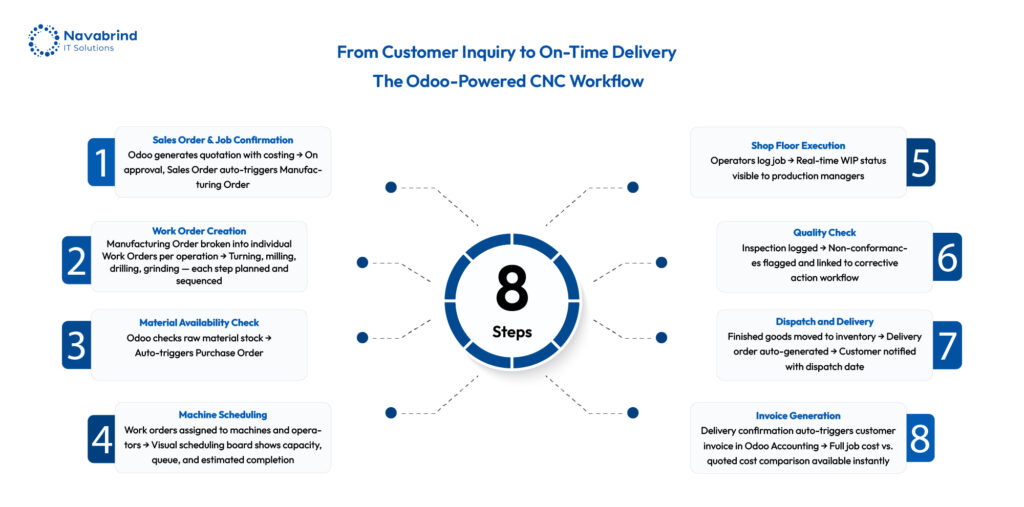
The order tracking system manufacturing capability within Odoo ERP software ensures that every order progresses with visibility. From sales confirmation to machining, quality checks, and dispatch, each stage is recorded and updated within the system. Teams access job status instantly, eliminating uncertainty around progress or delivery timelines. At the center of this flow, manufacturing execution system software captures shop floor activity and connects it with upstream and downstream processes. This ensures that updates reflect across departments without delay. These digital manufacturing solutions reduce errors caused by manual data entry and eliminate communication gaps, allowing CNC companies to maintain control over production, timelines, and customer commitments.
How Do CNC Shops Improve Delivery Time Using ERP Software?
Odoo ERP software addresses the question, How do CNC shops improve delivery time using ERP software? by organizing production planning with clarity. Jobs are sequenced based on priority, routing, and resource availability within a unified factory management system. This ensures that machines operate in the correct order, reducing delays caused by poor planning.
Capacity planning plays a central role. CNC businesses gain insight into machine workload, available hours, and job allocation in advance. This prevents overloading critical work centres and avoids last-minute rescheduling. With manufacturing execution system software at the center, production aligns with realistic timelines rather than assumptions.
Automated alerts highlight delays, material shortages, and bottlenecks as they arise. Teams respond before issues impact delivery commitments. The order tracking system manufacturing capability keeps progress visible across departments, ensuring alignment from machining to dispatch. Through these digital manufacturing solutions, CNC companies reduce lead times, improve machine utilization, and deliver orders on time with consistency.
What is the Best ERP System for CNC Machining Business in India?
Choosing the right ERP for a CNC machining business in India depends on four factors: usability, localisation, cost control, and scalability. Many systems fail because they are either too complex for shop floor teams or too limited to handle production workflows. A reliable solution must function as a connected factory management system, support compliance, and scale with production demands.
Odoo ERP software stands out when answering What is the best ERP system for CNC machining business in India? due to its flexibility and pricing model. Unlike SAP, which is designed for large enterprises with high implementation costs, or Tally, which focuses mainly on accounting, Odoo delivers a complete manufacturing operations software environment suited for small and mid-size CNC shops. SAP often requires heavy investment and long deployment cycles, whereas Odoo enables faster adoption with lower upfront cost.
Indian CNC businesses benefit from built-in GST localisation, including e-invoicing, e-way bills, and tax reporting, ensuring compliance without external tools. Deployment flexibility adds further value. Odoo supports cloud and on-premise setups, allowing manufacturers to choose based on infrastructure and control requirements. Its modular structure allows businesses to start with core functions and expand over time, aligning with growth.
From a financial perspective, total cost of ownership remains a key advantage. CNC shops avoid large licensing fees, reduce dependency on multiple systems, and gain ROI through improved planning, visibility, and delivery performance using digital manufacturing solutions and manufacturing execution system software within one platform.
What is Odoo Implementation for Manufacturing Operations Optimization?
Odoo ERP software answers the question, What is Odoo implementation for manufacturing operations optimization? by transforming disconnected CNC processes into a controlled, data-driven factory management system. The implementation journey begins with discovery, where workflows, machine capacity, and production challenges are mapped. Configuration follows, aligning the system with routing, BoM, and job sequencing needs. Data migration ensures legacy records move into a connected manufacturing operations software environment without loss. Training equips teams to execute tasks within the system, and go-live marks the shift to a fully operational digital manufacturing solutions framework.
Common failures arise from poor planning, incomplete data migration, and lack of user adoption. These issues disrupt production and reduce system trust. Avoiding them requires accurate process mapping, phased rollout, and hands-on training aligned with shop floor execution. Selecting the right implementation partner in India is critical. CNC businesses should prioritize partners with manufacturing expertise, proven deployment experience, and the ability to configure manufacturing execution system software aligned with real production workflows.
Timelines vary based on complexity, though small to mid-size CNC shops can expect deployment within a few months. Cost depends on scope, users, and customization level. With Odoo ERP software, businesses gain long-term value through improved visibility, reduced delays, and stronger control over operations and delivery performance.
Key Benefits of Odoo ERP for CNC Machining Companies At a Glance
- Odoo ERP software delivers measurable value for CNC machining companies by connecting production, inventory, sales, and finance within one environment. This unified manufacturing operations software view removes data silos, allowing teams to operate with alignment instead of fragmented inputs. As a result, decision-making improves across machining, planning, and dispatch.
- Shop floor visibility becomes immediate with integrated manufacturing execution system software. Managers track job status, machine utilization, and production flow without delays, enabling faster response to issues before they impact delivery timelines. This level of control strengthens coordination across departments.
- Delivery performance improves through an accurate order tracking system manufacturing framework. Each stage, from order confirmation to final dispatch, remains visible and traceable. CNC businesses reduce missed deadlines, improve customer satisfaction, and build reliability into operations.
- Inventory and procurement gain tighter control through synchronized material tracking. Stock levels, purchase planning, and material availability align with production schedules, preventing shortages and excess holding costs. This strengthens operational stability within the factory management system.
- As CNC businesses expand, Odoo ERP software adapts without disruption. Companies extend capabilities based on production needs, maintaining consistency across workflows. With India-ready compliance and cost efficiency, these digital manufacturing solutions support sustainable growth while protecting margins and operational control.
Learn how Odoo handles manufacturing order priorities and scheduling conflicts in real time
CNC machining businesses in India require control, visibility, and coordination across fast-moving production cycles. Odoo ERP software delivers this through a connected factory management system that aligns machining, inventory, sales, and finance within one environment. With integrated manufacturing execution system software, CNC shops gain continuous insight into job progress, machine load, and delivery timelines. This level of coordination supports consistent output, accurate planning, and dependable order tracking system manufacturing. As a result, businesses operate with confidence, reduce delays, and maintain stronger control over margins using proven digital manufacturing solutions.
Choosing to remain on legacy tools carries a measurable cost. Disconnected systems create production delays, missed deadlines, excess inventory, and poor visibility into operations. These gaps weaken competitiveness, reduce customer trust, and limit growth potential. Without a connected manufacturing operations software approach, CNC shops struggle to respond to changing demand and tighter delivery expectations.
Frequently Asked Questions
1.What is Odoo ERP system for CNC machining companies in India?
For CNC machining companies in India, Odoo ERP is far more than a digital record-keeping tool, it is the operational backbone that connects every function a job shop depends on to run profitably. In a typical CNC environment, critical information about work orders, machine availability, raw material stock, customer delivery commitments, and job costing lives in separate places, such as spreadsheets, WhatsApp threads, paper job cards, and isolated accounting software, creating a coordination gap that quietly erodes margins and on-time performance. Odoo closes that gap by unifying machining operations, inventory, procurement, sales, and finance within a single connected environment, where a confirmed sales order automatically triggers a manufacturing order, which checks material availability, sequences operations across machines, and tracks real-time shop floor progress, all without manual handoffs between departments. The embedded manufacturing execution system capability means that shop floor activity, from operator login to job completion, becomes visible data rather than verbal updates, giving production managers the accuracy they need for reliable order tracking, precise job costing, and confident delivery commitments, capabilities that are especially valuable for Indian CNC job shops navigating tight margins, high job variety, and growing customer expectations around transparency and turnaround time.
2.How do CNC shops improve delivery time using ERP software?
Delivery performance in a CNC job shop is not simply a logistics problem, it is a planning and visibility problem, and Odoo ERP addresses it at the root rather than the symptom. Most delivery delays in CNC operations are not caused by slow machining; they are caused by work orders released before materials are confirmed, jobs scheduled without accounting for existing machine queues, and bottlenecks that go unnoticed until they have already become missed deadlines. Odoo eliminates these failure points by sequencing jobs based on real constraints, actual machine availability, operator shift patterns, material readiness, and customer priority, so that every work order released to the shop floor has a realistic, data-backed completion timeline attached to it from the start. When a job falls behind its planned schedule, the system flags it immediately rather than waiting for an end-of-day report, giving production managers the window they need to reallocate capacity, expedite a purchase, or proactively update the customer, transforming delivery management from reactive firefighting into a structured, predictable process that compounds over time into a measurable improvement in on-time dispatch rates.
3.How does ERP software for tracking manufacturing operations in real time work?
Real-time manufacturing tracking in Odoo works by creating a continuous, live data connection between the shop floor and every layer of the organization that depends on production information, from supervisors managing daily output to sales teams updating delivery commitments to finance teams calculating job costs. When an operator starts or completes a work order, logs machine downtime, or flags a quality issue through a shop floor tablet or terminal, that input is instantly reflected in the central manufacturing dashboard, updating job progress, adjusting estimated completion times, and recalculating resource utilization without any manual data entry from a manager or planner. This matters enormously in a CNC environment where a single delayed operation, a tool change, a material shortage, an inspection hold, can cascade across multiple dependent jobs if it goes undetected for even a few hours. By capturing shop floor inputs at the point of activity rather than at the end of a shift or day, Odoo’s manufacturing execution capability transforms production visibility from a lagging report into a live operating picture, enabling faster decisions, more accurate order tracking, and a level of operational transparency that builds genuine confidence in the delivery commitments made to customers.
4.What is Odoo ERP solution for factory management and order tracking?
In a manufacturing environment where a single order touches procurement, production planning, shop floor execution, quality inspection, warehousing, and customer delivery before it is complete, the absence of a unified system means every department is working from a different version of reality — and the customer pays for that misalignment through delays, errors, and poor communication. Odoo ERP solves this by functioning as a true factory management system that treats the entire order lifecycle as one connected workflow rather than a series of handoffs between disconnected tools. From the moment a sales order is confirmed, Odoo creates a visible, traceable chain of activity — triggering manufacturing orders, validating bill of materials, allocating work centres, checking raw material availability, and scheduling operations — so that every stakeholder, from the production supervisor on the floor to the sales manager fielding a customer call, is looking at the same live information. The order tracking capability this creates is not simply about knowing where a job is; it is about knowing where it is relative to where it should be, why any gap exists, and what action is needed to close it — a level of operational transparency that reduces the coordination failures, departmental blame cycles, and last-minute surprises that erode both margin and customer trust in factory environments managing high job variety and tight turnaround expectations.
5.What is the best ERP system for CNC machining business in India?
The question of which ERP system is best for a CNC machining business in India cannot be answered by feature lists alone — it has to be answered in the context of how Indian job shops actually operate: with diverse job types, variable batch sizes, multi-shift production, GST-driven financial compliance, and the commercial reality that most small and mid-size CNC businesses cannot absorb the six-figure implementation costs and multi-year deployment timelines that characterize enterprise ERP platforms. Odoo stands out in this context not because it is the most feature-rich system available, but because it delivers the right depth of manufacturing capability — work order management, routing, bill of materials, shop floor tracking, and production costing — within a modular, cost-proportionate framework that a 10-machine job shop and a 100-machine facility can both adopt without overextending their IT budgets or operational bandwidth. Unlike accounting-first software that bolts on manufacturing as an afterthought, or legacy ERP platforms that require expensive customization to reflect how CNC operations actually run, Odoo is built around manufacturing workflows and extends naturally into GST-compliant invoicing, multi-warehouse inventory, and vendor management — making it a genuinely complete operational environment rather than a patchwork of partially integrated tools, which is precisely what growing Indian CNC businesses need to build reliable processes, accurate costing, and scalable capacity without losing control of complexity.
6.What is Odoo implementation for manufacturing operations optimization?
Odoo implementation for a CNC manufacturing business is not a software installation project — it is an operational transformation exercise that, when done well, fundamentally changes how production decisions are made, how shop floor activity is captured, and how reliably the business can deliver on its commitments to customers. The process begins not with technology configuration but with a detailed mapping of how the business actually operates: how jobs are received and estimated, how work orders are created and sequenced, how materials are planned and procured, how machines and operators are scheduled, and where the current workflow breaks down under pressure — because any implementation that configures Odoo around broken processes simply digitizes those breakdowns rather than resolving them. Once the operational blueprint is established, implementation involves configuring manufacturing workflows, bills of materials, work centre routing, and costing structures to reflect real CNC production logic, migrating existing job and inventory data with accuracy, and training not just managers but operators and supervisors who will interact with the system daily on the shop floor. The measure of a successful Odoo implementation is not go-live — it is the point, typically two to three months post-deployment, where production managers are making scheduling decisions based on live system data rather than instinct, where job costs are calculated from actual material and labour consumption rather than end-of-month estimates, and where the business has the operational visibility to confidently commit to delivery timelines and consistently meet them — which is the compounding competitive advantage that justified the implementation investment in the first place.
Schedule a conversation with us now!
Related Articles









 Post
Post Post
Post