Why Forging Companies in India Need ERP
Margins in Indian forging plants are shrinking under rising alloy costs, tighter delivery commitments, and aggressive competition. Delays in billet availability, unplanned machine downtime, and rework from inconsistent quality disrupt production flow and impact revenue. Disconnected spreadsheets and fragmented systems fail to give plant heads visibility across operations, leading to missed dispatch timelines and compliance risks.
ERP for forging companies India addresses these gaps by connecting production, procurement, quality checks, and inventory into a single operational framework. A robust forging ERP aligns shop-floor activities with business goals, ensuring each stage from raw material intake to finished components runs with accountability and traceability.
Odoo stands out as a flexible manufacturing ERP designed to support hot forging, cold forging, heat treatment, and machining workflows. With integrated production planning ERP, quality control software, and inventory management system capabilities, Odoo enables forging units to reduce delays, control defects, and maintain consistent output standards.
What Is the Best ERP Software for the Forging Industry in India?
Selecting the right ERP for forging companies India depends on how well the system fits shop-floor realities, not just feature lists. Forging plants require tight coordination between billet tracking, die life monitoring, heat cycles, machining, and dispatch. Generic ERP platforms like SAP or Oracle deliver broad functionality but demand heavy investment, long deployment cycles, and rigid configurations that don’t align with forging workflows. SAP Business One, for instance, suits large enterprises with complex structures but involves high licensing and long implementation timelines.
On the other side, niche or rigid systems designed for limited use cases struggle to adapt when forging units expand operations or diversify into machining and assemblies. This creates a gap where flexibility and cost control matter just as much as functionality.
Odoo fills this gap with a flexible manufacturing ERP approach. As a forging ERP, it enables phased adoption starting with production planning ERP, extending to quality control software, and scale into a full inventory management system without disrupting operations. Its open-core architecture allows forging companies to align workflows with Indian shop-floor practices instead of forcing process changes. For SME forging units, this translates into lower upfront investment, faster go-live cycles, and the ability to adapt processes as production complexity grows making Odoo a practical choice over rigid, high-cost ERP alternatives.
Key Requirements for Forging Industry ERP Systems
An effective ERP for forging companies India must connect the shop floor with business decisions through end-to-end visibility. From raw steel procurement to packed dispatch, the system should track material heat numbers, batch movement, die usage, and process stages without data gaps. This level of traceability reduces losses, supports audits, and strengthens customer trust.
A reliable forging ERP must deliver well-defined production planning ERP workflows tailored for forging operations. Batch planning, heat-load scheduling, and subcontract coordination need tight control to avoid idle machines and missed delivery timelines. The system should align production sequences with capacity and material readiness, ensuring smooth flow across forging, heat treatment, and machining stages.
Integrated quality control software is critical for monitoring dimensional accuracy, metallurgical properties, and rejection trends at each stage. Alongside this, a connected inventory management system should track raw material, work-in-progress, and finished goods with accuracy. This combination enables forging companies to reduce rework, control stock variance, and maintain consistent output standards.
Learn More: Is Odoo ERP Suitable for Steel Manufacturers and Traders
How Does Odoo ERP Implementation for a Forging Plant in India Work?
A successful rollout of ERP for forging companies India depends on aligning plant operations with a system that reflects real shop-floor execution. Odoo enables forging units to move from fragmented processes to a connected manufacturing ERP environment through a phased, practical approach.
Step 1: Current-State Assessment
Map the complete order-to-shipment cycle raw material intake, billet movement, forging stages, heat treatment, machining, and dispatch. This step identifies bottlenecks, rework points, and delays that impact throughput.
Step 2: Process & Work Order Mapping
Translate shop-floor activities into Odoo workflows. Define routing, work centers, die usage, and inspection checkpoints within the production planning ERP framework to reflect actual operations.
Step 3: Inventory Configuration
Set up the inventory management system to track ingots, billets, WIP, and finished forgings with batch and heat-level traceability, ensuring stock accuracy across stages.
Step 4: Workforce Enablement
Train operators, storekeepers, and planners to record production updates, quality checks, and material movement within the forging ERP interface.
Step 5: Phased Go-Live & Expansion
Start with one product line, stabilize processes, then extend across the plant. Integrated quality control software ensures consistent output as scale increases
How Does Odoo Help Forging Companies Reduce Production Delays?
Production delays in forging plants stem from poor visibility, overloaded machines, and late material movement. Odoo addresses these issues through a tightly connected production planning ERP framework designed for shop-floor control.
Clear routing and work-order scheduling allow supervisors to track each job across forging, heat treatment, and machining stages. When a batch stalls at any work center, the system highlights the exact delay point, enabling quick intervention before timelines slip further.
Capacity-driven planning ensures that press lines, furnaces, and machining centers operate within defined limits. This prevents overloading critical resources, which is a common cause of downtime and missed delivery commitments in forging units.
Live WIP visibility across stages gives planners a complete view of material flow. Supervisors can rebalance workloads, shift priorities, or allocate resources based on actual production status rather than assumptions. Automated alerts for delayed operations, pending approvals, or material shortages keep teams informed and responsive. As a result, ERP for forging companies India reduces idle time, improves throughput, and keeps production aligned with dispatch schedules using a robust forging ERP and connected inventory management system.
Can Odoo ERP Improve Quality in Forging Manufacturing?
Quality failures in forging plants lead to rework, scrap, and rejected shipments. Odoo addresses this through an integrated quality control software framework within a connected manufacturing ERP environment. For ERP for forging companies India, this translates into consistent control across raw material, in-process stages, and final output.
Incoming raw material inspection links test results in the chemical composition, hardness, and grade to each batch of ingots or billets. This ensures only approved material moves into production, reducing downstream defects.
During production, inspection checkpoints are embedded across critical stages such as heating, pre-forging, post-heat treatment, and pre-machining. These checks within the forging ERP capture deviations early, preventing defect propagation across batches.
Final inspection templates standardize dimensional and metallurgical checks. Non-conformities are tied to jobs, machines, dies, and operators, creating full traceability and accountability.
Interactive dashboards present defect trends by machine, material grade, and customer. With this visibility, forging units can reduce rejection rates, control variation, and maintain consistent output using a tightly integrated production planning ERP and inventory management system.
Odoo as an Inventory Management System for Forging
Inventory gaps in forging units lead to production stoppages, excess stock, and traceability risks. Odoo addresses these challenges through a tightly connected inventory management system within a scalable manufacturing ERP environment. For ERP for forging companies India, this ensures material visibility across stages without data loss.
The system tracks billets, scrap, rework, and finished components using lot, grade, and heat-treatment attributes. Each movement from raw material receipt to dispatch gets recorded with full context, enabling accurate stock control within a forging ERP setup.
Lot traceability links ingots to finished shipments, supporting certification requirements and fast response during recalls or audits. This level of control strengthens compliance and customer confidence.
Stock thresholds trigger replenishment actions based on consumption patterns, preventing shortages that disrupt production. Alerts for sensitive materials such as alloy steels requiring controlled storage that help maintain material integrity.
With this approach, forging companies gain tighter control over stock flow, reduce carrying costs, and align inventory with production needs using a connected production planning ERP and quality control software framework.
Is Odoo ERP Suitable for SME Forging Companies in India?
Yes! Odoo fits SME forging units that need control over production, quality, and inventory without heavy investment or complex IT setups. As an ERP for forging companies India, Odoo aligns with shop-floor needs and business constraints.
SMEs can begin with manufacturing ERP, inventory management systems, and sales modules, then extend into quality control software or HR as operations expand. This phased adoption avoids large upfront spending and keeps implementation practical for growing plants.
Deployment options support cloud-based access or lightweight on-site setups, which suits companies with limited IT resources. Teams can operate, monitor, and manage production without maintaining large infrastructure.
Localization for Indian GST, invoicing, and statutory reporting ensures compliance without external tools. Financial and operational data remain connected within the forging ERP environment.
Mid-sized forging units using Odoo report reduced production delays, lower scrap rates, and elimination of paperwork bottlenecks. With a connected production planning ERP, companies gain visibility, control, and consistency that are key drivers for scaling operations in a competitive market.
Why Choose Navabrind IT Solutions for Odoo ERP in the Forging Industry?
Selecting the right implementation partner determines whether an ERP for forging companies India delivers results or becomes another unused system. Navabrind IT Solutions brings domain-focused expertise that aligns technology with forging shop-floor execution.
Navabrind IT Solutions understands the complete forging lifecycle billet handling, heat treatment cycles, press operations, machining sequences, and testing requirements. This practical knowledge ensures that the forging ERP reflects actual plant conditions rather than generic workflows.
Their team configures Odoo to match forging operations by tailoring production planning ERP flows, routing logic, and inspection checkpoints. The result is a manufacturing ERP environment where planning, execution, and quality control operate in sync. Integrated quality control software captures inspection data across stages, strengthening traceability and reducing rejection rates.
Beyond implementation, Navabrind IT Solutions provides ongoing support, system refinement, and user training. As production scales or processes evolve, the ERP adapts without disruption. This long-term partnership helps forging companies sustain performance gains, reduce operational friction, and maintain control through a connected inventory management system and production framework.
How Odoo ERP Transforms the Overall Forging Ecosystem in India
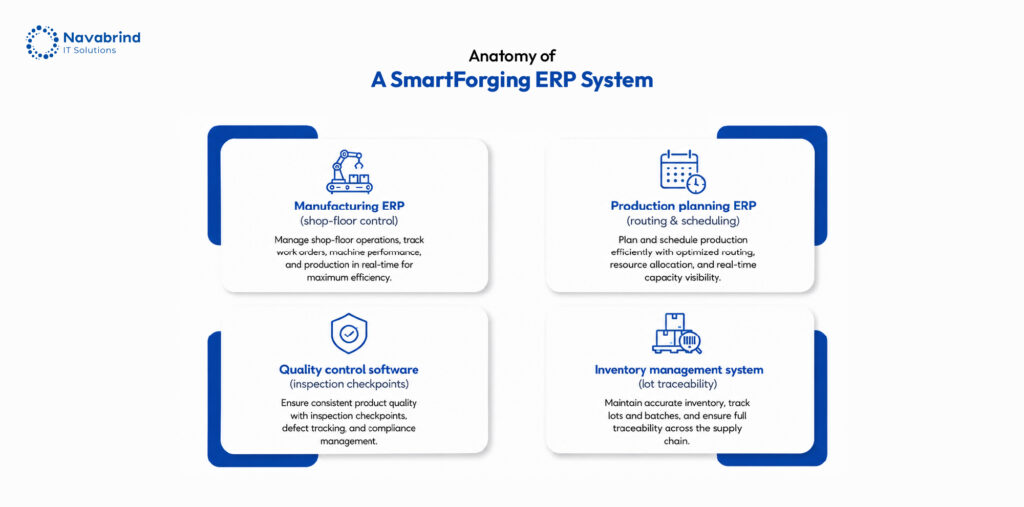
Odoo connects operations, quality, inventory, and finance into a single data backbone for ERP for forging companies India. Instead of disconnected tools, forging units operate through one system that links manufacturing ERP, production planning ERP, quality control software, and inventory management system into a unified workflow.
This integration removes data silos across departments. Production teams track batch progress, quality teams capture inspection data, and inventory teams manage stock movement all within the same system. As a result, decision-making shifts from reactive to controlled execution, reducing delays and inconsistencies across forging operations.
Sales teams gain accurate order status and delivery commitments backed by live production data. Finance teams benefit from connected transactions across procurement, production, and dispatch, leading to faster month-end closure and reduced reconciliation effort. Quality teams generate detailed reports linked to batches, machines, and customers, strengthening compliance and customer communication.
With this connected forging ERP environment, companies improve operational control, reduce errors, and deliver consistent output creating a stronger, data-driven forging ecosystem across India.
Frequently Asked Questions
1.What is the best ERP software for the forging industry in India?
The ideal ERP for forging companies in India align with shop-floor workflows such as billet tracking, heat cycles, machining, and inspection. Odoo stands out due to its flexibility, phased adoption, and strong fit for forging operations. As a forging ERP and manufacturing ERP, it connects production, quality, and inventory without rigid constraints or heavy investment.
2.How does Odoo ERP implementation for a forging plant in India work?
Implementation begins with mapping the order-to-dispatch cycle, followed by configuring routing, work centers, and inspection checkpoints. The inventory management system is set up for batch traceability, and teams are trained on system usage. Go-live starts with one product line, then expands plant-wide using a structured production planning ERP approach.
3.How does Odoo help forging companies reduce production delays?
Odoo improves visibility across operations through structured routing, capacity-based planning, and live WIP tracking. Supervisors can identify bottlenecks, rebalance workloads, and respond to delays or material shortages. This forging ERP setup ensures production stays aligned with delivery timelines.
4.Can Odoo ERP improve quality in forging manufacturing?
Yes. Integrated quality control software captures inspections at raw material, in-process, and final stages. Non-conformities link to batches, machines, and operators, enabling root-cause analysis. This reduces rejection rates and improves consistency in forged components.
5.Is Odoo ERP suitable for SME forging companies in India?
Yes. SMEs can begin with manufacturing ERP, inventory management systems, and sales modules, then extend into quality or HR as operations grow. Cloud or lightweight deployment suits small teams, and GST-ready features support compliance within the ERP for forging companies India framework.
6.Why choose Navabrind for Odoo ERP in the forging industry?
Navabrind IT Solutions delivers domain expertise in forging workflows, ensuring the forging ERP reflects actual plant operations. Their approach includes tailored production planning, ERP configuration, integrated quality control software, and continuous support to keep the system aligned with evolving business needs.
Schedule a conversation with us now!
Related Articles








 Post
Post Post
Post