Why Odoo Manufacturing ERP Matters for Foundries
Indian foundries operate under constant pressure from rising raw material prices, fluctuating energy costs, high rejection rates, and tight delivery commitments. Traditional systems fail to provide visibility across melting, casting, fettling, and dispatch, leading to cost leakage and missed deadlines. This is where Odoo ERP for manufacturing transforms operations into a connected, insight-driven workflow.
With Odoo manufacturing ERP, foundries gain a unified environment that links production planning, inventory, procurement, and quality control. As an ERP for foundry industry, it captures production data at each stage and feeds a real-time production tracking system, enabling supervisors to monitor output, detect bottlenecks, and act without delay.
On the financial side, integrated manufacturing cost control software tracks material consumption, energy usage, and labor allocation with accuracy. This combination of production planning ERP and cost visibility helps foundries reduce waste, control expenses, and protect margins turning operational challenges into measurable gains.
What Is Odoo ERP for the Foundry Industry in India?
Odoo ERP for manufacturing serves as a complete ERP for foundry industry, designed around the demands of metal casting operations in India. From enquiry to final dispatch, Odoo manufacturing ERP connects business processes with shop-floor execution, giving foundries a single environment to manage production, costs, and delivery commitments without gaps in information. At the operational level, the system links order management with Bills of Materials and routing. Each casting order follows a defined production path, ensuring consistency in raw material usage and process steps. With a production planning ERP, teams can plan melt schedules, assign machines, and manage workforce allocation based on order priority and capacity.
On the shop floor, Odoo ERP for manufacturing captures activities across melting, casting, heat treatment, fettling, and inspection. This data flows into a real-time production tracking system, giving supervisors visibility into batch progress, delays, and output at each stage. Issues such as bottlenecks or deviations can be identified early, preventing production losses and missed timelines. Beyond production, the platform integrates inventory, procurement, financials, and quality control. As manufacturing cost control software, it tracks material consumption, scrap levels, energy usage, and labor allocation with accuracy. This enables foundries to understand the actual cost per casting and take corrective action to protect margins.
Whether operating as a small unit, a mid-sized foundry, or managing multiple plants across India, Odoo manufacturing ERP adapts to different scales of operation. With its connected approach, Odoo ERP for manufacturing enables foundries to maintain control, improve output consistency, and drive profitability across locations.
How to Track Production in the Foundry Industry?
Production tracking in foundries has relied on whiteboards, paper logs, and verbal updates. This leads to missed pours, unrecorded rework, and unclear WIP status. Supervisors spend hours chasing updates instead of managing output. Delays surface late, and cost impact becomes visible only after completion.
A digital real-time production tracking system within Odoo ERP for manufacturing replaces guesswork with live visibility. Each stage is of melting, casting, fettling, and inspection that feeds data into a central dashboard. With Odoo manufacturing ERP, teams move from “Where is that order?” to viewing status instantly, with batch-level progress visible at any moment.
This shift replaces backward-looking reports with current-status visibility. A production planning ERP allows quick adjustments to schedules and resources as conditions change. Combined with manufacturing cost control software and designed as an ERP for foundry industry, tracking becomes a control mechanism that improves output consistency, reduces delays, and protects margins.
How Does Real-Time Production Tracking in Manufacturing Using ERP Work?
In a foundry setup, Odoo ERP for manufacturing runs a connected real-time production tracking system that captures progress at each stage of production. With Odoo manufacturing ERP, work orders are defined for operations such as furnace charging, casting, shake-out, riser cutting, inspection, and packing. Each step follows a planned sequence through a production planning ERP, ensuring consistency across batches and shifts.
On the shop floor, operators or helpers record completed operations and quantities through simple interfaces. This input feeds live data into the system without delays. As updates are recorded, dashboards reflect the current status of production across lines and machines.
Supervisors can view orders in-process versus completed, along with output at each stage. Bottlenecks become visible when a stage slows down, whether due to machine constraints, labor gaps, or material shortages. This level of visibility enables quick decisions to rebalance workloads or adjust schedules.
With manufacturing cost control software integrated into the system and aligned as an ERP for foundry industry, production tracking shifts from reactive reporting to active control. Foundries reduce delays, maintain smoother production flow, and resolve issues before they impact delivery timelines or margins.
How Does Manufacturing Cost Control Using Odoo ERP Help Foundries?
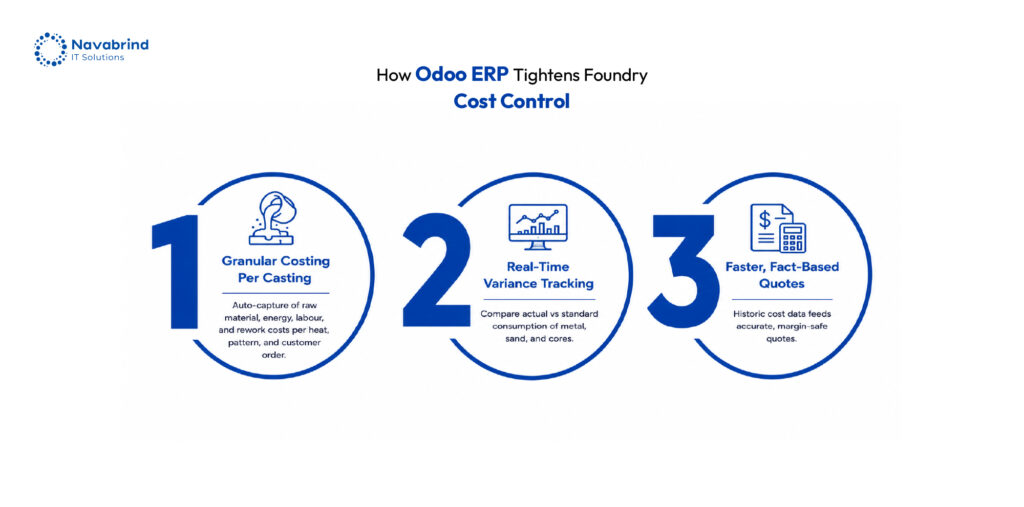
Odoo ERP for manufacturing acts as robust manufacturing cost control software for the ERP for foundry industry, giving managers full visibility into cost drivers across production. With Odoo manufacturing ERP, cost tracking moves beyond estimates and captures actual consumption at each stage of the process.
The system records raw material usage, including scrap, ingots, and alloys, along with yield and re-melting impact. Fuel, power, and consumables are tracked per heat, linking energy usage to output. Labour and maintenance costs are captured at the operation level by covering furnace work, casting, fettling, and inspection. This level of detail ensures that each activity contributes to an accurate cost structure.
Through a production planning ERP, Odoo allocates these costs to each melting order and cast batch. Managers can compare standard cost benchmarks with actual figures to identify variances in material usage, energy consumption, or labour input. Deviations become visible early, allowing corrective action before losses escalate. By combining cost tracking with a real-time production tracking system, Odoo ERP for manufacturing enables foundries to reduce waste, improve yield, and maintain tighter control over margins turning cost data into a daily operational advantage.
What Is the Process of Odoo ERP Implementation for Foundry Companies?
Implementing Odoo ERP for manufacturing in a foundry follows a structured path that aligns production workflows with digital control. With Odoo manufacturing ERP, the focus remains on mapping actual shop-floor activities into a connected system.
Step 1: Process mapping:
The journey begins by mapping key operations into melting orders, cast-batch tagging, heat treatment, fettling, quality checks, and dispatch. This creates a blueprint for configuring the ERP for foundry industry according to plant operations.
Step 2: Configuration of BoMs and routings:
Bills of Materials and routings are set for each product family. Quality checkpoints are embedded across stages to maintain consistency and traceability within the production planning ERP.
Step 3: Production tracking and cost setup:
A real-time production tracking system is configured to capture output at each stage. Cost coding is applied to materials, energy, labour, and operations, enabling manufacturing cost control software to track actual expenses.
Step 4: Training teams:
Supervisors, operators, and planners are trained to use digital work orders and dashboards, ensuring accurate data entry and adoption across shifts.
Step 5: Pilot and scale:
The system is tested in one production line or alloy group. After validation, Odoo ERP for manufacturing is expanded across the plant, establishing consistent control over production and costs.
What Is the Best ERP for a Small Foundry Business in India?
Odoo ERP for manufacturing stands out as a preferred choice for small foundry businesses in India due to its flexibility, cost structure, and fast deployment cycle. As an ERP for foundry industry, it aligns well with the operational scale and budget constraints of smaller units without introducing unnecessary complexity.
One of the key reasons is its modular pricing model. Foundries can start with essential applications such as inventory, production planning, ERP, and accounting, then expand as operations grow. This reduces upfront investment compared to enterprise systems, where licensing and implementation costs can reach several lakhs or even crores depending on scale.
With Odoo manufacturing ERP, deployment options include cloud and on-premise setups, making it suitable for teams with limited IT infrastructure. Pre-configured modules for production planning, inventory tracking, and shop-floor visibility integrate easily into foundry workflows, including melt planning and batch tracking.
When compared with heavier, industry-focused ERP platforms such as SAP or Infor, the difference becomes clear. Large systems demand long implementation cycles and significant investment, which suits enterprise-scale operations but not small foundries. In contrast, Odoo ERP for manufacturing delivers faster time-to-value, adaptable workflows, and lower total cost of ownership.
For small foundries aiming to control costs, adopt a real-time production tracking system, and improve operational visibility, Odoo manufacturing ERP provides a practical path to scale without financial strain.
Odoo ERP as a Production Planning ERP for Foundries
Odoo ERP for manufacturing functions as a robust production planning ERP for the ERP for foundry industry, aligning demand, capacity, and shop-floor execution. With Odoo manufacturing ERP, planning shifts from reactive scheduling to data-backed coordination across melting and casting operations.
The system enables capacity-driven scheduling for furnaces, molds, and kilns, ensuring that available resources match production demand. Melt schedules are planned with attention to furnace load, alloy type, and cycle time, preventing overlap of heats and reducing operational conflicts. Pattern-level planning ensures that casting sequences follow logical order, avoiding rework and material loss.
A key strength lies in linking the order book with raw material availability and energy-intensive operations. Odoo ERP for manufacturing checks stock levels for scrap, alloys, and consumables before confirming schedules. This connection prevents production holds due to material shortages and balances energy usage across shifts.
When integrated with a real-time production tracking system and manufacturing cost control software, planning becomes actionable and measurable. Supervisors can adjust schedules based on live production status, reducing idle furnace time and avoiding last-minute changes. For foundries, this structured planning approach leads to lower overtime, improved utilization of equipment, and consistent adherence to delivery timelines by turning planning into a profit-driving function.
Odoo ERP for Foundry-Specific Inventory & Traceability
Odoo ERP for manufacturing acts as a robust inventory management system and traceability engine for the ERP for foundry industry, giving full visibility into material movement and batch history. With Odoo manufacturing ERP, foundries track ingots, scrap, alloys, and finished castings at lot or heat-batch level, ensuring that each material entry and output is recorded with accuracy.
As materials move through melting, casting, and finishing stages, the system links each batch to its source inputs. This connection enables teams to trace which raw materials were used in a particular casting and how they performed during production. A real-time production tracking system supports this flow by capturing batch-level updates across operations.
Quality inspections and rejections are tied back to individual melts and patterns. When defects arise, supervisors can identify the exact source whether related to material composition, process variation, or handling. This level of traceability reduces repeated errors and supports faster corrective action.
With integrated manufacturing cost control software, rejected quantities and rework impact are reflected in cost analysis. In addition, Odoo ERP for manufacturing generates heat-trace reports required for customer audits and certifications, helping foundries maintain compliance, improve accountability, and strengthen trust with buyers.
Why Odoo ERP Is a Strategic Tool for the Future of Indian Foundries
Odoo ERP for manufacturing is reshaping how Indian foundries operate by connecting production, cost, and quality into one data-driven system. With Odoo manufacturing ERP, decision-making shifts from guesswork to measurable insights drawn from daily operations.
A real-time production tracking system gives full visibility into each stage by melting, casting, and finishing allowing teams to monitor progress, detect delays, and respond without waiting for end-of-shift updates. This level of control transforms production into a predictable and accountable process.
On the financial side, integrated manufacturing cost control software assigns actual expenses to each melting order and casting. Foundry managers gain clarity on cost per batch and per component, making it easier to control material usage, energy spend, and labour allocation. Variances are identified early, supporting timely corrective action.
As an ERP for foundry industry, Odoo strengthens traceability by linking raw materials, production batches, and inspection outcomes. This ensures that each casting can be tracked back to its source, supporting audit requirements and quality assurance. With connected planning, tracking, and costing, Odoo ERP for manufacturing enables foundries to deliver consistent quality, meet timelines, and build stronger customer confidence positioning them for sustained growth in a competitive market.
Frequently Asked Questions
1.What is Odoo ERP for the foundry industry in India?
Odoo ERP for manufacturing is a complete ERP for foundry industry designed to manage metal casting operations from enquiry to dispatch. Odoo manufacturing ERP connects order management, Bills of Materials, routing, and shop-floor execution across melting, casting, fettling, inspection, and dispatch. This integration ensures that production data, inventory movement, and financial transactions stay aligned. Foundries gain visibility into batch progress, material usage, and delivery timelines without relying on disconnected tools. The system adapts to different scales, supporting small units as well as multi-plant operations across India, enabling consistent control over production and cost.
2.How to track production in the foundry industry?
Production tracking becomes structured with a real-time production tracking system inside Odoo ERP for manufacturing. Instead of whiteboards or paper logs, operators record output at each stage, including melting, casting, and finishing. This data feeds into live dashboards that show order status, work-in-progress, and completed quantities. Supervisors no longer depend on verbal updates; they can monitor progress instantly and identify delays as they occur. This approach reduces missed operations, improves coordination between departments, and ensures that production stays aligned with delivery commitments.
3.How does real-time production tracking in manufacturing using ERP work?
With Odoo manufacturing ERP, each order is broken into work orders linked to defined operations. As operators complete tasks, they log quantities through the system, updating production status instantly. Dashboards display in-process orders, completed batches, and machine-level output. Bottlenecks become visible when a stage slows down, enabling supervisors to reallocate resources or adjust schedules. This continuous data flow transforms production tracking from delayed reporting into active monitoring, supporting faster decisions and better control over timelines.
4.How does manufacturing cost control using Odoo ERP help foundries?
As manufacturing cost control software, Odoo ERP for manufacturing captures detailed cost elements across production. Raw materials such as scrap, ingots, and alloys are tracked along with yield and re-melting impact. Energy usage, consumables, labour, and maintenance costs are recorded at operation level. The system allocates these costs to each melting order and casting batch, providing accurate cost per unit. Managers can compare planned versus actual figures to identify variances and take corrective action. This visibility helps reduce waste, improve yield, and maintain tighter control over margins.
5.What is the process of Odoo ERP implementation for foundry companies?
Implementation of Odoo manufacturing ERP begins with mapping foundry workflows, including melting orders, batch tracking, and finishing stages. Bills of Materials, routings, and quality checkpoints are then configured for each product category. A production planning ERP and real-time production tracking system are set up to capture shop-floor activity and cost data. Teams receive training on digital work orders and dashboards to ensure accurate usage. The system is first deployed in a pilot line or alloy group, then expanded across the plant. This phased approach reduces risk and ensures smooth adoption.
6.What is the best ERP for small foundry business in India?
Odoo ERP for manufacturing is widely adopted by small foundries due to its flexible structure and cost efficiency. Businesses can start with essential modules such as inventory, production planning ERP, and accounting, then expand as operations grow. Deployment options support both cloud and on-premise setups, making it suitable for teams with limited IT resources. Compared to heavier ERP platforms, Odoo manufacturing ERP offers faster implementation and easier adaptability to foundry workflows. For small foundries aiming to gain production visibility, cost control, and scalability, it provides a practical and sustainable solution.
Schedule a conversation with us now!
Related Articles









 Post
Post Post
Post