Why Hospitals Need ERP for Hospitals in 2026:
US hospitals face rising operational pressure with patient inflow fluctuates, staffing gaps impact care delivery, supplier networks demand tight coordination, and compliance standards continue to expand. Legacy hospital management system ERP platforms and fragmented tools struggle to keep pace with this complexity. Disconnected records, delayed reporting, and stock mismanagement lead to revenue leakage and operational strain.
ERP for hospitals addresses these gaps by bringing clinical, administrative, and financial data into one operational framework. A well-implemented hospital ERP software replaces scattered processes with controlled workflows, enabling faster billing cycles, tighter cost tracking, and stronger audit readiness. From patient admissions to procurement, ERP for the healthcare industry creates accountability across departments.
Odoo healthcare deployments are gaining traction in 2026 as healthcare providers look for scalable ERP solutions for healthcare without the overhead of legacy systems. With integrated hospital inventory management system capabilities and healthcare compliance software alignment, Odoo healthcare stands out as a practical shift toward measurable ROI and operational control.
Understanding Hospital ERP Software:
Hospital ERP software connects clinical operations, administration, finance, and supply chain into one coordinated environment designed for care delivery. Unlike generic ERP for the healthcare industry, ERP for hospitals aligns workflows with patient journeys, clinical documentation, insurance processes, and regulatory demands. Standard enterprise tools handle accounting or procurement; hospital ERP software supports admissions, discharge flows, treatment tracking, and audit requirements without fragmentation.
A hospital management system ERP includes patient administration for registration, appointments, and medical records linked to billing. Financials and billing manage insurance claims, reimbursements, and revenue capture with accuracy. Clinic and department management coordinates staff, equipment usage, and service delivery across units. A hospital inventory management system tracks medicines, consumables, and critical supplies, reducing stockouts and excess holding costs. Reporting and analytics convert operational data into actionable insights for leadership decisions.
Odoo healthcare deployments bring these capabilities together within ERP solutions for healthcare, strengthening visibility, compliance, and financial performance across hospital operations.
Why Are US Hospitals Switching to Odoo ERP in 2026?
US healthcare providers face continuous pressure to control costs without impacting patient outcomes. Rising operational expenses, insurance complexities, and staffing constraints demand tighter financial oversight. ERP for hospitals addresses this challenge by connecting revenue cycles, procurement, and clinical workflows into a single operational layer. Hospital ERP software reduces billing gaps, minimizes claim denials, and improves margin visibility.
Another driving factor is the need for live visibility across departments. Disconnected hospital management system ERP tools create blind spots in patient flow, inventory levels, and staff utilization. ERP solutions for healthcare eliminate these gaps by aligning data from admissions, pharmacy, labs, and finance. A hospital inventory management system ensures stock accuracy, preventing over-purchasing and shortages that affect care delivery.
Cloud-ready infrastructure is replacing rigid legacy stacks. Hospitals require flexible ERP for the healthcare industry that adapts to growth without heavy infrastructure investment. Odoo healthcare stands out with an open-core approach and cloud compatibility, making hospital ERP software accessible for mid-sized and regional providers. With integrated healthcare compliance software capabilities, Odoo healthcare delivers operational control, scalability, and measurable financial impact.
Benefits of Healthcare ERP Software for US Hospitals:
Healthcare ERP software delivers measurable gains across operations, finance, patient care, and leadership visibility. ERP for hospitals replaces fragmented tools with a connected environment that aligns departments, reduces delays, and protects revenue. Hospital ERP software enables hospitals to move from reactive management to controlled, insight-led execution.
- Operational efficiency:
ERP for hospitals standardizes workflows across wards, labs, and administrative units. A hospital management system ERP connects admissions, diagnostics, pharmacy, and discharge processes, eliminating repetitive data entry and inconsistencies. With a hospital inventory management system integrated into daily operations, supply usage aligns with patient demand, reducing wastage and preventing stock gaps.
- Financial and billing control:
Hospital ERP software links invoicing, insurance validation, and claims processing within one system. ERP solutions for healthcare ensure accurate billing records, faster reimbursements, and reduced claim rejections. ERP for the healthcare industry strengthens revenue tracking and cost accountability.
- Patient-centric experience:
Shorter wait times, fewer documentation errors, and improved coordination enhance patient satisfaction. Odoo healthcare supports smoother communication between departments, ensuring consistent care delivery.
- Data-driven decision-making:
Healthcare compliance software combined with reporting tools delivers actionable dashboards for utilization, capacity planning, and revenue leakage control.
Which Is the Best ERP System for Hospital Management in the US?
Choosing the right ERP for hospitals depends on scale, complexity, and financial priorities. Traditional hospital management system ERP platforms such as Epic and Oracle Cerner dominate large health systems with deep clinical capabilities. At the enterprise level, SAP S/4HANA supports finance-heavy operations across multi-entity networks. These systems demand high investment, long deployment cycles, and ongoing maintenance overhead.
Odoo healthcare positions itself as a flexible ERP for the healthcare industry that adapts to operational needs without excessive cost. ERP for hospitals built on Odoo integrates patient administration, billing, HR, and hospital inventory management system functions within one environment, reducing dependency on disconnected tools. Odoo-based hospital ERP software combines ERP with EMR capabilities, linking clinical and administrative workflows into a unified system.
For community hospitals and private groups, Odoo healthcare delivers faster deployment and lower total cost of ownership. Multi-site systems gain centralized visibility without heavy infrastructure. FQHCs benefit from scalable ERP solutions for healthcare aligned with compliance and reporting needs.
Odoo stands out with a clean interface, flexible configuration, and strong support for pharmacy, lab workflows, and healthcare compliance software. ERP for hospitals using Odoo shifts focus from system maintenance to operational performance and revenue growth.
Odoo ERP for Hospital Inventory Management
1.Hospital Inventory Management System inside Odoo
Inventory control in hospitals demands accuracy across high-value and high-risk items. ERP for hospitals using Odoo healthcare connects pharmacy, central stores, wards, and labs into one coordinated inventory environment. Hospital ERP software tracks medicines, implants, PPE, and consumables across locations with continuous visibility, ensuring that supply aligns with patient demand and treatment schedules.
A hospital inventory management system within Odoo healthcare manages lot numbers and expiry dates for drugs, vaccines, and blood products. This capability supports traceability, reduces risk of expired stock usage, and strengthens healthcare compliance software requirements. Batch-level tracking enables quick recalls and audit readiness without operational disruption.
Reorder logic is driven by consumption patterns and defined thresholds. ERP solutions for healthcare trigger replenishment alerts before stock reaches critical levels, preventing shortages during emergencies. ERP for the healthcare industry gains tighter control over procurement cycles, lowers wastage, and protects margins. With hospital ERP software embedded into daily workflows, inventory becomes a controlled asset rather than a recurring risk.
2.Odoo ERP in Supply Chain Management Across US Healthcare
Supply chains in healthcare demand coordination from vendor selection to patient billing. ERP for hospitals using Odoo healthcare connects procurement, warehouse operations, ward-level consumption, and billing into one controlled flow. Hospital ERP software ensures that items issued for patient care link with billing records, preventing revenue leakage and improving cost recovery. ERP for the healthcare industry aligns purchasing decisions with clinical demand, reducing excess stock and emergency procurement.
Visibility into vendor performance transforms procurement outcomes. Odoo healthcare within ERP solutions for healthcare tracks supplier reliability, delivery timelines, and contract pricing. Hospitals gain data-backed insights to negotiate better terms and avoid delays that impact care delivery. A hospital inventory management system tied to procurement ensures that stock levels reflect actual usage patterns.
For group purchasing organizations and multi-hospital networks, ERP for hospitals centralizes procurement across locations. Hospital management system ERP enables bulk purchasing, standardized pricing, and shared inventory visibility. This structure reduces duplication, improves cost control, and strengthens healthcare compliance software alignment across the network.
3.Odoo ERP and Healthcare Compliance Software
Compliance in US hospitals demands traceability across clinical actions, inventory movement, and financial transactions. ERP for hospitals using Odoo healthcare extends beyond a hospital management system ERP by acting as a compliance-enabling layer embedded into daily operations. Hospital ERP software records each transaction across pharmacy, labs, billing, and procurement, creating a verifiable history that supports regulatory audits and internal governance.
Audit trails and change logs capture updates to medicines, procedures, and charges with timestamped records. This level of tracking within healthcare compliance software reduces disputes, strengthens accountability, and supports faster audit responses. From prescription edits to billing adjustments, ERP for the healthcare industry ensures traceability without gaps.
Role-based access control enforces segregation of duties across departments. ERP solutions for healthcare restrict permissions based on job roles, reducing unauthorized actions and fraud risks. Combined with a hospital inventory management system, Odoo healthcare maintains compliance across stock handling, financial approvals, and clinical workflows, protecting operational integrity and financial outcomes.
4.How Does Odoo ERP Help US Hospitals Manage HIPAA Compliance in 2026?
HIPAA compliance depends on disciplined processes, controlled access, and verifiable records. ERP for hospitals using Odoo healthcare acts as a supportive backbone for these requirements rather than a one-click solution. Hospital ERP software enables healthcare organizations to enforce policies across patient data, billing records, and clinical workflows without fragmentation.
Role-based permissions control who can view, edit, or share protected health information. ERP for the healthcare industry ensures that access aligns with job responsibilities, reducing exposure risks. Within healthcare compliance software, this structure supports segregation of duties across departments such as billing, pharmacy, and administration.
Audit-ready logs record access, edits, and disclosures with time-stamped entries. These logs strengthen accountability and simplify audit preparation. Secure cloud hosting through certified partners supports data protection standards required by US healthcare providers.
Odoo healthcare integrates with encryption layers, single sign-on (SSO), and data loss prevention tools. ERP solutions for healthcare combined with these safeguards help hospitals enforce HIPAA policies, protect sensitive data, and maintain regulatory confidence.
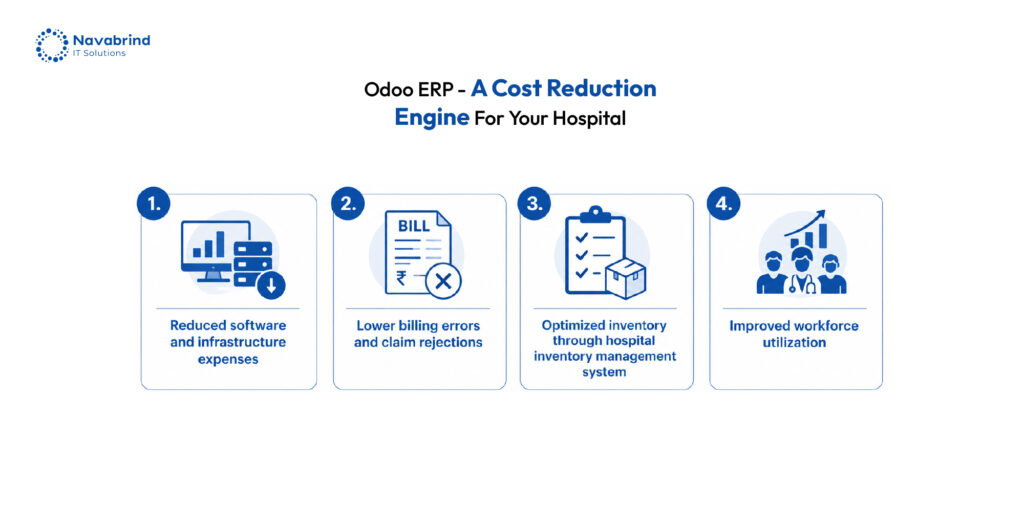
5.How Does Odoo ERP Reduce Operational Costs in US Hospitals?
Cost pressure in US healthcare continues to rise, forcing hospitals to rethink how resources are allocated and controlled. ERP for hospitals using Odoo healthcare targets cost reduction across licensing, operations, and workforce utilization. Hospital ERP software replaces fragmented legacy stacks that demand high upfront investment and ongoing maintenance. Cloud-based deployment reduces infrastructure expenses and lowers dependency on multiple vendors.
Operational inefficiencies drain margins through billing errors, duplicate entries, and stock mismanagement. ERP for the healthcare industry removes these gaps by connecting billing, procurement, and inventory workflows. A hospital inventory management system ensures accurate stock tracking, reducing wastage and emergency purchases. ERP solutions for healthcare improve claim accuracy, accelerating reimbursements and reducing revenue leakage.
Workforce utilization improves as administrative workload decreases. Staff spend less time on repetitive tasks and focus on patient care and service delivery. Odoo healthcare enables hospitals to reallocate human resources toward value-driven activities.
6.Implementation Approach: Odoo ERP for Hospitals
Successful adoption of ERP for hospitals depends on a phased, outcome-focused rollout rather than a disruptive switch. Odoo healthcare supports staged implementation, allowing hospitals to move from legacy hospital management system ERP or HMIS environments into a controlled, scalable framework.
The process begins with discovery and gap analysis. Existing workflows across admissions, billing, pharmacy, and procurement are evaluated to identify inefficiencies, data silos, and compliance risks. This step defines how hospital ERP software can replace fragmented processes with aligned operations.
Execution follows a prioritized rollout. High-impact areas such as pharmacy, stores, and billing go live first, delivering immediate visibility into revenue and inventory. A hospital inventory management system integrated at this stage reduces stock discrepancies and improves cost control. Subsequent phases extend ERP for the healthcare industry into labs, HR, and multi-location coordination.
ERP solutions for healthcare using Odoo healthcare enable staged adoption without operational disruption. Hospitals gain flexibility to scale usage, align teams, and strengthen healthcare compliance software frameworks as deployment progresses.
Frequently Asked Questions
1.How does Odoo ERP help US hospitals manage HIPAA compliance in 2026?
ERP for hospitals using Odoo healthcare acts as a compliance-support layer across clinical, financial, and administrative workflows. Hospital ERP software enforces role-based access to protected health information, ensuring that staff access aligns with responsibilities. Healthcare compliance software features include audit-ready logs that capture data access, edits, and disclosures with timestamps. Integration with encryption tools, SSO, and data loss prevention systems strengthens HIPAA policy enforcement. This approach supports audit readiness, reduces risk exposure, and improves control over sensitive patient data.
2.Why are US hospitals switching to Odoo ERP in 2026?
Rising operational costs and fragmented systems push hospitals toward ERP for the healthcare industry that delivers visibility and cost control. Odoo healthcare offers a flexible alternative to legacy hospital management system ERP platforms, enabling hospitals to unify billing, procurement, and patient workflows. Hospital ERP software built on Odoo reduces dependency on multiple tools, improves coordination across departments, and supports scalable growth for mid-sized and multi-location providers.
3.What are the benefits of healthcare ERP software for US hospitals?
Healthcare ERP software improves operational control, financial accuracy, and patient experience. ERP for hospitals standardizes workflows across departments, reducing duplicate data entry and delays. Hospital ERP software strengthens billing and claims processing, improving revenue capture. A hospital inventory management system reduces wastage and ensures stock availability. ERP solutions for healthcare deliver actionable insights through dashboards, enabling leadership to monitor utilization, capacity, and financial performance.
4.How does Odoo ERP reduce operational costs in US hospitals?
ERP for hospitals using Odoo healthcare reduces expenses across licensing, infrastructure, and operations. Hospital ERP software minimizes billing errors and claim rejections, protecting revenue. A hospital inventory management system aligns stock with demand, lowering excess procurement and wastage. ERP for the healthcare industry reduces administrative workload, allowing staff to focus on patient care. This combination improves cost control and financial stability.
5.Which is the best ERP system for hospital management in the US?
The answer depends on hospital size and operational needs. Large health systems rely on enterprise platforms like Epic, Oracle Cerner, or SAP. Mid-sized hospitals, private groups, and multi-site providers benefit from ERP for hospitals built on Odoo healthcare. Hospital ERP software based on Odoo delivers flexibility, lower total cost of ownership, and strong integration across departments. ERP solutions for healthcare using Odoo combine financial, operational, and inventory capabilities within one environment.
6.How does Odoo ERP improve supply chain management in US healthcare?
ERP for hospitals connects procurement, inventory, and billing into a coordinated process. Odoo healthcare tracks vendor performance, delivery timelines, and contract pricing within hospital ERP software. A hospital inventory management system ensures stock accuracy across locations, reducing shortages and excess inventory. ERP for the healthcare industry enables centralized procurement for multi-hospital networks, improving cost control and supplier negotiation.
Schedule a conversation with us now!
Related Articles









 Post
Post Post
Post