Launching a healthcare startup in the U.S. demands constant control over compliance, costs, and operations. Founders deal with strict data regulations, limited capital, and the pressure to scale services without operational gaps. Spreadsheets and disconnected apps may support early traction, yet they begin to fail as patient volume, billing complexity, and reporting requirements expand.
Within 12–18 months, many startups hit a breaking point. Entry-level tools can’t support audit trails, multi-location coordination, or secure patient data handling. At the same time, legacy enterprise platforms come with high licensing fees, long deployment cycles, and rigid architectures that don’t match the pace of a growing venture. This gap has pushed startups to explore open source healthcare ERP options that offer control without enterprise-level cost burdens.
This is where Odoo ERP for healthcare startups gains attention. It presents a practical route for founders who want an ERP system for hospitals and clinics without locking themselves into expensive vendor ecosystems. Compared to legacy platforms, the Odoo vs SAP for healthcare discussion now leans toward flexibility, faster rollout, and cost control key factors for startups managing tight financial plans.
Another critical factor is compliance. Handling patient data requires alignment with strict privacy standards, making HIPAA compliant ERP software a non-negotiable requirement. Startups are now evaluating how platforms like Odoo can be configured to meet these standards without inflating operational costs.
This guide breaks down what healthcare founders need to know:
- Whether Odoo ERP for healthcare startups fits clinical and operational workflows
- How open source healthcare ERP supports scalability without vendor lock-in
- Key considerations for meeting HIPAA compliant ERP software requirements
- A realistic view of affordable ERP for medical startups, including implementation and maintenance costs
- A comparison of Odoo vs SAP for healthcare, along with Oracle and NetSuite, from a startup lens
If you’re building a healthcare venture and evaluating an ERP system for hospitals and clinics, this guide will help you make a decision that impacts cost, compliance, and growth trajectory from day one.
What Is Odoo ERP and Why Are Healthcare Startups Paying Attention?
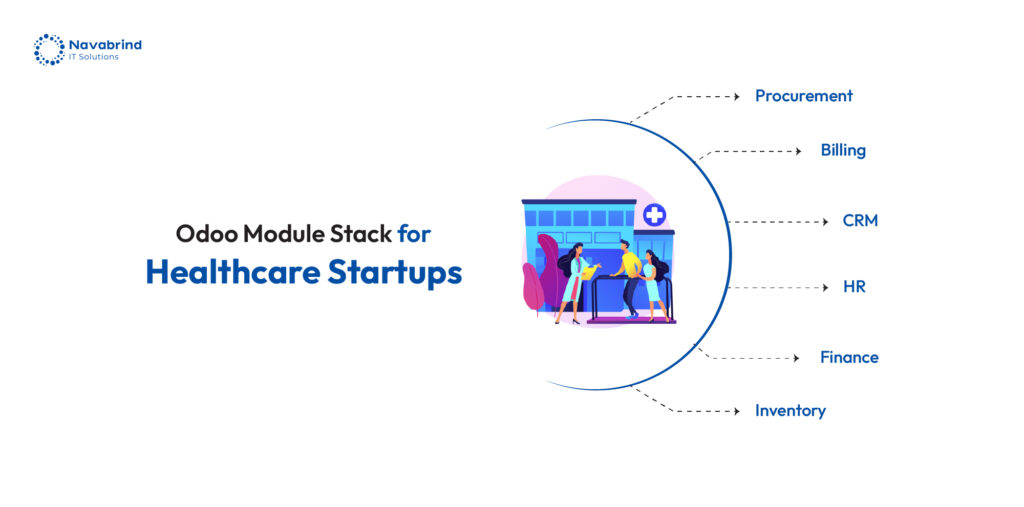
Odoo ERP for healthcare startups is an open source healthcare ERP platform designed to manage business operations across a growing organization. Instead of forcing companies into rigid systems, Odoo allows startups to activate only the applications they need covering finance, HR, procurement, inventory, CRM, and billing within one connected environment.
Why Healthcare Startups Are Evaluating Odoo in 2026:
Healthcare founders are moving away from disconnected tools that create reporting gaps and compliance risks. As operations expand, they require an ERP system for hospitals and clinics that brings financial control, staff coordination, and supply chain visibility under one roof.
The shift toward Odoo ERP for healthcare startups comes from three practical drivers:
- Cost control: Compared to legacy platforms in the Odoo vs SAP for healthcare discussion, Odoo reduces licensing and implementation overhead, making it an affordable ERP for medical startups.
- Scalable adoption: Teams can roll out modules step-by-step instead of committing to a full enterprise system from day one.
- Customization flexibility: As an open source healthcare ERP, Odoo allows startups to tailor workflows based on regulatory and operational needs.
Affordability Compared to Traditional ERP Vendors:
Healthcare startups often evaluate platforms like SAP, Oracle, and NetSuite, only to find pricing models that don’t align with early-stage budgets. In contrast, Odoo ERP for healthcare startups offers a cost structure that supports growth without locking companies into long-term financial commitments. This is why the Odoo vs SAP for healthcare comparison increasingly favors Odoo for startups that need operational control without enterprise-level spending
Modular Adoption Without Overcommitment:
Odoo allows startups to begin with essential functions such as accounting or inventory and expand into HR, CRM, or procurement when required. This phased approach reduces risk and ensures that teams invest only in what delivers immediate value. For founders seeking an affordable ERP for medical startups, this flexibility becomes a major advantage.
Active Ecosystem and Healthcare Extensions:
The strength of Odoo lies in its global developer ecosystem. Continuous contributions have led to a growing range of healthcare-focused extensions, enabling startups to align workflows with compliance requirements, including configurations that support HIPAA compliant ERP software environments when implemented correctly.
Cloud Deployment with Controlled Access:
Odoo supports cloud deployment with role-based permissions, giving healthcare organizations control over who can access sensitive data. This is critical for startups handling patient-related information and working toward HIPAA compliant ERP software standards.
Odoo Is Not an EHR or EMR:
A common misconception is that Odoo replaces clinical systems. It does not function as an Electronic Health Record (EHR) or Electronic Medical Record (EMR) platform. Startups must continue using dedicated clinical systems for patient records and treatment data.
Where Odoo Fits in Healthcare Operations:
Odoo ERP for healthcare startups works as the operational backbone that connects non-clinical functions across the organization:
Who Is Using Odoo in Healthcare Today
Adoption of open source healthcare ERP solutions like Odoo is expanding across different healthcare segments:
- Private clinics and outpatient centers managing administration and billing
- Medical device startups handling production, inventory, and distribution
- Healthcare staffing and administrative firms coordinating workforce operations
- Telehealth platforms running back-office functions such as billing and CRM
- Diagnostic labs and specialty care providers managing procurement and reporting
For these organizations, Odoo ERP for healthcare startups offers a balanced approach combining operational control, scalability, and cost efficiency making it a strong contender in the evolving Odoo vs SAP for healthcare landscape.
Can Odoo Be Made HIPAA Compliant for US Healthcare Organizations?
Healthcare founders evaluating Odoo ERP for healthcare startups must understand one fact upfront: HIPAA compliance is not a feature you switch on. It is a combination of technology, infrastructure, policies, and accountability.
What HIPAA Compliance Requires from a Software Perspective:
To qualify as HIPAA compliant ERP software, a system must support three categories of safeguards:
Technical safeguards
- Role-based access controls to restrict PHI visibility
- Audit logs that track user activity and data access
- Encryption for data at rest and in transit
- Session controls, such as automatic logoff
Administrative safeguards
- Defined user access policies
- Role assignment and permission governance
- Staff training records for compliance readiness
Physical safeguards
- Secure data center infrastructure
- Controlled access to servers and hosting environments
Any ERP system for hospitals and clinics handling Protected Health Information (PHI) must align with these requirements.
The Role of a Business Associate Agreement (BAA):
If a vendor touches PHI, a Business Associate Agreement becomes mandatory. This contract defines how data is handled, secured, and reported in case of breaches. Without a BAA, no platform can be considered part of a compliant environment.
Where Odoo Stands on HIPAA Compliance:
Odoo ERP for healthcare startups does not arrive as a certified HIPAA-compliant platform. That said, Odoo Enterprise deployed on Odoo.sh or a compliant cloud infrastructure can be configured to meet key technical safeguards. Odoo offers BAAs under enterprise agreements, though the scope depends on deployment choices and contractual terms. This is a critical point in the Odoo vs SAP for healthcare evaluation enterprise vendors may position compliance as bundled, yet responsibility still extends to the organization. For startups using the community edition, the responsibility increases. A self-hosted open source healthcare ERP setup requires the organization to manage security, infrastructure, and compliance controls end-to-end.
What Healthcare Startups Must Do to Achieve Compliance with Odoo:
Reaching compliance with Odoo ERP for healthcare startups involves deliberate setup decisions:
- Choose a HIPAA-eligible hosting provider
Platforms such as AWS, Azure, or Google Cloud can support compliant environments when a signed BAA is in place.
- Configure role-based access within Odoo
Limit PHI exposure by assigning permissions based on job roles.
- Enable audit logging
Maintain detailed activity records to track access and changes.
- Encrypt data at the infrastructure level
Ensure encryption for stored data and data in transit.
- Strengthen authentication controls
Implement multi-factor authentication and session timeout rules.
- Maintain administrative compliance
Document internal policies and conduct staff training aligned with HIPAA requirements.
These steps transform Odoo into part of a compliant ecosystem, making it viable as an affordable ERP for medical startups handling sensitive data.
What Odoo Cannot Do on Its Own:
No ERP, whether Odoo, SAP, or Oracle, guarantees compliance by default. Odoo ERP for healthcare startups supports the framework, but compliance remains a shared responsibility between:
- The ERP platform
- The hosting provider
- Internal processes and governance
This distinction is critical when comparing Odoo vs SAP for healthcare. Large vendors may package compliance messaging differently, yet the accountability model remains unchanged.
Why Implementation Expertise Matters
The difference between a secure deployment and a risky one lies in execution. Working with an experienced Odoo implementation partner who understands healthcare regulations ensures that configurations align with compliance expectations. For startups adopting an open source healthcare ERP, this expertise reduces misconfiguration risks and shortens the path to operational readiness.
Final Consideration:
Before deploying any HIPAA compliant ERP software, healthcare startups should consult a qualified HIPAA compliance expert. Legal and regulatory alignment cannot be handled by software decisions alone. When approached correctly, Odoo ERP for healthcare startups can support compliance goals without the financial strain associated with legacy platforms, making it a practical choice for organizations building a secure and scalable ERP system for hospitals and clinics.
Why Do Healthcare Startups Avoid SAP and Oracle ERP?
The Enterprise ERP Trap:
Large platforms such as SAP and Oracle were designed for hospital networks, pharmaceutical enterprises, and multi-layered organizations with established processes. Startups operate in a completely different environment. lean teams, evolving workflows, and constant iteration. This mismatch creates friction. Instead of enabling growth, enterprise systems introduce cost pressure, slow execution, and operational rigidity. That’s why founders evaluating Odoo ERP for healthcare startups are moving toward options that align with startup realities.
The Core Problems with SAP for Healthcare Startups:
1. High licensing barriers
SAP licensing can run into tens of thousands of dollars annually before implementation even begins. For early-stage companies, this alone makes it an impractical choice compared to an affordable ERP for medical startups.
2. Long implementation timelines
Deployments can take 12 to 24 months. Startups cannot wait that long to stabilize operations. By the time the system goes live, the business model may have already shifted.
3. Ongoing dependency on specialists
SAP environments demand dedicated administrators and external consultants. This adds recurring operational cost and slows down internal decision-making.
4. Limited flexibility during growth phases
Healthcare startups frequently pivot to new services, pricing models, or partnerships. SAP’s rigid architecture makes these changes time-consuming and expensive. In the Odoo vs SAP for healthcare comparison, this is where SAP loses ground for startups. It is engineered for scale at the enterprise level, not adaptability at the startup stage.
The Core Problems with Oracle ERP for Healthcare Startups:
1. Comparable cost and complexity
Oracle ERP follows a similar pricing and deployment model to SAP, placing it out of reach for most startups seeking an ERP system for hospitals and clinics.
2. Designed for large-scale operations
Oracle performs well in large hospital networks with established IT departments. Startups, on the other hand, need systems that can evolve quickly without heavy infrastructure.
3. Lengthy sales and contract cycles
Negotiations, approvals, and onboarding processes delay implementation. Startups need speed, not prolonged vendor cycles.
Where NetSuite Struggles for Healthcare Startups:
NetSuite positions itself as a cloud ERP alternative, yet many healthcare startups still encounter limitations in flexibility, customization depth, and cost scaling. A deeper breakdown appears later, though early-stage founders already see gaps when aligning it with healthcare workflows and compliance needs.
The Fundamental Mismatch
Enterprise ERP platforms were created for organizations with:
- Dedicated IT departments
- Large implementation budgets
- Stable and predictable processes
Startups operate with none of these. They need agility, cost control, and systems that adapt alongside their growth. This is where open source healthcare ERP platforms begin to stand out.
What Healthcare Startups Actually Need from an ERP
To support growth without operational friction, startups look for:
- Fast deployment measured in weeks, not years
- Low upfront investment with predictable monthly costs
- Scalable architecture that allows adding capabilities without reimplementation
- Ease of use so non-technical teams can manage operations without dependency on specialists
This is why Odoo ERP for healthcare startups is gaining traction. It aligns with the expectations of founders who want control over operations without the financial and operational burden seen in the Odoo vs SAP for healthcare debate. For teams searching for an affordable ERP for medical startups that can support compliance goals such as HIPAA compliant ERP software, Odoo offers a practical path bridging the gap between entry-level tools and enterprise-grade systems without locking startups into complexity.
What ERP Modules Do Healthcare Startups Actually Need to Run Operations?
Operational ERP vs. Clinical Systems
Start with a clear boundary. An ERP system for hospitals and clinics manages business operations like finance, staffing, procurement, and coordination across teams. Clinical platforms handle patient records, diagnoses, and treatment workflows. Odoo ERP for healthcare startups fits as the operational backbone, not a replacement for EHR or EMR systems. This distinction matters when planning a scalable stack within an open source healthcare ERP environment.
The Core Module Stack for Healthcare Startups Using Odoo
A focused module selection keeps costs controlled and speeds up adoption. For founders evaluating an affordable ERP for medical startups, these modules form the operational foundation:
1.Accounting and Finance
- Invoicing and revenue tracking
- Accounts payable and receivable
- Multi-entity support for expanding organizations
- Financial reporting aligned with investor or grant requirements
- Budget tracking for controlled spend
This module anchors compliance and reporting critical when preparing for audits or aligning with HIPAA compliant ERP software environments.
2.Inventory and Procurement
For any ERP system for hospitals and clinics, supply visibility directly impacts service delivery.
3.Human Resources and Payroll
- Staff records and role definitions
- Credential tracking for clinical teams
- Leave and attendance management
- Payroll integration
Healthcare startups rely on workforce coordination. This module ensures administrative control without adding complexity.
4.CRM (Customer Relationship Management)
- Managing patient or client pipelines
- Referral tracking for clinics and partnerships
- Outreach for private-pay or B2B healthcare models
Within Odoo ERP for healthcare startups, CRM supports growth without relying on disconnected marketing tools.
5.Project Management
- Planning clinic launches or service rollouts
- Coordinating internal initiatives
- Tracking execution timelines
Startups expanding locations or launching services benefit from structured execution.
6.Purchase Management
- Purchase orders and approvals
- Vendor evaluation workflows
- Spend tracking across departments
This adds financial discipline key for any affordable ERP for medical startups operating under tight budgets.
7.Document Management
- Storage for compliance files, contracts, and SOPs
- Organized access to operational records
This becomes essential when aligning processes with HIPAA compliant ERP software practices.
Additional Modules Based on Startup Type
As operations evolve, startups can extend their open source healthcare ERP setup with targeted modules:
- Helpdesk: for telehealth platforms handling patient queries and support tickets
- Field Service: for home healthcare or mobile medical services
- eCommerce: for health product or supplement brands selling online
- Subscription Management: for membership-based clinics or digital health platforms
These additions allow Odoo ERP for healthcare startups to adapt to different business models without system replacement.
Modules Startups Should Delay
Activating too many modules early creates confusion and slows adoption. Focus first on operational stability.
- Manufacturing: relevant only for medical device or product-based startups
- Advanced analytics tools: valuable only after clean, centralized data is available
In the Odoo vs SAP for healthcare comparison, enterprise platforms push full-suite adoption upfront. Startups benefit from a phased approach instead.
Building the Right Module Roadmap
The advantage of Odoo ERP for healthcare startups lies in controlled expansion. Start with finance, inventory, and HR. Add CRM, procurement, and support modules as operations grow. This approach aligns with the expectations of an affordable ERP for medical startups by keeping investment aligned with growth while maintaining flexibility. For founders evaluating an ERP system for hospitals and clinics, the goal is not to implement everything at once. The goal is to create a system that evolves alongside the organization, without forcing costly reimplementation or operational disruption.
How Much Does Odoo ERP Cost for a Healthcare Startup in the US?
Understanding the Odoo Pricing Model in 2026
Odoo ERP for healthcare startups follows a straightforward structure with two editions:
Odoo Community
- Free and open source healthcare ERP
- Self-hosted with no official vendor support
- Full responsibility for security, updates, and compliance rests with the organization
Odoo Enterprise
- Subscription-based pricing per user, per month
- Access to all applications, vendor support, and version upgrades
- Preferred choice for startups targeting HIPAA compliant ERP software environments due to support and hosting flexibility
Where Startups Commonly Underestimate Budget
The largest cost surprises rarely come from software licensing. Instead, they appear in:
- Compliance setup for HIPAA compliant ERP software
- Data migration from fragmented systems
- Staff onboarding and training
Ignoring these areas can delay adoption and increase long-term costs.
Final Takeaway
For founders evaluating an ERP system for hospitals and clinics, Odoo ERP for healthcare startups delivers a cost structure that aligns with early-stage and growth-phase realities. It allows organizations to invest in operations, compliance, and scalability without committing to the financial burden seen in traditional enterprise systems making it a strong contender among affordable ERP for medical startups.
How Long Does Odoo ERP Implementation Take for a Healthcare Clinic?
Why Timelines Vary: What Drives the Duration
Implementation timelines for Odoo ERP for healthcare startups depend on operational complexity, data quality, compliance scope, and integration needs. A clinic with clean data and limited workflows moves faster than a multi-entity organization connecting billing tools, EHR systems, and telehealth platforms. Healthcare adds another layer. Building toward HIPAA compliant ERP software standards introduces access controls, audit tracking, and validation steps that extend timelines beyond a typical open source healthcare ERP deployment.
Typical Implementation Phases for a Healthcare Startup
A structured rollout keeps execution predictable and reduces rework. For an ERP system for hospitals and clinics, these phases define the journey:
1. Discovery and Scoping
- Map current workflows across finance, HR, procurement, and operations
- Define module selection and priorities
- Identify compliance requirements for HIPAA compliant ERP software
2. Configuration and Customization
- Set up modules within Odoo ERP for healthcare startups
- Configure workflows, approvals, and reporting structures
- Establish role-based access aligned with compliance expectations
3. Data Migration
- Extract data from spreadsheets, billing tools, or legacy systems
- Clean and standardize records
- Import into the new ERP system for hospitals and clinics
4. User Acceptance Testing
- Validate workflows using real scenarios
- Identify gaps before launch
- Ensure operational readiness across departments
5. Training
- Role-based onboarding for finance, HR, and operations teams
- Focus on usability for non-technical staff
6. Go-Live and Stabilization
- Run parallel systems where needed
- Resolve early-stage issues
- Provide hands-on support as teams transition
Realistic Total Timelines by Organization Type
Small single-location clinic:
- 10 to 16 weeks
- Limited workflows, faster decision cycles
Multi-location or multi-entity healthcare startup:
- 16 to 28 weeks
- Requires coordination across departments and entities
Health tech startup with integrations:
- 20 to 32 weeks
- Integration with EHR, billing platforms, or APIs extends timelines
In the Odoo vs SAP for healthcare comparison, these timelines stand out. Enterprise platforms can take a year or longer, which does not align with startup growth cycles.
Factors That Extend Timelines in Healthcare:
Healthcare implementations carry additional complexity:
How to Accelerate Implementation Without Risk
Speed comes from prioritization, not shortcuts. A phased rollout works better than launching everything at once. Start with finance, HR, and procurement. Add CRM, support, or subscription modules after stabilization. This approach aligns with the expectations of an affordable ERP for medical startups while keeping investment controlled and execution focused.
The Cost of Delayed or Rushed Go-Live
Skipping proper discovery to save time leads to misaligned workflows, reconfiguration, and user resistance. The result: delays that cost more than the time saved. A well-planned implementation of Odoo ERP for healthcare startups balances speed with accuracy. When executed with discipline, it delivers a stable operational foundation that supports compliance, scalability, and long-term growth within an open source healthcare ERP environment.
Is Odoo Better Than NetSuite for Small Healthcare Companies?
Why This Comparison Matters
For founders evaluating an ERP system for hospitals and clinics, the decision often comes down to Odoo ERP for healthcare startups versus NetSuite. NetSuite is widely known among venture-backed companies, yet many healthcare startups question whether it fits their operational and financial constraints.
Overview of NetSuite for Healthcare
For startups seeking an affordable ERP for medical startups, these factors can create long-term cost pressure.
NetSuite brings strong financial capabilities:
- Advanced financial reporting and multi-entity consolidation
- Suitable for investor reporting and compliance-heavy environments
- Healthcare-focused extensions available through partner applications
That said, trade-offs exist:
- Rising costs across licensing, implementation, and user expansion
- Limited flexibility for operational customization without technical intervention
- Dependence on partner solutions for healthcare workflows
Overview of Odoo for Small Healthcare Companies
Odoo ERP for healthcare startups positions itself as an open source healthcare ERP that balances cost, flexibility, and operational coverage.
- Lower total cost across licensing, implementation, and support
- Wide module range covering finance, HR, inventory, CRM, and service operations
- Customization flexibility for healthcare workflows without heavy development layers
- Faster rollout compared to enterprise-focused platforms
- Can be configured toward HIPAA compliant ERP software standards with proper hosting and setup
For clinics and health tech teams, this makes Odoo a practical choice for building an adaptable ERP system for hospitals and clinics.
Head-to-Head Comparison:
Upfront and Ongoing Cost
- Odoo: Lower entry cost, predictable scaling
- NetSuite: Higher initial investment with rising annual costs
Financial Reporting and Consolidation
- NetSuite: Strong multi-entity reporting for investor-backed companies
- Odoo: Capable reporting, suitable for startups without complex consolidation needs
HIPAA Compliance Configuration
Implementation Speed
- Odoo: Faster rollout, aligned with startup timelines
- NetSuite: Longer deployment cycles due to configuration depth
Ease of Use for Non-Technical Teams
- Odoo: Designed for usability across administrative staff
- NetSuite: Learning curve for teams without ERP experience
Vendor Support
- NetSuite: Structured enterprise support model
- Odoo: Support through enterprise plans and implementation partners
When NetSuite Makes Sense
NetSuite fits organizations that:
- Have significant funding and complex multi-entity structures
- Require advanced investor-grade financial consolidation
- Depend on integrations within a broader enterprise software ecosystem
When Odoo Makes Sense
Odoo ERP for healthcare startups stands out for:
- Bootstrapped or early-stage healthcare companies
- Clinics prioritizing operational flexibility
- Health tech startups needing workflow customization without high cost
- Teams searching for an affordable ERP for medical startups that can scale without reimplementation
For small healthcare companies, the choice is less about features and more about alignment with the growth stage. In the Odoo vs SAP for healthcare and NetSuite comparison landscape, Odoo delivers a balanced path—cost control, flexibility, and operational depth by making it a strong fit for startups building a scalable open source healthcare ERP foundation.
Choosing the Right Odoo Implementation Partner for a Healthcare Startup
Why Partner Selection Matters as Much as Platform Choice
Selecting Odoo ERP for healthcare startups is only half the decision. The implementation partner determines whether the system supports compliance, scalability, and operational stability. Healthcare environments demand alignment with HIPAA compliant ERP software practices, integration with clinical tools, and disciplined configuration. Without the right partner, even a strong open source healthcare ERP can fail to deliver value.
What to Look for in an Odoo Partner for Healthcare
1. Proven experience in regulated environments:
Choose a partner with a track record in healthcare or similar regulated sectors. Experience with an ERP system for hospitals and clinics ensures familiarity with compliance expectations and operational complexity.
2. Understanding of HIPAA safeguards
The partner must know how to configure access controls, audit logs, and data protection measures required for HIPAA compliant ERP software. This goes beyond basic setup that requires alignment with regulatory standards.
3. Integration capability with healthcare tools
Your ERP must connect with EHR platforms, billing systems, and telehealth applications. A capable partner ensures Odoo ERP for healthcare startups integrates smoothly into your existing ecosystem.
4. Post go-live support structure
Implementation is only the beginning. Look for partners who provide ongoing support, system optimization, and issue resolution after launch.
Questions to Ask Before Signing
Use these questions to evaluate whether a partner can handle a healthcare deployment:
- Can you share references from healthcare clients?
- How do you configure audit logging and role-based access for compliance?
- What is your approach to migrating data from billing or practice management systems?
- How do you structure support after go-live?
These questions help validate whether the partner can deliver an affordable ERP for medical startups without cutting corners on compliance.
Red Flags to Watch For:
- No prior healthcare or regulated industry experience
- Claims of “full HIPAA compliance” delivered by software alone
- Quotes that appear low but exclude compliance configuration, integrations, or training
These gaps often lead to delays, rework, and increased costs after implementation begins.
The Role of a HIPAA Compliance Consultant:
Even with a capable implementation partner, healthcare startups should engage an independent HIPAA consultant. This ensures that the ERP system for hospitals and clinics aligns with regulatory requirements beyond technical setup. Compliance involves policies, training, and governance not just software configuration.
Final Takeaway
For Odoo ERP for healthcare startups to deliver value, execution must match platform capability. The right partner brings healthcare knowledge, compliance awareness, and technical expertise together. When combined with guidance from a HIPAA specialist, startups can deploy an open source healthcare ERP that supports operations, maintains compliance, and scales without unnecessary cost making it a practical alternative in the Odoo vs SAP for healthcare landscape.
Odoo ERP for healthcare startups stands as a practical ERP choice in 2026. Startups gain cost control, flexible configuration, and the ability to align with HIPAA compliant ERP software requirements when supported by the right partner and hosting setup. For teams exploring an open source healthcare ERP, Odoo fills the gap between entry-level tools and enterprise platforms.
At the same time, no ERP platform arrives with guaranteed compliance. Not Odoo ERP for healthcare startups, not SAP, not Oracle, and not NetSuite. Compliance always depends on how software, infrastructure, internal processes, and people work together.
For early to mid-stage companies comparing options in the Odoo vs SAP for healthcare landscape, the decision comes down to alignment. Odoo delivers a balanced mix of cost, capability, and implementation speed making it a strong fit for startups building an ERP system for hospitals and clinics without heavy financial strain.
The real risk is not choosing one platform over another. The real risk lies in poor execution entering implementation without a defined module roadmap, ignoring compliance requirements, or underestimating total investment. These mistakes delay outcomes and increase long-term costs, regardless of the platform selected.
What to Do Next
- Map current operational gaps across finance, HR, procurement, and reporting
- Clarify HIPAA obligations with a qualified compliance consultant
- Use these insights to guide conversations with ERP implementation partners
Approached with clarity and planning, Odoo ERP for healthcare startups can support sustainable growth within a compliant, scalable open source healthcare ERP environment giving healthcare founders the control they need without enterprise-level complexity.
Frequently Asked Questions
1.Can Odoo be made HIPAA compliant for US healthcare organizations?
Yes, Odoo ERP for healthcare startups can be configured to support HIPAA compliant ERP software requirements when deployed in the correct environment. Compliance depends on three layers: secure hosting (such as AWS or Azure with a signed BAA), proper system configuration (access controls, audit logs, encryption), and internal policies. Odoo does not deliver compliance by default. The organization, hosting provider, and implementation partner share responsibility.
2.Why do healthcare startups avoid SAP and Oracle ERP?
SAP and Oracle target large hospital systems and enterprises. Startups avoid them due to:
- High licensing and implementation costs
- Long deployment timelines
- Dependence on specialized consultants
- Limited flexibility for evolving workflows
For startups seeking an adaptable ERP system for hospitals and clinics, these constraints slow down growth and increase operational overhead.
3.What ERP modules do healthcare startups actually need to run operations?
A focused module stack delivers faster results within an open source healthcare ERP setup:
- Accounting and finance
- Inventory and procurement
- Human resources and payroll
- CRM for patient or client management
- Purchase management
- Document management
Additional modules like helpdesk, field service, or subscriptions can be added based on the business model. Odoo ERP for healthcare startups supports phased adoption, which helps control cost and complexity.
4.Is Odoo better than NetSuite for small healthcare companies?
For many early-stage organizations, yes. Odoo ERP for healthcare startups offers lower cost, broader operational modules, and easier customization.
NetSuite provides strong financial reporting and multi-entity consolidation, which suits heavily funded companies.
The choice depends on priorities:
- Choose Odoo for flexibility, cost control, and operational coverage
- Choose NetSuite for complex financial structures and investor reporting
In the broader Odoo vs SAP for healthcare landscape, Odoo continues to stand out as an affordable ERP for medical startups building a scalable ERP system for hospitals and clinics.
Schedule a conversation with us now!
Related Articles









 Post
Post Post
Post