Why Manufacturing Businesses Struggle with Legacy Tools
US manufacturers now manage multi-location production, supplier coordination, compliance tracking, inventory movement, procurement cycles, and production forecasting under tight margins. QuickBooks and spreadsheets cannot support this operational scale without creating delays, disconnected data, and reporting confusion. As production expands, decision-making depends on visibility across purchasing, warehousing, finance, and shop floor activities. A Manufacturing ERP System connects these operational layers into one operational environment that supports faster planning and production accuracy. ERP System Manufacturing platforms help manufacturers monitor inventory consumption, production status, machine utilization, and order fulfillment without relying on fragmented spreadsheets. Manufacturing Execution System ERP platforms strengthen production coordination by connecting factory operations with financial and supply chain workflows. Manufacturers using Process Manufacturing Software and Manufacturing Software Solutions gain sharper production control, cleaner reporting, and stronger forecasting accuracy. ManufacturingSystem ERP Comparison studies consistently show that ERP-led manufacturers reduce operational waste and improve production responsiveness across competitive US manufacturing sectors.
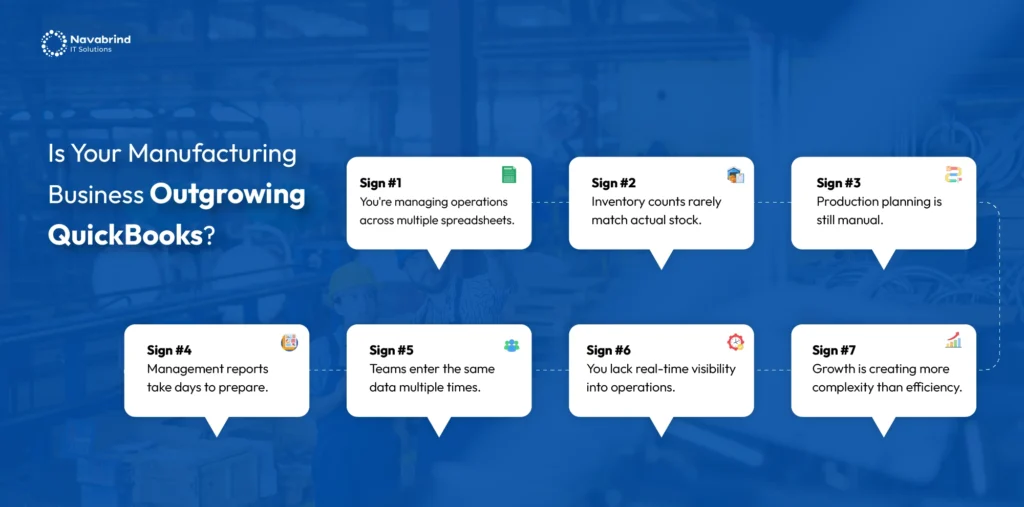
Sign #1 Inventory Errors Are Becoming a Daily Problem
Manufacturers relying on spreadsheets and disconnected accounting tools struggle to maintain inventory accuracy across warehouses, production units, and supplier locations. Duplicate entries, delayed updates, and disconnected purchasing records create inventory mismatches that interrupt production planning. Teams waste valuable production hours verifying stock counts instead of focusing on manufacturing output. A Manufacturing ERP System connects warehouse operations, procurement, sales, and production data into one operational workflow. ERP System Manufacturing platforms help manufacturers track raw materials, finished goods, scrap levels, and incoming shipments without spreadsheet dependency. Manufacturing Execution System ERP platforms strengthen inventory coordination between shop floor production and warehouse management, reducing reporting confusion and stock discrepancies. Process Manufacturing Software improves batch tracking, material consumption visibility, and production forecasting across manufacturing environments. Manufacturing Software Solutions support barcode scanning, inventory movement tracking, automated replenishment planning, and supplier coordination. ManufacturingSystem ERP Comparison reports show manufacturers achieve sharper inventory control, reduced carrying costs, and stronger production continuity after ERP adoption.
Sign #2 Production Planning Is Disorganized
Production planning becomes unstable when manufacturers rely on spreadsheets, disconnected approvals, and outdated inventory records. Raw material shortages, missing work orders, and delayed procurement cycles create confusion across production teams and supplier networks. Plant managers struggle to monitor production timelines, machine allocation, labor availability, and material movement through fragmented systems. Delayed scheduling creates bottlenecks that impact delivery commitments, production costs, and customer retention. A Manufacturing ERP System connects procurement, inventory, production, finance, and warehouse operations into one operational framework that strengthens production coordination. ERP System Manufacturing platforms help manufacturers monitor work orders, bill of materials, production stages, and material consumption with stronger operational visibility. Manufacturing Execution System ERP platforms connect shop floor activities with production scheduling, helping manufacturers reduce downtime and improve manufacturing flow. Process Manufacturing Software supports batch production tracking, quality monitoring, and resource planning across manufacturing facilities. Manufacturing Software Solutions improve production forecasting, purchasing coordination, and manufacturing performance. ManufacturingSystem ERP Comparison reports consistently highlight stronger production stability after ERP adoption.
Sign #3 Financial Reporting Takes Too Long
Manufacturers managing finance through disconnected spreadsheets and outdated accounting tools face reporting delays, inaccurate cost tracking, and operational blind spots. Finance teams spend valuable hours reconciling purchase orders, production costs, payroll data, inventory valuation, and supplier invoices across multiple files. This fragmented process slows profitability analysis and weakens operational decision-making across manufacturing facilities. Multi-location manufacturers face added pressure when production plants, warehouses, and finance departments operate without connected reporting systems. A Manufacturing ERP System connects accounting, procurement, inventory, sales, and production data into one operational environment that strengthens financial visibility. ERP System Manufacturing platforms help manufacturers track production costs, material consumption, revenue performance, and operational expenses with stronger reporting accuracy. Manufacturing Execution System ERP platforms connect production activities with financial workflows, helping manufacturers monitor manufacturing profitability across production cycles. Process Manufacturing Software improves batch costing, inventory valuation, and production expense tracking. Manufacturing Software Solutions support faster financial reporting, stronger forecasting, and improved operational accountability. ManufacturingSystem ERP Comparison studies consistently show ERP-driven manufacturers gain sharper financial control and faster executive reporting.
Sign #4 Your Teams Are Working in Data Silos
Manufacturers relying on disconnected software and spreadsheets struggle with fragmented communication across sales, procurement, inventory, finance, and production departments. Teams operate with conflicting data, outdated reports, and inconsistent inventory records that create delays across purchasing, order fulfillment, and production planning. Duplicate entries increase operational risk and reduce confidence in financial and inventory reporting. Procurement teams may purchase excess materials without updated warehouse visibility, while sales departments commit delivery timelines without production alignment. A Manufacturing ERP System connects operational departments into one connected ecosystem that strengthens collaboration across manufacturing activities. ERP System Manufacturing platforms help manufacturers align inventory movement, purchasing decisions, production schedules, and financial reporting through connected workflows. Manufacturing Execution System ERP platforms strengthen coordination between shop floor operations and business functions, reducing reporting gaps and operational confusion. Process Manufacturing Software improves production tracking, material planning, and batch visibility across facilities. Manufacturing Software Solutions create stronger operational transparency, cleaner reporting accuracy, and faster decision-making. ManufacturingSystem ERP Comparison studies consistently show ERP-connected manufacturers achieve sharper cross-functional coordination and reduced operational disruption.
Sign #5 Supply Chain and Procurement Issues Are Increasing
Manufacturers using spreadsheets and disconnected procurement tools struggle to manage supplier communication, purchase orders, inventory replenishment, and production demand with consistency. Procurement delays create raw material shortages that interrupt production schedules, increase operational costs, and weaken delivery performance. Teams face difficulty monitoring supplier timelines, pending orders, material availability, and procurement approvals across multiple departments. Without accurate forecasting, manufacturers risk excess inventory accumulation or production slowdowns caused by delayed replenishment cycles. A Manufacturing ERP System connects procurement, warehouse operations, inventory planning, supplier management, and production workflows into one operational framework that strengthens supply chain visibility. ERP System Manufacturing platforms help manufacturers monitor supplier performance, purchase order status, inventory movement, and production demand through connected reporting. Manufacturing Execution System ERP platforms connect shop floor production with procurement planning, helping manufacturers align material availability with manufacturing schedules. Process Manufacturing Software improves material consumption tracking, batch planning, and supplier coordination. Manufacturing Software Solutions strengthen forecasting accuracy, purchasing visibility, and supply chain responsiveness. ManufacturingSystem ERP Comparison reports consistently show ERP-driven manufacturers reduce procurement inefficiencies and improve production continuity.
Sign #6 You Cannot Scale Operations Efficiently
Manufacturers experiencing business growth quickly discover that spreadsheets and outdated accounting platforms cannot support rising production demands, warehouse expansion, supplier coordination, and increasing customer orders. Teams spend excessive time updating reports, reconciling inventory data, managing procurement approvals, and correcting operational inconsistencies instead of focusing on production output and revenue growth. As manufacturing operations expand across multiple plants or warehouse locations, disconnected systems create reporting confusion, delayed decision-making, and operational instability. A Manufacturing ERP System supports scalable manufacturing operations by connecting finance, inventory, procurement, production, warehousing, and sales within one operational environment. ERP System Manufacturing platforms help manufacturers manage growing order volumes, production planning, supplier coordination, and inventory movement without operational disruption. Manufacturing Execution System ERP platforms strengthen shop floor coordination and production visibility across facilities. Process Manufacturing Software improves batch planning, resource allocation, and production forecasting. Manufacturing Software Solutions support manufacturing expansion with stronger operational control, production consistency, and faster business responsiveness. ManufacturingSystem ERP Comparison studies consistently show ERP-connected manufacturers scale operations with stronger profitability and production stability.
Sign #7 Compliance, Quality Control, and Traceability Are Weak
Manufacturers operating with spreadsheets and disconnected systems face rising compliance risks across production, inventory, supplier management, and quality assurance processes. Missing documentation, inconsistent reporting, and delayed audit preparation expose manufacturers to regulatory penalties, production delays, and customer trust issues. Limited batch and lot tracking creates difficulty identifying defective materials, tracing production history, or managing product recalls with speed. Quality teams struggle to maintain inspection records, supplier certifications, and production documentation across fragmented files and disconnected departments. A Manufacturing ERP System strengthens compliance management by connecting production records, inventory tracking, supplier documentation, and quality workflows within one operational framework. ERP System Manufacturing platforms help manufacturers maintain traceability across raw materials, work orders, finished goods, and shipment records. Manufacturing Execution System ERP platforms connect shop floor activities with quality control processes, strengthening production accountability. Process Manufacturing Software improves batch tracking, inspection management, and audit readiness. Manufacturing Software Solutions support regulatory compliance, production traceability, and stronger manufacturing governance. ManufacturingSystem ERP Comparison reports consistently show ERP-driven manufacturers reduce compliance risks and strengthen product quality management.
Why US Manufacturers Are Moving to ERP Systems in 2026
US manufacturers are accelerating ERP adoption to strengthen production visibility, operational control, supply chain responsiveness, and manufacturing profitability in an increasingly competitive market. Industry 4.0 initiatives now demand connected production environments that support data-driven manufacturing operations, predictive maintenance, inventory optimization, and faster production planning. Spreadsheets and disconnected accounting tools cannot support the operational complexity required for smart manufacturing growth. A Manufacturing ERP System helps manufacturers connect production, procurement, finance, warehousing, quality management, and supplier operations within one connected framework. ERP System Manufacturing platforms provide production insights, inventory tracking, machine performance visibility, and operational analytics that support faster executive decisions. Manufacturing Execution System ERP platforms strengthen shop floor coordination through connected production workflows and manufacturing monitoring. Process Manufacturing Software improves batch planning, traceability, compliance tracking, and production forecasting across manufacturing facilities. Manufacturing Software Solutions now integrate AI-driven forecasting, automated procurement planning, and operational analytics that strengthen manufacturing performance. ManufacturingSystem ERP Comparison studies consistently show Odoo ERP gaining attention among manufacturers seeking flexible manufacturing management, operational scalability, and stronger production visibility.
Choosing the Right ERP After QuickBooks and Spreadsheets
Manufacturers replacing QuickBooks and spreadsheets must evaluate ERP platforms based on production visibility, inventory control, financial management, procurement coordination, and operational scalability. A Manufacturing ERP System should support production planning, warehouse management, supplier tracking, quality control, batch traceability, and manufacturing analytics within one connected operational environment. ERP System Manufacturing platforms with connected inventory, production, and accounting workflows help manufacturers reduce reporting delays, purchasing errors, and operational inefficiencies across departments. Manufacturing Execution System ERP platforms strengthen shop floor visibility through connected production monitoring, work order tracking, and manufacturing coordination. Manufacturers evaluating cloud ERP and on-premise ERP platforms should assess deployment flexibility, operational accessibility, security requirements, infrastructure costs, and expansion plans before implementation. Process Manufacturing Software supports production consistency, compliance management, and material planning across manufacturing operations. Manufacturing Software Solutions with AI-driven analytics and automation capabilities strengthen operational responsiveness and profitability. ManufacturingSystem ERP Comparison research consistently shows manufacturers achieve stronger production control, cleaner financial reporting, and scalable business growth through successful ERP migration planning and connected manufacturing operations.
Frequently Asked Questions
1.What Is ERP in Manufacturing?
ERP in manufacturing refers to software that connects production, inventory, procurement, finance, warehousing, quality control, and supply chain operations within one connected system. A Manufacturing ERP System helps manufacturers manage production planning, material tracking, work orders, purchasing, and financial reporting with stronger operational visibility. ERP System Manufacturing platforms improve production coordination, inventory accuracy, compliance tracking, and manufacturing profitability. Manufacturing Execution System ERP platforms connect shop floor activities with business operations, helping manufacturers strengthen production control and operational performance. Process Manufacturing Software and Manufacturing Software Solutions support manufacturing growth through connected workflows, operational analytics, and production visibility across manufacturing facilities.
2.When Should a Manufacturing Company Switch From QuickBooks to ERP?
A manufacturing company should move from QuickBooks to a Manufacturing ERP System when spreadsheets, disconnected software, and outdated processes begin slowing production, inventory management, financial reporting, procurement coordination, and operational decision-making. Common indicators include inventory mismatches, delayed production scheduling, supplier management issues, reporting delays, and operational confusion across departments. ERP System Manufacturing platforms support scalable manufacturing growth by connecting production, finance, inventory, and procurement into one operational framework. Manufacturing Execution System ERP platforms strengthen shop floor visibility and manufacturing coordination. Manufacturing Software Solutions help manufacturers reduce operational inefficiencies and improve production responsiveness.
3.What Are the Signs a Business Has Outgrown QuickBooks?
Manufacturers outgrow QuickBooks when operational complexity exceeds the capabilities of accounting-focused software. Frequent inventory discrepancies, disconnected reporting, delayed financial analysis, production bottlenecks, procurement inefficiencies, and communication gaps across departments signal the need for a Manufacturing ERP System. Multi-location manufacturing operations, rising order volumes, compliance management challenges, and limited production visibility also indicate operational limitations. ERP System Manufacturing platforms provide stronger inventory tracking, production management, and financial visibility across manufacturing workflows. Manufacturing Execution System ERP platforms improve coordination between production teams and business departments. ManufacturingSoftware Solutions support operational scalability, forecasting accuracy, and manufacturing performance across growing businesses.
4.How Does ERP Improve Manufacturing Operations?
A Manufacturing ERP System improves manufacturing operations by connecting inventory, procurement, production planning, finance, quality management, warehousing, and supplier coordination into one operational ecosystem. ERP System Manufacturing platforms strengthen production visibility, inventory accuracy, financial reporting, and operational decision-making across manufacturing facilities. Manufacturing Execution System ERP platforms connect shop floor operations with production schedules, work orders, and quality tracking, helping manufacturers reduce delays and production inefficiencies. Process Manufacturing Software improves batch tracking, compliance management, and material planning. Manufacturing Software Solutions support forecasting, production monitoring, procurement visibility, and operational scalability that strengthen manufacturing profitability and production stability.
5.What Is the Difference Between QuickBooks and ERP for Manufacturing?
QuickBooks focuses on accounting and financial management, whereas a Manufacturing ERP System manages manufacturing operations across inventory, production, procurement, warehousing, finance, quality control, and supply chain activities. QuickBooks lacks production planning, manufacturing visibility, work order management, batch tracking, and manufacturing analytics required for growing manufacturers. ERP System Manufacturing platforms connect operational departments through connected workflows that strengthen production coordination and business visibility. Manufacturing Execution System ERP platforms improve shop floor management and production tracking across manufacturing facilities. Process Manufacturing Software and Manufacturing Software Solutions support manufacturing scalability, compliance management, operational forecasting, and production performance beyond traditional accounting software capabilities.
Schedule a conversation with us now!
Related Articles









 Post
Post