The Challenge Every Growing Business Faces
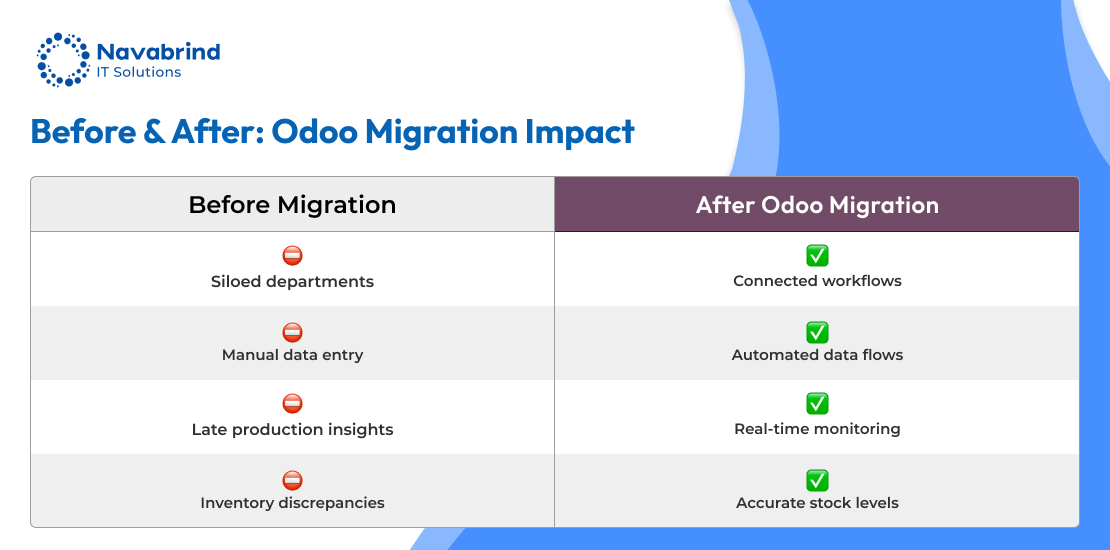
As operations expand, spreadsheets and standalone tools fail to keep pace. Inventory data doesn’t match actual stock. Production teams lack clarity on demand. Finance works with delayed inputs. This disconnect directly impacts revenue, margins, and customer commitments. With Odoo manufacturing ERP, manufacturers gain visibility across the production lifecycle. Raw material availability, work orders, machine utilization, and delivery timelines stay aligned. Instead of reacting to problems, businesses operate with foresight.
Key Questions Before Choosing Odoo ERP
Before adopting any ERP, manufacturers evaluate three critical areas:
1. What does Odoo ERP actually do?
Odoo ERP connects departments, standardizes workflows, and delivers visibility across operations. In manufacturing, it manages bills of materials, work centers, production planning, quality checks, and maintenance ensuring production runs without disruption.
2. What is the cost of Odoo ERP?
Odoo ERP pricing depends on the number of users, selected modules, and deployment model. Businesses can choose a phased rollout, which spreads Odoo implementation cost over time instead of requiring a large upfront investment.
3. Is it suitable for manufacturing operations?
With Odoo manufacturing ERP, businesses gain production planning, shop floor control, inventory synchronization, and demand forecasting in one system. This makes it a strong fit for small to mid-sized manufacturers aiming to scale without operational chaos.
What Is Odoo ERP Software and Why Are Businesses Choosing It in 2026?
Odoo ERP software stands as a flexible, open-source business platform that connects critical operations within a single Odoo ERP system. Sales, CRM, inventory, manufacturing, accounting, HR, and procurement operate on one shared framework, eliminating data silos and fragmented workflows. At its foundation, Odoo ERP replaces disconnected tools with a connected environment where each module shares the same data structure. This means information flows across departments without duplication, delays, or reconciliation gaps. For manufacturers and growing businesses, this translates into faster decisions, tighter cost control, and consistent operational visibility.
Why Businesses Choose Odoo ERP Software in 2026:
- Flexible Adoption Model
Businesses deploy Odoo ERP based on immediate operational needs. Start with essential modules and expand gradually, keeping Odoo implementation cost aligned with growth.
- Connected Data Across Functions
With a single data model, Odoo ERP software removes the need for middleware. CRM, Odoo manufacturing ERP, inventory, and accounting operate in sync, reducing errors and improving decision speed.
- Open-Source Advantage
The open-source nature of the Odoo ERP system gives businesses full control over customization and scalability. There is no dependency on a single vendor, and access to a global developer ecosystem accelerates innovation.
- Cost Advantage Over Legacy ERP
Compared to platforms like SAP, Oracle, or Microsoft Dynamics, Odoo ERP pricing offers a lower total cost of ownership. Licensing, customization, and maintenance costs remain manageable, making it suitable for businesses scaling operations.
- Faster Deployment Timelines
Implementation cycles for Odoo ERP software are shorter compared to traditional ERP systems. Businesses move from planning to execution quickly, allowing faster realization of ROI.
Who Is Using Odoo ERP Software in 2026?
- Small Businesses
Companies moving away from tools like QuickBooks, Tally, or spreadsheets adopt Odoo ERP to bring accounting, sales, and inventory into one system.
- Mid-Sized Manufacturers
Businesses requiring production planning, inventory control, and quality tracking rely on Odoo manufacturing ERP to manage operations without complexity.
- Scaling Companies
Fast-growing organizations choose the Odoo ERP system to expand operations without switching platforms, avoiding disruption and repeated investment.
- Enterprises and Large Groups
Enterprises adopt Odoo ERP software for divisions or subsidiaries where cost control and flexibility matter, reducing reliance on expensive legacy ERP systems. By aligning operational control, cost efficiency, and scalability, Odoo ERP continues to gain traction across industries in 2026. The combination of flexible deployment, competitive Odoo ERP pricing, and manageable Odoo implementation cost makes it a compelling choice for businesses aiming to scale with confidence.
The Odoo ERP System: How It Is Structured and What It Covers
The Odoo ERP system is designed as a connected ecosystem of applications that operate on a shared database. Each function has sales, production, inventory, finance, or HR that runs as an app within the larger framework of Odoo ERP software, yet all data flows through a single source of truth. This structure removes duplication, reduces reconciliation work, and gives leadership a consistent view of operations across the organization.
The Two Editions of the Odoo ERP System:
- Odoo Community Edition
A free, open-source version of Odoo ERP that businesses can host independently. It suits organizations with in-house technical expertise capable of managing deployment, customization, and maintenance without vendor support.
- Odoo Enterprise Edition
A subscription-based version of the Odoo ERP system that includes the complete suite of applications, official support, hosting options, and regular upgrades. This edition aligns well with businesses seeking scalability, reliability, and predictable Odoo ERP pricing.
Core Functional Areas Covered by Odoo ERP
- Operations
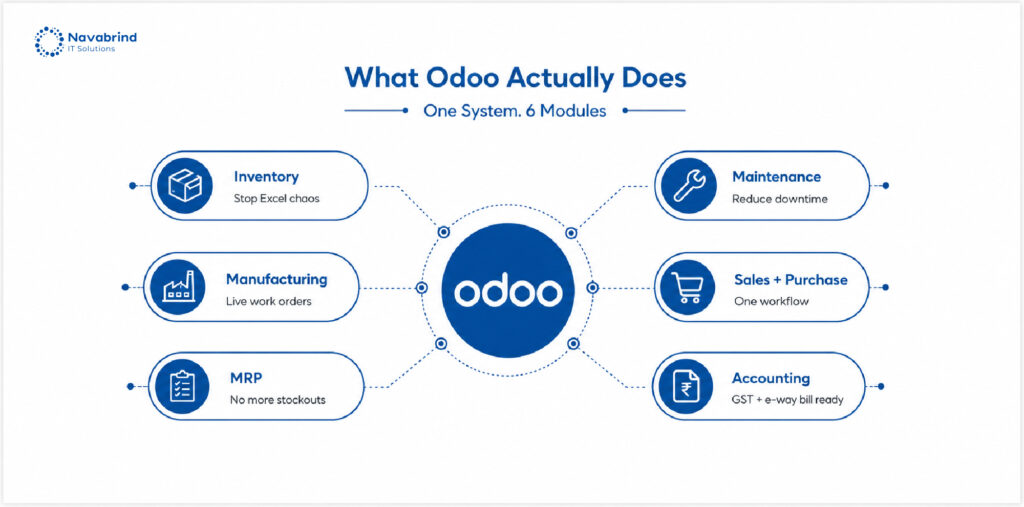
Odoo manufacturing ERP, inventory, purchase, maintenance, and quality management work together to control production cycles, stock movement, and supplier coordination.
- Sales and CRM
The Odoo ERP system tracks leads, manages customer relationships, generates quotations, and supports after-sales processes, creating a connected revenue pipeline.
- Finance and Accounting
From general ledger to invoicing and expense tracking, Odoo ERP software ensures financial data stays aligned with operational activity, enabling accurate reporting.
- Human Resources
Recruitment, employee records, payroll, leave management, and performance reviews operate within the same system, reducing administrative overhead.
- Marketing
Campaign management, email outreach, event tracking, and automation tools help businesses engage prospects and customers from a single platform.
- Project and Services
Project tracking, timesheets, field service management, and helpdesk functions support service-driven operations and client delivery.
- eCommerce and Website
Businesses can manage their website, online store, and customer interactions within Odoo ERP, keeping digital channels connected to backend operations.
The Odoo.sh Platform
Odoo.sh serves as the cloud platform for deploying and managing Odoo ERP software. It provides version control, testing environments, and automated backups, allowing businesses to manage customization without disrupting live operations. For companies seeking flexibility without managing infrastructure from scratch, this platform offers a balanced approach between control and convenience.
Deployment Options for the Odoo ERP System
- Odoo Online
A fully managed SaaS model where the Odoo ERP system runs on Odoo’s infrastructure. This option suits businesses looking for quick deployment and minimal technical involvement.
- Odoo.sh
A cloud environment offering greater control over customization, staging, and upgrades, while still reducing infrastructure complexity.
- On-Premise Deployment
Organizations host Odoo ERP software on their own servers or private cloud. This option gives complete control over data and security, preferred by companies with strict compliance requirements.
By combining flexibility, connected workflows, and scalable deployment options, the Odoo ERP system delivers a strong operational foundation. Whether the focus is reducing inefficiencies, managing production through Odoo manufacturing ERP, or controlling Odoo ERP pricing and Odoo implementation cost, the platform adapts to business needs without adding complexity.
Odoo ERP Pricing: What It Actually Costs in 2026:
Understanding the Odoo ERP Pricing Model
- Odoo Community Edition
The Community version of the Odoo ERP system carries no licensing fee. Organizations invest in hosting, setup, customization, and ongoing support. This model suits teams with technical capability that can manage infrastructure and development internally.
- Odoo Enterprise Edition
The Enterprise version follows a per-user, per-month subscription model. One fee unlocks the complete suite of apps within Odoo ERP software, including CRM, accounting, inventory, and Odoo manufacturing ERP. There are no additional charges for activating extra modules.
What Makes Odoo Pricing Competitive
- Complete Application Access
A single subscription unlocks CRM, finance, HR, inventory, and Odoo manufacturing ERP without additional licensing layers.
- No Per-Module Charges
Activating new functionality such as quality checks or warehouse management that does not increase per-user pricing within the Odoo ERP system.
- Predictable Annual Spend
Businesses plan budgets with confidence since standard updates and new app releases are included within Odoo ERP pricing.
Odoo Pricing Compared to Alternatives
- SAP Business One
Requires higher per-user licensing and ongoing maintenance contracts, increasing total cost over time.
- Microsoft Dynamics 365
Follows a module-based pricing structure where costs rise as businesses activate additional functions.
- NetSuite
Comes with a higher base subscription and layered pricing for advanced features and expanded user access.
- ERPNext
Lower licensing entry point, though customization and scalability for complex manufacturing workflows can increase overall investment.
Odoo ERP pricing covers only the software subscription. The complete investment includes:
- System setup and configuration
- Custom workflow development
- Data migration from existing tools
- User training and onboarding
- Ongoing support and maintenance
Odoo Manufacturing ERP: Capabilities, Modules, and Industry Fit
Core Manufacturing Capabilities in Odoo
- Bill of Materials (BOM)
Manage multi-level BOMs with product variants, configurable items, and by-product tracking. This ensures accurate material planning and cost visibility across production layers.
- Manufacturing Orders
Create and schedule production orders with material availability checks. Track progress lives within the Odoo ERP system, keeping production aligned with demand.
- Work Orders and Routing
Define production stages, assign workcenters, and monitor operator time at each step. This improves shop floor control and highlights inefficiencies.
- Material Requirements Planning (MRP)
MRP in Odoo manufacturing ERP aligns procurement and production using demand signals from sales and forecasts. Raw material planning becomes proactive rather than reactive.
- Subcontracting
Manage outsourced operations with full visibility of material movement, vendor involvement, and cost impact.
- Scrap and Rework Management
Capture waste and defective output at the point of occurrence. The Odoo ERP system reflects cost implications instantly, helping control production losses.
- Production Dashboards
Supervisors track workcenter load, order status, and bottlenecks through live dashboards, enabling faster decisions on the shop floor.
Modules That Extend Manufacturing Capability:
Inventory Management
Track stock across multiple locations with lot and serial number control. Automated replenishment ensures materials remain available for production.
Quality Management
Define inspection checkpoints during production. Record non-conformance issues and manage corrective actions within the same Odoo ERP software.
Maintenance
Plan preventive maintenance and respond to equipment breakdowns with minimal disruption to production schedules.
PLM (Product Lifecycle Management)
Handle engineering changes, maintain BOM versions, and manage design documentation within the Odoo ERP system.
Purchase Management
Procurement is triggered by MRP signals. Vendor tracking, pricing control, and landed cost calculation remain aligned with production needs.
Learn more : What is the difference between Odoo Manufacturing and Odoo MRP
Manufacturing Types Supported
- Discrete Manufacturing
Track assemblies, components, and finished goods with unit-level visibility.
- Process and Batch Manufacturing
Manage recipes and batch production with traceability across lots.
- Make-to-Order (MTO)
Production begins based on confirmed sales orders, ensuring minimal inventory holding.
- Make-to-Stock (MTS)
Manufacture based on demand forecasts and safety stock levels.
- Job Shop Manufacturing
Handle custom production flows with flexible routing and varying production steps.
Industry Fit for Odoo Manufacturing ERP in India
Odoo manufacturing ERP supports a wide range of industries:
- Automotive components and assemblies
- Food and beverage processing
- Electronics and PCB assembly
- Pharmaceuticals and nutraceuticals
- Textiles and garments
- Plastic and rubber products
- Metal fabrication and engineering
India-Specific Compliance Within Odoo ERP
- GST Integration
Handle input tax credit, job work transactions, and finished goods invoicing within Odoo ERP software.
- E-Invoicing
Generate compliant invoices for B2B transactions, aligned with regulatory requirements.
- E-Way Bill Management
Track inter-state goods movement with integrated e-way bill generation.
- Job Work Compliance
Manage challans, track material movement, and reconcile inventory under GST regulations.
Odoo Implementation Cost: The Complete Breakdown
The Five Components of Odoo Implementation Cost
1. Software Licensing
This includes the subscription for Odoo ERP software under the Enterprise plan, calculated based on user count and selected tier. This is the starting point, not the full investment.
2. Implementation and Consulting Fees
Certified partners handle system setup, workflow configuration, customization, and go-live support. This stage defines how well the Odoo ERP system aligns with business operations.
3. Data Migration
Data from legacy tools, customers, vendors, inventory, financial records must be extracted, cleaned, and imported. Poor data quality increases effort and cost.
4. Training
Teams need structured onboarding based on roles in sales, finance, production, and management. Training ensures the Odoo ERP software delivers value from day one.
5. Post Go-Live Support
After deployment, businesses require ongoing assistance issue resolution, performance tuning, and system enhancements within the Odoo ERP system.
Self-Implementation vs. Partner-Led Implementation:
- Self-Implementation
Lower upfront cost, suitable for technically skilled teams.
Risk increases with complexity, especially in Odoo manufacturing ERP environments.
- Certified Partner Implementation
Higher initial investment, though significantly reduces risk.
Partners bring structured deployment, industry knowledge, and faster execution, which improves ROI from the Odoo ERP system.
Hidden Costs Businesses Overlook:
- Temporary productivity drop during transition to Odoo ERP software
- Running legacy systems alongside the new platform during migration
- Post go-live adjustments as real usage reveals gaps
- Upgrade management for on-premise or Odoo.sh deployments
These factors impact the total Odoo implementation cost and must be accounted for early.
Building a Realistic Odoo Budget:
A reliable budget for Odoo ERP includes:
- Subscription cost based on Odoo ERP pricing
- Full implementation scope across modules
- Data migration and validation effort
- Training and onboarding programs
- Post go-live support and optimization
Odoo ERP Implementation: What the Process Looks Like
The Standard Odoo Implementation Methodology
Phase 1: Discovery and Scoping
This phase defines the foundation. Teams map current workflows, identify gaps, and outline how the Odoo ERP system will be configured. A detailed scope reduces rework and keeps Odoo implementation cost under control.
Phase 2: Configuration
Modules within Odoo ERP software are set up based on business requirements. This includes workflows, user roles, approval hierarchies, and India-focused compliance such as GST and e-invoicing.
Phase 3: Customization
Where business needs extend beyond standard features, custom development is introduced. The goal is to enhance the Odoo ERP system without overcomplicating it.
Phase 4: Data Migration
Legacy data is cleaned, validated, and imported into Odoo ERP. This includes master data, opening balances, and transactional records required for continuity.
Phase 5: User Acceptance Testing (UAT)
Teams test real workflows using actual business scenarios. This ensures the Odoo ERP software performs as expected before launch.
Phase 6: Training
Users are trained based on roles like finance, operations, sales, HR, and production teams using Odoo manufacturing ERP. Strong training drives faster adoption.
Phase 7: Go-Live and Stabilization
The system goes live in a controlled manner. Implementation partners remain available to resolve issues and stabilize operations during the initial phase.
Choosing the Right Odoo Implementation Partner
Selecting a partner for Odoo ERP carries as much weight as choosing the platform itself. The capabilities of the Odoo ERP system remain underutilized if the implementation lacks direction, structure, and domain understanding. A skilled partner turns Odoo ERP software into a revenue-driving system. The wrong partner leads to delays, budget overruns, and low adoption.
What to Look for in a Certified Odoo Implementation Partner:
Official Odoo Partner Status
Evaluate whether the partner holds Gold, Silver, or Ready certification. This reflects experience level, project delivery track record, and alignment with Odoo standards.
Relevant Industry Experience
Choose a partner who has implemented Odoo ERP for businesses in your sector. For manufacturers, hands-on experience with Odoo manufacturing ERP ensures accurate production workflows, BOM structures, and shop floor configuration.
India-Focused Expertise
The partner should demonstrate strong capability in GST, e-invoicing, and compliance requirements within the Odoo ERP system. Local expertise reduces risk during audits and statutory reporting.
End-to-End Capability
A reliable partner handles the full lifecycle by scoping, configuration, customization, data migration, training, and post go-live support. This ensures continuity and accountability across the project.
Transparent Pricing Structure
Clear documentation of scope, deliverables, timelines, and assumptions is essential. This avoids unexpected increases in Odoo implementation cost and keeps the project aligned with business goals.
Questions to Ask Before Signing:
- How many Odoo ERP implementations have you delivered in our industry?
- Can you share at least three client references for direct feedback?
- How do you manage scope changes during implementation?
- What does your post go-live support model include, and how is it priced?
- How do you handle upgrades within the Odoo ERP system over time?
These questions reveal the partner’s maturity, transparency, and long-term reliability.
Red Flags to Watch For:
- Unrealistically Low Quotes
If pricing appears far below market benchmarks, the scope may be incomplete. This often leads to cost escalation later, increasing overall Odoo implementation cost.
- Lack of Industry Demonstration
A partner unable to showcase working models of Odoo ERP software for your sector may struggle with real-world requirements.
- Vague Scope Documentation
Ambiguous statements of work without defined milestones create confusion during execution and increase project risk.
- No Manufacturing References
For companies adopting Odoo manufacturing ERP, absence of relevant client experience signals a gap in capability.
- Customization as the First Approach
Partners who push heavy customization from the start may inflate complexity and cost. A strong partner first maximizes standard features within the Odoo ERP system before extending functionality.
Is Odoo ERP the Right Choice for Your Business?
Choosing Odoo ERP is not about following trends. The value of the Odoo ERP system depends on how closely it aligns with your operational needs, growth plans, and budget.
When Odoo ERP Makes Strong Business Sense:
You’re outgrowing disconnected tools
If spreadsheets and standalone systems are slowing decisions, Odoo ERP software brings operations into one connected environment like the sales, inventory, finance, and Odoo manufacturing ERP working together.
You want everything in one platform
Managing multiple tools increases cost and complexity. The Odoo ERP system replaces separate solutions for CRM, accounting, inventory, and production without stacking multiple subscriptions.
You need ERP capability within a controlled budget
For businesses priced out of SAP, Oracle, or Dynamics, Odoo ERP pricing offers access to enterprise-level functionality without heavy upfront investment.
You want a system that scales with your business
Start with essential modules and expand over time. This keeps Odoo implementation cost aligned with growth instead of forcing a full system replacement later.
You operate in India with compliance requirements
For manufacturers dealing with GST, e-invoicing, and production tracking, Odoo ERP provides an integrated approach within one system.
How to Evaluate Odoo ERP for Your Business
- Map your operational challenges:
List current bottlenecks as the inventory gaps, delayed reporting, production inefficiencies and match them against features in Odoo ERP software.
- Request a tailored demo:
Ask for a walkthrough of Odoo manufacturing ERP using your products, workflows, and production scenarios. This reveals how well the system fits real operations.
- Compare implementation proposals:
Collect detailed quotes from two or three partners. Focus on scope, deliverables, and timelines, not just Odoo ERP pricing.
- Speak with existing users:
Connect with businesses in your industry already using the Odoo ERP system. Their experience provides insight into actual performance and ROI.
The Final Takeaway
Odoo ERP delivers strong value when business needs align with its capabilities and the implementation is executed with discipline. When evaluated against operational goals, budget, and scalability, the platform can transform how companies manage production, finance, and growth without inflating Odoo implementation cost.
Odoo ERP software in 2026 stands as a compelling choice for small and mid-size businesses, including manufacturers aiming to bring operations under control without heavy enterprise spend. The Odoo ERP system delivers wide functional coverage from finance and CRM to Odoo manufacturing ERP within a single platform, enabling connected decision-making and stronger operational visibility.
The strength of Odoo ERP pricing lies in its transparency. Subscription costs remain predictable, giving businesses clarity at the licensing level. The broader investment, however, includes Odoo implementation cost, which requires careful planning. Organizations that align scope, timelines, and partner expertise during this stage avoid budget overruns and accelerate returns.
On the manufacturing side, Odoo manufacturing ERP has evolved into a capable solution for handling complex production environments. Multi-level BOMs, production planning, quality control, and India-focused compliance such as GST and e-invoicing operate within one system without the financial burden associated with legacy ERP platforms.
Frequently Asked Questions
1. What makes Odoo ERP suitable for manufacturing businesses in India?
Odoo ERP connects production, inventory, procurement, and finance within a single Odoo ERP system, eliminating the disconnect that slows down manufacturing operations. With Odoo manufacturing ERP, businesses manage multi-level BOMs, production planning, shop floor execution, and quality checks in one environment. The system aligns demand with production and procurement, reducing stock shortages and excess inventory. For Indian manufacturers, compliance features such as GST, e-invoicing, and e-way bill handling are integrated into Odoo ERP software, ensuring regulatory alignment without separate tools. This combination of operational control and compliance makes it a practical choice for scaling manufacturing businesses.
2. How much does Odoo ERP cost in 2026?
Odoo ERP pricing depends on the edition, number of users, and deployment model. The Enterprise version follows a per-user subscription, giving access to the full suite of applications within Odoo ERP software. The Community version has no license fee, though businesses still invest in hosting and setup. For most companies, annual subscription costs range from a few lakhs to several lakhs based on team size. However, the license is only one part of the investment. The overall budget must include Odoo implementation cost, which covers configuration, customization, and onboarding. A clear understanding of both licensing and implementation ensures accurate financial planning.
3. What is included in Odoo implementation cost?
Odoo implementation cost includes multiple components required to make the system operational. This starts with configuration of the Odoo ERP system based on business workflows. It extends to customization where required, ensuring the platform fits operational needs. Data migration is another major element, involving the transfer of customers, vendors, inventory, and financial records into Odoo ERP software. Training ensures teams can use the system effectively, while post go-live support handles issue resolution and optimization. These elements together determine how quickly the business sees returns from Odoo ERP.
4. How long does it take to implement the Odoo ERP system?
The timeline for implementing Odoo ERP depends on business size and scope. A basic setup covering accounting, sales, and inventory within the Odoo ERP system may take 6–10 weeks. When manufacturing, procurement, and quality processes are included through Odoo manufacturing ERP, the timeline extends to 12–20 weeks. For larger organizations deploying multiple modules with integrations and customization, implementation can take 20–36 weeks. Timelines are influenced by data readiness, decision-making speed, and the complexity of workflows being configured.
5. Can Odoo ERP scale as my business grows?
Odoo ERP software supports growth through a phased approach. Businesses begin with essential modules and expand the Odoo ERP system as operations evolve. For example, a company may start with accounting and inventory, then add Odoo manufacturing ERP, CRM, and HR over time. This approach prevents disruption and keeps Odoo implementation cost aligned with business expansion. The platform’s flexibility allows organizations to scale without replacing their ERP system, making it suitable for long-term growth.
6. Is Odoo ERP better than SAP, Oracle, or Microsoft Dynamics?
The answer depends on business requirements. Odoo ERP delivers a strong balance between functionality and cost, making it suitable for small and mid-size businesses. Compared to SAP, Oracle, or Microsoft Dynamics, Odoo ERP pricing is lower, and deployment timelines are shorter. The Odoo ERP system provides broad coverage across business functions without layered licensing. However, large enterprises with highly complex regulatory environments may still rely on legacy platforms. For growing companies seeking flexibility and cost control, Odoo ERP software presents a strong alternative.
7. How do I choose the right Odoo implementation partner?
Selecting the right partner plays a major role in the success of Odoo ERP. Businesses should look for certified partners with proven experience in implementing the Odoo ERP system, especially in their industry. For manufacturers, expertise in Odoo manufacturing ERP is essential to ensure accurate production workflows. A reliable partner provides a clear scope of work, realistic timelines, and transparent pricing, helping manage Odoo implementation cost effectively. Client references, past project demonstrations, and post go-live support models offer insight into the partner’s capability. A strong partner ensures that Odoo ERP software delivers measurable results after deployment.
Schedule a conversation with us now!
Related Articles








 Post
Post Post
Post