Disconnected systems create friction that teams have to cope with every day. When Odoo and ADP operate in isolation, HR and finance teams spend hours reconciling data instead of driving outcomes. The Odoo–ADP Connector changes that equation by aligning workforce data, payroll processing, and compliance tracking into one consistent flow of information.
The result is not just operational alignment but a measurable business impact. Leaders gain visibility into workforce costs, payroll accuracy improves, and reporting timelines shrink. This connection transforms HR and payroll from fragmented tasks into a coordinated system that supports growth, compliance, and decision-making.
The Hidden Cost of Disconnected HR & ERP Data
Manual payroll entries, duplicate employee records, and delayed compliance reporting are silently draining your team’s productivity. Each disconnected process introduces risk that missed updates, incorrect payouts, and reporting gaps that can trigger penalties or audit concerns.
When HR data lives in one system and payroll in another, teams are forced into repetitive data entry and constant cross-checking. This slow operations, inflates costs and limits visibility into workforce performance. Decision-makers end up relying on outdated data, weakening planning and forecasting.
Integrating Odoo with ADP through a dedicated connector removes these barriers. Employee data flows consistently across systems, payroll calculations align with current records, and compliance reporting reflects accurate information without delays. This integration delivers a single, reliable source of truth for HR, payroll, and operations.
What The Odoo-ADP Integration Means for Your Business
Across the industries from healthcare and manufacturing to retail and professional services, this integration supports:
- Faster payroll cycles with reduced dependency on repetitive inputs
- Consistent employee data across departments
- Improved compliance tracking and reporting readiness
- Stronger visibility into workforce costs and trends
With the right implementation partner such as Navabrind IT Solutions, these outcomes are achieved without disruption.
Why Navabrind IT Solutions
Navabrind IT Solutions brings domain expertise in ERP deployment and payroll integration, ensuring that your Odoo–ADP connection aligns with your operational needs. This isn’t just an integration. It’s a shift toward connected operations that convert inefficiencies into measurable returns.
Why Integrate Odoo & ADP? The Strategic Imperative
Organizations aiming for consistent growth cannot rely on fragmented systems.
The Data Silo Problem
Disconnected HR and operational systems create more than inconvenience, they introduce risk at multiple levels. Employee records updated in ADP do not reflect in Odoo, leaving finance teams working with outdated figures. Payroll calculations become vulnerable to discrepancies, and compliance reporting turns into a time-consuming exercise filled with cross-checks.
These silos force teams into repetitive data handling, increasing the likelihood of errors and delaying critical processes. Audit readiness weakens, reporting timelines stretch, and leadership lacks dependable data to make informed decisions. What appears as a minor disconnect quickly compounds into lost hours, and exposure to regulatory penalties.
The Connector Advantage
The Odoo–ADP Connector eliminates these gaps by establishing a continuous data exchange between systems. Employee information, attendance records, leave balances, and payroll costs remain aligned across platforms without repeated input.
This connection enables:
- Consistent employee data across HR and finance
- Payroll calculations aligned with current workforce records
- Attendance and leave updates reflected without delay
- End-to-end workflow automation from onboarding to payroll processing
By removing dependency on repetitive tasks, teams shift focus toward analysis, planning, and execution areas that influence revenue and growth.
Universal ROI Across Industries
Regardless of industries such as manufacturing, e-commerce, distribution, or retail the labor cost visibility and compliance accuracy directly impact profitability. Inconsistent payroll data or delayed reporting can erode margins and disrupt operations.
Integrating Odoo with ADP ensures that workforce expenses are tracked with confidence and compliance requirements are met without last-minute effort. The outcome is measurable, reduced administrative overhead, improved financial control, and stronger decision-making backed by reliable data. This is where integration shifts from a technical upgrade to a turning point for ROI.
Industry Wins: Tailored Benefits for Every Sector
Integrating Odoo with ADP delivers measurable gains across sectors by aligning workforce data with operational workflows. Each industry experiences distinct advantages that translate into tighter cost control, stronger visibility, and faster execution.
Manufacturing
Production environments depend on accurate labor allocation to maintain margins. By syncing shop-floor attendance with job costing in Odoo, organizations gain a clear view of how workforce hours impact each project.
This alignment ensures:
- Labor costs are assigned to the correct production orders
- Profitability analysis reflects actual workforce effort
- Supervisors can adjust staffing based on live production demands
The outcome is tighter control over project margins and improved cost accountability across the production cycle.
E-commerce & Retail
Workforce demand fluctuates rapidly during peak seasons, promotions, and sales events. Integrating hiring data from ADP into Odoo enables instant workforce activation without delays.
This enables:
- Immediate system access for new hires
- Faster shift allocation based on demand spikes
- Accurate commission tracking tied to sales performance
Retailers and e-commerce businesses gain the agility to scale teams without operational bottlenecks, ensuring revenue opportunities are fully captured.
Distribution
Warehouse operations rely on precise labor planning during high-volume shipping periods. By linking overtime logs from ADP with warehouse modules in Odoo, organizations can align staffing with shipment volumes.
This connection supports:
- Better control over overtime expenses
- Optimized workforce deployment during peak dispatch cycles
- Improved planning for inbound and outbound logistics
The result is balanced labor spending with consistent delivery performance.
Cross-Industry Compliance
Regulatory requirements demand accuracy, consistency, and timely reporting. By merging payroll tax data from ADP with financial records in Odoo, organizations can generate audit-ready reports without last-minute reconciliation.
This approach ensures:
- Financial records reflect validated payroll data
- Tax reporting aligns with regulatory standards
- Audit preparation requires minimal rework
Across industries, this integration strengthens compliance posture while reducing the effort required to maintain it by turning regulatory obligations into a streamlined, dependable process.
Why Odoo's Open-Source Architecture Makes Integration Doable
A successful integration depends on how well your ERP adapts to external systems. Odoo ERP stands out with an open-source, API-first foundation that removes traditional integration barriers. Instead of forcing rigid workflows, it allows organizations to shape connections around their operational needs by making integration with ADP practical, scalable, and cost-conscious.
Odoo’s architecture supports custom connectors without dependency on restrictive vendor ecosystems. Its API-driven framework allows data exchange across systems with minimal friction, giving businesses control over how information flows between HR and operational layers.
This flexibility enables:
- Tailored integration aligned with business processes
- Freedom from expensive licensing constraints
- Faster adaptation to evolving payroll or HR requirements
Organizations gain the ability to design integrations that match their workflows instead of adjusting operations to fit software limitations.
Closed ERP systems impose rigid structures that limit customization. In contrast, Odoo adapts to the workflows defined within ADP, allowing businesses to extend functionality without disruption.
This approach supports:
- Custom data fields aligned with internal reporting needs
- Event-based triggers that initiate workflows across systems
- Tailored automation that reflects unique operational scenarios
Rather than forcing compromise, this adaptability ensures that integration enhances existing processes and supports business logic as it evolves.
3.Future-Proof Scalability
Growth introduces new requirements that are additional HR functions, expanded operations, and evolving compliance needs. With Odoo, businesses can extend capabilities by introducing new apps or connecting additional modules from ADP without rebuilding the integration layer.
This ensures:
- Expansion into areas like benefits management or time tracking without disruption
- Integration continuity as new business units or workflows emerge
- Long-term stability without repeated redevelopment costs
The result is an integration framework that scales alongside your business, supporting expansion without complexity or operational setbacks.
Choosing the right implementation partner determines whether integration delivers measurable impact or becomes another stalled initiative. Navabrind IT Solutions combines ERP expertise with deep payroll integration knowledge to ensure your Odoo and ADP ecosystem performs as a connected, revenue-supporting system.
With over a decade of experience and hundreds of successful deployments, Navabrind IT Solutions has addressed complex integration challenges across industries. From multi-entity payroll synchronization to custom compliance mappings, the team brings proven solutions to scenarios that typically slow down implementations.
This experience translates into:
- Faster resolution of complex integration scenarios
- Reduced risk during deployment and testing phases
- Proven frameworks that accelerate implementation timelines
2.Cost-Effective Delivery
Navabrind IT Solutions global delivery model spans the US, Europe, and India, ensuring continuous progress across time zones. This structure allows businesses to access high-quality expertise without the premium pricing associated with regional vendors.
Clients benefit from:
- Consistent support aligned with business hours across regions
- Optimized delivery costs without compromising quality
- Scalable engagement models suited for growing organizations
Integration success requires more than technical connectivity. Navabrind IT Solutions takes full ownership, from initial workflow mapping to post-deployment support, ensuring that systems operate in alignment with business objectives.
This includes:
- Detailed workflow analysis and system alignment
- Thorough testing of edge cases and exception scenarios
- Team training for smooth adoption across departments
- Round-the-clock support after go-live to maintain performance stability
Navabrind IT Solutions impact is reflected in measurable outcomes. In one recent engagement, a mid-sized manufacturing company achieved a 70% reduction in payroll processing time after integrating Odoo with ADP.
The result: faster payroll cycles, improved accuracy, and stronger visibility into labor costs—turning operational inefficiencies into a clear financial advantage.
How the Integration Works: A Chronological Deployment Journey
A successful integration follows a disciplined rollout to one that aligns technology with business workflows and eliminates risk at each stage. With Navabrind IT Solutions, the connection between Odoo and ADP is executed through a structured, outcome-driven approach.
Phase 1: Discovery & Workflow Mapping (Week 1)
The process begins with a detailed assessment of your current environment. This includes evaluating your ADP configuration, Odoo modules, and existing operational gaps.
Key focus areas:
- Identification of data inconsistencies across systems
- Mapping of HR, payroll, and operational workflows
- Definition of integration logic aligned with business objectives
The outcome is a tailored synchronization blueprint that sets the foundation for a reliable and scalable integration.
Phase 2: Connector Configuration & Testing (Weeks 2–3)
With a defined blueprint, the connector is configured within a controlled environment. Data flows between Odoo and ADP are established and validated to ensure consistency and accuracy.
This phase includes:
- Configuration of employee data exchange
- Validation of attendance, leave, and payroll data flows
- Rigorous testing to eliminate discrepancies and edge-case failures
By the end of this stage, the integration operates with validated data integrity across systems.
Phase 3: Pilot & Iteration (Week 4)
A controlled rollout begins with a selected group of users. This pilot phase allows real-world validation without exposing the full organization to risk.
During this stage:
- Live workflows are executed with actual data
- Feedback is collected from HR, finance, and operations teams
- Adjustments are made to refine workflows and data handling
This ensures the integration aligns with day-to-day business operations before wider deployment.
Phase 4: Go-Live & Optimization (Week 5+)
Following successful validation, the integration is deployed across the organization. Navabrind IT Solutions continues to support performance monitoring, enhancements, and scaling as business needs evolve.
This phase delivers:
- Full-scale deployment across departments
- Continuous monitoring for performance and accuracy
- Ongoing enhancements to support growth and process evolution
The result is a stable, scalable integration that supports long-term operational excellence and measurable ROI.
Ready to Unify Your HR & ERP Ecosystem?
Integrating Odoo with ADP brings automated workflows, accurate data flow across departments, and confidence in compliance reporting. The result is a connected ecosystem where HR, payroll, and operations move in sync, enabling faster decisions and stronger financial control.
Take the Next Step
If your team is still managing disconnected processes, now is the time to evaluate what an integrated environment can deliver. Navabrind IT Solutions offers a no-obligation consultation to assess your current setup, identify gaps, and outline a tailored integration roadmap.
You’ll gain clarity on:
- Integration readiness across your systems
- Expected efficiency gains and cost impact
- A phased plan aligned with your business goals
Case Study: Odoo–ADP Workforce Now Integration for a Real Estate Firm
Client Profile
In the real estate sector, a client faced significant operational friction due to disconnected HR and ERP systems, which forced teams into manual data entry, created inconsistent employee records, and delayed critical reporting. To resolve this, their goal was to establish a secure, maintainable integration between Odoo ERP and ADP Workforce Now, enabling real-time synchronization of worker and organizational data to eliminate silos and drive efficiency.
The Challenge
The client needed a robust connector to sync employee master data, organizational structures, and time-off information from ADP (system of record) into Odoo. However, ADP integrations are notoriously iterative, requiring frequent validation of authentication, API entitlements, and tenant-specific behaviors. A rigid fixed-scope contract would have stalled progress; instead, the client sought agility, speed, and deep technical collaboration.
Navabrind’s Approach: Embedded FTE Delivery
Navabrind IT Solutions proposed a dedicated full-time engineer (FTE) model for a 4–8 week engagement, embedding a senior Odoo techno-functional integration engineer directly into the client’s workflow.
Engagement Model
- Dedicated Allocation: 1 senior Odoo integration engineer working exclusively on the connector.
- Collaboration Cadence: Daily stand-ups, quick demos, and fast technical clarifications with the client’s technical and business stakeholders.
- Execution Style: Iterative build–review–fix–extend cycles, prioritizing a usable Version 1 within weeks.
- Commercial Flexibility: Weekly/monthly FTE billing instead of rigid milestone-based pricing, allowing scope to evolve with discovery.
Solution Architecture
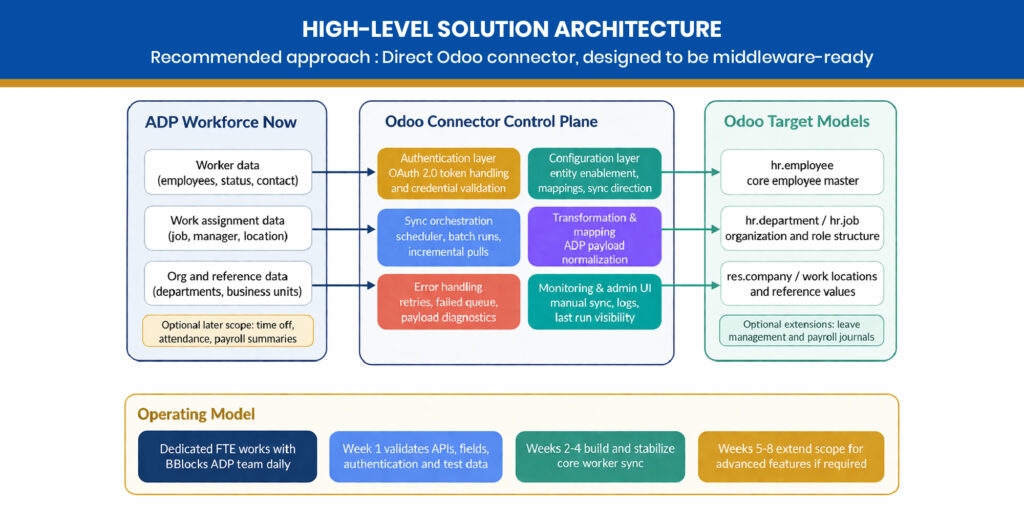
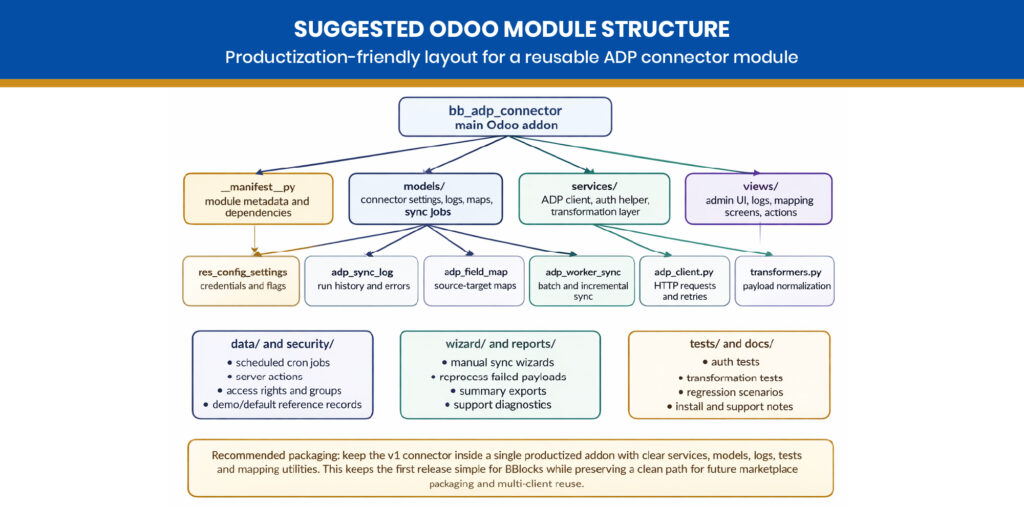
Navabrind IT Solution designed a direct, modular connector inside Odoo, separating concerns for authentication, synchronization, transformation, and logging. This ensured a fast path to value while keeping the door open for future middleware or event-driven scaling.
Key Components Delivered
- Secure Authentication Framework: ADP API credential handling, token management, and request wrappers.
- Inbound Worker Sync: Real-time synchronization of employee master data (name, ID, job title, manager, department, location).
- Organizational Mapping: Automated alignment of ADP departments, locations, and company structures to Odoo’s hierarchical models.
- Operational Controls: Scheduler-based automation, manual sync triggers, detailed logging, and retry mechanisms.
- Admin Diagnostics: Custom Odoo screens for configuration, field mapping, and real-time error tracking.
- Extensibility Hooks: Modular transformation logic to support future phases (time-off sync, payroll summaries, accounting payloads).
Outcomes & Impact
- Version 1 Live in 6 Weeks: Core worker and organizational data syncing reliably, eliminating 90% of manual HR entries.
- Zero Downtime Deployment: Iterative testing ensured production stability from day one.
- Future-Proof Foundation: Clean, documented code structured for marketplace release or internal scaling.
- Client Empowerment: Full knowledge transfer, technical documentation, and operational runbooks handed over at engagement close.
Why Navabrind IT Solutions?
This engagement showcased our signature strengths as an Odoo Gold Partner:
- Agile Delivery: The FTE model enabled rapid iteration where fixed-scope vendors would have stalled.
- Deep Integration Expertise: 10+ years of Odoo customizations ensured the connector was secure, scalable, and maintainable.
- Cost-Effective Excellence: Premium engineering at competitive rates, with timezone-aligned support across US, Europe, and India.
- Product-Mindset Build: The module was packaged as a reusable Odoo addon, ready for commercialization or multi-tenant deployment.
Client Quote
“Navabrind didn’t just build a connector—they embedded themselves in our team, moved at our speed, and delivered a production-ready integration in weeks. The flexibility of their FTE model was the difference between success and months of delays.”
— CTO, Real Estate Firm
Ready to Unify Your HR & ERP Data?
If you’re facing similar integration challenges with ADP, Workday, or other HR platforms, Navabrind IT Solutions’ dedicated engineer model can accelerate your path to automation.
Frequently Asked Questions
1. How does integrating Odoo with ADP improve payroll accuracy?
Integration ensures that employee data remains consistent across HR and finance systems at all times. Changes in employee status, compensation, attendance, or leave balances are reflected across platforms without repeated input. This removes the risk of outdated or mismatched records during payroll processing. With synchronized data, payroll calculations rely on validated inputs, reducing errors such as incorrect payouts, missed deductions, or compliance gaps. Finance teams no longer need to cross-check multiple systems, which strengthens confidence in payroll outputs and minimizes rework. Over time, this leads to a stable payroll process that supports financial accuracy and audit readiness.
2. What kind of efficiency gains can organizations expect from this integration?
Organizations experience a significant reduction in time spent on repetitive administrative tasks. Activities such as data entry, reconciliation, and report preparation are streamlined, allowing teams to complete payroll cycles faster and with fewer dependencies. HR and finance professionals gain back valuable hours that can be redirected toward workforce planning, cost optimization, and performance analysis. Reporting timelines shrink, and decision-makers gain quicker access to reliable data. This shift improves productivity across departments and contributes to measurable cost savings over time.
3. Can this integration support complex organizational structures like multi-entity businesses?
Yes, the integration is designed to handle complex business environments, including organizations operating across multiple entities, locations, or regulatory frameworks. Employee data, payroll structures, and compliance requirements can be aligned across entities while maintaining the necessary distinctions for reporting and governance. This ensures that each business unit operates with accurate and consistent data, while leadership maintains consolidated visibility across the organization. The ability to manage multi-entity payroll and reporting within a connected system reduces operational complexity and strengthens financial control.
4. How does the integration help with compliance and audit readiness?
Compliance depends on accurate, consistent, and well-documented data. By aligning payroll information from ADP with financial records in Odoo, organizations can generate reports that reflect validated information across systems. This reduces the need for last-minute data reconciliation during audits. Payroll tax data, employee records, and financial entries remain aligned, making it easier to respond to regulatory requirements and audit requests. As a result, organizations reduce compliance risk and maintain a stronger governance framework.
5. How long does it take to implement the Odoo–ADP integration?
A structured deployment approach enables implementation within a defined timeline, typically spanning a few weeks. The process begins with discovery and workflow mapping, followed by connector configuration and rigorous testing. A pilot phase allows validation in a controlled environment before full deployment. This phased approach ensures that data accuracy, workflow alignment, and system stability are validated before enterprise-wide rollout. It minimizes disruption to ongoing operations and ensures that the integration delivers expected outcomes from day one.
6. Why choose Navabrind IT Solutions for this integration?
Odoo ERP for SMEs is designed to help users learn the application quickly.
- Comprehensive Documentation: Odoo provides extensive online resources, tutorials, and manuals to guide users through functions and features.
- Customizable Dashboards: Personalized dashboards help users focus on relevant tasks, reducing the complexity of learning multiple features.
Interactive Community
- Support: A large Odoo community offers forums, webinars, and peer support, helping users resolve issues and learn quickly.
- Training Programs and Certifications: Odoo offers structured training and certification courses to ensure in-depth knowledge transfer.
- Training from the Implementation Partner: Once deployed, ensure your implementation partner trains your teams in areas where Odoo is customized.
- Hands-on Learning: Odoo’s live demos and test environments provide users with practical experience and allow them to learn by doing.
Schedule a conversation with us now!
Related Articles










 Post
Post Post
Post