In 2026, distribution is no longer just about moving goods but about mastering complexity. Supply chains have evolved into fast-moving, interconnected ecosystems where delays, disruptions, and demand shifts happen in real time. Customers now demand speed, precision, and visibility. With same-day accuracy, live order tracking, and flawless fulfillment becoming the norm, not the exception. For distributors managing multiple warehouses and high order volumes, this creates intense pressure to operate smarter, faster, and with complete control over data.
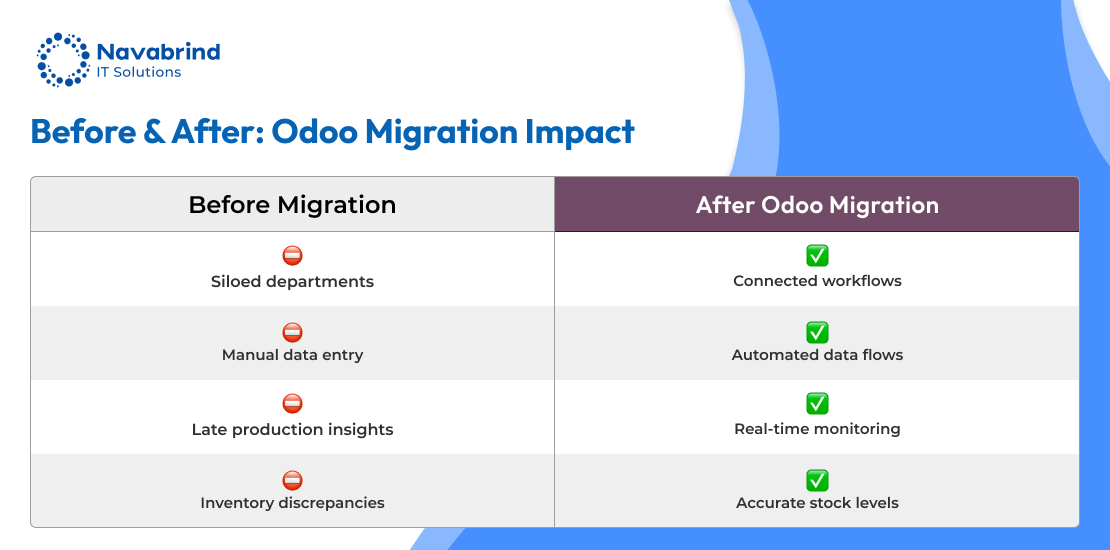
Many businesses are still trying to navigate this complexity using outdated legacy systems and scattered spreadsheets. These tools were built for a simpler time, and today, they’re holding companies back. Disconnected systems create blind spots across warehouses, slow down decision-making, and increase the risk of costly errors. A missed update here or a delayed entry there can lead to stock mismatches, delayed shipments, and dissatisfied customers. As operations grow, these inefficiencies don’t just persist; they multiply, making it harder for distributors to scale.
This is where Odoo ERP brings together ERP software for wholesale distributors with advanced warehouse management capabilities. It creates a single, connected platform where everything from inventory to order fulfillment works in sync.
For distributors looking to lead in 2026, this is a shift in how business is done. The combination of Odoo Inventory and Odoo Warehouse Management Software (WMS) becomes the backbone of growth.
What is Odoo WMS, and How Does It Help Distributors Manage Warehouses?
Odoo warehouse management software (WMS) is a fully integrated module within the Odoo ecosystem. This integration means that warehouse operations are directly connected with sales, inventory, procurement, and accounting, creating a unified flow of information across the business. Instead of operating as a disconnected storage space, the warehouse becomes a strategic asset that supports faster decision-making and smoother operations. By centralizing data and processes, Odoo WMS transforms what was once a chaotic storage environment into a structured, intelligent fulfillment hub.
At the operational level, Odoo WMS introduces powerful functionality. One of the key features is strategies, in which the system guides staff to store products in optimal locations based on factors such as product velocity, size, or category. Fast-moving items are placed in easily accessible areas, reducing picking time and improving workflow. Barcode and RFID integration minimizes human error by enabling scan-based processes for receiving, picking, and packing. This ensures accurate inventory tracking and reduces manual mistakes that can lead to delays or losses.
In high-volume environments, Odoo WMS enhances productivity through advanced techniques such as wave picking and clustering. These methods group multiple orders together, allowing warehouse staff to pick items in batches rather than one order at a time, saving time and reducing unnecessary movement. The result is faster order fulfillment and improved efficiency across the warehouse floor. The key insight is simple, Odoo WMS transforms a traditional “storage room” into a fully optimized “fulfillment center,” offering complete visibility over every pallet, shelf, and bin.
How Does Odoo ERP Help Distributors Manage Multi-Warehouse Inventory Efficiently?
Managing multiple warehouses in 2026 is no longer just about storage coordination, visibility, and speed. Distributors often face challenges such as stock imbalances, where one warehouse is overstocked while another runs out of the same item. Inter-warehouse transfers become time-consuming and error-prone when handled manually, leading to delays in order fulfillment. On top of this, the lack of consolidated visibility across locations makes it difficult to make informed decisions. Without a unified view, businesses struggle to answer simple questions like “Where is the stock available?” or “Which warehouse should fulfill this order?” These inefficiencies can result in missed sales, higher operational costs, and dissatisfied customers.
Learn more : How does Odoo help reduce stockouts and overstock in distribution
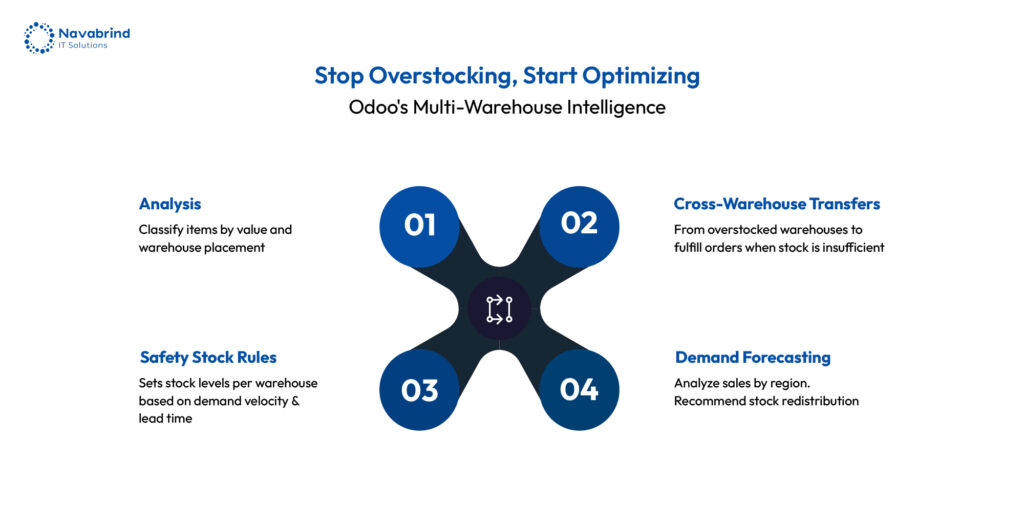
This is where Odoo ERP provides a solution with its multi-warehouse capabilities. Through centralized control, businesses can monitor stock levels across regional warehouses, third-party logistics (3PL) centers, and retail outlets from a single dashboard. This unified visibility eliminates guesswork and ensures that decision makers always have accurate, up-to-date information. Odoo also introduces resupply rules, which automate stock transfers between locations. For example, when inventory in a micro-fulfillment center drops below a defined threshold, the system can automatically trigger a transfer from a central warehouse.
Odoo’s advanced routing capabilities allow businesses to define intelligent rules for order fulfillment. Orders can be automatically assigned to the most suitable warehouse based on factors such as proximity to the customer, shipping cost, or product availability. This not only reduces delivery time but also optimizes logistics expenses. The key insight for distributors is clear: when multiple warehouses operate as a connected network rather than isolated units, efficiency increases dramatically. With the right ERP software for wholesale distributors, the ability to treat multiple locations as one cohesive system becomes the difference between being “in stock” and losing a sale due to unavailability.
Is Odoo Warehouse Management System Suitable for Small Distribution Businesses?
There’s a common misconception that advanced warehouse management systems are only meant for large enterprises with massive budgets. In reality, this belief often holds small distributors back from adopting tools that could significantly improve their operations. Traditional Odoo WMS solutions are often expensive, complex, and difficult to implement, which reinforces this myth. However, ERPs, such as Odoo are designed to offer flexibility and scalability that align with the needs of growing businesses. Instead of requiring a full-scale transformation from day one, Odoo allows businesses to start small and expand gradually.
One of the biggest advantages for small distributors is modular growth. Businesses can begin with Odoo Inventory to manage stock, orders, and basic accounting, and activate additional warehouse management features as their needs evolve. Capabilities like barcode scanning, automated routing, and advanced picking strategies can be introduced step by step without switching systems or disrupting operations. This eliminates the need for costly and time-consuming migrations, which are often a major hurdle for growing companies. Odoo’s cloud-based model ensures cost-effectiveness, as there are no heavy upfront licensing fees. Businesses only pay for the applications they use, making it easier to control expenses while still accessing advanced functionality.
Odoo gives small distributors a real competitive edge. By automating processes such as inventory tracking, order fulfillment, and warehouse operations, businesses can reduce manual effort, minimize errors, and improve delivery speed. This allows smaller players to compete with larger organizations that had the advantage of scale and resources. Instead of outgrowing their systems and facing disruptive upgrades, small distributors can rely on a platform that evolves with them.
Learn more: How does Odoo improve order fulfillment speed for distribution businesses
Why is Odoo the Best ERP for Distributors in 2026?
A warehouse doesn’t operate in isolation that sits at the center of a larger ecosystem that includes sales, purchasing, and finance. When these functions are disconnected, errors and delays become inevitable. With Odoo ERP, all departments are connected through a single platform, ensuring that information flows across the business. This integration provides real-time visibility, allowing sales teams to check accurate inventory levels before committing to delivery dates. As a result, businesses avoid overpromising, reduce backorders, and build stronger customer trust by delivering on time.
For distributors, understanding true profitability is just as important as managing inventory. This is where landing cost becomes critical. Odoo enables businesses to calculate the actual cost of products by including additional expenses such as freight, insurance, and customs duties. Instead of relying on estimated costs, distributors get a precise view of margins for every product. This level of financial clarity helps in setting the right pricing strategies, improving profitability, and making informed purchasing decisions. At the same time, automated procurement simplifies replenishment by using reordering rules. When stock levels fall below a defined threshold across any warehouse the system automatically generates purchase orders, ensuring inventory is maintained without manual intervention.
Looking ahead, adopting a cloud-based warehouse management system is essential for staying competitive. Odoo’s cloud approach allows businesses to access operations from anywhere, including mobile devices, making warehouse management more flexible and responsive. It also supports emerging technologies like AI-driven demand forecasting, which helps predict stock requirements with greater accuracy, and IoT integration for smarter tracking and monitoring. This forward-looking capability ensures that businesses are not just solving today’s challenges but are also prepared for the evolving demands of distribution in 2026 and beyond.
How Does Odoo Cloud Based Warehouse Management System Improve Distribution Operations?
The cloud advantage is transforming how distributors manage warehouse operations by making systems more accessible, responsive, and reliable. With Odoo, warehouse managers can monitor and control operations directly from a mobile device. Field sales teams can instantly check stock availability without contacting the warehouse, improving responsiveness and customer service. Cloud-based systems also ensure real-time synchronization, meaning the moment a barcode is scanned, inventory levels are updated across sales, purchasing, and accounting modules. This eliminates delays seen in traditional on-premise systems. Built-in disaster recovery mechanisms protect data and ensure system uptime, which is essential for high-volume distribution environments.
Beyond accessibility, cloud-based warehouse management drives measurable operational improvements. One major benefit is the reduction of “travel time” within the warehouse. By using smart picking routes, the system guides workers through efficient paths. Another key improvement is cycle counting, which allows businesses to maintain continuous inventory accuracy without halting operations for full physical stock counts. Instead of shutting down the warehouse, inventory is verified in smaller, manageable segments on an ongoing basis.
What is the Best Distribution Management System Software for Multi-Warehouse Operations?
Choosing the right warehouse management system in 2026 is about finding the right fit for your business model, scale, and growth plans. Many distributors make the mistake of selecting systems based solely on functionality, only to realize later that the solution doesn’t align with their workflows. The first and most critical factor is integration. A WMS should not operate as a separate layer that requires middleware to connect with accounting or CRM systems. Instead, it should be part of a connected ecosystem in which inventory, sales, finance, and customer data flow. This is where Odoo Warehouse Management stands out, offering native integration within the broader Odoo ERP environment.
Equally important is usability, especially in fast-paced warehouse environments where staff turnover or temporary labor is common. A system that requires extensive training slows down operations and increases the risk of errors. The ideal WMS should offer an intuitive interface that allows workers to learn picking, packing, and receiving processes within minutes. Odoo’s user-friendly design ensures that even new or seasonal employees can quickly adapt, maintaining productivity without long onboarding cycles. Alongside usability, flexibility plays a key role. Distributors today often operate across multiple channels handling bulk B2B pallet shipments, individual B2C e-commerce orders, and direct store delivery (DSD) models. A rigid system that supports only one workflow creates inefficiencies, whereas a flexible WMS can manage all these operations within a single platform.
The final consideration is the solution’s overall value and long-term scalability. Odoo Warehouse Management delivers a strong balance by combining the capabilities expected from a Tier-1 WMS, such as advanced routing, automation, and inventory control with the simplicity and integration of a modern ERP platform designed for wholesale distributors. Instead of investing in multiple disconnected systems, businesses gain a unified solution that grows with them.
The Implementation Factor: Why Strategy Matters
Adopting an ERP is only part of the journey; implementation is what truly determines return on investment. Even the most advanced automation can fail to deliver value if it is not aligned with how a business actually operates. Distributors often underestimate the complexity of translating real-world warehouse workflows into a digital system. Without proper planning, this can lead to misconfigured processes, low user adoption, and missed performance goals. That’s why success with Odoo ERP depends on how effectively it is implemented to match operational needs.
This is where the role of experienced professionals is critical. Implementing a system like Odoo Inventory and Odoo Warehouse Management requires a deep understanding of distribution workflows from receiving and storage to picking, packing, and shipping. Experts analyze existing processes, identify inefficiencies, and map them to Odoo’s capabilities in a way that enhances performance rather than disrupting it. This structured approach ensures that automation, routing, and inventory controls are configured to reflect real business scenarios, enabling smooth adoption and measurable results.
Navabrind IT Solutions plays a key role as a trusted implementation partner in this process. With a strong understanding of distribution operations, Navabrind IT Solutions ensures that Odoo is not just installed, but strategically tailored to each business. Our approach focuses on aligning system setup with clear business goals, such as reducing dead stock, accelerating shipping timelines, and improving inventory accuracy. By bridging the gap between technology and operations, we help distributors enjoy the full potential of Odoo.
Building a Future-Ready Distribution Operation
In summary, this guide addressed five critical questions that distributors face in 2026 from whether advanced warehouse management is suitable for small businesses to how modern systems handle complex multi-warehouse operations. It explored how integrated solutions improve inventory accuracy, streamline fulfillment, enable automation, and provide better visibility across the supply chain. From understanding the role of warehouse management systems to evaluating platform choices and implementation strategies, the focus has been on helping distributors build a scalable and efficient operational foundation.
The core takeaway is clear: success in distribution today depends on breaking down silos and connecting operations into a single, cohesive system. Odoo ERP delivers that unified view, acting as a single source of truth across inventory, sales, purchasing, and finance. With accurate data, faster decision-making, and improved coordination, businesses can ensure better stock control, deliver consistent customer experiences, and maintain strong profit margins.
Frequently Asked Questions
1. What is Odoo WMS, and How Does It Help Distributors Manage Warehouses?
Odoo WMS is an integrated warehouse management system within Odoo ERP that helps distributors streamline storage, picking, packing, and shipping processes. It improves warehouse efficiency through features like automated putaway strategies, barcode scanning, and optimized picking routes, while providing complete visibility over inventory at the level of bins, shelves, and pallets, enabling faster and more accurate order fulfillment
2. How Does Odoo ERP Help Distributors Manage Multi-Warehouse Inventory Efficiently?
Odoo ERP enables distributors to manage multiple warehouses from a single platform, offering centralized stock visibility across locations. It automates inter-warehouse transfers using resupply rules, ensures optimal order fulfillment through routing logic based on proximity and availability, and reduces stock imbalances by keeping inventory synchronized across all locations
3. Is Odoo Warehouse Management System Suitable for Small Distribution Businesses?
Yes, Odoo is well-suited for small distributors because of its modular structure, which allows businesses to start with basic inventory features and scale gradually. It eliminates the need for expensive system migrations, offers flexible pricing based on usage, and helps small businesses compete by automating processes, improving accuracy, and increasing fulfillment speed.
4. Why is Odoo the Best ERP for Distributors in 2026?
Odoo ERP stands out in 2026 for combining inventory, warehouse management, sales, accounting, and procurement into a single connected system. This integration eliminates data silos, improves decision-making with accurate data, and supports scalability, making it ideal for distributors managing complex operations and looking for long-term growth.
5. How Does Odoo Cloud-Based Warehouse Management System Improve Distribution Operations?
Odoo improves operations by enabling cloud access, allowing teams to manage warehouses from anywhere and access live inventory data instantly. It ensures synchronized updates across modules, reduces delays, supports mobile-based operations, and enhances productivity with features like smart picking routes and continuous inventory tracking.
6. What is the Best Distribution Management System Software for Multi-Warehouse Operations?
For multi-warehouse operations, Odoo ERP is considered one of the most effective solutions due to its ability to unify inventory, automate transfers, optimize routing, and provide complete visibility across locations. It supports complex distribution networks while remaining flexible and scalable, making it a strong choice for businesses of all sizes.
Schedule a conversation with us now!
Related Articles









 Post
Post Post
Post