



















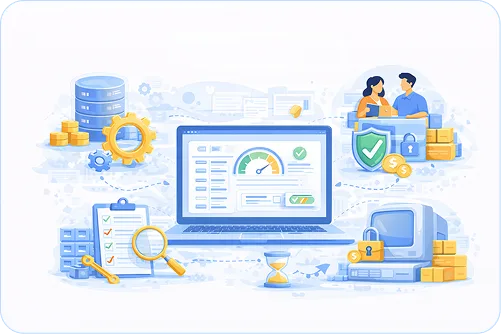
Smart Businesses Migrate Data to Identify New Revenue Streams.
Buried in your legacy silos are the customer patterns, cross-sell signals, and market gaps that only clean, unified data can reveal.
Faster digital initiatives
Faster data migration
Data loss
See how demand forecasting transforms your operations in 30 minutes.
Trusted by large brands


5 Powerful Capabilities,
One Intelligent Platform
03
Technical Mapping
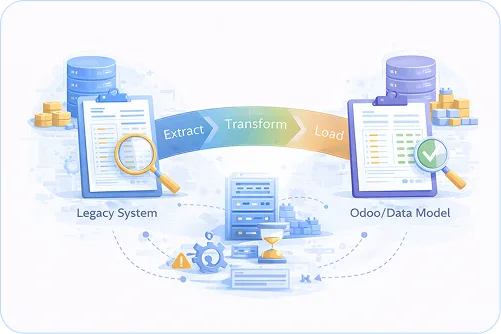
- Create a detailed field-to-field dictionary linking legacy structures to the target Odoo/data model.
- Build Extract-Transform-Load workflows that handle high volumes without throttling the source.
- Configure delta loads to capture transactions occurring during the migration window.
Why Data Migration is Worth the Effort and Cost
The Pillars of Flawless
Transactional
Data Migration
Make your data, your competitive advantage
Extract with Precision
Pull only closed, period-locked transactions within a defined cutoff to prevent mid-migration drift and ensure ledger integrity.
Contextual Enrichment
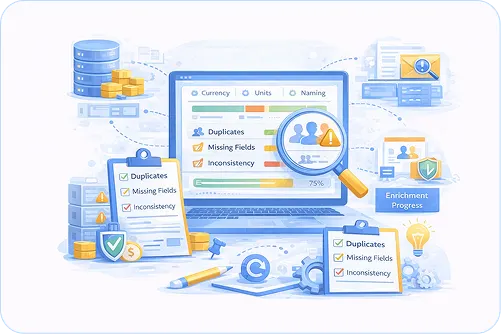
Map legacy fields to new schemas while injecting missing dimensions (e.g., profit centers, tax codes) to turn raw history into analytics-ready insights.
Dependency Sequencing
Inject transactions in strict chronological and hierarchical order, such as headers before lines, invoices before payments.
Granular Hashing
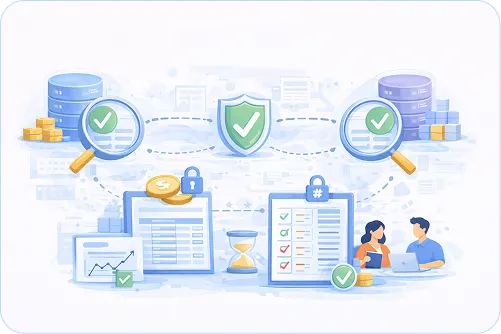
Validate migrated records using checksums and balance proofs. Ensure data integrity between source and target ledgers.
Reinvent Your ERP with
Cutting-Edge Data Migration

Strategic Equity
Migrate not just records, but hidden intelligence—transforming years of scattered legacy data into a clean, queryable asset that fuels AI-driven forecasts and smarter decisions.

Kill the “Shadow ERP” Hidden in Spreadsheets
Consolidate rogue spreadsheets and siloed databases into Odoo’s unified core, ending the chaos of version conflicts and ensuring every team operates from the same truth.

Unlock Latent Revenue
Cleanse duplicates, fix broken SKU mappings, and recover lost sales opportunities caused by inaccurate inventory or pricing—turning migration into an immediate ROI event.

Faster Time-to-Insight
Replace manual data wrangling with real-time dashboards fed by migrated, validated data—so your CFO sees margin erosion before it becomes a crisis, not after.

Compliance Moat
Embed audit-ready lineage and immutable logs during migration, so GDPR, SOX, or industry audits become routine checklists instead of quarter-ending panic sprints.

Future-Proof for AI
Structure data in Odoo’s relational schema with enrichment-ready fields, so tomorrow’s AI agents can auto-classify products, predict demand, or personalize pricing without another re-platforming nightmare.
Who Benefits from
Strategic Data Migration?

Retail
Unify POS, inventory, CRM into Odoo to enable real-time stock visibility and personalized omnichannel experiences.

Distribution
Consolidate multi-warehouse records, supplier histories, and logistics data to accelerate order fulfillment.

Manufacturing
Migrate BOMs and work orders to Odoo, access precise job costing and production traceability.

E-commerce
Sync order data, customer profiles, and product catalogs from Shopify or Magento into Odoo.
Calculate Your PPAP ROI
in 60 Seconds
- Eliminate Hidden Administrative Costs
- Reduce the Risk of Non-Compliance Penalties
- Accelerate Time-to-Revenue
Calculate Your ROI
See exactly how Navabrind IT Solutions PPAP module slashes approval cycles, cuts rework costs, and delivers 6-figure savings, input your numbers now!
How businesses transformed their data with Navabrind IT Solutions
Stop losing insights in legacy systems.
Migrate smarter.
Get a custom migration roadmap, timeline, and cost estimate in under 48 hours. No commitment required.
Trusted by 200+ manufacturers · Odoo Gold Partner · Setup in 24 hours
Got Questions? We've Got Answers
What types of data can Navabrind IT Solutions migrate for my business?
Navabrind IT Solutions migrates the full spectrum of critical business data required for a seamless ERP transition, including master data (customers, vendors, products, employees), transactional history (sales orders, purchases, invoices, payments), inventory records (stock levels, warehouses, lot/serial tracking), and complex manufacturing artifacts (BOMs, routings, work orders). Beyond core ERP entities, we handle financial ledgers, HR payroll histories, CRM pipelines, and e-commerce order flows, ensuring no operational context is lost. Our ETL (Extract, Transform, Load) expertise specifically addresses legacy system quirks—whether migrating from Sage, SAP Business One, DDI, or custom SQL databases—by cleansing duplicates, mapping fields accurately, and validating integrity before a single record goes live.
How does Navabrind IT Solutions ensure data security during migration?
Security is embedded into every phase of our migration lifecycle, starting with a comprehensive risk assessment that classifies data sensitivity and aligns with compliance standards like GDPR, HIPAA, and PCI DSS. We enforce end-to-end encryption (TLS 1.3) for data in transit, use secure VPN tunnels or private endpoints for transfers, and apply role-based access controls so only authorized personnel handle critical datasets. Before migration, we create immutable backups and run integrity checksums; during transfer, real-time monitoring detects anomalies, and post-migration, we conduct validation audits to confirm zero data loss or corruption. This disciplined, defense-in-depth approach ensures your business continuity and data privacy remain uncompromised.
What is the typical timeline for a data migration project?
Timelines vary by complexity, but most small-to-midmarket migrations complete in 4–8 weeks, while large enterprise transitions with multi-entity data may span 8–12 weeks. The first 1–2 weeks focus on discovery, data profiling, and mapping design; weeks 3–5 cover extraction, cleansing, and iterative test migrations in a sandbox; and the final 1–2 weeks validate production cutover with planned downtime only. Factors like legacy system accessibility, data quality (e.g., duplicate cleanup needs), and custom transformation rules can extend schedules, but our agile, phased approach prioritizes critical data first—ensuring you achieve a usable Version 1 quickly while deferring edge cases to post-go-live optimization.
Will there be any downtime during the migration process?
Downtime is strategically minimized and typically confined to a planned, short cutover window—often just a few hours over a weekend or off-peak period—once all data has been validated in a parallel sandbox environment. Our phased migration approach extracts and transforms historical data while your legacy system remains fully operational, running final delta syncs only during the cutover to capture last-minute transactions. For mission-critical operations, we can even deploy a temporary dual-write bridge that keeps both systems live until you’re confident in the new Odoo instance, ensuring business continuity with zero disruption to sales, production, or customer service.
Can Navabrind IT Solutions handle migration from multiple platforms?
Absolutely—Navabrind specializes in complex, multi-source migrations where businesses consolidate data from disparate ERPs, CRMs, e-commerce platforms, and legacy databases into a unified Odoo instance. We’ve successfully orchestrated migrations from combinations like Sage + Shopify + Salesforce, SAP Business One + Magento + Excel archives, or even custom SQL servers + QuickBooks + homegrown tools. Our ETL framework normalizes conflicting data models, resolves duplicate entities across sources, and maps everything into Odoo’s relational structure, giving you a single source of truth without forcing you to abandon valuable historical insights trapped in older systems.


