UK Steel Manufacturers at a Crossroads
Steel producers across the UK are reassessing enterprise technology investments as operational pressure continues to rise in 2026. Energy costs, raw material volatility, import competition, fragmented supply chains, and workforce shortages are forcing manufacturers to rethink how production, procurement, inventory, and finance operate across the business. Legacy ERP environments are struggling to support faster decision-making, plant visibility, and production accountability demanded by today’s market.
This shift has intensified the debate around Odoo vs SAP UK. Steel businesses are no longer choosing ERP platforms based only on brand reputation. Leadership teams now evaluate deployment flexibility, ownership costs, scalability, production visibility, and implementation timelines before making technology investments. For many organizations, the search now centres around identifying the best ERP for steel company UK operations without carrying excessive licensing and maintenance expenses.
Odoo vs SAP in the UK Market
The Odoo vs SAP UK discussion has become increasingly relevant as steel manufacturers evaluate ERP investments against rising operational expenditure and competitive pressure. SAP platforms such as SAP Business One and S/4HANA remain widely recognized across large enterprises for extensive functionality, enterprise governance, and multi-location process management. These environments support large-scale manufacturing groups with substantial IT budgets, layered operational structures, and long-term transformation programmes.
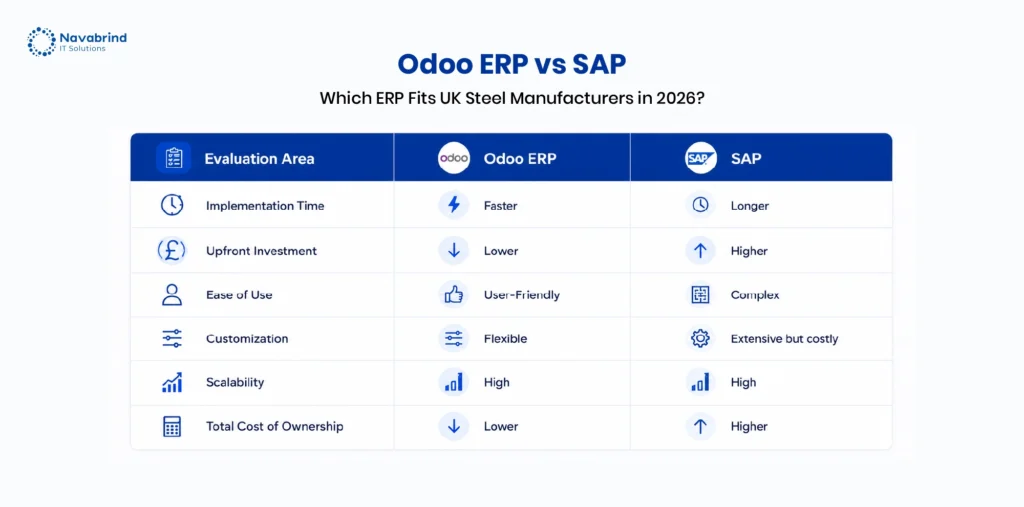
Odoo has gained momentum across the UK manufacturing sector by delivering connected business applications through a cloud-focused ecosystem covering ERP, CRM, procurement, accounting, e-commerce, warehouse operations, and production planning within one environment. UK manufacturers favour Odoo for faster implementation cycles, adaptable workflows, lower ownership expenditure, and reduced infrastructure dependency. This shift continues to position Odoo ERP for steel manufacturers as a practical SAP alternative for small businesses seeking operational visibility without enterprise-level software complexity.
For organisations managing 50–500 users, either platform can support manufacturing operations. The deciding factors now revolve around deployment timelines, customisation flexibility, scalability, and Odoo ERP pricing UK 2026 compared with long-term SAP investment commitments.
What Should “Best ERP for Steel Company UK” Really Mean?
Selecting the best ERP for steel company UK operations requires far more than comparing feature lists or global software brands. Steel manufacturers need ERP environments that support quotation management, nesting workflows, procurement, production scheduling, coil tracking, warehouse coordination, quality control, dispatch planning, and financial reporting within a single, connected operational framework. Traceability across batches, heat numbers, inventory movement, and subcontracting processes has become essential for compliance, accountability, and customer retention.
The Odoo vs SAP UK conversation increasingly focuses on practical business outcomes rather than enterprise branding. Manufacturers now evaluate implementation timelines, local consulting support, workforce training requirements, integration with machinery and third-party systems, and long-term ownership expenditure before selecting a platform. For growing manufacturers, complexity inside the ERP environment can create operational friction rather than productivity gains.
This is why Odoo ERP for steel manufacturers UK continues gaining attention as a SAP alternative for small businesses with UK operations. Through the Odoo steel production module and flexible deployment structure, manufacturers gain operational control aligned with business scale, production maturity, and expansion goals without excessive software overhead or inflated Odoo ERP pricing UK 2026 commitments.
Functional Fit: Odoo ERP for Steel Manufacturers UK
Odoo ERP for steel manufacturers UK delivers operational coverage aligned with the day-to-day requirements of steel mills, fabrication units, stockholders, processors, and metal service centres. The platform supports manufacturing, inventory, maintenance, procurement, quality control, sales, finance, and warehouse operations through connected applications that improve production visibility and material accountability for coils, sheets, pipes, bars, plates, and fabricated components.
The Odoo steel production module supports bill of materials management, routing control, machine-level operations, batch and lot traceability, subcontracting workflows, scrap monitoring, production planning, and inventory movement tracking. Steel businesses gain visibility into raw material consumption, finished goods status, supplier coordination, and dispatch operations without fragmented systems slowing operational flow. Integration between purchasing, sales, manufacturing, and finance reduces data duplication and reporting delays across departments.
Within the Odoo vs SAP UK comparison, manufacturers increasingly value implementation flexibility and operational adaptability. Existing Odoo metal ERP deployments provide proven workflow templates that accelerate implementation timelines for steel companies seeking a practical SAP alternative for small business UK operations with scalable manufacturing control and competitive Odoo ERP pricing UK 2026 expectations.
Functional Fit: How SAP Serves Steel and Manufacturing
SAP has maintained a long-standing position across global manufacturing by supporting large-scale operational structures, multi-site production environments, cross-border financial management, and layered supply chain coordination. Within the Odoo vs SAP UK comparison, SAP remains attractive for steel enterprises managing multiple subsidiaries, international procurement networks, large user volumes, and extensive compliance requirements. Its manufacturing ecosystem supports production planning, plant operations, warehouse coordination, procurement governance, and enterprise reporting across complex organisational structures.
For major steel groups operating across multiple countries and production facilities, SAP provides extensive operational depth to manage sophisticated manufacturing and financial processes. Large enterprises with dedicated internal IT teams and significant transformation budgets can benefit from this level of process control and governance.
Smaller and mid-sized manufacturers across the UK frequently encounter challenges associated with lengthy deployment cycles, heavier system administration, extended training requirements, and higher ownership costs. This is where Odoo ERP for steel manufacturers UK continues gaining traction as a SAP alternative for small business with UK operations. Many regional steel companies require operational agility, faster deployment, and scalable manufacturing control through the Odoo steel production module, rather than the enterprise-scale complexity that goes beyond their operational requirements.
Cost and Pricing: Odoo ERP Pricing UK 2026 vs SAP
Cost remains a defining factor in the Odoo vs SAP UK decision for steel manufacturers evaluating long-term ERP investments. Odoo ERP pricing in the UK for 2026 follows a subscription-based model, with Standard and Custom plans charged per user and covering access to connected business applications across manufacturing, inventory, accounting, purchasing, CRM, maintenance, and e-commerce. For UK cloud deployments in 2026, pricing generally ranges from £16 to £25 per user per month, depending on hosting, support structure, and application scope.
Implementation expenditure varies according to manufacturing complexity, data migration requirements, custom workflows, and integration needs. Smaller steel businesses frequently launch Odoo ERP for steel manufacturers UK projects on low five-figure budgets, whereas wider multi-department manufacturing rollouts may extend into low- to mid-six-figure investment ranges.
SAP environments demand substantially larger licensing commitments, consulting expenditure, infrastructure planning, and implementation resources. Even modest UK manufacturing deployments can rapidly enter six-figure territory before expansion phases begin. For this reason, many growing steel businesses now evaluate Odoo as a practical SAP alternative for small businesses with UK operations seeking manufacturing visibility through the Odoo steel production module without enterprise-scale software expenditure.
Total Cost of Ownership and ROI for UK Steel Manufacturers
ERP investment decisions within the Odoo vs SAP UK landscape extend far beyond initial implementation expenditure. Steel manufacturers must evaluate ongoing ownership costs associated with software licensing, cloud hosting, infrastructure maintenance, third-party integrations, technical support agreements, upgrades, cybersecurity management, and the internal resources required for daily operations. These recurring expenses directly influence profitability, operational agility, and long-term digital transformation outcomes.
Odoo ERP for steel manufacturers UK continues attracting attention because its phased rollout approach allows manufacturers to digitize operations progressively without committing to large-scale enterprise expenditure from day one. Businesses moving away from spreadsheets, disconnected applications, or aging ERP environments can begin with manufacturing, inventory, procurement, and finance before expanding into maintenance, CRM, e-commerce, or quality management. This approach accelerates operational visibility, reduces process bottlenecks, and shortens ROI timelines through controlled investment stages. The Odoo steel production module further strengthens operational accountability across production and warehouse workflows.
SAP can deliver value across multinational steel groups with complex governance structures and extensive operational layers. Mid-sized manufacturers across the UK, though, frequently experience longer payback periods and reduced operational flexibility due to higher ownership costs and larger implementation commitments.
Flexibility, Customization, and Ecosystem
Flexibility has become a deciding factor in the Odoo vs SAP UK conversation as steel manufacturers seek ERP environments capable of adapting to operational workflows without excessive redevelopment costs. Odoo ERP for steel manufacturers UK provides configurable manufacturing, inventory, purchasing, quality, and finance applications that can be tailored around steel processing requirements through workflow settings, custom fields, automation rules, and Odoo Studio. Manufacturers can align the Odoo steel production module with nesting operations, toll processing, slitting, fabrication workflows, subcontracting, service-centre activities, and multi-stage production tracking without depending on prolonged redevelopment cycles.
Odoo’s application marketplace and UK implementation ecosystem strengthen its position as an SAP alternative for small-business UK operations seeking operational expansion without fragmented technology stacks. Manufacturers can extend operations into e-commerce, supplier collaboration, customer portals, ESG reporting, maintenance management, barcode operations, and field service through connected applications within one environment. This reduces dependency on disconnected third-party systems and lowers operational fragmentation across departments.
SAP environments can support extensive enterprise functionality, though extensions frequently require additional modules, specialist consultants, layered integrations, and larger implementation budgets. For many steel SMEs, this increases operational complexity and slows digital transformation initiatives compared with the adaptable structure offered through Odoo ERP pricing UK 2026 models.
Usability and Adoption on the Shop Floor
User adoption plays a critical role in ERP success across manufacturing environments, making usability a major factor in the Odoo vs SAP UK comparison. Odoo ERP for steel manufacturers UK is widely recognised for its browser-based interface, simplified navigation, and application layout that enables operators, warehouse teams, planners, procurement staff, and supervisors to work with minimal technical barriers. Compared with traditional ERP environments, users can access production orders, inventory movement, maintenance tasks, quality checks, and dispatch activities through cleaner workflows compatible with tablets, shop-floor terminals, and handheld devices.
Steel manufacturers operate in fast-moving production environments where extended classroom training and complex navigation structures create operational disruption. Teams managing coil movement, fabrication schedules, goods receipt, barcode operations, and production reporting require systems that reduce friction rather than increase administrative workload. The Odoo steel production module supports this operational requirement through accessible workflows aligned with manufacturing activities on the plant floor.
Faster user adoption reduces implementation risk, lowers training expenditure, and accelerates operational gains. For manufacturers operating under margin pressure, quicker process adoption can influence profitability, production accountability, and return on investment far sooner than traditional enterprise ERP deployments.
Case-Study: Odoo in Metal and Steel
Across metal processing and fabrication businesses, Odoo ERP for steel manufacturers UK has helped organizations replace disconnected spreadsheets, ageing ERP platforms, and fragmented operational workflows with connected manufacturing and inventory management environments. Existing Odoo metal implementation projects demonstrate measurable gains in stock visibility, production coordination, procurement planning, warehouse accuracy, and dispatch management. Manufacturers gain stronger control over raw material movement, subcontracting operations, scrap tracking, and customer order fulfillment through connected business processes.
A UK steel service centre can use the Odoo steel production module to manage quotations based on weight, dimensions, grades, and processing requirements before converting approved estimates into production workflows. Sales teams can coordinate directly with purchasing and warehouse operations, enabling visibility into coil availability, cutting schedules, nesting requirements, fabrication status, and dispatch planning. Batch and lot traceability support accountability from material receipt through final shipment, strengthening compliance and customer confidence.
In the Odoo vs SAP UK comparison, delivering a similar operational scope with SAP often requires larger consulting teams, longer deployment cycles, layered integrations, and substantially higher investment commitments. For mid-sized steel manufacturers operating within competitive margins, these timelines and costs can slow transformation initiatives and delay operational returns.
When Odoo Is the Better SAP Alternative for Small Business UK
Odoo ERP for steel manufacturers UK delivers substantial value for steel processors, fabrication companies, stockholders, and service centres seeking operational control without the overhead associated with large enterprise ERP environments. Within the Odoo vs SAP UK discussion, Odoo becomes an attractive option for manufacturers operating with turnover ranging from smaller regional businesses to organisations generating several hundred million pounds in annual revenue. These businesses frequently require connected manufacturing, inventory, finance, procurement, CRM, and warehouse operations without maintaining large internal IT departments or extended transformation programmes.
Manufacturers pursuing rapid operational improvements, phased digitalization, and adaptable workflows frequently identify Odoo as the best ERP for steel company in the UK because implementation cycles can move faster and scale according to business growth. The Odoo steel production module supports production planning, traceability, subcontracting, stock visibility, and dispatch coordination within a single connected ecosystem. This allows steel businesses to reduce fragmented software usage and improve operational accountability across departments.
As a SAP alternative for small businesses with UK operations, Odoo delivers enterprise-level manufacturing capability without excessive licensing structures, prolonged deployment timelines, or complex governance layers. SAP continues holding advantages for multinational steel corporations managing global subsidiaries, heavily standardised corporate ERP strategies, and extensive enterprise governance requirements across multiple countries and business units.
When Odoo Is the Better SAP Alternative for Small Business UK
Odoo ERP for steel manufacturers UK delivers substantial value for steel processors, fabrication companies, stockholders, and service centres seeking operational control without the overhead associated with large enterprise ERP environments. Within the Odoo vs SAP UK discussion, Odoo becomes an attractive option for manufacturers operating with turnover ranging from smaller regional businesses to organisations generating several hundred million pounds in annual revenue. These businesses frequently require connected manufacturing, inventory, finance, procurement, CRM, and warehouse operations without maintaining large internal IT departments or extended transformation programmes.
Manufacturers pursuing rapid operational improvements, phased digitalization, and adaptable workflows frequently identify Odoo as the best ERP for steel companies in the UK because implementation cycles can move faster and scale according to business growth. The Odoo steel production module supports production planning, traceability, subcontracting, stock visibility, and dispatch coordination through one connected ecosystem. This allows steel businesses to reduce fragmented software usage and improve operational accountability across departments.
As an SAP alternative for small-business UK operations, Odoo delivers enterprise-level manufacturing capabilities without excessive licensing structures, prolonged deployment timelines, or complex governance layers. SAP continues to hold advantages for multinational steel corporations managing global subsidiaries, heavily standardized corporate ERP strategies, and extensive enterprise governance requirements across multiple countries and business units.
Practical Next Steps for UK Steel Manufacturers Comparing Odoo vs SAP
Steel manufacturers evaluating Odoo vs SAP UK should begin with a structured operational assessment rather than a software feature comparison alone. Leadership teams should map production workflows, inventory movement, procurement cycles, traceability requirements, reporting expectations, integration needs, expansion plans, implementation timelines, and internal technical capabilities before selecting an ERP environment. Budget planning should include licensing, implementation services, support, infrastructure, workforce training, and long-term ownership expenditure to create a realistic investment model aligned with operational priorities.
For many manufacturers, running a proof-of-concept using the Odoo steel production module provides a practical way to validate operational fit before committing to a full ERP rollout. This approach allows production teams, planners, warehouse managers, procurement staff, and finance leaders to evaluate how Odoo ERP for steel manufacturers UK supports quotations, production scheduling, batch traceability, subcontracting workflows, inventory visibility, and dispatch coordination within live business scenarios.
Manufacturers seeking the best ERP for steel company UK operations should explore a dedicated ERP workshop or demonstration comparing Odoo ERP pricing UK 2026 projections against an equivalent SAP deployment model. This side-by-side evaluation helps decision-makers assess scalability, implementation effort, operational flexibility, and return on investment before selecting a long-term SAP alternative for small-business growth in the UK.
Frequently Asked Questions
1.What is the difference between Odoo and SAP for UK steel companies?
The Odoo vs SAP UK comparison mainly comes down to complexity, flexibility, implementation effort, and long-term ownership expenditure. SAP targets large enterprise environments with extensive governance, multi-country operations, and layered business structures. Odoo ERP for steel manufacturers UK focuses on connected manufacturing, inventory, finance, procurement, CRM, and warehouse operations through a flexible platform suited for growing steel businesses. Many manufacturers prefer Odoo because deployment cycles move faster and operational adaptation requires less technical overhead.
2.Is Odoo ERP cheaper than SAP for steel manufacturing in the UK?
Yes. Odoo ERP pricing in the UK for 2026 remains substantially lower than SAP’s across licensing, implementation, infrastructure, and support expenditure. Odoo cloud subscriptions generally follow a per-user pricing structure, making budgeting easier for steel SMEs. SAP deployments frequently involve larger consulting teams, extended implementation phases, infrastructure planning, and added integration expenditure, increasing long-term ownership costs.
3.Can Odoo replace SAP for mid-size steel companies in the UK?
For many mid-sized manufacturers, yes. Odoo ERP for steel manufacturers UK supports production planning, inventory management, procurement, maintenance, accounting, traceability, and warehouse operations through the Odoo steel production module. Steel processors, fabrication companies, and service centres frequently adopt Odoo as a SAP alternative for small business UK operations because the platform delivers manufacturing visibility without enterprise-scale software overhead.
4.How long does Odoo ERP implementation take for a UK steel business?
Implementation timelines depend on operational complexity, user count, custom workflows, data migration, and integration requirements. Smaller steel businesses can launch priority modules within a few months, whereas larger multi-site manufacturing environments may require phased deployments across longer periods. Compared with SAP implementations, Odoo implementations generally move faster due to reduced infrastructure requirements and more adaptable application configuration.
5.What are the hidden costs of SAP compared to Odoo for UK manufacturers?
SAP environments can involve hidden costs associated with consulting services, custom development, infrastructure maintenance, integrations, upgrades, technical administration, user training, and third-party software dependencies. These costs can increase substantially across multi-phase manufacturing deployments. Within the Odoo vs SAP UK discussion, manufacturers frequently value Odoo because licensing structures and implementation planning remain easier to forecast over longer operational periods.
6.Which Odoo modules does a UK steel company need for full operations?
A steel manufacturer typically requires Manufacturing, Inventory, Purchase, Sales, Accounting, Maintenance, Quality, Barcode, CRM, and HR applications alongside the Odoo steel production module. Steel service centres and fabrication businesses may expand into subcontracting management, ecommerce, supplier portals, field service, or customer self-service environments depending on operational requirements. This connected application ecosystem strengthens Odoo’s position as the best ERP for steel company UK growth and operational scalability.
Schedule a conversation with us now!
Related Articles








 Post
Post