ERP system implementation stands among the highest-impact investments for any manufacturing business. Industry data reveals a harsh pattern over half of ERP initiatives exceed planned budgets, miss deadlines, or fail to deliver measurable returns. In the context of ERP implementation in manufacturing, the consequences extend far beyond software challenges. Production timelines slip, procurement cycles lose control, inventory accuracy declines, and financial visibility weakens. These disruptions translate into lost revenue, strained vendor relationships, and reduced operational confidence.
This guide addresses those risks with a practical lens. Manufacturing leaders, operations heads, and IT decision-makers will gain a grounded understanding of what drives success in ERP system implementation from evaluating ERP implementation companies in India to selecting dependable ERP implementation services and controlling ERP implementation cost without compromising outcomes.
Throughout this discussion, Odoo ERP implementation serves as a reference point. The platform has gained traction among mid-sized manufacturers aiming to align operational control, scalability, and cost discipline within a single, business-focused system.
Why ERP System Implementation Is a Business Transformation, Not a Software Project
ERP system implementation fails when leadership treats it as a technical rollout instead of a business overhaul. Software rarely causes breakdowns; misaligned processes, weak ownership, and poor change adoption do. ERP implementation services must align with business workflows, not just system configuration. In manufacturing, ERP system implementation reshapes how operations run day to day. Production planning, scheduling accuracy, inventory control, warehouse flow, procurement cycles, supplier coordination, quality compliance, financial tracking, costing visibility, and sales order execution all depend on one connected system. A gap in one area disrupts the rest.
ERP implementation in manufacturing carries added complexity. Shop floor data must sync with planning. Bill of materials, work-in-progress tracking, and multi-level routing demand careful setup and validation before launch. Errors at this stage create long-term operational instability. Top ERP implementation companies in India focus on process redesign and workforce adoption alongside deployment. Odoo ERP implementation delivers results when organisations treat change management as a priority and control ERP implementation cost through disciplined execution.
The ERP Implementation Lifecycle: A Phase-by-Phase Breakdown
ERP system implementation succeeds through disciplined execution across six critical phases. Each stage demands ownership, business alignment, and control over ERP implementation cost.
Phase 1: Discovery and Requirements Gathering
This stage defines the direction of ERP implementation in manufacturing. Teams document business goals, map current workflows, identify operational gaps, and set the scope. Weak discovery leads to scope expansion, budget overruns, and misaligned outcomes. Leading ERP implementation companies in India invest significant time here to anchor success.
Phase 2: System Design and Architecture
Business needs to convert into system blueprints. This includes module selection, workflows, integrations, user roles, and data structures. In Odoo ERP implementation, this stage shapes production planning, BOM hierarchy, routing logic, and inventory valuation.
Phase 3: Configuration and Customization
ERP implementation services configure the system using standard capabilities. Customization enters only when business value justifies the effort. Excess custom work increases ERP implementation cost and long-term maintenance risk.
Phase 4: Data Migration
Accurate data drives system performance. Teams extract, clean, and load supplier records, inventory balances, purchase orders, and financial data. Poor data quality disrupts operations from day one.
Phase 5: Testing and User Acceptance
Teams validate system performance through unit, integration, and end-to-end testing. Business users confirm workflows across production, procurement, finance, and logistics during UAT.
Phase 6: Go-Live and Hypercare
The organization transitions to the new system. ERP implementation services teams provide close support to resolve issues and stabilize operations.
ERP Implementation in Manufacturing: Industry-Specific Considerations
ERP system implementation in manufacturing demands a specialist approach. Generic deployments fail because they ignore production complexity, operational dependencies, and financial sensitivity tied to manufacturing workflows. ERP implementation services must align with how factories run, not just how software functions.
- Bill of Materials (BOM) Management:
Multi-level BOM structures define how raw materials convert into finished goods. Variant handling, substitute materials, and engineering change control must stay synchronised with production and procurement. Weak BOM design leads to incorrect material planning, stock imbalances, and distorted costing. During Odoo ERP implementation, disciplined BOM governance ensures planning accuracy and protects ERP implementation cost from rework.
- Production Planning and Scheduling:
MRP or MPS must reflect the manufacturer’s operating model make-to-order, make-to-stock, or hybrid. Lead times, batch sizes, capacity constraints, and work center availability must align with actual plant conditions. Poor configuration results in missed deadlines, idle resources, and excess inventory.
- Shop Floor Data Capture:
Accurate data collection transforms ERP into a live operations system. Work order updates, labor tracking, machine utilization, and work-in-progress visibility must flow into the system without delay. This enables production control, variance tracking, and faster decision-making.
- Inventory and Warehouse Management:
Manufacturing relies on tight inventory control. Lot traceability, serial tracking, expiry monitoring, and multi-location visibility ensure compliance and stock accuracy. Misconfigured inventory flows create shortages, overstocking, and audit risks during ERP implementation in manufacturing.
- Quality Management:
Quality must integrate into production, not sit outside it. Incoming inspections, in-process checks, non-conformance tracking, and supplier quality evaluation must link with procurement and production workflows. This reduces defects, rework, and customer complaints.
- Costing and Margin Visibility:
Cost control defines manufacturing profitability. ERP must support standard, actual, or average costing with overhead absorption, landed cost allocation, and variance analysis. Without this, pricing decisions lack financial grounding.
ERP Implementation Companies in India: How to Evaluate and Select the Right Partner
Partner selection carries the highest impact on ERP system implementation success. Many organizations focus on software features, yet execution depends on the capability of ERP implementation services providers. In ERP implementation in manufacturing, the partner shapes process alignment, system reliability, user adoption, and overall ERP implementation cost control. A weak partner leads to delays, rework, and operational disruption regardless of platform choice.
India has earned global recognition for ERP implementation companies in India due to a large pool of skilled consultants across ERP platforms, disciplined project governance, and cost-efficient delivery models. Indian firms deliver ERP implementation in manufacturing for clients across the US, UK, Europe, the Middle East, and Southeast Asia. This exposure strengthens their ability to handle complex production environments, multi-location operations, and compliance requirements while maintaining competitive pricing.
Selecting the right partner requires a structured evaluation framework:
- Manufacturing Domain Expertise:
The partner must understand production environments in detail, including BOM structures, routing logic, shop-floor execution, procurement cycles, and inventory dependencies. ERP implementation services without manufacturing knowledge fail to translate business needs into system design, leading to misalignment and costly corrections.
- Platform Certification and Accreditation:
Certified consultants demonstrate technical capability and adherence to platform standards. In Odoo ERP implementation, partner tiers such as Gold or Silver indicate experience, successful deployments, and access to vendor support channels.
- Reference Clients in Your Sector:
Proven success in similar manufacturing environments reduces uncertainty. Organizations should request case studies and speak directly with reference clients to understand delivery quality, timelines, and post-implementation support experience.
- Implementation Methodology:
A structured approach defines project success. Strong ERP implementation companies in India follow defined phases of discovery, design, configuration, testing, and go-live with clear deliverables, documentation, and quality checkpoints. This ensures visibility and control across the project lifecycle.
- Post-Go-Live Support Model:
Support after go-live determines system stability. Hypercare must include rapid issue resolution, user assistance, and performance monitoring. Long-term support should follow defined SLAs with clear escalation paths.
- Team Stability and Continuity:
Frequent team changes disrupt knowledge flow and slow progress. Organisations should assess consultant tenure and ensure key team members remain assigned throughout the ERP system implementation.
- Transparency on Cost and Scope:
A reliable partner provides a detailed breakdown of ERP implementation costs, including scope definitions, assumptions, exclusions, and change-request handling. This prevents disputes and protects budget control.
The right partner is not defined by the lowest price. ERP implementation companies in India that combine manufacturing expertise, disciplined execution, and transparent engagement models deliver stronger business outcomes. Odoo ERP implementation, when executed by such partners, aligns operational processes, controls cost exposure, and enables measurable performance improvement across manufacturing operations.
Odoo ERP Implementation: Why It Has Become the Go-To Choice for Mid-Market Manufacturers
Odoo has established a distinct position in the ERP market by offering a balanced alternative to entry-level systems and heavy enterprise platforms. ERP system implementation with Odoo enables manufacturers to achieve operational control, financial visibility, and process alignment without excessive complexity or inflated ERP implementation cost. For organizations evaluating ERP implementation in manufacturing, Odoo presents a practical path to scale operations with discipline and clarity.
- Modular Architecture:
Odoo allows manufacturers to start with selected modules such as manufacturing, inventory, procurement, quality, and accounting. This phased rollout reduces initial ERP implementation cost and limits operational disruption. Businesses expand system capability in line with growth, avoiding unnecessary upfront investment. ERP implementation services built around this approach help organizations maintain financial control while scaling functionality over time.
- Manufacturing Module Depth:
Odoo ERP implementation supports key manufacturing requirements including make-to-order, make-to-stock, and hybrid production models. Multi-level BOM management, routing logic, capacity planning, work order execution, OEE tracking, and subcontracting workflows are part of the standard system. This enables manufacturers to align production planning with execution and track performance across the shop floor without relying on multiple disconnected tools.
- Integrated Procure-to-Pay and Order-to-Cash:
Odoo connects procurement, inventory, production, sales, and finance into a single system. This integration removes data silos, improves coordination between departments, and strengthens decision-making. ERP system implementation becomes more effective when information flows across the organization without manual intervention or reconciliation gaps.
- Odoo Studio and Low-Code Customization:
Odoo Studio enables functional customization without heavy development effort. Businesses can adapt workflows, forms, and reports to match operational needs without increasing technical complexity. This approach reduces dependency on extensive coding, shortens implementation timelines, and helps control ERP implementation cost.
- Global Partner Ecosystem:
A wide network of certified partners supports Odoo ERP implementation across global markets. ERP implementation companies in India play a significant role by delivering high-quality ERP implementation services at competitive cost levels. Their experience across manufacturing sectors and geographies strengthens execution quality and reduces project risk.
- Predictable Licensing Model:
Odoo follows a per-user subscription model with transparent pricing. Organizations gain visibility into licensing costs as they scale, helping them avoid unexpected charges. This supports better financial planning and long-term cost control.
- Implementation Timeline:
A mid-market manufacturer can complete Odoo ERP implementation within 12 to 24 weeks, depending on scope, data readiness, and integration requirements. This shorter timeline reduces disruption and accelerates return on investment compared to traditional ERP platforms.
Odoo ERP implementation enables manufacturers to align operations, control ERP implementation cost, and scale with confidence through a connected, business-focused system.
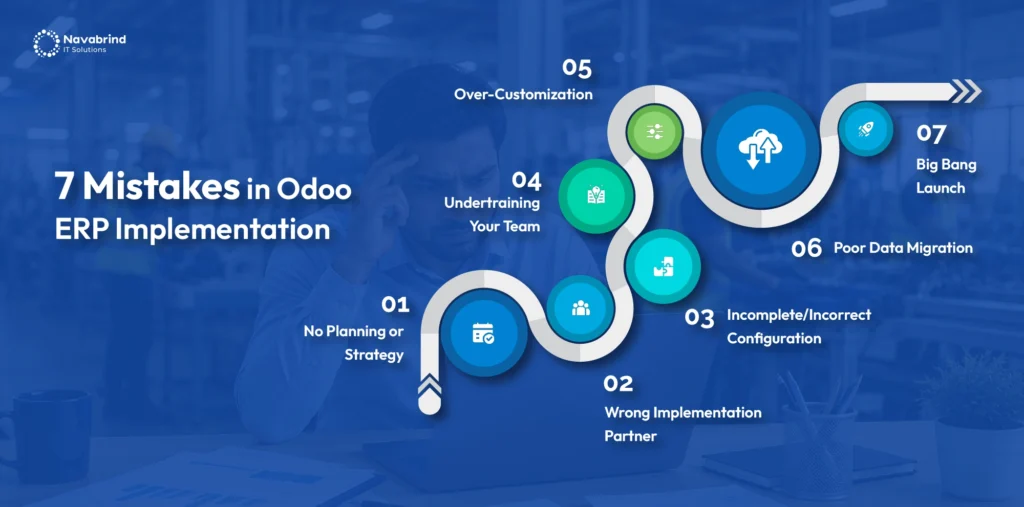
The 10 Most Common ERP Implementation Mistakes And How to Avoid Them
ERP system implementation failures follow clear patterns. These mistakes appear across industries, yet in ERP implementation in manufacturing, the impact multiplies due to operational dependencies. This section highlights real execution gaps, their root causes, and how strong ERP implementation services prevent them. Organizations that avoid these mistakes gain stronger control over ERP implementation cost, achieve stable operations, and unlock measurable value from ERP system implementation.
1. Underdefining Scope Upfront
Root cause: weak discovery and unclear business objectives.
Impact: uncontrolled change requests, rising ERP implementation cost, delayed timelines.
Prevention: invest time in detailed discovery, process mapping, and scope validation before project approval.
2. Choosing a Partner on Price Alone
Root cause: cost-driven selection without evaluating capability.
Impact: poor execution, rework, and long-term instability.
Prevention: assess ERP implementation companies in India based on manufacturing expertise, delivery methodology, and proven results.
3. Neglecting Data Quality Before Migration
Root cause: assumption that legacy data is usable.
Impact: inaccurate reporting, planning errors, operational disruption.
Prevention: assign ownership for data cleansing at least 60–90 days before migration.
4. Over-Customising the System
Root cause: forcing ERP to match old processes.
Impact: high maintenance effort, upgrade challenges, increased ERP implementation cost.
Prevention: prioritise configuration within standard ERP capabilities before approving custom work. Odoo ERP implementation supports flexibility without heavy coding.
5. Under-Resourcing the Business Side
Root cause: over-reliance on IT teams.
Impact: misalignment between system design and operational needs.
Prevention: appoint experienced business users as process owners and super-users from the start.
6. Skipping or Compressing UAT
Root cause: timeline pressure.
Impact: process failures after go-live.
Prevention: execute structured UAT with defined test cases, real scenarios, and formal sign-offs.
7. Ignoring Change Management
Root cause: focus on the system, not people.
Impact: low adoption, resistance, reduced ROI.
Prevention: invest in training, communication, and leadership involvement throughout ERP system implementation.
8. Treating Go-Live as the Finish Line
Root cause: lack of post-launch planning.
Impact: unresolved issues disrupt operations.
Prevention: plan a 4–8 week hypercare phase with dedicated ERP implementation services support.
9. No Post-Implementation Review
Root cause: absence of performance tracking.
Impact: missed improvement opportunities.
Prevention: conduct a 90-day review against business objectives and KPIs.
10. Selecting the Wrong Deployment Model
Root cause: decision based on short-term preference.
Impact: long-term cost and scalability challenges.
Prevention: evaluate cloud vs on-premise based on operational needs, security requirements, and financial outlook.
Building Your ERP Implementation Business Case: How to Get Internal Buy-In
Securing approval for ERP system implementation depends less on software evaluation and more on financial clarity and organizational alignment. In ERP implementation in manufacturing, leadership teams approve investment when the business case connects operational pain with measurable financial return. ERP implementation services providers support this process by structuring the case around impact, cost, and risk.
- Quantify the Cost of the Status Quo:
Start by exposing current inefficiencies in financial terms. Measure time spent on disconnected systems, inventory inaccuracies, production delays, rework, and lost sales opportunities. Translate these into monthly or annual cost figures. This establishes urgency and frames ERP system implementation as a corrective investment rather than discretionary spend.
- Define the Expected Business Outcomes:
Focus on measurable results instead of software features. Reduced inventory carrying cost, faster order-to-cash cycles, improved production planning, higher on-time delivery rates, and controlled procurement spend form the foundation of a credible case. ERP implementation in manufacturing must link directly to these outcomes.
- Present a Realistic ERP Implementation Cost Model:
Break down ERP implementation cost into licensing, ERP implementation services, infrastructure, data migration, and training. Include a timeline that shows when cost recovery begins. ERP implementation companies in India help structure cost-efficient models with strong return visibility.
- Address Risk with Transparency:
Acknowledge execution risks such as timeline delays, data migration issues, and adoption challenges. Then outline mitigation, structured methodology, experienced partner selection, and governance controls. This builds confidence in decision-makers.
- Show a Phased Rollout Approach:
A modular rollout reduces upfront ERP implementation cost and demonstrates value early. Starting with manufacturing and inventory before expanding into finance or CRM allows the organization to stabilize operations and build internal confidence.
Beyond Software Deployment: How Strategic ERP Implementation Drives Manufacturing Growth
ERP system implementation must be viewed through the lens of value creation, not cost reduction. Manufacturers that approach ERP implementation in manufacturing as a transformation initiative backed by disciplined execution, strong governance, and support from capable ERP implementation services achieve measurable gains in efficiency, cost control, and operational visibility. Those that treat it as a software rollout face delays, budget escalation, and limited return. The difference lies in how the investment is planned, executed, and adopted across the organization.
Odoo ERP implementation presents a compelling path for mid-market manufacturers seeking a balance between capabilities and ERP implementation costs. The platform delivers manufacturing depth, integrated workflows, and scalability without the overhead associated with legacy enterprise systems. When supported by experienced ERP implementation companies in India, businesses gain access to high-quality ERP implementation services with strong delivery standards and cost efficiency.
Manufacturing now operates under constant pressure from volatile supply chains, rising labor expenses, and increasing demand for faster fulfillment. In this environment, ERP system implementation becomes the operational backbone that connects planning, execution, and financial control. Organizations that invest with clarity and execute with discipline position themselves for sustained performance and resilience.
Frequently Asked Questions
1.What is ERP system implementation and how long does it typically take?
ERP system implementation refers to the process of deploying an enterprise resource planning platform across business functions such as production, inventory, procurement, finance, and sales. In ERP implementation in manufacturing, this includes configuring production workflows, BOM structures, and shop floor processes. Timelines depend on scope, data readiness, and integrations. Small to mid-sized manufacturers typically complete implementation within 12 to 24 weeks, while larger or multi-site operations may require longer. The timeline also depends on the capability of ERP implementation services providers and the level of business involvement during the project.
2.How much does ERP implementation cost for a manufacturing business?
ERP implementation cost varies based on business size, number of users, complexity, and partner selection. Small manufacturers may invest between $30,000 and $100,000, mid-market businesses between $100,000 and $400,000, and larger manufacturers $400,000 to $1M or more. The cost includes software licensing, ERP implementation services, infrastructure, data migration, and training. ERP implementation companies in India offer a cost advantage while maintaining delivery quality, helping businesses optimise investment.
3.What makes ERP implementation in manufacturing different from other industries?
ERP implementation in manufacturing involves production planning, BOM management, shop floor data tracking, inventory control, quality processes, and costing. These elements require accurate configuration and testing before go-live. Unlike service or retail sectors, manufacturing depends on synchronised operations across multiple stages of production. Any misalignment affects output, cost, and delivery timelines, making ERP system implementation more complex.
4.Why are ERP implementation companies in India a strong option for global manufacturers?
ERP implementation companies in India combine technical expertise, structured delivery practices, and competitive pricing. They have experience delivering ERP implementation in manufacturing across global markets, including the US, UK, Europe, and the Middle East. This exposure enables them to handle complex requirements while maintaining cost efficiency. Their ability to deliver high-quality ERP implementation services at lower cost makes them a preferred choice for global organizations.
5.What should I look for when evaluating ERP implementation services providers?
Key evaluation factors include manufacturing domain expertise, platform certification, proven client references, structured implementation methodology, post-go-live support capability, team stability, and transparency in ERP implementation cost and scope. A reliable partner aligns system design with business processes and ensures disciplined execution throughout ERP system implementation.
6.How does Odoo ERP implementation compare to SAP or Microsoft Dynamics for manufacturers?
Odoo ERP implementation offers a balanced alternative to larger enterprise platforms such as SAP or Microsoft Dynamics. It provides strong manufacturing functionality, integrated business processes, and faster deployment timelines at a controlled ERP implementation cost. For mid-market manufacturers, Odoo delivers required capability without the overhead and complexity associated with large-scale ERP systems, especially when supported by experienced ERP implementation companies in India.
Schedule a conversation with us now!
Related Articles









 Post
Post Post
Post