Why ERP Implementations Fail (the Real Reasons)
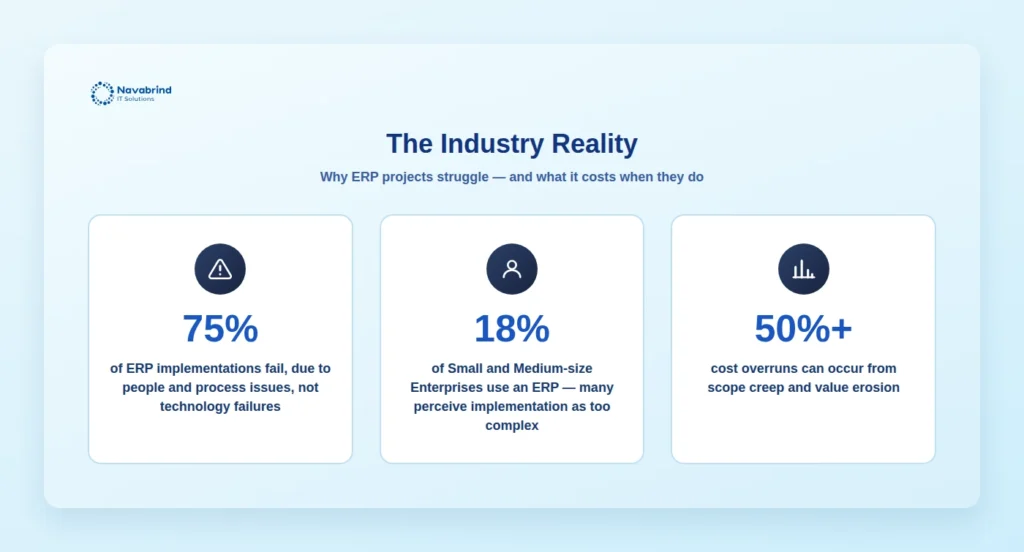
Businesses don’t struggle because of ERP software alone. The real cause lies in decisions made long before deployment begins. Incomplete business analysis, disconnected leadership, unclear ownership, unrealistic delivery expectations, fragmented communication, and limited user involvement create conditions that expose organizations to ERP implementation risks from day one. When project teams overlook operational priorities, workflows fail to support day-to-day activities, creating delays, cost escalation, and declining stakeholder confidence. These ERP implementation challenges spread across departments, reducing productivity and slowing adoption after launch. Organizations that ignore governance, risk assessment, and measurable success criteria experience recurring ERP implementation issues that become expensive to resolve after deployment. Understanding why ERP implementations fail allows decision-makers to identify hidden gaps before investment grows. A disciplined planning approach, executive accountability, cross-functional collaboration, and continuous validation reduce ERP implementation problems, protect business continuity, and deliver measurable operational improvements with greater confidence.
The Top ERP Implementation Risks
ERP implementation risks rarely appear as isolated events. They emerge through a combination of planning gaps, operational disconnects, inconsistent decision-making, and execution failures that compound throughout the project lifecycle. Organizations facing ERP implementation challenges without a formal governance framework expose budgets, timelines, productivity, and user confidence to unnecessary disruption. From incomplete requirements and uncontrolled project expansion to inaccurate data transfers and limited workforce readiness, each risk weakens business performance long after deployment. Understanding why ERP implementations fail requires evaluating operational processes, leadership commitment, resource allocation, and accountability before configuration begins. Identifying ERP implementation issues early creates opportunities to reduce financial exposure, maintain delivery momentum, and improve adoption across departments. Organizations that recognize ERP implementation problems before they escalate establish stronger project discipline, improve implementation outcomes, accelerate operational value, and achieve measurable returns from their ERP investment without costly corrective initiatives.
Poor Requirements Gathering
Poor requirements gathering ranks among the leading ERP implementation risks because incomplete business discovery produces software configurations that fail to support operational objectives. Teams that document surface-level requirements without validating workflows, reporting expectations, compliance obligations, integrations, and approval processes create significant ERP implementation challenges during deployment. Business users lose confidence when critical functions remain unsupported, leading to expensive redesign, extended project timelines, and operational disruption. This pattern explains why ERP implementations fail despite capable technology platforms. Successful projects depend on collaborative workshops, stakeholder interviews, process mapping, and documented acceptance criteria before development begins. Capturing business expectations across finance, operations, procurement, inventory, manufacturing, sales, and customer service reduces ERP implementation issues and strengthens alignment across departments. Investing time in discovery lowers ERP implementation problems, minimizes unexpected rework, supports informed decision-making, and creates a deployment roadmap that reflects measurable business priorities and long-term organizational growth.
Weak Change Management
Technology adoption succeeds when people understand the value behind operational change. Weak change management creates ERP implementation risks by leaving employees uncertain about responsibilities, workflows, and expected outcomes. Resistance grows when communication remains inconsistent, leadership engagement declines, or training fails to reflect daily business activities. These ERP implementation challenges reduce productivity, increase support requests, and delay organizational acceptance after deployment. One of the primary reasons why ERP implementations fail is the assumption that employees will adapt without preparation or ongoing guidance. Organizations achieve stronger outcomes by involving department leaders early, communicating project milestones, addressing employee concerns, and delivering role-based learning experiences throughout the implementation journey. Continuous engagement strengthens confidence, encourages accountability, and supports organizational alignment. Reducing ERP implementation issues through effective change leadership creates faster adoption, protects project investment, minimizes ERP implementation problems, and accelerates measurable business performance after go-live.
Data Migration Errors
Reliable business decisions depend on accurate information, making data migration one of the highest ERP implementation risks. Incomplete records, duplicate entries, inconsistent formatting, missing historical transactions, and incorrect data mapping create ERP implementation challenges that affect finance, inventory, procurement, manufacturing, and customer operations. Even small migration mistakes can interrupt reporting, delay transactions, and reduce trust in the ERP platform. This remains a major reason why ERP implementations fail despite successful software deployment. Organizations should validate legacy data, remove obsolete records, standardize master data, test migration cycles, and reconcile results before production rollout. Cross-functional validation strengthens accuracy and reduces operational disruption during transition. Preventing ERP implementation issues through disciplined data governance improves reporting quality, strengthens compliance, protects customer information, and minimizes ERP implementation problems that require expensive corrections after deployment, allowing organizations to achieve faster operational stability and stronger business performance.
Scope Creep
Expanding project requirements without disciplined governance introduces significant ERP implementation risks that affect budgets, timelines, resource allocation, and delivery quality. Organizations frequently request additional features, workflow modifications, custom development, or integration changes after implementation begins, creating ERP implementation challenges that disrupt project momentum. Each unplanned addition increases testing effort, extends deployment schedules, and raises implementation costs without evaluating business impact. This pattern explains why ERP implementations fail even when initial planning appears complete. Successful organizations establish documented project boundaries, formal approval processes, business impact assessments, and executive oversight before accepting change requests. Prioritizing business-critical capabilities for initial deployment creates faster organizational value and reduces unnecessary complexity. Controlling ERP implementation issues through disciplined governance protects project focus, limits ERP implementation problems, strengthens stakeholder confidence, and creates a scalable foundation for phased enhancements aligned with evolving business objectives.
How to De-Risk Your ERP Implementation
Reducing ERP implementation risks starts with defining measurable business goals and KPIs that align project outcomes with operational priorities, financial performance, and long-term growth. A phased implementation roadmap allows organizations to validate processes, resolve gaps, and stabilize operations before expanding across additional business functions, lowering exposure to costly disruptions. Strong project governance establishes accountability, decision ownership, approval controls, and consistent communication, preventing delays and strengthening execution. Prioritizing standard ERP capabilities before requesting custom development simplifies deployment, lowers maintenance effort, and improves upgrade readiness without increasing project complexity. Continuous risk monitoring across planning, configuration, testing, data migration, user adoption, and go-live enables teams to identify emerging ERP implementation challenges before they escalate into critical ERP implementation issues. Organizations that embrace disciplined governance, ongoing validation, and measurable performance reviews gain valuable insight into why ERP implementations fail, minimize ERP implementation problems, protect investment, and accelerate business value with greater confidence.
ERP Implementation Best Practices
Successful ERP outcomes depend on disciplined planning, consistent execution, and active business participation throughout the implementation journey. Engaging business stakeholders from the earliest planning stage validates operational priorities, aligns project decisions with organizational goals, and reduces ERP implementation risks before configuration begins. Investing in user education and adoption programs builds confidence, strengthens process acceptance, and minimizes ERP implementation challenges during deployment. Repeated testing across workflows, integrations, reporting, security, and migrated data identifies defects before production, preventing costly ERP implementation issues that disrupt daily operations. Tracking business KPIs such as process efficiency, inventory accuracy, financial performance, user adoption, and order fulfillment enables leadership to evaluate implementation outcomes using measurable results. Continuous refinement after go-live through performance reviews, user feedback, and process enhancements addresses the root causes behind why ERP implementations fail, reduces recurring ERP implementation problems, protects long-term ERP investment, and supports sustained operational growth and business value.
Frequently Asked Questions
1.What are the biggest ERP implementation risks?
The largest ERP implementation risks include incomplete requirements gathering, poor project governance, inaccurate data migration, weak user adoption, uncontrolled scope expansion, unrealistic timelines, and limited executive involvement. These factors increase project costs, delay deployment, and reduce the business value expected from the ERP investment.
2.Why do most ERP implementations fail?
Understanding why ERP implementations fail starts with examining planning and execution. Projects lose momentum when organizations overlook business process analysis, involve stakeholders too late, underestimate data preparation, neglect employee adoption, or fail to manage project scope. Strong governance and continuous oversight help prevent these setbacks.
3.What are common ERP implementation challenges?
Common ERP implementation challenges include migrating legacy data, aligning ERP workflows with business operations, managing organizational change, integrating third-party applications, controlling project budgets, and maintaining communication across departments. Addressing these areas early reduces operational disruption during deployment.
4.How can a business reduce ERP implementation risk?
Businesses can reduce ERP implementation risks by defining measurable objectives, documenting business requirements, establishing project governance, validating data before migration, conducting multiple testing cycles, investing in user training, monitoring project milestones, and reviewing risks throughout the implementation lifecycle.
5.Does hiring a certified partner reduce implementation risk?
Yes. Working with a certified ERP implementation partner helps reduce ERP implementation issues through proven implementation methodologies, experienced project leadership, business process expertise, risk management practices, technical guidance, and post-deployment support. An experienced partner identifies potential ERP implementation problems early, helping organizations achieve faster adoption and stronger business outcomes.
Schedule a conversation with us now!
Related Articles










 Post
Post Post
Post