Understanding the Role of Healthcare ERP Software:
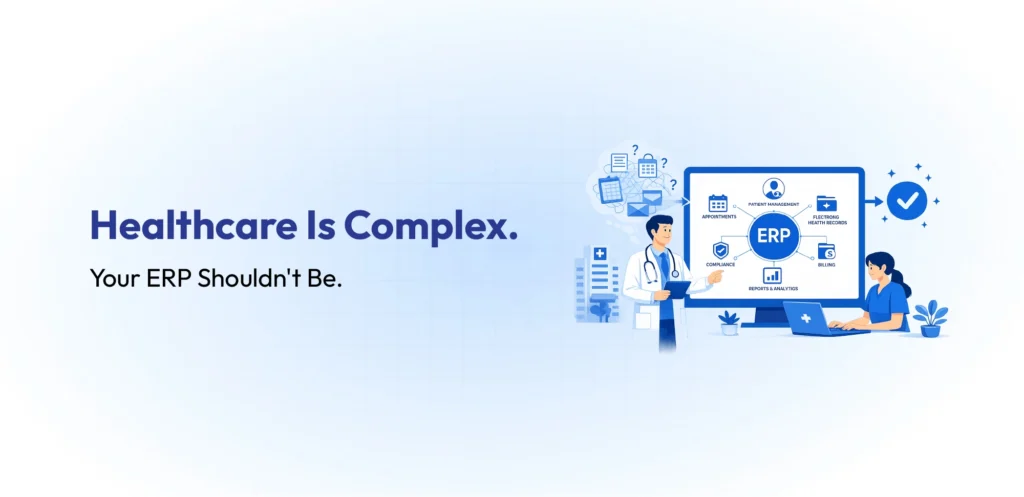
ERP software for the healthcare industry manages the business side of healthcare delivery. This includes financial accountability, supply chain control, workforce coordination, and regulatory reporting.
A common mistake is confusing healthcare ERP systems with clinical platforms:
- EHR and EMR platforms focus on patient care: medical records, physician documentation, diagnostics, and treatment workflows
- Medical ERP software focuses on operations: procurement, finance, HR, compliance, and cross-department coordination
Both layers serve different roles. When organizations treat them as interchangeable, decision-making breaks down. Clinical excellence cannot compensate for weak operational control, and strong operations cannot replace clinical systems.
What Healthcare ERP Software Manages in Hospitals and Clinics
A well-implemented hospital ERP system governs the entire operational ecosystem:
- Inventory and medical supply control
Tracks pharmaceuticals, consumables, and critical equipment across departments and locations, reducing wastage and stockouts
- Procurement and vendor management
Standardizes purchasing, negotiates vendor terms, and controls spending across categories
- Financial management
Covers billing operations, cost allocation, budgeting, and reporting, enabling leadership to understand profitability at a granular level
- Human resources and workforce planning
Maintains staff records, certifications, shift allocation, leave tracking, and payroll execution
- Facilities and asset lifecycle management
Monitors medical equipment, maintenance cycles, and capital assets to avoid downtime and compliance risks
- Compliance and audit readiness
Maintains documentation trails, regulatory records, and policy enforcement required for healthcare governance
- Inter-department coordination
Links clinical departments with procurement, finance, and administration, eliminating operational silos
This is where ERP solutions for healthcare create measurable impact by connecting decisions across departments instead of isolating them.
Why Healthcare ERP Matters More in 2026
Healthcare organizations are facing pressure from multiple directions. Cost control, compliance demands, and operational scale are no longer optional concerns.
- Rising Cost Pressure Without Compromising Care:
Margins are tightening across hospitals and clinics. Without healthcare ERP software, procurement inefficiencies, excess inventory, and poor cost tracking inflate the cost per patient.
- Increasing Regulatory Complexity:
Value-based care models demand accurate cost and outcome data. Top healthcare ERP systems provide the reporting structure required to meet these expectations without scrambling for data during audits.
- Workforce Constraints Driving Process Automation:
Administrative overload is no longer sustainable. Medical ERP software reduces dependence on repetitive administrative tasks by standardizing workflows across departments.
- Investor and Stakeholder Expectations:
Private equity and institutional investors expect financial discipline, transparency, and reporting clarity. Healthcare ERP systems provide structured financial insights that support funding, expansion, and valuation.
Expansion into Multi-Site Healthcare Networks
Healthcare delivery is no longer limited to a single location. Hospital groups, diagnostic chains, and telehealth operations require centralized control. Disconnected tools cannot manage multi-location operations effectively, whereas ERP software for the healthcare industry provides a unified operational view.
The Cost of Operational Inefficiency:
- Increased cost per patient due to poor resource allocation
- Uncontrolled procurement spend due to lack of visibility
- Compliance risks due to missing documentation and audit gaps
A well-implemented best ERP for healthcare addresses these issues by turning operational data into actionable insight.
What Are the Top Healthcare ERP Systems Available in 2026?
The market for top healthcare ERP systems includes a mix of large enterprise platforms and flexible solutions tailored for growing organizations. Some platforms originate from clinical systems and expand into operations. Others start as enterprise ERP platforms and adapt to healthcare needs.
How to Evaluate Healthcare ERP Systems
Selecting the best ERP for healthcare requires a structured evaluation:
- Depth of healthcare functionality available without heavy customization
- Compliance readiness including HIPAA alignment and interoperability standards like HL7 and FHIR
- Integration capability with EHR, lab, radiology, and pharmacy systems
- Total cost of ownership over a five-year horizon
- Ability to scale from a single clinic to a multi-location network
- Vendor roadmap and long-term viability
These factors determine whether an ERP investment drives measurable return or becomes a cost burden.
Platform Breakdown: Leading Healthcare ERP Systems:
1.Epic:
A dominant name in healthcare IT, widely adopted by large hospital systems in the United States.
- Strength lies in clinical systems, especially EHR and patient record management
- Expanded into operational areas such as supply chain and billing
- Strong integration between clinical and operational data
Limitations:
High cost, long deployment cycles, and limited flexibility for mid-size organizations
Best fit:
Large hospital networks and academic medical centers with dedicated IT teams
2.Oracle Health (Formerly Cerner):
Offers integrated clinical and operational capabilities after Oracle’s acquisition.
- Strong connection between clinical data and administrative processes
- Widely used in government and public healthcare systems
Limitations:
Enterprise-level cost and complexity
Best fit:
Large hospital systems and government healthcare organizations
3.SAP S/4HANA for Healthcare:
An enterprise-grade ERP platform known for financial and supply chain depth.
- Strong financial control and procurement management
- Widely used for back-office operations in large healthcare groups
Limitations:
High investment and long deployment timelines
Best fit:
Large healthcare conglomerates requiring robust financial governance
4.Microsoft Dynamics 365 for Healthcare:
A growing presence in healthcare operations.
- Strong finance and HR capabilities
- Integrates well with Microsoft tools used across healthcare administration
Limitations:
Healthcare functionality depends on partner-led extensions
Best fit:
Mid-size organizations already using Microsoft infrastructure
5.Odoo ERP for Healthcare:
A rapidly adopted option among growing healthcare organizations.
- Covers procurement, inventory, finance, HR, and compliance workflows within one platform
- Lower total cost compared to enterprise-heavy platforms
- Configurable to meet healthcare regulatory requirements with the right implementation approach
- Expanding ecosystem of healthcare-focused modules
Why it stands out:
Delivers operational control without the cost and complexity associated with traditional enterprise systems
Best fit:
Clinic chains, diagnostic networks, specialty care providers, medical device companies, and healthcare startups seeking scalable healthcare ERP software
The choice of healthcare ERP systems determines how effectively a healthcare organization controls cost, maintains compliance, and scales operations. Enterprise platforms serve large institutions with significant budgets. On the other hand, solutions like Odoo ERP for healthcare offer a practical path for organizations that need operational control without heavy investment. The difference lies not in features alone, but in how well the system aligns with operational goals, financial discipline, and long-term growth.
Why Is Odoo the Best ERP Choice for Healthcare Organizations in 2026?
Selecting the best ERP for healthcare is not about feature lists—it is about how fast an organization gains control over cost, operations, and compliance. Among the top healthcare ERP systems, Odoo stands out by aligning with how healthcare organizations expand, operate, and invest.
Here is the operational case for choosing healthcare ERP software based on Odoo.
The Operational Case for Odoo in Healthcare: Five Compelling Reasons
Reason 1: Modular Adoption Matches Healthcare Growth Patterns
Healthcare organizations evolve in phases. A clinic network may begin with a few locations, then expand into multi-site operations with increasing administrative complexity.
Traditional healthcare ERP systems force full-scale deployment from day one. That approach creates unnecessary cost and slows adoption.
Odoo follows a phased model:
- Start with procurement and inventory to control medical supplies
- Introduce HR and payroll as workforce size increases
- Add financial management when multi-location reporting becomes critical
Each layer of this medical ERP software delivers measurable value on its own. At the same time, it contributes to a connected operational environment. This approach allows healthcare providers to scale without replacing systems or reworking processes. Growth happens on the same platform, avoiding disruption and preserving data continuity.
Reason 2: Total Cost of Ownership Creates Strategic Financial Advantage
Cost is where many ERP solutions for healthcare fail to justify their investment. Enterprise platforms demand high licensing fees, extended deployment cycles, and ongoing maintenance overhead. Over five years, this creates a significant financial burden.
Odoo changes that equation.
- Lower licensing and infrastructure costs
- Reduced dependency on large technical teams
- Faster deployment, which limits implementation expense
For a hospital group or clinic chain, the financial gap between Odoo and enterprise platforms such as Epic, SAP, or Oracle is substantial.
That difference is not just cost saved but becomes capital available for:
- Expanding facilities
- Hiring medical staff
- Investing in clinical equipment
Among top healthcare ERP systems, Odoo delivers operational capability without draining financial resources.
Reason 3: Faster Implementation Drives Earlier Operational Gains
Time-to-value defines the success of any ERP software for the healthcare industry. Long deployment cycles delay benefits. During that period, inefficiencies continue to procurement leakage, inventory errors, and fragmented financial reporting.
Odoo accelerates this timeline:
In practical terms, healthcare organizations begin seeing results sooner:
- Reduced supply chain waste
- Improved stock accuracy across departments
- Better control over operational spending
This speed matters because operational inefficiency in healthcare directly impacts margins and service delivery. A faster rollout means earlier control.
Reason 4: Open Architecture Enables Best-Fit Clinical Integration
Healthcare providers rely on multiple systems EHR, laboratory platforms, radiology systems, and pharmacy applications. Forcing all functions into one vendor ecosystem can create limitations.
Odoo addresses this challenge with an open architecture.
- API-driven integration with external clinical systems
- Flexibility to connect with specialized healthcare applications
- No dependency on a single vendor for all operations
This gives organizations the freedom to choose the clinical tools that suit their specialty, without compromising operational efficiency.
For example:
- A diagnostic network can integrate with a laboratory information system
- A specialty clinic can connect with a focused EHR platform
- A hospital group can align pharmacy systems with centralized procurement
This flexibility positions Odoo as a practical healthcare ERP software option for organizations that require adaptability.
Reason 5: HIPAA Compliance Without Excessive Cost Burden
Compliance remains a major barrier when selecting hospital ERP systems, especially for organizations with limited resources.
Odoo provides a workable path toward compliance:
- Configurable access controls and audit trails
- Secure hosting environments aligned with healthcare regulations
- Support from implementation partners experienced in compliance frameworks
With the appropriate setup, Odoo can meet HIPAA technical safeguard requirements without the heavy cost associated with enterprise platforms.
This makes compliance achievable for:
- Mid-size hospital groups
- Multi-location clinic networks
- Healthcare startups entering regulated markets
Instead of restricting compliance capabilities to large institutions, Odoo extends access to organizations that need operational control without excessive financial strain.
Why Odoo is the Best Fit
Among top healthcare ERP systems, Odoo stands out because it aligns with how healthcare organizations operate in reality but not in theory.
- Growth happens in stages
- Budgets demand careful allocation
- Operational improvements cannot wait years
- Clinical systems must remain flexible
- Compliance must remain achievable
Odoo addresses each of these priorities through a practical, scalable approach to ERP solutions for healthcare. For organizations evaluating the best ERP for healthcare, the decision is not only about technology, but rather about how quickly and effectively operations can be controlled, costs can be managed, and expansion can be supported.
Where Odoo Delivers the Strongest Outcomes in Healthcare
Odoo consistently performs well across a range of healthcare business models that require scalable ERP solutions for healthcare.
Private Hospital Chains
Organizations managing 3 to 20 locations benefit from centralized procurement, financial consolidation, and operational visibility across sites.
Specialty Care Providers
Dental chains, eye care networks, fertility clinics, and diagnostic labs rely on coordinated inventory, staff scheduling, and cost tracking areas where healthcare ERP software plays a critical role.
Medical Device Manufacturers and Distributors
These organizations require manufacturing workflows combined with compliance and supply chain control. Odoo bridges healthcare operations with production management.
Healthcare Startups
Startups scaling from early-stage to growth phases need systems that evolve with them. Odoo supports this transition without requiring platform changes.
Healthcare Staffing and Administration Firms
Managing large workforces, payroll, and compliance becomes manageable with integrated HR and financial workflows.
Telehealth Platforms
Back-office operations across distributed teams require centralized control. Odoo provides operational consistency across virtual care models.
Implementing Healthcare ERP Software: A Practical Guide for 2026
Rolling out healthcare ERP software is not a routine IT upgrade. It reshapes how procurement, finance, HR, compliance, and administration operate across the organization. Success depends on preparation, disciplined execution, and strong internal ownership. This guide outlines how healthcare organizations can deploy healthcare ERP systems with clarity and control.
The Non-Negotiable Preparation Steps Before Implementation
Before selecting or configuring any ERP software for the healthcare industry, foundational work must be completed. Skipping these steps leads to delays, cost overruns, and weak adoption:
1.Map Current Operational Workflows
Document how procurement, inventory, finance, and HR operate today.
- How purchase requests are raised and approved
- How inventory moves across departments
- How billing and financial reporting are handled
- How workforce scheduling and payroll are managed
This step reveals inefficiencies that the medical ERP software must address.
2.Identify Compliance Obligations
Healthcare operations are tightly regulated.
- HIPAA requirements for organizations operating in the US
- Local regulatory frameworks for other regions
- Internal audit and reporting expectations
Healthcare ERP systems must support audit trails, access control, and documentation standards aligned with these obligations.
3.Conduct a Data Audit
ERP performance depends on data quality.
Assess and clean:
- Vendor records
- Item and pharmaceutical catalogs
- Employee data and credentials
- Financial structures such as the chart of accounts
Poor data quality undermines even the best ERP for healthcare.
4.Define Integration Requirements
Healthcare environments rely on multiple systems.
Identify what must connect with the ERP:
- EHR and clinical platforms
- Laboratory and radiology systems
- Payment gateways and billing tools
- Third-party applications used in operations
A well-defined integration plan ensures that ERP solutions for healthcare function as a connected ecosystem.
5.Establish an Internal Project Team
No implementation succeeds without internal ownership.
- Assign a dedicated project lead
- Involve stakeholders from procurement, finance, HR, and administration
- Ensure decision-making authority remains within the organization
Implementation partners guide the process, but internal leadership drives outcomes.
Implementation Phases for Healthcare ERP Systems
Deploying hospital ERP systems follows a structured sequence. Each phase builds on the previous one and requires focused execution.
Phase 1: Discovery
- Map current processes across departments
- Document compliance requirements
- Define integration architecture
This phase sets the foundation for how the healthcare ERP software will operate.
Phase 2: Configuration
- Set up modules for procurement, inventory, finance, and HR
- Configure workflows based on organizational processes
- Implement compliance controls such as access restrictions and audit logs
- Define user roles and permissions
Configuration translates business needs into system behavior.
Phase 3: Integration
- Connect ERP with clinical systems and operational tools
- Align data flow between departments and platforms
- Validate interoperability across systems
Integration ensures that ERP software for the healthcare industry does not operate in isolation.
Phase 4: Data Migration
- Clean and standardize master data
- Import vendor records, inventory catalogs, employee data, and financial balances
- Validate data accuracy before moving forward
Reliable data is essential for effective healthcare ERP systems.
Phase 5: Testing
- Run end-to-end scenarios covering procurement, billing, payroll, and reporting
- Validate compliance workflows and audit trails
- Identify and fix gaps before launch
Testing confirms that the system performs under real healthcare conditions.
Phase 6 : Training
- Train procurement teams on purchasing workflows
- Train finance teams on reporting and accounting processes
- Train HR teams on workforce management
- Train administrative leaders on system usage and oversight
Adoption depends on how well users understand the system.
Phase 7: Go-Live and Stabilization
- Launch the system in a controlled manner
- Keep implementation partners available for support
- Monitor system performance and user adoption
Stabilization ensures that the healthcare ERP software operates reliably from day one.
Common Healthcare ERP Implementation Failures And How to Avoid Them
Even the best ERP for healthcare fails when execution lacks discipline. The following pitfalls are common and avoidable.
1.Treating ERP as an IT Project
ERP impacts operations across departments. Treating it as a technical deployment leads to poor adoption.
Avoidance: Position the project as an operational transformation led by business stakeholders.
2.Underestimating Compliance Complexity
Healthcare compliance requires careful configuration of access controls, audit logs, and reporting structures.
Avoidance: Involve compliance experts early and validate requirements during configuration.
3.Migrating Poor-Quality Data
Unclean data leads to reporting errors, procurement issues, and operational confusion.
Avoidance: Invest time in data cleaning before migration begins.
4.Inadequate Training
Users who do not understand the system create workarounds, reducing the value of ERP solutions for healthcare.
Avoidance: Conduct role-based training with practical scenarios.
5.No Post-Go-Live Optimization Plan
Implementation does not end at go-live. Without optimization, system usage plateaus.
Avoidance: Plan for continuous improvement, performance monitoring, and periodic system enhancements.
Final Insight
Implementing healthcare ERP software is a defining step for any healthcare organization aiming to control cost, maintain compliance, and scale operations. With the right preparation, structured execution, and strong internal leadership, healthcare ERP systems especially flexible platforms like Odoo that deliver measurable operational impact within a defined timeframe. Execution determines success. The organizations that approach implementation with clarity and discipline gain lasting advantage from their ERP investment.
In 2026, healthcare ERP software is no longer viewed as a system reserved for large hospital enterprises. It has become the operational framework that shapes how healthcare organizations manage cost, maintain regulatory alignment, and expand without losing control.
Healthcare providers are facing tighter margins, stricter reporting demands, and rising operational complexity. Under these conditions, the quality of internal systems directly influences financial performance and service delivery. The organizations that invest in the right healthcare ERP systems are creating stronger operational control across procurement, inventory, finance, workforce management, and compliance.
For large hospital networks in the United States, Epic Systems continues to lead in clinical infrastructure. Its integration between patient records and hospital workflows remains a benchmark for institutions with the resources to support a large-scale ecosystem. For organizations that require a deeply connected clinical environment, Epic remains an influential platform.
Yet for a large share of the global healthcare market including private hospital groups, specialty providers, diagnostic networks, and growth-stage healthcare businesses that the operational requirements are different. These organizations need ERP software for the healthcare industry that strengthens business performance without introducing enterprise-level cost or unnecessary deployment complexity. In many cases, the operational layer needs flexibility that traditional clinical-first systems were never designed to deliver.
This is where Odoo has emerged as one of the top healthcare ERP systems for growing healthcare organizations. Odoo gives providers access to:
- Broad operational coverage across finance, procurement, HR, and asset management
- Configurable compliance support suitable for regulated healthcare environments
- Open integration with EHR, pharmacy, laboratory, and clinical platforms
- Predictable investment that supports long-term growth
For healthcare leaders evaluating the best ERP for healthcare, the real advantage does not come from choosing the largest platform. It comes from choosing the platform that supports the organization’s mission without burdening it. The healthcare organizations that will lead in 2026 and beyond will not always be the ones with the highest technology budgets. They will be the ones that choose ERP solutions for healthcare that align operational discipline with clinical excellence by creating a business foundation that strengthens patient care rather than competing with it.
Frequently Asked Questions
1.What is healthcare ERP software and why does it matter in 2026?
Healthcare ERP software manages the operational side of healthcare like the finance, procurement, inventory, HR, compliance, and administration within a connected system.
In 2026, its importance has increased due to:
- Rising operational costs across hospitals and clinics
- Stricter regulatory reporting requirements
- Expansion into multi-location healthcare networks
- Pressure to improve efficiency without impacting patient care
Without well-implemented healthcare ERP systems, organizations struggle with cost control, fragmented data, and compliance risks. A strong ERP foundation enables structured operations, financial visibility, and controlled growth.
2.What are the top healthcare ERP systems available in 2026?
The landscape of top healthcare ERP systems includes a mix of enterprise platforms and flexible alternatives:
3.Why is Odoo the best ERP choice for healthcare organizations?
Among ERP solutions for healthcare, Odoo stands out due to its balance of capability, cost, and scalability.
Key advantages:
- Flexible module-based adoption aligned with organizational growth
- Lower total cost compared to enterprise-heavy platforms
- Faster deployment leading to earlier operational improvements
- Open integration with clinical systems such as EHR, lab, and pharmacy platforms
- Configurable compliance support for regulated healthcare environments
For many organizations, Odoo delivers the functionality required from the best ERP for healthcare without the financial and operational burden of large enterprise systems.
4.How much does Epic medical software cost vs Odoo in 2026?
Epic Systems operates at enterprise scale:
- Implementation costs can range from millions to tens of millions of dollars depending on hospital size
- Deployment timelines extend over multiple years
- Ongoing maintenance and staffing requirements add to total cost
In contrast, Odoo offers a significantly lower cost structure:
- Subscription-based pricing with modular flexibility
- Implementation costs suited for small to mid-size healthcare organizations
- Shorter deployment cycles, reducing overall project expense
Over a five-year period, the cost difference can be substantial enough to fund operational expansion such as new facilities or additional staff.
5.What should medical ERP systems include that Epic doesn’t offer?
Epic Systems excels in clinical workflows but is not designed as a flexible operational ERP for all healthcare organizations.
A well-rounded medical ERP software should include:
- Strong procurement and vendor management controls
- Detailed inventory tracking across departments and locations
- Flexible financial management with cost center visibility
- Workforce planning including payroll and shift management
- Asset and facility lifecycle management
- Adaptability to integrate with multiple clinical systems
Platforms like Odoo focus on these operational areas, making them suitable for organizations that need stronger administrative and financial control.
6.Why choose Odoo ERP for healthcare over other systems?
Compared to other healthcare ERP systems, Odoo offers:
- Broad operational coverage across departments
- Predictable cost as functionality expands
- Faster implementation timelines
- Flexibility to integrate with specialized clinical tools
- Scalability from small clinics to multi-location networks
Unlike enterprise platforms that demand heavy investment, Odoo provides access to ERP software for the healthcare industry that supports growth without creating financial strain.
7.How does Odoo compare to Epic for hospital management?
Epic Systems and Odoo serve different roles within healthcare technology.
- Epic focuses on clinical systems—patient records, physician workflows, and care delivery
- Odoo focuses on operations—finance, procurement, HR, inventory, and compliance
For large hospitals with significant budgets, Epic may serve as the clinical backbone.
For operational management:
- Odoo provides flexibility and cost control
- Supports integration with existing clinical platforms
- Enables faster deployment and easier scalability
In many cases, healthcare organizations use Odoo alongside clinical systems to build a complete operational and clinical ecosystem.
Schedule a conversation with us now!
Related Articles







 Post
Post