




Production Planning Chaos Is Costing Indian Factories Lakhs – Here’s How Odoo Fixes It
- June 9, 2026
- Posted by: Mario J Kevin
- Categories: Blog, Manufacturing ERP, Odoo ERP, Production Management
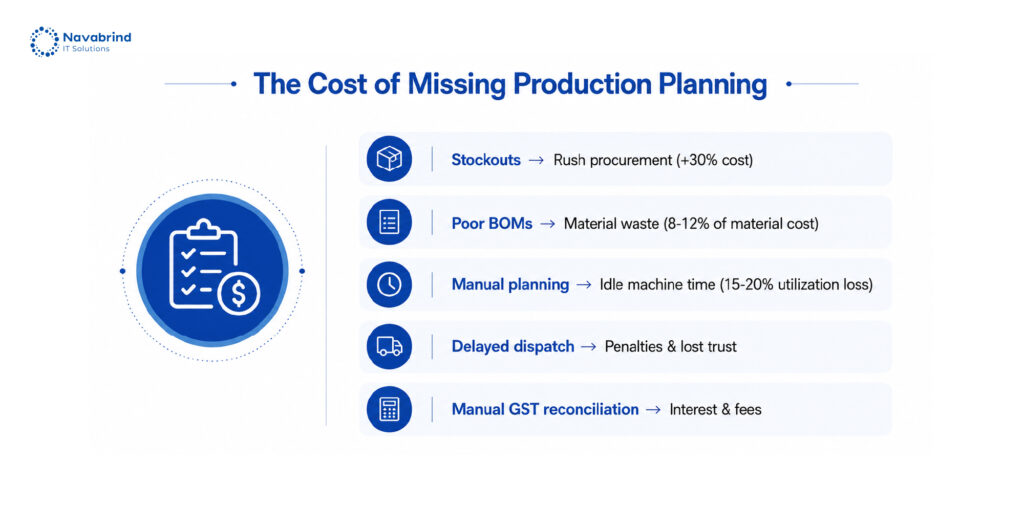
Production planning breakdowns don’t announce themselves, they show up as missed dispatches, idle machines, rushed procurement, and rising operational costs. In Indian factories, where margins are closely watched, even small planning errors can translate into lakhs in losses. The root issue lies in disconnected workflows and limited visibility across departments. When production planning depends on fragmented tools, teams react instead of executing with control.
This is where ERP for production planning changes the equation. With integrated production planning software, manufacturers gain visibility across inventory, work orders, and capacity in one system. Odoo’s manufacturing production planning software connects demand, procurement, and shop floor activity, allowing production scheduling software to adjust based on actual conditions. Instead of firefighting, businesses operate with consistency and control. Production planning and control becomes measurable, trackable, and aligned with business outcomes turning unpredictability into a manageable process that protects margins and improves delivery reliability.
Why Production Planning and Control Remains a Complex Challenge
Production planning and control sits at the intersection of demand forecasting, procurement, inventory management, and shop floor execution. Each function generates data, yet without integration, this data fails to guide decision-making. That’s why many manufacturers continue to struggle despite years of operational experience.
Spreadsheets remain widely used because they appear simple, yet they lack the ability to handle changing variables. As production scales, spreadsheet-based production planning introduces delays, errors, and misalignment between teams. Manufacturing production planning software eliminates this gap by consolidating information into a unified system.
ERP for production planning ensures that production scheduling software works with accurate inputs material availability, machine capacity, and order priorities. This alignment allows production planning software to deliver actionable insights rather than static plans. As a result, production planning and control evolves from a reactive task into a coordinated operational function that supports consistent output and cost control.
The Shift in 2026: From Spreadsheets to ERP-Driven Planning
Manufacturing production planning software embedded within ERP systems connects procurement, inventory, and shop floor activity in one environment. Production scheduling software can adjust timelines based on delays, capacity constraints, or changing demand without disrupting the entire workflow.
Production planning software now acts as a control layer for operations. Instead of updating multiple sheets, teams work within a single system that reflects current conditions. Production planning and control becomes data-driven, allowing manufacturers to respond to disruptions without losing momentum. This shift positions ERP for production planning as a necessary investment for factories aiming to reduce waste, improve delivery timelines, and maintain operational discipline.

What Is Production Planning and Why Does It Matter So Much?
Production planning defines how a factory converts demand into output with discipline. It answers four critical questions: what to produce, how much to produce, when to produce, and which resources are required. Without structured production planning, operations drift into guesswork, causing delays, cost overruns, and missed commitments. Production planning software brings structure to this process by linking demand, inventory, and capacity into one system. Manufacturing production planning software ensures that production decisions are based on data rather than assumptions. With ERP for production planning, teams align procurement, workforce, and machines before execution begins. Production planning and control forms the backbone of manufacturing performance. When production scheduling software is used effectively, factories move from reactive decisions to planned execution. This shift protects margins, stabilizes operations, and builds delivery reliability making production planning a critical driver of profitability and long-term growth.
The Relationship Between Production Planning and Control
Production planning and control operate as two sides of the same system. Production planning defines the roadmap of what needs to be produced, in what sequence, and with which resources. Production control ensures that execution follows this roadmap, identifying deviations and correcting them as conditions shift. Production planning software sets schedules, allocates materials, and assigns capacity before manufacturing starts. Production scheduling software then tracks progress, compares actual output with planned targets, and triggers adjustments when disruptions occur. Manufacturing production planning software connects these two functions, eliminating gaps between planning and execution. ERP for production planning ensures that control actions are based on accurate data from the shop floor. Without this connection, production planning and control operate in isolation, leading to inefficiencies. When aligned, they create a continuous loop of planning, monitoring, and correction ensuring that production stays on track despite operational challenges.
Why Both Are Inseparable
Separating production planning from execution creates instability. A plan without monitoring fails the moment conditions shift. Monitoring without a plan leads to reactive decisions with no direction. Production planning and control must function together to maintain consistency.
Production planning software creates structured plans based on demand and resource availability. Production scheduling software tracks whether these plans are being followed and identifies gaps in execution. Manufacturing production planning software integrates these functions, ensuring that adjustments happen without disrupting the entire workflow.
ERP for production planning connects planning and control across departments, enabling coordinated action. When procurement delays or machine downtime occurs, the system recalibrates production schedules instead of forcing teams to rebuild plans from scratch. This integration ensures that production planning and control works as a continuous system, enabling factories to maintain stability, meet deadlines, and control operational costs.
The Cascading Impact of Poor Production Planning
Weak production planning triggers a chain reaction across the business. Delays in production lead to late deliveries, damaging client trust and reducing repeat orders. Production planning software prevents such breakdowns by aligning schedules with available resources and demand timelines.
Excess inventory is another consequence. Without accurate production planning and control, businesses overproduce to avoid stockouts, locking working capital in warehouses. Manufacturing production planning software balances supply with demand, reducing unnecessary stock accumulation. Material shortages disrupt operations, forcing urgent procurement at higher costs. Production scheduling software highlights material gaps early, allowing timely action. At the same time, poor planning results in idle machines and underutilized labour, increasing cost per unit. ERP for production planning addresses these issues by connecting procurement, inventory, and production. This alignment ensures that production planning supports financial stability, operational efficiency, and consistent delivery performance.
Why the Stakes Are Higher for Indian Manufacturers in 2026
Indian manufacturers face rising expectations driven by policy initiatives and global market expansion. Participation in the Production Linked Incentive (PLI) scheme demands consistent output and strict adherence to production targets. Production planning plays a central role in meeting these requirements.
Export growth introduces stricter delivery timelines and quality benchmarks. Production planning software helps businesses meet these expectations by aligning production schedules with international demand. Manufacturing production planning software ensures that capacity and material planning support export commitments without disruption.
ERP for production planning connects operations across procurement, production, and distribution, enabling manufacturers to meet rising expectations with confidence. In this environment, production planning and control is no longer optional that determines whether a business can compete and scale successfully.

The Core Components of Production Planning and Control
Production planning and control brings structure to manufacturing by connecting demand, materials, capacity, and execution. Each component contributes to a coordinated flow where decisions are based on data rather than assumptions. Production planning software integrates these elements into a single environment, allowing teams to plan, execute, and adjust without fragmentation.
Manufacturing production planning software links demand inputs with procurement and shop floor activity, ensuring alignment across functions. Production scheduling software translates plans into executable actions, assigning resources and sequencing tasks with discipline. ERP for production planning connects these layers, enabling visibility across operations.
Demand Planning: Understanding What Needs to Be Produced and When
Demand planning sets the foundation for production planning. It determines what products are required and the timelines for delivery. In make-to-order environments, sales order analysis drives production decisions, ensuring that output aligns with confirmed demand. In make-to-stock scenarios, demand forecasting guides production volumes based on historical patterns and market signals.
Production planning software consolidates demand inputs, reducing reliance on disconnected data sources. Manufacturing production planning software ensures that forecasts and sales orders feed directly into planning workflows. When demand data lacks accuracy, the impact spreads across procurement, scheduling, and inventory.
ERP for production planning aligns demand planning with downstream processes, ensuring that production scheduling software operates on reliable inputs. This connection enables production planning and control to function with consistency, preventing overproduction, shortages, and missed timelines.
Master Production Schedule: Translating Demand into Action
The Master Production Schedule (MPS) converts demand into a time-based production plan. It defines what needs to be produced, in what quantity, and by when. This schedule acts as the central reference point for production planning and control.
Production planning software generates the MPS by combining demand data with available capacity. Manufacturing production planning software ensures that this schedule reflects operational constraints, preventing unrealistic commitments. The MPS balances customer requirements with production capability, maintaining alignment between demand and execution.
Production scheduling software uses the MPS to guide shop floor activity, ensuring that orders are processed in the correct sequence. ERP for production planning connects the MPS with procurement and inventory, enabling accurate delivery timelines. This alignment allows businesses to commit to customers with confidence, reducing delays and improving reliability.
Material Requirements Planning: Ensuring Material Availability
Material Requirements Planning (MRP) ensures that raw materials and components are available when needed. It works by breaking down the Bill of Materials (BOM) against the production schedule to calculate material requirements.
Production planning software performs net requirement calculations by considering current inventory, open purchase orders, and safety stock levels. Manufacturing production planning software ensures that these calculations remain accurate as conditions change. When gaps are identified, the system generates purchase requisitions and production orders to maintain continuity.
Production scheduling software depends on material availability to execute plans without interruption. ERP for production planning connects MRP with procurement, ensuring that supply aligns with production timelines. This integration prevents shortages, reduces excess inventory, and supports consistent production planning and control.
Capacity Planning: Ensuring Feasible Production Plans
Capacity planning validates whether production schedules can be executed with available resources. Rough-cut capacity planning provides a high-level assessment, checking whether key resources can support the Master Production Schedule. Detailed capacity planning goes deeper, analyzing workload at the workcenter level against available hours.
Production planning software enables this evaluation by linking schedules with machine and labour capacity. Manufacturing production planning software highlights overloads and underutilization, allowing corrective action before execution begins.
Production Scheduling: Executing the Plan with Discipline
Production scheduling translates plans into detailed work instructions. It assigns work orders to workcenters, shifts, and operators, ensuring that tasks are executed in the correct sequence. Production scheduling software optimizes job sequencing to reduce changeover time and improve throughput. Manufacturing production planning software ensures that scheduling decisions consider material availability and capacity constraints.
When demand shifts or disruptions occur, production planning software allows adjustments without rebuilding the entire schedule. ERP for production planning connects scheduling with real-time data, enabling coordinated responses across departments. This level of control ensures that production planning and control remains stable even in dynamic environments, supporting consistent output and timely delivery.
Production Control: Monitoring and Improving Execution
Production control tracks execution against the plan, ensuring that deviations are identified and corrected early. Production planning software enables visibility into work order progress, allowing teams to monitor performance across the shop floor.
Manufacturing production planning software records actual material consumption, labour time, and scrap, creating a feedback loop for improvement. Production scheduling software uses this data to adjust timelines and maintain alignment with targets.

What Is Production Planning Software and How Does It Work?
Production planning software is a digital system that automates and connects production planning and control across demand, materials, capacity, and execution. Instead of relying on fragmented tools, manufacturers use a single platform to plan output, allocate resources, and monitor progress. This shift brings consistency and visibility into production planning.
Manufacturing production planning software processes inputs such as sales orders, inventory levels, and bills of materials to generate actionable plans. Production scheduling software then translates these plans into work orders and sequences aligned with capacity. ERP for production planning connects this flow with procurement, finance, and quality functions.
With this structure, production planning evolves from guesswork into a controlled process. Decisions are based on current data, and adjustments are made without disrupting operations. Production planning and control becomes measurable, enabling manufacturers to maintain delivery commitments, control costs, and respond to change with confidence.
How Production Planning Software Replaces Traditional Methods
Traditional planning methods struggle to keep up with manufacturing complexity. Spreadsheet-based MRP appears flexible but breaks under changing variables, leading to errors and inconsistent outputs. Whiteboard scheduling provides visibility on the shop floor but lacks traceability and coordination across departments. Email-based communication slows decision-making and creates gaps between planning, procurement, and execution.
Production planning software replaces these disconnected approaches with a unified system. Manufacturing production planning software ensures that data flows across functions without duplication or delay. Production scheduling software updates plans based on current inputs, eliminating the need for repeated manual adjustments.
ERP for production planning connects all stakeholders within one platform, ensuring alignment across teams. This transition reduces dependency on fragmented tools and brings discipline into production planning and control, enabling manufacturers to operate with accuracy and consistency.
How Production Planning Software Connects the Business
Production planning does not operate in isolation that relies on continuous data exchange across departments. Production planning software connects sales, inventory, procurement, finance, and quality into one workflow. Sales and order management feed confirmed orders into production planning without re-entry, ensuring accuracy. Inventory management provides live stock levels that drive MRP calculations within manufacturing production planning software. Procurement receives system-generated purchase requisitions, aligning material supply with production schedules.
Production scheduling software ensures that financial implications are visible, enabling cost tracking and margin analysis. Quality processes are integrated into production plans, ensuring that inspection requirements and hold statuses are considered before execution. ERP for production planning enables this level of connectivity, ensuring that production planning and control reflects the actual state of the business. This alignment reduces delays, improves coordination, and supports consistent operational performance.
Standalone vs ERP-Embedded Production Planning Software
Manufacturers evaluating production planning software often choose between standalone tools and ERP-embedded solutions. Standalone production scheduling software offers specialized planning capabilities and advanced algorithms. These tools focus deeply on planning functions but require integration with inventory, procurement, and finance systems to operate effectively.
ERP for production planning offers a different advantage with complete connectivity across business functions. Manufacturing production planning software within ERP systems ensures that planning decisions are aligned with inventory availability, procurement timelines, and financial data without additional integration effort.
Production planning and control benefits from this connected environment, as decisions are based on unified data rather than isolated systems. While standalone tools may offer depth in certain areas, ERP-embedded production planning software delivers operational alignment that supports consistent execution across the organization.
Why 2026 Favors ERP-Embedded Production Planning
Manufacturers are shifting toward ERP for production planning due to the need for visibility and coordination across operations. As production environments grow in complexity, disconnected tools create delays and inconsistencies that impact performance.
Manufacturing production planning software embedded within ERP systems eliminates these gaps by connecting planning with execution. Production scheduling software operates on live data from inventory, procurement, and sales, ensuring that plans reflect current conditions.
This approach reduces reliance on integrations and minimizes data inconsistencies. Production planning and control becomes aligned across departments, enabling faster decision-making and improved delivery performance.
In 2026, the focus is not only on planning accuracy but on execution consistency. ERP-embedded production planning software supports this goal by providing a connected environment where planning, scheduling, and control function as one system by helping manufacturers scale operations with confidence.
Why Production Scheduling Is the Most Visible Challenge
Production scheduling exposes operational gaps faster than any other function. Manufacturing environments involve multiple variables like machine availability, operator capability, material readiness, tooling requirements, and setup time. Managing these variables without structured production scheduling software leads to confusion and inefficiency.
Frequent disruptions add complexity. Rush orders, equipment breakdowns, delayed materials, and quality holds force constant adjustments. Without production planning software, teams rely on experience rather than data, resulting in inconsistent decisions.
Manufacturing production planning software addresses this by integrating scheduling with real-time inputs. ERP for production planning ensures that changes in one area reflect across the system, maintaining alignment. Production planning and control becomes stable when scheduling decisions are based on data rather than assumptions, reducing chaos on the shop floor.
Advanced Capabilities in Production Scheduling Software
Advanced production scheduling software handles multiple constraints at once, balancing due dates, machine utilization, and material availability within a single schedule. This capability ensures that production planning decisions consider all operational factors. Predictive scheduling uses historical performance data to refine time estimates, improving planning accuracy. Manufacturing production planning software learns from past execution, enabling better forecasts for future schedules.
What-if analysis allows planners to test scenarios such as accepting a rush order or reallocating workcenters before making commitments. This reduces risk and improves decision-making. Integration with machine data enables schedules to adapt based on actual performance, ensuring alignment with shop floor conditions. ERP for production planning connects these advanced capabilities with other functions, ensuring that production planning and control benefits from continuous data flow. This integration strengthens execution reliability and operational consistency.
The Business Impact of Better Production Scheduling
Effective production scheduling software delivers measurable business outcomes. On-time delivery rates improve without increasing inventory, as production planning aligns with actual capacity and demand. Better workcenter utilization reduces idle time and increases output, lowering cost per unit. Manufacturing production planning software ensures that resources are used efficiently, supporting profitability.
Shorter lead times enable manufacturers to commit to tighter delivery schedules, strengthening competitiveness. Production planning software ensures that these commitments are achievable. Reduced overtime and fewer emergency procurement decisions lower operational stress and costs. ERP for production planning connects scheduling with procurement and inventory, ensuring that production planning and control operates with stability. This results in consistent execution, improved margins, and stronger customer relationships.
ERP for Production Planning: How Integrated Systems Change Everything
Production planning fails when data is fragmented. Plans rely on inputs from sales, inventory, procurement, and shop floor activity. When these inputs sit in disconnected tools, production planning and control turns unreliable. ERP for production planning resolves this by bringing data into one system, ensuring that decisions are based on current inputs.
Manufacturing production planning software within ERP connects orders, inventory, BOMs, supplier timelines, and capacity in a unified environment. Production scheduling software operates on this shared dataset, aligning execution with actual conditions. This structure ensures that production planning reflects what is happening across the business.
Production planning software within ERP transforms planning from a disconnected task into a coordinated function. With consistent data flow, manufacturers reduce errors, improve delivery performance, and maintain control over operations without constant rework.
How ERP Connects Production Planning Across the Business
ERP for production planning links upstream and downstream functions into a continuous flow. Sales orders update demand instantly, ensuring that production planning software reflects current requirements. Manufacturing production planning software uses this data to generate accurate MRP outputs.
Procurement receives system-generated purchase requisitions, aligning material supply with production schedules. Inventory data feeds directly into planning, ensuring that stock levels remain accurate during decision-making. Production scheduling software assigns work orders to shop floor queues, ensuring execution follows the plan.
Shop floor updates on the completed orders, delays, and scrap with the feed back into the system, allowing production planning and control to adjust without delay. Financial data linked to production planning supports cost tracking and variance analysis. ERP for production planning creates a connected loop where planning, execution, and analysis operate as one system, eliminating gaps that disrupt operations.
ERP Modules That Support Production Planning
ERP for production planning relies on multiple modules working together. The manufacturing module manages work orders, BOMs, routing, and production workflows, forming the execution layer of production planning and control.
The inventory module provides stock visibility, lot tracking, and replenishment triggers, ensuring that manufacturing production planning software operates with accurate material data. The purchase module supports MRP-driven procurement, aligning supplier timelines with production needs.
The sales module feeds demand inputs into production planning software, ensuring alignment between customer orders and production schedules. The quality module influences material release by incorporating inspection results into planning decisions.
The maintenance module ensures that equipment availability feeds into capacity planning, supporting accurate production scheduling software outputs. Together, these modules enable ERP for production planning to maintain alignment across operations.
ERP for Production Planning in Indian Manufacturing
Indian manufacturers operate in an environment shaped by regulatory requirements, supplier variability, and multi-location operations. ERP for production planning supports these conditions by integrating compliance and operational data within one system.
Procurement aligned with GST ensures that purchase orders generated through manufacturing production planning software include correct tax treatment. This reduces compliance risks and improves financial accuracy. Supplier performance tracking enables production planning software to factor in actual lead times, improving MRP accuracy over time. Production scheduling software benefits from this data by aligning schedules with realistic material availability.
Multi-plant coordination becomes manageable with shared inventory visibility across locations. ERP for production planning enables production planning and control across factories, ensuring that resources are utilized effectively. This integration supports manufacturers in maintaining consistency, meeting delivery commitments, and scaling operations within a competitive environment.

Key Features to Look for in Manufacturing Production Planning Software
Selecting manufacturing production planning software requires a focus on capabilities that directly influence execution quality. Production planning software must deliver accuracy, flexibility, and visibility across the entire planning cycle. Without these elements, production planning and control remains fragmented and reactive.
The goal is not just to generate plans, but to ensure those plans hold up during execution. Production scheduling software should adapt to changing inputs without breaking workflows. ERP for production planning must connect planning with procurement, inventory, and shop floor activity so decisions reflect actual conditions.
A strong system enables planners to move from reactive adjustments to controlled execution. Each feature below contributes to that outcome, ensuring production planning supports cost control, delivery performance, and operational consistency.
1.MRP Engine Quality
The MRP engine sits at the center of production planning software. Its accuracy determines whether materials arrive on time or disrupt production. Manufacturing production planning software must calculate net requirements across multi-level BOMs without delays or errors.
An effective MRP engine considers current inventory, open purchase orders, safety stock, and demand inputs simultaneously. Production planning and control depends on this calculation to align procurement with production needs.
ERP for production planning strengthens this capability by connecting MRP with live data from inventory and sales. This ensures that production scheduling software operates with reliable material inputs. A weak MRP engine leads to shortages or excess stock, both of which impact margins and delivery timelines.
2.Capacity Planning Depth
Capacity planning ensures that production schedules are achievable. Production planning software must support rough-cut capacity checks for high-level validation along with detailed workcenter-level analysis.
Manufacturing production planning software should highlight load versus available hours, allowing planners to identify bottlenecks early. Production scheduling software relies on this data to assign work orders without overloading resources.
ERP for production planning connects capacity planning with maintenance and workforce data, ensuring that machine availability and labour constraints are considered. This alignment allows production planning and control to produce schedules that can be executed without disruption.
3.Scheduling Flexibility
Production environments require flexibility to respond to change. Production scheduling software must allow planners to adjust schedules without losing system consistency.
Manufacturing production planning software should support manual overrides where required, while maintaining alignment with material availability and capacity constraints. This ensures that changes do not create downstream issues.
ERP for production planning connects scheduling adjustments with procurement and inventory, ensuring that updates reflect across the system. Production planning software becomes a controlled environment where flexibility exists without compromising execution stability.
4.Real-Time Data Connectivity
Production planning depends on current data. Production planning software must update automatically when inventory levels, sales orders, or capacity conditions change. Manufacturing production planning software ensures that MRP calculations and schedules reflect the latest inputs. Production scheduling software uses this data to adjust execution plans without delay. ERP for production planning enables continuous data flow across departments, ensuring that production planning and control operates with accuracy. Without this connectivity, planning decisions rely on outdated information, leading to errors and inefficiencies.
5.Exception Management
Production planning software must identify issues before they disrupt operations. Exception management highlights risks such as delayed orders, material shortages, and overloaded workcenters. Manufacturing production planning software should provide alerts that guide planners toward corrective action. Production scheduling software uses these alerts to adjust schedules and maintain alignment. ERP for production planning ensures that exceptions are visible across departments, enabling coordinated responses. Production planning and control becomes proactive, reducing the impact of disruptions on delivery performance and costs.
6.Visual Planning Tools
Planners need visibility to make informed decisions. Production scheduling software should include intuitive visual tools such as Gantt charts, capacity load views, and scheduling boards. Manufacturing production planning software uses these tools to present complex data in an accessible format. This allows planners to understand workloads, identify bottlenecks, and adjust schedules with confidence. ERP for production planning ensures that visual tools reflect live data from across the system. Production planning software becomes easier to use, supporting faster and more accurate decision-making on a daily basis.
7. What-If Scenario Modelling
Production planning involves constant trade-offs. Production planning software must allow planners to simulate changes before committing to them. Manufacturing production planning software should enable scenario modelling for demand shifts, resource changes, or supply disruptions. Production scheduling software evaluates these scenarios, showing the impact on timelines and capacity.
ERP for production planning connects these simulations with actual data, ensuring that decisions are grounded in reality. Production planning and control benefits from this capability by reducing risk and improving planning accuracy.
8. Multi-Site Support
Manufacturers operating across multiple locations require coordinated planning. Production planning software must support production and inventory visibility across plants and warehouses. Manufacturing production planning software should enable centralized planning with local execution, ensuring alignment across sites. Production scheduling software must consider inter-plant dependencies and material transfers. ERP for production planning connects these locations within one system, enabling production planning and control across the network. This ensures that resources are utilized effectively and production remains aligned with demand.
9. Integration with Procurement and Inventory
Production planning depends on accurate material flow. Production planning software must connect directly with procurement and inventory systems. Manufacturing production planning software generates purchase requisitions based on MRP outputs, aligning procurement with production schedules. Production scheduling software ensures that work orders are released only when materials are available.ERP for production planning integrates these functions, ensuring that stock movements and procurement actions support production planning and control. This alignment reduces shortages and excess inventory.
10. Shop Floor Feedback Loop
Execution data must feed back into planning. Production planning software should capture actual production results, including completions, scrap, and delays. Manufacturing production planning software uses this data to refine future plans. Production scheduling software adjusts timelines based on actual performance.ERP for production planning ensures that this feedback loop operates continuously, strengthening production planning and control. This enables continuous improvement in planning accuracy and execution consistency.
11. India-Specific Requirements
Production planning software for Indian manufacturers must address regulatory and operational needs. GST-compliant procurement ensures accurate tax treatment for purchase transactions. Manufacturing production planning software should support e-way bill generation for inter-plant transfers, ensuring compliance during logistics movement. Multi-currency support is essential for imported materials, enabling accurate cost tracking.ERP for production planning integrates these requirements into daily operations, ensuring that production planning and control aligns with regulatory frameworks without additional effort.
12. Ease of Use for Planners
Adoption depends on usability. Production planning software must be accessible to planners without requiring technical expertise. Manufacturing production planning software should offer intuitive interfaces for scheduling, MRP review, and capacity analysis. Production scheduling software must support quick adjustments without complex steps. ERP for production planning ensures that usability extends across modules, enabling planners to work efficiently within a connected system. This improves adoption and ensures that production planning and control delivers consistent results.
Best Production Planning Software Options in 2026: What Indian Manufacturers Are Using
Option 1: Odoo Manufacturing and MRP
Odoo offers manufacturing production planning software designed for integration across business functions. Its MRP engine handles multi-level BOMs and generates purchase requisitions aligned with demand. This ensures that production planning software connects material requirements with procurement timelines.
Production scheduling software within Odoo provides visual workcenter load views, enabling planners to manage capacity and sequence tasks effectively. ERP for production planning connects manufacturing with inventory, purchase, quality, and accounting modules, ensuring that production planning and control operates with shared data. The pricing structure makes it accessible for small and mid-size manufacturers in India. Businesses gain structured production planning without the overhead of complex standalone tools.
Best fit: Manufacturers seeking integrated production planning software that connects planning, procurement, and execution within a single system.
SAP delivers one of the deepest production planning environments available. Its manufacturing production planning software includes advanced MRP, capacity planning, and detailed production scheduling software capabilities.
ERP for production planning within SAP supports large-scale operations with complex workflows and high transaction volumes. Production planning and control benefits from detailed configuration options and strong data handling capabilities.
This depth comes with higher cost and implementation effort. Dedicated planning teams are required to manage the system effectively. For smaller manufacturers, this level of complexity can outweigh the benefits.
Best fit: Large Indian manufacturers in automotive, pharmaceuticals, and heavy industry requiring advanced production planning software with extensive customization.
Option 3: Microsoft Dynamics 365 Supply Chain Management
Microsoft offers production planning software through its Dynamics 365 platform. The system provides solid master scheduling and MRP capabilities, supporting structured production planning and control.
Manufacturing production planning software within Dynamics integrates with finance and operations modules, enabling ERP for production planning across departments. Production scheduling software supports capacity alignment and demand-driven planning.
The cost positioning places it within the mid to upper mid-market range. Businesses already using Dynamics benefit from tighter integration and reduced transition effort.
Best fit: Mid-size manufacturers using Microsoft systems who want production planning software integrated with finance and operations.
Option 4: ERPNext Manufacturing
Frappe Technologies provides an open-source approach to manufacturing production planning software. The platform includes MRP, work order management, and BOM handling, supporting production planning and control for smaller operations.
Production scheduling software capabilities continue to evolve, with an active Indian community contributing to improvements. ERP for production planning through ERPNext offers cost advantages, making it attractive for businesses with budget constraints. Configuration effort is required to align the system with operational needs. Manufacturers investing time in setup can achieve structured production planning at a lower cost.
Best fit: Small manufacturers seeking production planning software with lower upfront cost and flexibility through customization.
Option 5: Advanced Planning and Scheduling (APS) Tools
Specialized APS tools such as Siemens Opcenter APS, Asprova APS, and Preactor APS focus on advanced production scheduling software capabilities. These tools excel in handling complex constraints, optimizing sequences, and managing high-variability environments.
Manufacturing production planning software in APS systems delivers depth in scheduling logic, supporting intricate production planning scenarios. However, these tools require integration with ERP for production planning to access inventory, procurement, and financial data. The cost and implementation effort are higher, making them suitable only when ERP-based production scheduling software cannot meet operational demands.
Best fit: Large manufacturers with complex scheduling requirements where standard ERP-based production planning software is insufficient.
Common Production Planning Mistakes and How Software Fixes Them
The following mistakes are common across Indian manufacturing, along with how production planning software resolves them:
Mistake 1: Planning Against Inaccurate Inventory Data
The problem begins with unreliable stock data. This leads to phantom shortages or unnecessary procurement, increasing costs and disrupting production planning. Production planning software resolves this by connecting planning with live inventory data. Manufacturing production planning software updates stock levels as transactions occur, ensuring that MRP calculations reflect actual availability.
ERP for production planning strengthens this connection by linking inventory movements, procurement, and production consumption within one system. Production scheduling software then releases work orders only when materials are available. This approach ensures that production planning and control operates on accurate inputs, preventing costly errors.
Mistake 2: Ignoring Capacity Constraints in the Plan
Plans that ignore capacity constraints fail during execution. Production scheduling software addresses this through finite capacity planning. Work orders are scheduled based on available machine hours and workforce capacity, ensuring that production plans remain achievable.
Manufacturing production planning software highlights overloads and bottlenecks, allowing planners to adjust schedules before execution begins. ERP for production planning connects capacity data with maintenance and workforce availability, ensuring alignment. This approach ensures that production planning and control produces realistic schedules, reducing disruptions and improving delivery performance.
Mistake 3: Treating the Production Plan as Fixed
Machine breakdowns, material delays, and demand shifts can disrupt even the most well-prepared plans. Production planning software introduces dynamic replanning capabilities. Manufacturing production planning software allows planners to adjust schedules quickly when conditions change. Production scheduling software recalculates timelines and highlights the impact across orders.
ERP for production planning ensures that these adjustments reflect across procurement, inventory, and execution. Production planning and control becomes adaptive, enabling manufacturers to respond to disruptions without losing coordination.
Mistake 4: Disconnecting Planning from Procurement
When planning operates without visibility into procurement, production schedules become unreliable. ERP for production planning resolves this by linking MRP outputs with the purchasing function. Manufacturing production planning software generates purchase requisitions aligned with production schedules, ensuring that procurement supports planning decisions.
Production scheduling software uses this information to release work orders based on confirmed material availability. Production planning software maintains visibility into supplier timelines, ensuring alignment across departments.
Mistake 5: No Feedback Loop from the Shop Floor
Differences between planned and actual production go unnoticed until they impact delivery timelines. Production planning software captures shop floor data such as completions, delays, and scrap. Manufacturing production planning software uses this data to update planning inputs and improve future schedules.
Production scheduling software adjusts timelines based on actual performance, ensuring alignment with reality. ERP for production planning connects this feedback loop across the system, ensuring that production planning and control evolves continuously. This approach enables early detection of issues and supports continuous improvement in planning accuracy.
Mistake 6: Over-Relying on Individual Planner Knowledge
When production planning depends on individual expertise, consistency becomes a challenge. Manufacturing production planning software addresses this by systemizing planning logic. Production planning software standardizes workflows, ensuring that decisions follow defined rules rather than personal judgment.
Production scheduling software applies consistent logic across work orders, maintaining alignment with capacity and material availability. ERP for production planning documents processes and ensures traceability, enabling teams to operate with shared understanding.
Typical Implementation Phases
Production planning software implementation follows a structured progression. Discovery begins with mapping current workflows, identifying gaps, and defining how production planning and control should operate.
Configuration involves setting up BOMs, routings, workcenters, and planning parameters within manufacturing production planning software. This stage shapes how production scheduling software will function during execution.
Data migration transfers item masters, BOMs, open orders, and inventory balances into the system. Testing follows, where parallel planning cycles validate outputs against existing processes.
Training ensures that planners, procurement teams, and shop floor supervisors understand their roles within ERP for production planning. Go-live marks the transition to the new system, supported by stabilization efforts to resolve initial challenges. Each phase builds toward a controlled and consistent production planning environment.
The Most Important Success Factor: Planner Adoption
Planner adoption defines whether production planning software delivers value. When planners rely on spreadsheets instead of the system, production planning and control breaks down due to inconsistent data. Involving planners during configuration builds ownership and ensures manufacturing production planning software reflects actual workflows. Setting a clear transition away from spreadsheets establishes ERP for production planning as the primary source of truth. This shift turns production scheduling software into a dependable operational tool, enabling consistent execution and improved visibility.
Production planning and control sits at the center of manufacturing performance. Managing it through disconnected tools leads to rising costs, delays, and instability. Manufacturing production planning software connects planning with execution by aligning inventory, procurement, shop floor activity, and financial data within one system. Production scheduling software ensures plans translate into coordinated action, reducing disruptions. For Indian manufacturers, selecting production planning software with strong MRP capability, inventory connectivity, and compliance support strengthens control, protects margins, and drives consistent growth.
Frequently Asked Questions
1. What is production planning and why is it important for manufacturers?
Production planning defines what to produce, how much to produce, when to produce, and which resources are required. It ensures that demand is translated into structured output. Without effective production planning and control, manufacturers face delays, excess inventory, and rising costs. Production planning software brings discipline by aligning demand, materials, and capacity, enabling consistent delivery and better cost management.
2. How does production planning software improve manufacturing operations?
Production planning software connects demand, inventory, procurement, and execution within one system. Manufacturing production planning software automates MRP calculations, while production scheduling software ensures that work orders are aligned with capacity and material availability. This reduces errors, improves visibility, and allows faster response to disruptions. ERP for production planning strengthens this by linking all departments, ensuring coordinated decision-making.
3. What is the difference between production planning and production scheduling?
Production planning focuses on what needs to be produced and in what quantity. Production scheduling software takes this plan and defines when production happens, on which machine, in what sequence, and by whom. Both functions are part of production planning and control. Without scheduling, plans remain theoretical. Without planning, scheduling lacks direction.
4. Why do manufacturers struggle with production planning even today?
Many manufacturers still rely on spreadsheets and disconnected tools. These methods cannot handle changing variables such as demand shifts, material delays, or capacity constraints. As a result, production planning becomes reactive. Manufacturing production planning software resolves this by integrating data and enabling production scheduling software to adjust plans based on actual conditions.
5. What should Indian manufacturers look for in production planning software?
Indian manufacturers should focus on strong MRP capability, accurate capacity planning, and integration with inventory and procurement. ERP for production planning should support GST compliance, supplier lead time tracking, and multi-site operations. Production planning software must align with the scale and complexity of the business to ensure effective production planning and control.
6. How long does it take to implement production planning software?
Implementation timelines depend on business complexity. Small manufacturers may complete implementation in 6–10 weeks. Mid-size businesses with multi-level BOMs may require 12–20 weeks. Larger operations with multi-site coordination and advanced production scheduling software needs may take 20–36 weeks. Successful implementation depends on accurate data, structured processes, and planner adoption.
Schedule a conversation with us now!
written by

Mario J Kevin
Business Consultant - ERP and PIM Solutions
Mario J Kevin works with manufacturing, distribution, e-commerce and retail organizations to bring clarity to operational systems as business scale. He educates and supports organizations in adopting AI-enabled Odoo ERP to improve visibility, coordination and decision-making, while guiding them on Product Information Management (PIM). Through discovery and process analysis he uncovers hidden inefficiencies and helps organizations rethink workflows. He focuses on aligning technology with real needs, enabling adoption and sustainable growth. He works with leadership teams exploring ERP modernization, PIM adoption and AI-driven operations.
Related Articles
-
 Post
PostERP Data Migration Services for Manufacturers: Why Odoo is the Best Fit
ERP Data Migration Services for Manufacturers: Why Odoo is the Best Fit September 9, 2025 Posted by: Dania Sibionna Philemon Categories: Blog, Odoo No Comments Odoo has become a top choice for manufacturing companies looking for reliable ERP solutions. The platform serves millions of users worldwide and expects to continue its aggressive market growth. The -
 Post
PostIs Odoo Worth It for Small Businesses in 2026?
Is Odoo Worth It for Small Businesses in 2026? August 26, 2026 Posted by: Dania Sibionna Philemon Categories: Blog, ERP for Small Business, Odoo Reviews & Comparisons No Comments Why Odoo is a differentiator in 2026 For small businesses, choosing an ERP system is an investment that must deliver measurable value. Odoo has gained attention -
Post
Odoo Pros and Cons: An Honest 2026 Breakdown
Odoo Pros and Cons: An Honest 2026 Breakdown August 24, 2026 Posted by: Dania Sibionna Philemon Categories: Blog, Odoo Buyer’s Guide No Comments Why an increasing number of businesses are evaluating Odoo in 2026 Odoo is one of the fastest-growing ERP platforms for businesses seeking an integrated solution to manage finance, sales, inventory, manufacturing, CRM,


written by
Mario J Kevin
Business Consultant - ERP and PIM Solutions
Mario J Kevin works with manufacturing, distribution, e-commerce and retail organizations to bring clarity to operational systems as business scale. He educates and supports organizations in adopting AI-enabled Odoo ERP to improve visibility, coordination and decision-making, while guiding them on Product Information Management (PIM). Through discovery and process analysis he uncovers hidden inefficiencies and helps organizations rethink workflows. He focuses on aligning technology with real needs, enabling adoption and sustainable growth. He works with leadership teams exploring ERP modernization, PIM adoption and AI-driven operations.
How can we help you?
Get in touch with a solutions consultant that can share best practices and help solve specific challenges.