







Odoo for Retail.
Powering Omnichannel Growth
One system for stores, sales, and customers—turning data into smarter experiences and faster revenue.
Less inventory holding costs
Higher customer retention
faster sales cycles
See how demand forecasting transforms your operations in 30 minutes.
Trusted by large brands














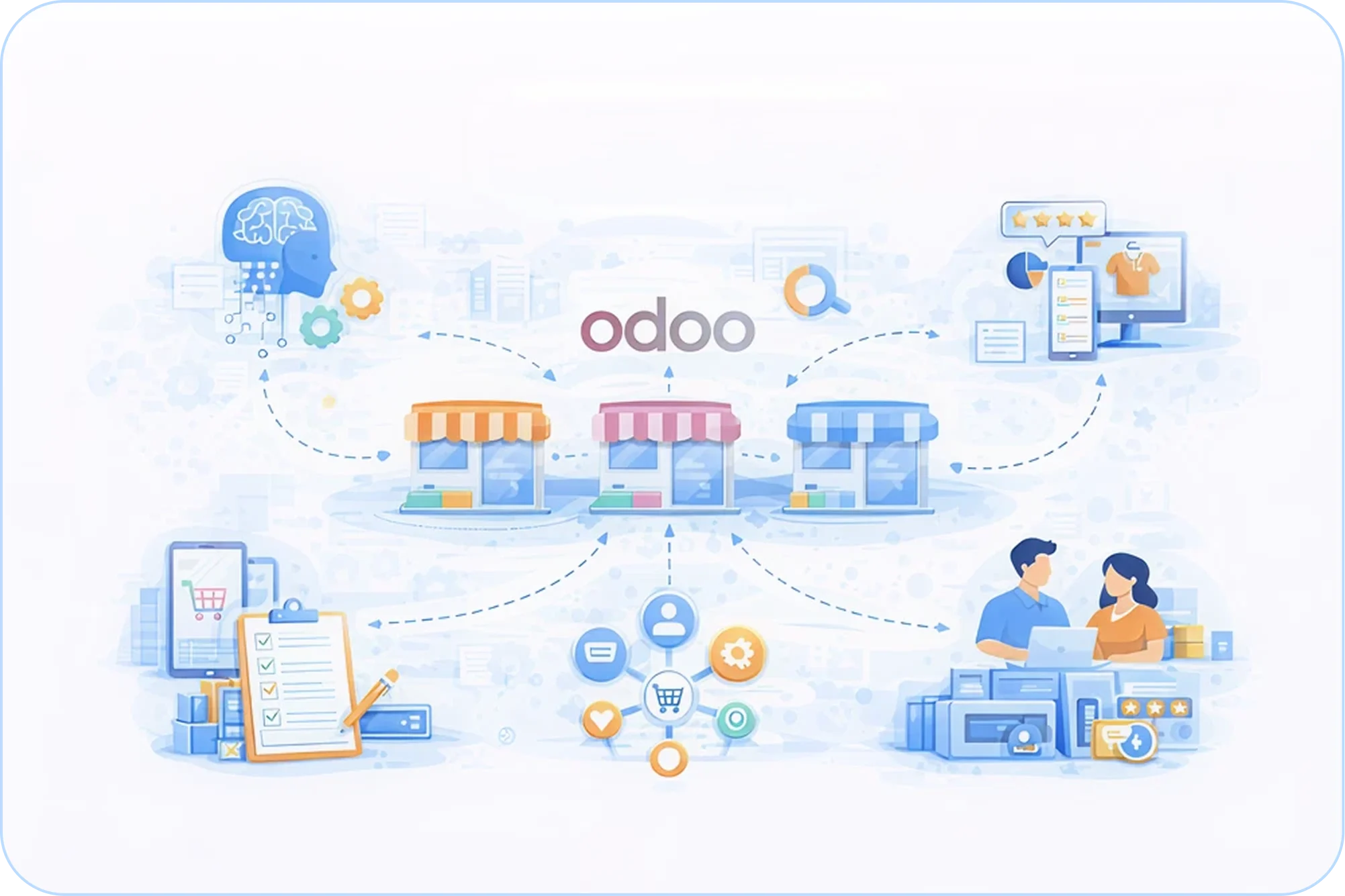
Odoo ERP for retail represents the next evolution of how small and mid‑sized businesses operate: moving beyond legacy systems into an AI‑driven, insight‑rich environment where every interaction—online and in‑store—becomes a layer of intelligence. Instead of hoping for customer loyalty, Odoo uses built‑in AI and automation to proactively connect with buyers, surface personalized offers, recommend products, and flag at‑risk relationships, so teams are guided by insight, not instinct.
150+
Odoo
Technologists
100+
Successful
Implementations
10+
Years of Domain
experience
95%
Customer
Satisfaction Rates
150+
Odoo
Technologists
100+
Successful
Implementations
10+
Years of Domain
experience
95%
Customer
Satisfaction Rates
Services for
Retail Industry
01
Retail Transformation
Retailers move to a single, AI‑driven Odoo backbone tailored to their store network and growth plans.
- Audit retail workflows and map them into a unified Odoo data model.
- Define a phased rollout that keeps stores running while modernizing.
- Adopt omnichannel, multi‑store, & AI‑driven personalization strategies.
02
Data Migration
Migrate years of Zoho, Tally, Microsoft, or Oracle data into Odoo.
- Create a field‑to‑field dictionary that links old structures to Odoo’s retail model.
- Build ETL pipelines that handle high‑volume transactional data.
- Use delta loads to capture live transactions during the migration window.

03
Omnichannel Operations
Connect physical stores, e‑commerce, and marketplaces into a synchronized retail engine.
- Integrate POS, inventory, and online channels so stock, pricing, and promotions stay consistent.
- Set up centralized catalog management and market‑specific rules.
- Enable unified order fulfillment, returns, and loyalty across touchpoints.

04
AI Optimization
Use Odoo’s analytics and AI to turn customer data into offers and higher‑value sales.
- Implement segmentation, targeting, and dynamic promotions based on real‑time purchase behavior.
- Configure recommendation engines and loyalty programs that feel personal.
- Surface KPIs and alerts that help store managers adjust pricing, bundles, and staffing.

05
Team Enablement
Reduce manual work by automating routine tasks while upskilling retail teams on Odoo.
- Automate replenishment, invoicing, basic reporting, and returns.
- Provide hands‑on training and playbooks tailored to cashiers, store managers, and head‑office users.
- Offer ongoing support and optimization so Odoo evolves as the business grows.

Driving Profitability in Retail
with Odoo ERP
Build a future-ready retail business powered by AI and unified operations.
Centralize data
Odoo brings together POS, inventory, e‑commerce, and accounting into a single source, so sales, returns, and stock movement lives in one place.
Structure data
Organize transactional history and real‑time activity into a standardized model, so reports reflect accurate, comparable figures.
Live dashboards
Built‑in dashboards show sales, stock, and customer metrics in real time, so managers can spot trends, bottlenecks, and opportunities.
Trigger action
Retailers can adjust pricing, launch promotions, reorder stock, or tweak campaigns directly from the data.
See how Odoo powers smarter retail decisions in under 30 minutes.
Book Your Retail ERP Assessment
Integrate Odoo with third-party apps
How they mastered PPAP compliance and saved thousands
Our client with 240 showrooms in South East Asia increased online sales by 60% with a high customized Odoo solutions
Increase in Sales
36%
Errors
2%

Book an Odoo ERP demo tailored to your retail business
See how Odoo connects your stores, inventory, and customers into one retail engine, customized to your operations.
Got questions? We've got answers
What is Odoo ERP and how does it benefit the retail industry?
Odoo ERP is a modular, open‑core business management platform that unifies sales, inventory, finance, CRM, and e‑commerce into a single database and interface. For retailers, this means all channels, locations, and functional silos share the same live data, instead of living in disconnected systems that must be manually reconciled.
Key benefits for retail include:
- True omnichannel control: Synchronize inventory, pricing, and customer data across physical stores, your own website, and marketplaces like Amazon and Zalando.
- Shop‑floor speed: Modern Odoo POS handles barcode scanning, returns, loyalty programs, and split payments while updating stock in real time.
- Data‑driven decisions: Real‑time dashboards show which products sell, which channels work best, and which SKUs are overstocked or at risk of stockout.
- Scalability without bloat: Start with core modules (POS, Inventory, Sales), then add e‑commerce, accounting, or manufacturing as you grow.
How can Odoo ERP help manage retail inventory and stock efficiently?
Odoo ERP turns inventory management from a reactive spreadsheet grind into a proactive, rules‑driven operation. For retailers, this is critical because mistakes in stock directly cause lost revenue (stockouts) and wasted capital (overstock).
Odoo helps in three powerful ways:
1.Real‑time, multi‑location visibility
Odoo tracks stock in real time across warehouses, store backrooms, and shelves, updating instantly with every sale, purchase, or transfer. This eliminates the classic “showroom stockout while warehouse is full” scenario.
2.Smart stock control and replenishment
- Automated reordering: When stock for a SKU drops below a predefined threshold, Odoo can trigger a purchase order automatically.
- Lot/serial and expiry tracking: Perishable or quality‑sensitive items (e.g., food, cosmetics, specialized tools) can be tracked by batch, serial number, or expiry date, enabling recalls, FEFO/FIFO.
- Barcode & mobile support: Warehouse staff use barcode scanners and mobile devices to receive, pick, pack, and count stock quickly and accurately, cutting manual errors by 80–90%.
3.Demand‑aware planning and optimization
Odoo’s built‑in analytics and add‑on AI tools help retailers forecast demand by product, channel, and season, then align purchase orders and transfers accordingly. This reduces both stockouts and dead, slow‑moving SKUs, freeing up working capital and improving space utilization on the shop floor.
By combining real‑time visibility, automation rules, and data‑driven replenishment, Odoo ERP enables retailers to run leaner, more accurate, and more profitable inventory operations.
Can Odoo ERP integrate with POS systems and ecommerce platforms?
Yes—Odoo ERP is designed as a central hub that both talks to external POS systems and powers native e‑commerce workflows.
- POS integration: Odoo has a built‑in POS module that connects directly to inventory, accounting, CRM, and often your existing hardware (barcode scanners, card terminals). Sales made at the till update stock and accounts in real time.
- E‑commerce integration: Odoo integrates with Shopify, WooCommerce, Magento, PrestaShop, Amazon, eBay, and others via APIs or connectors. Inventory, prices, and SKUs are synced from Odoo to the store, and orders, customer data, and payments flow back into Odoo for end‑to‑end fulfillment and reporting.
- Unified engine: Rather than having POS on one side and a web store on another, Odoo allows you to run both from the same core, so you manage one master product catalog, one pricing policy, and one set of inventory rules.
Is Odoo ERP suitable for small and multi-store retail businesses?
Yes. Odoo ERP is well‑suited for small retailers and multi‑store chains.
- Small retailers: Start with just a few core modules (POS, Inventory, Sales, Accounting) and scale as your team grows. Because Odoo is modular and open‑core, you can keep costs low at first and add capabilities only when you need them. The built‑in POS and simple web store make it possible for a single‑store business to look and run like a mini‑brand without an enterprise budget.
- Multi‑store retail: Odoo supports multi‑company, multi‑location structures with one shared master catalog and separate stock per store or warehouse. This lets headquarters control pricing, promotions, and reporting while each store operates with autonomy on the floor. Real‑time inventory visibility across all locations reduces stockouts, improves transfers, and simplifies replenishment.
- Flexible deployment: Whether you run a one‑store, 10‑store, or 100‑store network, Odoo can scale with you, especially when you choose Odoo Enterprise for advanced reporting, mobile access, and official support.
How does Odoo ERP improve customer experience and sales in retail?
Odoo ERP improves customer experience and sales in retail by breaking down data silos and connecting every touchpoint into a single, intelligent loop.
1.Faster, smoother shopping experience
Odoo’s integrated POS and web store mean staff can check real‑time inventory, process returns, apply loyalty points, and ring up complex orders in seconds. When stock and customer data move in sync, checkout is faster, errors drop, and customers feel understood.
2. Personalization at scale
By connecting CRM, sales history, and marketing, Odoo lets you:
- Track customer preferences, purchase frequency, and favorite categories
- Run targeted promotions, loyalty rewards, and follow‑up campaigns that feel relevant, not random
- Identify cross‑sell and upsell opportunities at the counter or online checkout
This turns occasional buyers into repeat customers.
3. Fewer stockouts, better availability
Odoo keeps inventory synchronized across physical stores, online channels, and marketplaces. When customers see accurate “in‑stock” statuses and get realistic delivery estimates, trust increases and cart abandonment drops. Automated replenishment and forecasting ensure hot‑selling lines stay on the shelf.
4. Consistent omnichannel experience
Whether a customer starts browsing online and finishes in‑store, or vice versa, Odoo makes sure pricing, product info, and promotions are consistent. They can buy, return, and pick up online orders offline—or the other way around—without friction, which greatly improves perception and satisfaction.
5. Smarter decisions, better offers
Real‑time dashboards show what sells, who buys, and which channels perform best. Retailers use that insight to:
- Adjust pricing, bundles, and promotions on the fly
- Optimize layouts and product placements
- Invest in products that drive margin, not just movement
This tighter feedback loop turns customer data into smarter selling.