Margins are tightening across the automotive sector. Supply chains stretch across regions, EV adoption is accelerating, and buyers expect faster delivery with zero compromise on quality. These pressures are forcing automotive companies to rethink how operations, inventory, procurement, and finance are managed. Spreadsheets and disconnected tools are no longer viable for scale. This is where automotive ERP software becomes a critical investment, not an optional upgrade.
Why ERP Is Now Critical for Automotive Businesses
From OEMs to component manufacturers and dealerships, the need for a connected system is unavoidable. An ERP for automotive industry operations brings procurement, production, inventory, sales, and finance into one ecosystem.
Without this level of integration:
- Inventory mismatches lead to production delays
- Supplier coordination breaks down
- Cost visibility becomes unclear
- Decision-making slows down
Businesses that delay ERP adoption risk losing control over margins and delivery commitments.
The Cost of Getting ERP Wrong
ERP failure is expensive and not just in terms of ERP pricing.
Companies that choose the wrong system or partner face:
- Long implementation timelines with no measurable outcome
- Low user adoption due to complex interfaces
- Excessive customization that increases maintenance costs
- Disruption in operations during rollout
This leads to “shelfware” systems that are paid for but rarely used. The hidden cost here includes lost productivity, missed deadlines, and revenue leakage.
What This Guide Covers
This guide breaks down everything automotive companies need to evaluate before investing in ERP:
- A transparent look at Odoo pricing for 2026
- A detailed breakdown of Odoo implementation cost based on business size and complexity
- How Odoo compares with other automotive ERP software options in terms of value and scalability
- ROI insights: how the right ERP investment reduces operational waste and improves profitability
If you’re evaluating ERP for automotive industry use cases, this guide will help you understand what drives cost and what drives returns.
What Is Automotive ERP Software and Why Does the Industry Need It?
Definition of ERP in an Automotive Context
Automotive ERP software connects production, procurement, quality control, compliance, sales, and finance into one operational framework. Instead of switching between disconnected tools, teams work with shared data across departments. For automotive companies, this connection is critical. A delay in procurement impacts production. A quality issue affects compliance. A pricing change influences margins. An ERP system ensures that these moving parts stay aligned. This is why ERP for automotive industry operations is no longer limited to large enterprises. Growing manufacturers and suppliers now depend on it to maintain control over cost, timelines, and output.
The Unique Operational Demands of Automotive Businesses
Automotive companies operate under tighter coordination requirements than general manufacturing. Each process depends on accuracy, timing, and compliance.
- Just-in-Time and Just-in-Sequence Manufacturing
Production schedules depend on exact delivery timing. Components must arrive when needed, not earlier, not later. Any mismatch leads to halted assembly lines or excess inventory carrying costs. An ERP system helps align procurement with production schedules, reducing delays and avoiding overstocking.
- Multi-Tier Supplier Management and Traceability
Automotive supply chains involve multiple supplier layers. Tracking material origin, batch details, and supplier performance is essential. With automotive ERP software, companies gain full traceability from raw materials to finished vehicles ensuring accountability at each stage.
- Compliance Requirements: IATF 16949, PPAP, APQP, FMEA
Automotive manufacturing operates under strict compliance frameworks. Documentation, quality checks, and process validation are mandatory.
An ERP system supports:
- Standardized quality processes
- Audit trails for inspections and approvals
- Documentation required for certifications
Without this, compliance risks can lead to penalties or lost contracts.
- Complex Bill of Materials (BOM)
Vehicles come with multiple configurations, variants, and optional features. Managing BOMs across these combinations is challenging without a centralized system. ERP enables structured BOM management, helping teams track components, revisions, and dependencies across product lines.
- Warranty Tracking and After-Sales Service
Post-sale operations carry long-term cost implications. Warranty claims, service history, and spare parts management must be tracked accurately. ERP systems connect sales with service, giving full visibility into product lifecycle and customer support costs.
How ERP for Automotive Industry Differs from Generic Manufacturing ERP
Generic manufacturing ERP systems fail to address the depth of automotive requirements. They lack support for compliance frameworks, supplier traceability, and variant-heavy production models.
ERP for automotive industry use cases demand:
- Supplier network visibility across tiers
- Compliance-ready workflows
- Production scheduling aligned with JIT/JIS models
- Lifecycle tracking from production to after-sales
This is where solutions like Odoo stand out, offering flexibility in Odoo pricing and a scalable structure that adapts to automotive workflows without excessive investment.
Who Needs Automotive ERP?
Adoption is no longer limited to large OEMs. Different segments across the automotive value chain benefit from ERP:
- OEM suppliers managing large-scale production
- Tier 1 and Tier 2 manufacturers handling complex supply chains
- Auto dealerships tracking inventory, sales, and service
- Aftermarket parts businesses managing distribution and warranties
For these businesses, ERP is not just a system but a cost control mechanism. Understanding ERP pricing and Odoo implementation cost helps decision-makers choose a solution that supports growth without unnecessary expenditure.
Which Is the Best ERP for the Automotive Industry in 2026?
Leading ERP Platforms Across the Automotive Sector:
Automotive companies evaluate ERP platforms based on cost control, operational fit, and long-term scalability. The market in 2026 includes a mix of enterprise-grade systems and flexible platforms suited for growing businesses.
A dominant choice for large automotive enterprises. Strong compliance support and deep functionality across production, finance, and supply chain. The downside lies in high ERP pricing and extended deployment cycles, which increase overall Odoo implementation cost comparisons significantly.
A solid mid-market option with integration across Microsoft tools. Suitable for companies seeking balance between capability and usability. Costs remain moderate, though customization can increase total investment over time.
Designed for large, multi-entity automotive groups. Offers robust financial management and global scalability. Investment levels are substantial, making it suitable for enterprises with large budgets and complex operations.
- Infor CloudSuite Automotive
Focused on automotive suppliers. Includes features aligned with production scheduling and supplier collaboration. Works well for Tier 1 and Tier 2 manufacturers with defined processes.
The fastest-growing choice among small to mid-size companies adopting automotive ERP software. Known for flexible Odoo pricing, faster deployment cycles, and the ability to scale without excessive upfront investment. This makes it attractive for businesses aiming to control Odoo implementation cost without compromising operational coverage.
Key Evaluation Criteria for Automotive ERP in 2026
Choosing the right ERP for automotive industry operations requires a structured evaluation across several factors.
- Automotive Functionality Coverage:
The system must support production planning, supplier coordination, inventory tracking, and variant-based BOM management without heavy customization.
- Compliance and Quality Management:
Support for standards like IATF 16949, along with audit trails and quality checks, is essential for maintaining certifications and supplier relationships.
- Total Cost of Ownership (3–5 Years):
Initial erp pricing is only part of the equation. Licensing, customization, upgrades, and maintenance define the long-term financial impact. This is where platforms with transparent odoo pricing gain attention.
- Implementation Timeline and Operational Impact:
Long deployment cycles can disrupt production and delay ROI. Faster rollout reduces risk and enables quicker value realization.
- Scalability and Business Expansion:
The ERP must support growth of new plants, product lines, or distribution channels without requiring a complete system replacement.
Why No Single ERP Fits All Automotive Businesses
There is no universal answer to the “best ERP” question. The right choice depends on:
- Business size and operational scale
- Complexity of supply chain and production
- Budget constraints and cost expectations
- Internal capability to manage implementation
Large enterprises may justify high ERP Pricing for extensive functionality. Growing companies, on the other hand, prioritize faster deployment and controlled Odoo implementation cost.
Where Odoo Stands Out
Odoo positions itself as a practical solution for companies seeking control over cost without sacrificing operational capability.
Key advantages include:
- Flexible odoo pricing that aligns with business size
- Lower Odoo implementation cost compared to traditional ERP platforms
- Adaptability for diverse automotive workflows, from manufacturing to after-sales
- Faster deployment, reducing downtime and accelerating ROI
For businesses adopting automotive ERP software without enterprise-level budgets, Odoo offers a balanced path combining functionality, scalability, and cost discipline within one platform.
What Is the Cost of Odoo Implementation for Automotive Companies in 2026?
Understanding Odoo Pricing Structure:
- Odoo pricing: It is divided into two editions, each aligned with different business needs and internal capabilities.
- Odoo Community: An open-source edition with no licensing fees. Suitable for companies with in-house developers who can configure, maintain, and extend the system. This option reduces upfront erp pricing, though internal resource costs must be considered.
- Odoo Enterprise: A subscription-based model charged per user, per month. This edition unlocks advanced modules across manufacturing, accounting, inventory, CRM, and service management. It includes official support and regular upgrades, making it a preferred choice for companies seeking reliability and long-term scalability.
For automotive businesses, Enterprise is widely adopted due to its alignment with automotive ERP software requirements and reduced dependency on internal development teams.
Typical Odoo Pricing Ranges for Automotive Businesses in 2026
The total Odoo implementation cost varies based on business size, operational complexity, and deployment scope. Below is a practical breakdown.
Small Automotive Supplier or Parts Business
Estimated Range: ₹3 lakh – ₹10 lakh
Covers:
- Core modules such as inventory, sales, purchase, and accounting
- Basic manufacturing workflows
- Limited user access
- Minimal customization
This level suits small businesses entering the ERP for automotive industry space with a focus on cost control.
Mid-Size Automotive Manufacturer or Dealer Group
Estimated Range: ₹10 lakh – ₹40 lakh
Covers:
- Manufacturing, quality management, CRM, and service modules
- Multi-department usage across operations
- Integration with existing tools
- Moderate customization for workflows like supplier coordination and service tracking
At this stage, odoo pricing remains competitive compared to traditional ERP platforms, making it attractive for scaling operations.
Larger Multi-Site Automotive Operation
Estimated Range: ₹40 lakh – ₹1.5 crore+
Covers:
- Multi-location deployment
- Complex manufacturing processes and BOM structures
- Advanced reporting and dashboards
- Integration with third-party systems (logistics, eCommerce, dealer networks)
- Higher user volumes
Even at this level, Odoo implementation cost remains significantly lower than enterprise ERP alternatives with a similar scope.
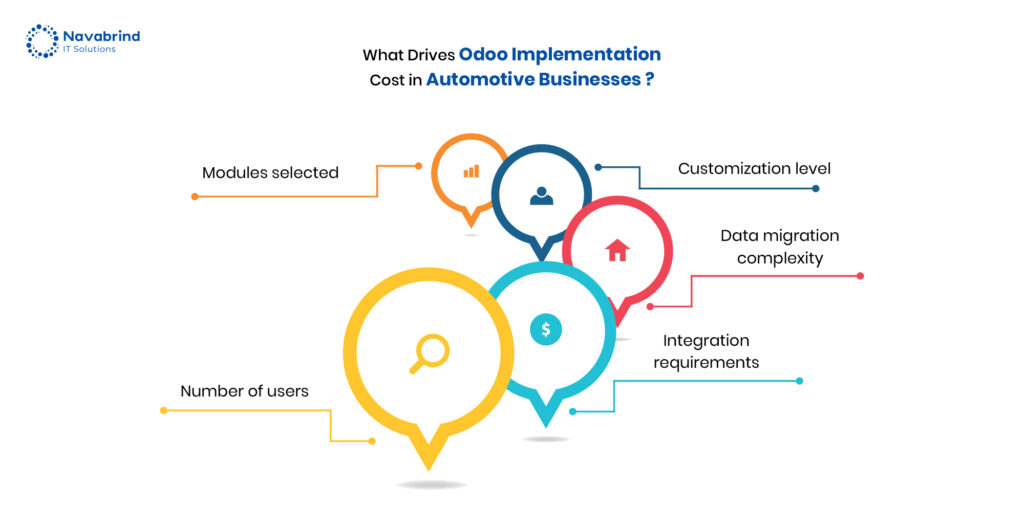
What Drives Odoo Pricing Up or Down
Several factors influence the final investment in automotive ERP software:
- User Count and Module Selection:
Higher user numbers and activation of additional modules increase subscription costs.
- Customization Requirements:
Automotive workflows such as JIT production, supplier traceability, and warranty tracking may require configuration or development, impacting cost.
- Implementation Approach:
Self-implementation reduces external expenses but requires skilled internal teams. Working with a certified partner increases initial cost but reduces risk and accelerates deployment.
- Data Migration Complexity:
Transferring data from legacy systems, especially fragmented or unstructured data can increase effort and cost.
- Support and Maintenance Agreements:
Post-implementation support ensures system stability, updates, and issue resolution. This is a recurring component of erp pricing.
Odoo Pricing vs SAP, Oracle, and Dynamics
When compared with traditional ERP platforms, odoo pricing offers a clear financial advantage.
- SAP S/4HANA: High licensing fees, long deployment cycles, and heavy customization lead to significantly higher total cost
- Oracle Cloud ERP: Premium pricing suited for large enterprises with complex global operations
- Microsoft Dynamics 365: Moderate pricing, though customization and integrations can increase long-term costs
In contrast, Odoo implementation cost remains controlled due to:
- Flexible subscription model
- Lower dependency on heavy customization
- Faster deployment timelines
For automotive companies
evaluating ERP for automotive industry needs, Odoo delivers a cost structure that aligns with growth, without the financial burden seen in traditional enterprise systems.
What Is the ERP Implementation Cost Breakdown for Automotive Businesses?
Why Software Licensing Is Rarely the Largest Cost:
Many companies assume erp pricing is driven by license fees. In reality, licensing forms only one part of the total investment. The larger share comes from implementation effort, data preparation, training, and post-go-live support. For automotive companies adopting automotive ERP software, the real cost lies in aligning the system with production workflows, supplier coordination, and compliance requirements. This is why Odoo implementation cost varies widely even when odoo pricing appears predictable at the start.
The Five Main Cost Categories in Automotive ERP Implementation
A structured view of cost helps decision-makers plan budgets with accuracy.
1. Software Licensing or Subscription Fees
This includes user-based subscription charges under odoo pricing or licensing fees in other ERP platforms. The cost depends on user count and module selection.
2. Implementation and Consulting Fees
This is one of the largest cost components.
It covers:
- Business requirement mapping
- System configuration
- Workflow alignment for production, procurement, and finance
- Go-live support
For ERP for the automotive industry, this phase requires careful planning due to operational complexity.
Legacy data must be cleaned, mapped, and transferred into the ERP system. Poor data quality increases time and cost. Historical production data, supplier records, and inventory details require special attention in automotive environments.
4. Training and Change Management
Teams need to understand new workflows and system usage.
This includes:
- End-user training
- Train-the-trainer programs
- Internal process alignment
Without proper training, user adoption drops, impacting ROI.
5. Ongoing Support and System Administration
Post go-live, businesses require support for:
- Issue resolution
- System updates
- Performance monitoring
This ongoing investment ensures stability and long-term value from the ERP system.
Automotive-Specific Cost Drivers
Automotive operations introduce additional cost layers that generic ERP projects do not face.
1.Complex BOM and Routing Setup
Vehicle components involve multi-level BOMs with variants and dependencies. Configuring these structures requires time and expertise.
2.Integration with Shop Floor and External Systems
ERP must connect with:
- Shop floor systems
- Quality management tools
- Supplier portals
These integrations increase implementation scope and cost.
3.Compliance Configuration
Standards such as IATF 16949 require detailed process mapping, documentation, and audit trails. Setting up compliance workflows adds to Odoo implementation cost.
4.Multi-Plant or Multi-Entity Rollouts
Companies operating across locations must configure inter-company transactions, inventory transfers, and financial consolidation. This increases both timeline and investment.
Hidden Costs to Plan For:
Ignoring hidden costs leads to budget overruns.These factors influence total erp pricing beyond initial estimates.
- Parallel Running Periods: Operating old and new systems together during transition
- Productivity Dip: Teams take time to adapt to new workflows
- Post-Go-Live Optimization: Adjustments after initial rollout to improve performance
Implementation Timelines and Cost Impact
Project timelines have a direct impact on cost.
- Phased Approach:
Modules are deployed in stages like finance first, then inventory, manufacturing, and others. This reduces operational risk and spreads Odoo implementation cost over time, though total duration may extend.
- Big-Bang Approach:
All modules go live at once. This shortens the timeline but increases risk and requires intense preparation. Any issue during go-live can disrupt operations.
For ERP for the automotive industry, phased deployment is widely preferred due to the complexity of production and supply chain dependencies. A clear understanding of these cost components helps automotive businesses evaluate automotive ERP software with confidence. Instead of focusing only on odoo pricing, decision-makers should assess total investment, operational impact, and long-term value.
Why Is Odoo the Most Affordable ERP for Automotive Manufacturing Companies?
Where Odoo Reduces Cost Compared to Enterprise Alternatives:
When automotive companies evaluate erp pricing, the focus should shift from license fees to total cost over time. This is where odoo pricing creates a strong advantage.
- No Per-Module Licensing Barriers
Under the Enterprise plan, access to multiple business applications does not require separate licensing for each module. Automotive companies can run manufacturing, inventory, procurement, quality, and service operations within one subscription model. This reduces fragmentation in automotive ERP software spending.
- Lower Implementation Investment
Compared to enterprise platforms, Odoo implementation cost remains controlled due to faster configuration and a wide partner network. Businesses avoid long consulting cycles and heavy customization layers that inflate budgets in traditional ERP systems.
- Shorter Deployment Timelines
Time impacts cost. Faster rollout reduces consulting hours and limits disruption to production and supply chain operations. This has a direct impact on ROI for companies adopting ERP for automotive industry use cases.
- Open-Source Foundation
Odoo’s architecture reduces dependency on a single vendor. Automotive businesses retain flexibility in choosing partners, customizing workflows, and managing upgrades without being locked into expensive long-term contracts.
Modular Adoption Without Platform Switching
Automotive companies rarely need full ERP functionality on day one. Odoo supports gradual adoption.
A typical journey:
- Start with manufacturing and inventory
- Add procurement and quality management
- Expand into accounting, HR, CRM, and after-sales service
This phased approach keeps Odoo implementation cost aligned with business growth. There is no need to replace the system as operations expand, which protects long-term investment.
Community Ecosystem Advantage
Odoo benefits from a large global ecosystem of developers and partners. Thousands of third-party modules are available for extended functionality.
For automotive businesses, this means:
- Access to extensions for production workflows and supplier management
- Lower development costs compared to custom-built features
- Faster deployment of niche requirements
This ecosystem reduces overall erp pricing pressure and gives companies flexibility in shaping their automotive ERP software environment.
Three-Year Cost Comparison: Odoo vs SAP vs Dynamics
For a mid-size automotive supplier, total cost over three years highlights the gap clearly:
Odoo
- Predictable odoo pricing based on users
- Lower Odoo implementation cost
- Reduced consulting dependency
- Faster ROI due to shorter deployment cycle
SAP S/4HANA
- High licensing fees
- Significant implementation investment
- Long deployment timelines
- Ongoing maintenance costs remain high
Microsoft Dynamics 365
- Moderate licensing costs
- Implementation cost varies with customization
- Integration expenses can increase total investment
Across this comparison, Odoo stands out as a cost-controlled option for companies entering or scaling within the ERP for automotive industry space.
Where Odoo’s Affordability Has Limits
Odoo is not the right fit for every scenario.
Large automotive enterprises with:
- Extensive global operations
- Heavy regulatory layers
- Deeply customized workflows
May require platforms designed for enterprise-scale complexity. In such cases, higher erp pricing may be justified due to specialized requirements.
Final Takeaway
For small to mid-size automotive companies, Odoo delivers a balance between capability and cost. With flexible odoo pricing, controlled Odoo implementation cost, and scalability across operations, it positions itself as a practical choice in the automotive ERP software landscape.
What ERP Software for the Automotive Industry Gives the Best ROI?
Why ROI Matters More Than Upfront Cost
Focusing only on erp pricing leads to short-sighted decisions. Automotive companies operate on tight margins, where small inefficiencies compound into significant losses. The right automotive ERP software reduces waste, improves throughput, and strengthens financial control. A lower upfront cost does not guarantee value. ROI depends on how quickly the system improves operations and how consistently it delivers measurable gains. This is where solutions with balanced Odoo pricing and controlled Odoo implementation cost gain attention, they enable faster payback without heavy financial exposure.
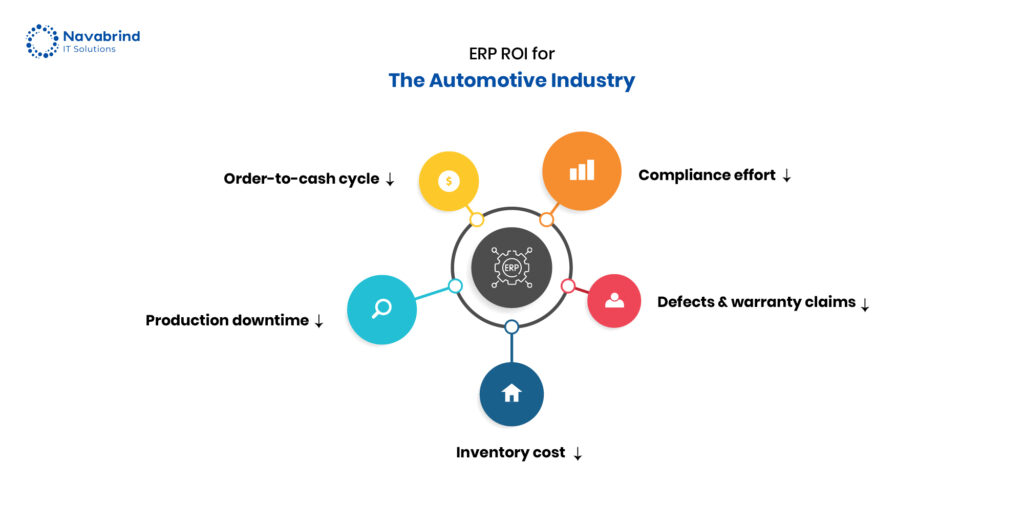
Key ROI Drivers in Automotive ERP Implementations
ROI in the ERP for automotive industry space comes from operational improvements across multiple areas.
- Reduced Production Downtime
Better planning and scheduling ensure materials, machines, and labor stay aligned. This minimizes idle time on production lines.
- Lower Inventory Carrying Costs
Accurate demand forecasting and MRP reduce excess stock and prevent stockouts. Businesses free up working capital tied in inventory.
- Improved Quality Control
Integrated quality checks reduce defects, rework, and warranty claims. This protects margins and strengthens customer trust.
- Faster Order-to-Cash Cycle
Connected sales, production, and invoicing accelerate revenue realization. Delays in order processing and billing are reduced.
- Reduced Compliance Effort and Audit Risk
Automated documentation and audit trails simplify compliance with automotive standards, reducing preparation time and risk of penalties.
How to Calculate ROI for Your Automotive Business
A structured approach helps quantify returns from ERP investment.
1. Establish Your Baseline
Measure current operational costs:
- Labor hours spent on repetitive tasks
- Error rates in production and inventory
- Inventory waste and excess stock levels
- Production downtime
2. Estimate Post-ERP Improvements
Use industry benchmarks to project improvements:
- Reduction in manual effort
- Lower defect rates
- Improved inventory turnover
- Faster processing cycles
3. Compare Against Total Investment
Calculate total cost over three years, including:
- Subscription or licensing under odoo pricing or other platforms
- Full Odoo implementation cost or equivalent implementation investment
- Support and maintenance
ROI becomes clear when operational savings exceed total ERP investment within a defined period.
Which Platforms Deliver the Strongest ROI by Business Size
- Small Automotive Businesses
Odoo delivers the fastest payback. Lower odoo pricing and shorter deployment timelines reduce risk and enable quicker returns.
- Mid-Size Automotive Suppliers
Odoo or Microsoft Dynamics 365 are common choices. The decision depends on compliance requirements and integration needs. Odoo remains attractive where cost control is a priority.
- Large OEM Suppliers and Enterprises
SAP S/4HANA or Oracle Cloud ERP provide depth for complex operations. Despite higher erp pricing, they support large-scale requirements where process complexity justifies the investment.
Real-World ROI Indicators
Automotive businesses adopting ERP systems commonly report:
- Noticeable reduction in production delays
- Improved inventory turnover and reduced excess stock
- Lower defect rates and warranty claims
- Faster billing cycles and improved cash flow
- Reduced audit preparation time
These outcomes highlight that ROI is not tied to system cost alone. The right ERP for the automotive industry delivers measurable operational gains that sustain profitability over time. The right automotive ERP software requires balancing cost, capability, and speed of execution. Solutions with controlled Odoo implementation cost and flexible odoo pricing position businesses to achieve faster ROI without long financial commitments.
How Does an Automotive ERP System Reduce Operational Costs?
1.Production Planning and Scheduling:
Unplanned changes in production create waste idle machines, excess inventory, and missed delivery timelines. Automotive ERP software aligns demand, material availability, and production capacity in one system.
This coordination helps:
- Avoid overproduction that ties up working capital
- Prevent underproduction that delays orders
- Reduce last-minute schedule changes that increase operational expenses.
2. Inventory Optimization
Inventory is one of the largest cost centers in automotive operations. Excess stock increases carrying cost, while shortages halt production.
An ERP system enables:
- Accurate demand forecasting
- Material requirement planning (MRP) aligned with production schedules
- Better visibility into stock movement across locations
This reduces excess safety stock and ensures critical components are available when required without inflating inventory costs.
Procurement inefficiencies lead to delays, higher purchase costs, and poor supplier performance tracking.
With automotive ERP software, businesses can:
- Automate purchase order creation
- Track supplier performance through scorecards
- Manage lead times with greater accuracy
This reduces procurement overhead and strengthens supplier relationships, which is essential for maintaining consistent production flow.
Defects discovered late in the process are expensive. They lead to scrap, rework, and warranty claims.
ERP systems integrate quality checks at multiple stages:
- Incoming material inspection
- In-process quality validation
- Final product checks
Early detection reduces financial loss and protects brand reputation. For companies managing Odoo implementation cost, this is one of the fastest areas to deliver ROI.
Automotive companies must track components from source to finished product. Without traceability, recalls become expensive and difficult to manage.
ERP enables:
- Batch and serial number tracking
- Full visibility into component origin
- Faster root cause analysis during quality issues
This reduces the financial impact of recalls and supports compliance requirements within the ERP for the automotive industry landscape.
Shop floor operations depend on accurate reporting and coordination. Paper-based processes slow down decision-making and increase errors.
ERP systems digitize:
- Production reporting
- Work order tracking
- Supervisor dashboards
This improves workforce productivity and reduces time spent on administrative tasks. The result is better output without increasing labor costs.
7. Finance and Compliance
Financial operations in automotive businesses involve cost allocation, intercompany transactions, and regulatory reporting.
ERP systems automate:
- Cost tracking across departments
- Financial consolidation for multi-entity operations
- Compliance documentation and reporting
This reduces workload on finance teams and improves accuracy, which directly impacts overall erp pricing efficiency over time.
After-Sales and Warranty Management
Post-sale operations carry hidden costs, especially warranty claims and spare parts handling.
With integrated ERP:
- Service requests are tracked within the system
- Warranty claims are linked to production and quality data
- Spare parts inventory is managed alongside service demand
This reduces the cost of after-sales operations and improves customer satisfaction.
Final Insight
Cost reduction in automotive businesses does not come from one area alone. It comes from connected operations. An ERP system brings production, inventory, procurement, quality, and finance into alignment. With balanced odoo pricing and controlled Odoo implementation cost, companies can reduce operational expenses and improve profitability without heavy upfront investment.
How to Plan and Budget for an Automotive ERP Implementation
Step 1: Define the Scope Before Engaging Vendors:
Start with a clear internal assessment. Map out processes across production, procurement, inventory, quality, sales, and finance. Identify gaps, inefficiencies, and areas where cost leakage occurs. A well-defined scope prevents unnecessary expansion during implementation, keeping Odoo implementation cost under control and ensuring accurate erp pricing comparisons across vendors.
Not every feature needs to be deployed in the first phase. Focus on capabilities that impact operations and revenue.
Must-haves for automotive businesses:
- Production planning and scheduling
- Inventory and supplier management
- Quality tracking and traceability
- Financial control
Optional features can be introduced later. This phased approach aligns investment with business priorities and optimizes odoo pricing over time.
Step 3: Get Quotes from Multiple Certified Partners:
Do not rely on a single quote. Engage at least three certified partners with experience in automotive ERP software.
Compare:
- Scope coverage
- Implementation timelines
- Cost breakdown
- Support structure
This approach gives a realistic view of Odoo implementation cost and helps avoid underestimation or hidden charges.
Step 4: Build a Contingency Budget:
Unexpected requirements arise in almost every ERP project. Allocate an additional 15–20% above the initial estimate.
This buffer covers:
Step 5: Plan for Productivity Dip During Go-Live:
During the transition phase, teams need time to adapt to the new system. Output may slow down temporarily.
Factor this into your ROI timeline:
- Reduced productivity during initial weeks
- Learning curve for users
- Process adjustments post go-live
Ignoring this phase leads to unrealistic expectations from ERP for automotive industry deployments.
Step 6: Define KPIs Before Implementation:
Success must be measurable. Establish clear performance indicators before starting the project.
Track metrics such as:
- Production downtime
- Inventory turnover
- Order processing time
- Defect rates
- Procurement cycle time
Post-implementation, these KPIs help evaluate whether the ERP investment is delivering expected returns.
Questions to Ask Odoo Implementation Partners Before Signing
Choosing the right partner is as important as selecting the ERP system.Reliable support ensures long-term stability and protects your investment in odoo pricing and implementation.
1. How many automotive clients have you implemented Odoo for?
Look for proven experience in automotive ERP software deployments. Industry exposure reduces risk and improves implementation accuracy.
2. How do you handle IATF 16949 compliance configuration?
The partner should demonstrate knowledge of compliance workflows, audit trails, and documentation requirements relevant to the ERP for the automotive industry.
3. What does your post-go-live support model look like?
Understand:
- Response time for issue resolution
- Support channels
- Ongoing maintenance structure
Planning determines success. A well-scoped project, controlled Odoo implementation cost, and realistic expectations around erp pricing create a strong foundation for ERP success in automotive businesses.
Automotive companies in 2026 are navigating tighter margins, complex supply chains, and rising operational expectations. In this environment, choosing the right automotive ERP software defines whether a business controls cost or struggles with inefficiencies. Odoo stands out by combining manufacturing capability, flexible odoo pricing, and the ability to scale as operations expand. This balance makes it a strong contender for companies evaluating ERP for automotive industry needs without committing to excessive investment.
That said, erp pricing alone does not determine success. The outcome depends on:
- Implementation quality
- Partner expertise
- Internal readiness for process change
A poorly executed project increases Odoo implementation cost without delivering measurable returns. A well-planned rollout, on the other hand, drives operational clarity, cost reduction, and faster ROI. For small to mid-size automotive manufacturers and suppliers, Odoo delivers a practical balance of cost control, operational coverage, and scalability within one platform.
What to Do Next
Start with a focused internal assessment:
- Audit current operational costs across production, inventory, and procurement
- Identify your top five process bottlenecks
- Quantify their financial impact
Use these insights as the foundation for your ERP evaluation. When aligned with the right implementation approach, odoo pricing and controlled Odoo implementation cost can translate into measurable business gains.
Frequently Asked Questions
1.What is the cost of Odoo implementation for automotive companies in 2026?
The Odoo implementation cost depends on business size, operational complexity, and module selection.
- Small automotive businesses: ₹3 lakh – ₹10 lakh
- Mid-size manufacturers or dealer groups: ₹10 lakh – ₹40 lakh
- Large multi-site operations: ₹40 lakh – ₹1.5 crore+
This includes configuration, deployment, and initial support. Ongoing odoo pricing is based on users and selected applications, making it easier to align cost with business scale.
2.What is the ERP implementation cost breakdown for automotive businesses?
The total erp pricing extends beyond software fees. Key cost components include:
- Software subscription or licensing
- Implementation and consulting
- Data migration from legacy systems
- Training and change management
- Post go-live support and system maintenance
For ERP for the automotive industry, additional cost drivers include BOM complexity, compliance setup, and system integrations.
3.Which is the best ERP for the automotive industry in 2026?
There is no single answer. The right choice depends on business size, complexity, and budget.
4.What ERP software for the automotive industry gives the best ROI?
ROI depends on how quickly the ERP improves operations and reduces cost.
- Small businesses: Odoo delivers fast payback due to lower investment and faster deployment
- Mid-size suppliers: Odoo or Dynamics based on compliance and integration needs
- Large enterprises: SAP or Oracle provide depth, though with higher erp pricing
A system that reduces downtime, inventory waste, and manual effort will deliver stronger ROI regardless of upfront cost.
5.How does an automotive ERP system reduce operational costs?
An ERP system lowers costs by improving coordination across operations:
- Better production planning reduces downtime
- Inventory optimization lowers carrying cost
- Supplier management reduces procurement inefficiencies
- Quality control reduces defects and warranty claims
- Financial automation reduces administrative workload
This makes automotive ERP software a key investment for long-term cost control.
6.Why is Odoo the most affordable ERP for automotive manufacturing companies?
Odoo pricing is structured to keep total investment under control.
- No separate licensing for multiple applications within the Enterprise plan
- Lower Odoo implementation cost due to faster deployment
- Flexible expansion as business needs grow
- Access to a large ecosystem of extensions
For companies adopting ERP for the automotive industry, Odoo provides cost discipline without limiting operational capability.
Schedule a conversation with us now!
Related Articles









 Post
Post