





Best ERP Solutions for US Manufacturing Companies — And Why Odoo Stands Out in 2026
- April 10, 2026
- Posted by: Sumit Sinha
- Categories: Blog, ERP solutions for US manufacturing companies
American manufacturing is entering a renewed growth phase. Policies like the CHIPS and Science Act, reshoring initiatives, and rising demand for domestic production are opening new doors for manufacturers across the country.
This shift is creating strong momentum for businesses searching for the best ERP manufacturing solution to support expansion.
Yet growth brings complexity. Supply chain instability, labor shortages, and rising operational costs are putting pressure on margins. Manufacturers that fail to adapt risk losing ground in an evolving environment. This is where ERP systems for manufacturing steps in but not as optional tools, but as a critical foundation for growth and control.
A large number of American manufacturers are those exploring the best ERP for a small manufacturing business still dependent on spreadsheets, disconnected tools, or outdated ERP platforms.
These systems were never designed for the current pace of operations. They struggle to handle demand fluctuations, production planning, and inventory visibility at scale.
The consequences are visible across operations:
- Production delays that disrupt delivery timelines
- Inventory blind spots leading to stockouts or overstocking
- Limited coordination between departments
- Rising operational costs with no clear visibility into performance
For companies aiming to compete, relying on fragmented systems is no longer sustainable. The search for the best ERP manufacturing platform has become a priority, especially for businesses seeking a reliable small business manufacturing ERP that can grow alongside them.
This is where Odoo manufacturing ERP changes the equation.
Positioned as a leading best ERP manufacturing option, Odoo manufacturing ERP provides a flexible and scalable platform designed for how manufacturers operate today.
Instead of forcing rigid workflows, it adapts to your production model whether you manage discrete manufacturing, process manufacturing, or a hybrid setup.
For companies evaluating ERP software for manufacturers in the USA, Odoo offers:
- End-to-end visibility across production, inventory, procurement, and sales
- Scalable capabilities suited for growing businesses
- A practical path for ERP implementation in manufacturing in the USA without excessive complexity or cost
This makes it a strong contender for businesses looking for the best ERP for manufacturing and distribution, especially those transitioning from disconnected systems to a unified platform.
Choosing the best ERP manufacturing platform is no longer just a technology decision by shaping how efficiently a business operates, scales, and competes.

The State of American Manufacturing in 2026
The Reshoring Revolution
American manufacturers are bringing production back home to reduce supply chain risk, shorten lead times, and take advantage of incentives introduced under policies like the CHIPS and Science Act. This shift is driving demand for the best ERP manufacturing platforms that can support rising production volumes and operational complexity.
Small and mid-sized companies especially those searching for the best ERP for a small manufacturing business that are seeing strong growth. Yet scaling operations remains a major challenge.Production is increasing. Supply chains are becoming layered and harder to manage. Customer expectations are rising around delivery timelines and order visibility.
Legacy tools cannot keep up.
- They lack coordination across procurement, production, and distribution
- They fail to provide accurate planning inputs
- They slow down decision-making at a time when speed matters
To handle this shift, manufacturers are actively evaluating ERP systems for manufacturing that can support expansion without disrupting operations. For many, the goal is clear, implement the best ERP manufacturing solution that aligns with how their business runs today.
The Digital Transformation Imperative
Manufacturers across the United States are under pressure to digitize operations and build a strong technology foundation. Adopting Industry 4.0 capabilities such as IoT, AI, and automation, requires a connected system that ties operations together. This is driving adoption of ERP software for manufacturers in the USA that can act as a central system for data and workflows.
Three priorities are shaping decisions:
1. Modernizing Operations:
Manufacturers need systems that support connected machines, automated workflows, and production tracking. Without the best ERP manufacturing platform, these initiatives remain fragmented.
2. Improving Visibility:
Access to live data across production, inventory, and finance has become a competitive requirement. Companies investing in ERP systems for manufacturing gain better control over operations and faster response times.
3. Controlling Costs:
Rising material, labor, and energy costs demand tighter operational oversight. Businesses adopting the best ERP for manufacturing and distribution gain visibility into cost drivers and can take action before margins are impacted.
For companies planning ERP implementation in manufacturing in the USA, the focus is no longer on replacing software, it is about enabling growth through connected operations.
The ERP Gap
Despite rising demand, a gap exists in the market for small business manufacturing ERP solutions.
Manufacturers evaluating options face three challenges:
- Too Limited
Entry-level tools handle accounting but lack production planning, inventory control, and shop floor visibility. These systems cannot support companies searching for the best ERP manufacturing solution. - Too Costly
Large enterprise platforms like SAP and Oracle come with high licensing and implementation costs, making them unsuitable for businesses seeking the best ERP for a small manufacturing business. - Too Rigid
Traditional systems force companies to adjust their workflows to match the software. This creates friction and slows down adoption, especially during ERP implementation in manufacturing in the USA.
Key Insight
The role of ERP has shifted. It is no longer a back-office tool as the operational backbone. A well-implemented best ERP manufacturing platform connects production, inventory, procurement, and finance into a single system. This reduces dependency on disconnected tools and improves coordination across departments.
For manufacturers aiming to scale, the path forward is clear, adopt ERP systems for manufacturing that align with business processes, support growth, and provide visibility across operations.

What Is Manufacturing ERP and Why Does It Matter?
Defining ERP for Manufacturing
ERP systems for manufacturing bring together operations, data, and workflows into one connected platform. From sales and procurement to production, inventory, and finance as everything runs through a shared system instead of disconnected tools.
For companies searching for the best ERP manufacturing solution, this unified approach eliminates data silos and improves coordination across departments. Solutions like Odoo manufacturing ERP are gaining traction as a reliable option for businesses that want control without complexity.
For organizations evaluating ERP software for manufacturers in the USA, the focus is shifting toward platforms that support growth, adaptability, and visibility across operations.
Core Capabilities of a Manufacturing ERP
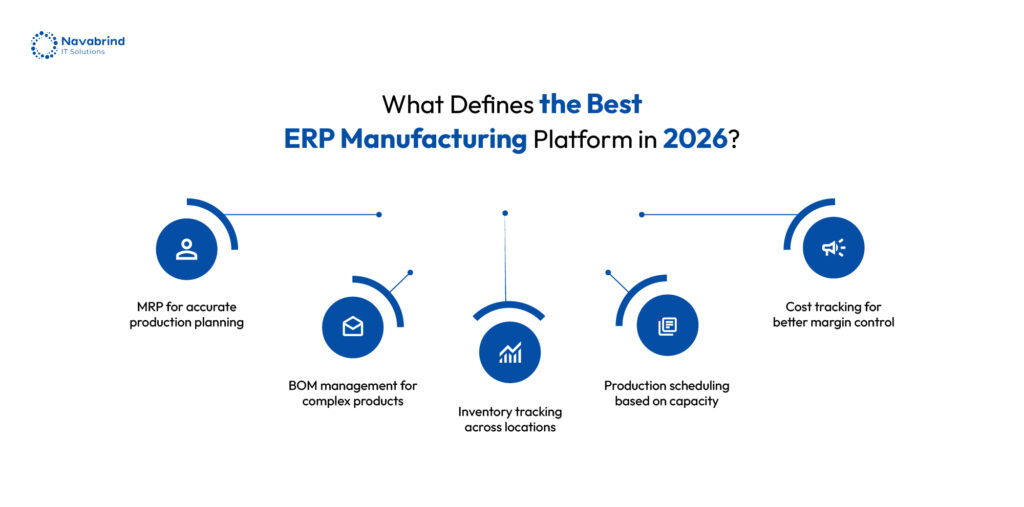
A strong best ERP manufacturing platform supports key operational functions that drive production and profitability:
|
Capability |
What It Does |
|
Material Requirements Planning (MRP) |
Calculates raw material requirements based on demand, production schedules, and sales orders to maintain optimal stock levels |
|
Bill of Materials (BOM) Management |
Defines product structures, components, quantities, and assembly sequences for accurate production planning |
|
Production Scheduling |
Aligns work orders with machine capacity and workforce availability to maintain consistent production flow |
|
Inventory Management |
Tracks raw materials, work-in-progress (WIP), and finished goods across warehouses and production stages |
|
Quality Control |
Monitors inspections, identifies defects, and tracks corrective actions to maintain product standards |
|
Procurement |
Manages purchase orders, supplier coordination, and material receipts to support uninterrupted production |
|
Shop Floor Control |
Provides visibility into production progress, machine usage, downtime, and output levels |
|
Costing |
Tracks material, labor, and overhead costs, enabling comparison between planned and actual expenses |
Why Manufacturers Need Specialized ERP
Generic accounting tools cannot meet the demands of manufacturing operations.
They fall short in several areas critical to growth:
- They cannot calculate material requirements based on production schedules
- They fail to track work-in-progress inventory across production stages
- They struggle with multi-level bills of materials
- They do not support production planning based on machine capacity and workforce availability
This is why companies are moving toward ERP systems for manufacturing that address operational complexity head-on.
For businesses exploring the best ERP for a small manufacturing business, choosing a system designed for manufacturing is no longer optional as it is necessary for scaling operations. Solutions like Odoo manufacturing ERP provide a balanced approach, offering the functionality required for production along with flexibility that supports evolving business needs.
Key Insight
A well-implemented best ERP manufacturing system connects every stage of production into a synchronized workflow. With the right platform, manufacturers gain the ability to track work-in-progress, manage inventory with accuracy, and meet production deadlines without relying on disconnected tools. For companies planning ERP implementation in manufacturing in the USA, selecting the right system determines how effectively operations scale, adapt, and compete.
What Is the Best ERP for Manufacturers in the USA?
Selecting the best ERP manufacturing solution depends on business size, operational complexity, and growth plans. Companies evaluating ERP systems for manufacturing need clarity on how different solutions fit their stage of growth.
Market Segmentation:
|
ERP Type |
Best For |
Examples |
|
Entry-Level / Small Business |
Small manufacturers with simple production (10–50 employees) looking for the best ERP for a small manufacturing business |
Odoo, Acumatica, SAP Business One |
|
Mid-Market |
Growing manufacturers managing complex production and multiple locations, evaluating the best ERP for manufacturing and distribution |
Odoo, Microsoft Dynamics 365, Epicor |
|
Enterprise |
Large manufacturers with global operations and complex supply chains requiring advanced ERP implementation in manufacturing in the USA |
SAP S/4HANA, Oracle NetSuite, Infor |
Top ERP Systems for Manufacturing (2026):
|
ERP System |
Key Strength |
Typical User |
Starting Cost (Annual) |
|
Odoo |
Flexibility, cost control, user-friendly interface |
Small-to-mid manufacturers searching for the best ERP manufacturing |
$3,600 – $15,000 |
|
SAP Business One |
Strong financial management and distribution capabilities |
Small-to-mid manufacturers with complex accounting needs |
$15,000 – $30,000 |
|
Microsoft Dynamics 365 |
Integration with Microsoft tools and ecosystem |
Mid-market manufacturers |
$10,000 – $50,000 |
|
Acumatica |
Cloud-based deployment with flexible user access |
Growing manufacturers evaluating small business manufacturing ERP |
$15,000 – $40,000 |
|
Epicor |
Strong manufacturing depth for complex production |
Discrete and make-to-order manufacturers |
$50,000 – $150,000+ |
|
Oracle NetSuite |
Broad functionality and scalability |
Larger manufacturers with advanced operational needs |
$25,000 – $100,000+ |
Why Odoo Is Emerging as the Best ERP for Small Manufacturing Businesses
For companies evaluating a small business manufacturing ERP, Odoo is gaining recognition as a leading best ERP manufacturing option in the United States. Manufacturers are choosing Odoo manufacturing ERP because it aligns with how growing businesses operate without forcing complex changes or high upfront investment.
Here’s what sets it apart:
- Modular Pricing That Fits Your Business
With Odoo manufacturing ERP, companies select only the applications they need, Manufacturing, Inventory, Accounting, Procurement, and more. This makes it a practical choice for businesses searching for the best ERP for a small manufacturing business without overcommitting resources. - Faster Implementation Timeline
Compared to traditional platforms, ERP implementation in manufacturing in the USA with Odoo moves quickly. Businesses can go live within weeks, allowing them to start seeing operational improvements without long delays. - Transparent Cost Structure
Odoo follows a subscription-based model with clear pricing. This gives manufacturers better control over budgets when evaluating ERP software for manufacturers in the USA. - Scalability Without Disruption
As operations expand, companies can add functionalities without replacing the system. This makes Odoo a strong fit for organizations planning long-term growth and looking for the best ERP for manufacturing and distribution. - User Experience That Drives Adoption
Adoption plays a major role in ERP success. Odoo’s interface is intuitive, making it easier for teams across production, inventory, and finance to use the system consistently. This reduces reliance on spreadsheets and disconnected tools.
Manufacturer Perspective
“When we started evaluating Odoo manufacturing ERP, the first thing that stood out was how everything connects, sales, inventory, production, and accounting in one place. Spreadsheets were removed, and data entry became far easier.”

Selecting the best ERP manufacturing partner shapes how successful your implementation will be. The software matters, but the company guiding your ERP implementation in manufacturing in the USA plays a critical role.
Here’s a practical framework to guide your decision:
Step 1: Assess Your Manufacturing Type
Understanding your production model helps identify the ERP systems for manufacturing that match your operations. Companies searching for the best ERP for manufacturing and distribution need a platform that supports hybrid operations without constraints.
|
Manufacturing Type |
ERP Requirements |
|
Make-to-Stock (MTS) |
Demand forecasting, safety stock planning, inventory control |
|
Make-to-Order (MTO) |
BOM management, production scheduling, costing visibility |
|
Engineer-to-Order (ETO) |
Project tracking, custom BOMs, revision and design control |
|
Discrete Manufacturing |
Work orders, routing, shop floor tracking |
|
Repetitive Manufacturing |
Production line tracking, rate-based scheduling |
|
Mixed-Mode |
Flexible system combining multiple production methods |
Step 2: Define Your Functional Requirements
Before selecting the best ERP manufacturing solution, define what your business needs across departments:
- Sales & Operations: CRM, quotation handling, order processing
- Manufacturing: MRP, BOM, work orders, scheduling, quality control
- Inventory: Multi-location tracking, lot and serial tracking, cycle counts
- Procurement: Purchase orders, supplier coordination, goods receipt
- Finance: Cost accounting, revenue tracking, financial reporting
- Reporting: Dashboards, analytics, performance tracking
This step is critical for businesses evaluating a small business manufacturing ERP, as it prevents choosing tools that lack production capabilities.
Step 3: Evaluate Technology Criteria
Technology decisions influence long-term performance and scalability.
- Cloud vs. On-Premise
Cloud-based ERP software for manufacturers in the USA reduces upfront investment and simplifies updates. On-premise setups provide greater control over infrastructure. - Integration Capabilities
Ensure the system connects with shop floor tools, eCommerce platforms, and logistics providers. Platforms like Odoo manufacturing ERP offer flexible integration options. - Mobile Access
Production teams benefit from mobile or tablet access for shop floor updates and tracking. - Scalability
Choose a system that can support growth, from a small team to large-scale operations without replacement. This is key when selecting the best ERP for a small manufacturing business.
Step 4: Calculate Total Cost of Ownership
Evaluating the best ERP manufacturing solution goes beyond license pricing.
Consider the full investment:
- Implementation: Partner fees, data migration, system configuration
- Training: Time spent onboarding teams and formal training programs
- Customization: Adjustments required to match business workflows
- Maintenance: Support plans, upgrades, ongoing improvements
- Infrastructure: Hardware, devices, and network setup (if applicable)
This gives a realistic view of ERP implementation in manufacturing in the USA and prevents unexpected costs later.
Step 5: Evaluate Implementation Partners
Even the best ERP manufacturing platform can fail without the right partner.
Look for:
- Manufacturing experience: Proven understanding of production workflows
- Platform expertise: Certified partners for systems like Odoo manufacturing ERP
- Client references: Feedback from manufacturers with similar operations
- Support model: Post-go-live assistance and long-term engagement
A strong partner ensures your ERP systems for manufacturing align with your processes from day one.
Step 6: Plan for Change Management
ERP success depends on how well your team adapts to the system.
- Involve key users early in the decision process
- Communicate the reason behind adopting the best ERP manufacturing platform
- Allocate time for training across departments
- Recognize early progress to build momentum
For companies implementing a small business manufacturing ERP, focusing on people, not just technology that drives adoption and long-term success.
How Much Does Manufacturing ERP Cost in the USA?
Understanding the cost of the best ERP manufacturing solution helps manufacturers plan investments and avoid surprises during ERP implementation in manufacturing in the USA. Pricing varies based on system choice, business size, and implementation scope.
Cost Breakdown by ERP System
|
ERP System |
License Cost (Annual) |
Implementation Cost |
Total Year 1 Cost |
|
Odoo |
$3,600 – $15,000 |
$10,000 – $40,000 |
$15,000 – $55,000 |
|
SAP Business One |
$15,000 – $30,000 |
$30,000 – $80,000 |
$45,000 – $110,000 |
|
Microsoft Dynamics 365 |
$10,000 – $50,000 |
$40,000 – $100,000 |
$50,000 – $150,000 |
|
Acumatica |
$15,000 – $40,000 |
$30,000 – $80,000 |
$45,000 – $120,000 |
|
Epicor |
$50,000 – $150,000+ |
$100,000 – $300,000+ |
$150,000 – $450,000+ |
This comparison helps businesses evaluating ERP systems for manufacturing understand how investment levels differ across platforms. For companies searching for the best ERP for a small manufacturing business, cost plays a major role in decision-making.

Odoo Manufacturing ERP Cost in Detail
For manufacturers exploring Odoo manufacturing ERP as the best ERP manufacturing option, pricing remains accessible and predictable.
Odoo Enterprise Edition widely used by manufacturers:
- Base subscription: $20–$30 per user/month (minimum 5 users)
- Manufacturing module: Included
- Inventory module: Included
- Accounting module: Included
- MRP capabilities: Included
Typical 20-user setup:
- Annual subscription: $6,000 – $8,000
- Implementation (partner-led): $15,000 – $30,000
- Training: $3,000 – $5,000
- Total Year 1 Investment: $24,000 – $43,000
This makes Odoo a strong contender for businesses evaluating a small business manufacturing ERP without excessive financial pressure.
Odoo Community Edition (open-source option)
- No license cost
- Requires in-house technical expertise
- No official support from Odoo
- Suitable for manufacturers with internal development teams
For companies comparing ERP software for manufacturers in the USA, this dual model offers flexibility in how they approach investment and implementation.
Hidden Costs to Watch For
When selecting the best ERP manufacturing solution, hidden costs can impact the total investment.
Key areas to evaluate include:
- Data Migration: Transferring legacy data into the new system
- Customizations: Adjustments required to match business workflows
- Integrations: Connecting ERP with eCommerce, EDI, or shop floor systems
- Training: Time and resources required to onboard teams
- Ongoing Support: Annual maintenance, upgrades, and partner support
These factors play a major role in ERP implementation in manufacturing in the USA and should be included in planning from the start.
Key Insight
For businesses evaluating the best ERP for manufacturing and distribution, investment varies based on scope and system choice. Small and mid-sized manufacturers adopting ERP systems for manufacturing can expect a total investment ranging from $20,000 to $75,000 for software, implementation, and first-year support. For companies seeking the best ERP manufacturing platform, the focus should not be on cost alone, but on long-term value, scalability, and operational control.
Why Use Odoo ERP for Manufacturing?
For manufacturers searching for the best ERP manufacturing solution, Odoo stands out by combining flexibility, functionality, and cost control in one platform.
Odoo’s Manufacturing Capabilities
Odoo manufacturing ERP delivers a wide range of features required to manage production from planning to execution.
|
Feature |
Capability |
|
Material Requirements Planning (MRP) |
Generates procurement and production orders based on demand forecasts and safety stock levels |
|
Bill of Materials (BOM) |
Supports single-level and multi-level BOMs, version control, engineering changes, and substitutes |
|
Work Orders |
Create, schedule, and monitor work orders; assign operations and work centers with live progress tracking |
|
Routing |
Define operation sequences, work centers, and expected durations for production workflows |
|
Shop Floor Control |
Tablet-friendly interface for workers to report production, scrap, and downtime |
|
Quality Control |
Set quality checkpoints, inspection plans, and track non-conformities |
|
Maintenance |
Plan preventive maintenance, track equipment usage, and manage service history |
|
PLM Integration |
Connect product lifecycle management with manufacturing processes |
|
Costing |
Track standard, average, and FIFO costing with variance analysis |
These capabilities position Odoo as a strong contender for businesses evaluating ERP systems for manufacturing and aiming to improve operational control.
Key Differentiators of Odoo Manufacturing
1. Flexibility
Unlike traditional systems, Odoo manufacturing ERP adapts to your workflows. Manufacturers can configure processes, fields, and production steps based on their operations.
This makes it a reliable choice for companies searching for the best ERP for a small manufacturing business that aligns with existing processes.
2. Integrated Ecosystem
Odoo connects manufacturing with other business functions:
- Sales: Quotes convert into production orders without duplication
- Inventory: Visibility across raw materials, WIP, and finished goods
- Procurement: Purchase orders generated based on MRP recommendations
- Accounting: Production costs reflected in financial reports
This level of integration supports companies evaluating the best ERP for manufacturing and distribution, where coordination across departments is critical.
3. Scalability
Odoo supports business growth in phases, making it suitable for small business manufacturing ERP adoption:
- Phase 1: Work orders and inventory tracking
- Phase 2: MRP, BOM management, production scheduling
- Phase 3: Quality control, maintenance, PLM
- Phase 4: Shop floor integration, IoT, analytics
This phased approach supports long-term ERP implementation in manufacturing in the USA without system replacement.
4. User Experience That Drives Adoption
Odoo’s interface is designed for ease of use. Shop floor teams can update production data through tablets with minimal training. Higher adoption leads to better data accuracy, which strengthens decision-making across operations.
5. Accessible Innovation
What once required large capital investment is now within reach for growing manufacturers. Odoo delivers capabilities expected from the best ERP manufacturing platforms at a cost point suitable for companies evaluating ERP software for manufacturers in the USA.
Real-World Odoo Manufacturing Results
Manufacturers adopting Odoo manufacturing ERP report measurable improvements across operations:
|
Metric |
Improvement Reported |
|
Inventory Accuracy |
95–99% (up from 60–70% with spreadsheets) |
|
Production Planning Time |
Reduced by 50–70% |
|
Stockouts |
Reduced by 40–60% |
|
On-Time Delivery |
Improved by 20–35% |
|
Operational Cost Savings |
$50,000 – $200,000+ annually for mid-sized manufacturers |
For companies evaluating the best ERP manufacturing solution, Odoo delivers a balanced combination of flexibility, integration, and scalability. It addresses the key challenges faced by manufacturers and supports long-term growth through connected ERP systems for manufacturing.

How Does Odoo Help Manufacturing in the USA?
For companies evaluating the best ERP manufacturing solution, Odoo plays a critical role in helping manufacturers overcome operational challenges and scale with confidence.
Addressing American Manufacturing Challenges
Odoo manufacturing ERP aligns closely with the challenges faced by manufacturers across the United States.
|
Challenge |
How Odoo Helps |
|
Labor Shortages |
Reduces repetitive tasks through automation; user-friendly interface lowers training effort and improves workforce productivity |
|
Supply Chain Disruptions |
Provides visibility into inventory levels that supports automated reordering and multi-supplier management |
|
Rising Material Costs |
Enables accurate costing, variance tracking, and smarter procurement decisions |
|
Reshoring Complexity |
Supports multi-location operations and scales with increasing production volumes |
|
Industry 4.0 Adoption |
Open architecture integrates with IoT devices, sensors, and shop floor systems |
|
Regulatory Compliance |
Offers traceability through lot and serial tracking, quality management, and audit logs |
This makes Odoo a strong contender for businesses searching for the best ERP for manufacturing and distribution and looking to improve operational control.
Odoo’s US-Specific Advantages:
1. US Accounting Standards
Odoo manufacturing ERP supports GAAP accounting, US tax structures, and integrates with payment processors and banking systems. This is essential for companies evaluating ERP software for manufacturers in the USA.
2. Local Implementation Partners
A growing network of certified partners across the United States supports ERP implementation in manufacturing in the USA. These partners bring manufacturing experience, local expertise, and ongoing support.
3. Cloud Infrastructure
Odoo can be deployed on US based cloud platforms such as Amazon Web Services or hosted on Odoo-managed servers. This ensures data residency and compliance with U.S. regulations.
4. Manufacturing Community
A strong ecosystem of manufacturers, partners, and developers contributes to continuous improvement. Businesses adopting ERP systems for manufacturing benefit from shared knowledge, proven practices, and ongoing innovation.
Odoo for Small Manufacturing Businesses in the USA
For companies searching for the best ERP for a small manufacturing business, Odoo provides a practical and scalable approach.
No Dedicated IT Team Required
Cloud-based deployment reduces the need for internal infrastructure and technical maintenance, making it ideal for small business manufacturing ERP adoption.
Pay-As-You-Grow Approach
Start with essential modules and expand into manufacturing, quality, and maintenance as operations grow. This supports long-term scalability without system replacement.
Competitive Edge for Small Manufacturers
Capabilities that were once limited to large enterprises are now accessible to smaller businesses through Odoo manufacturing ERP.
Faster Time to Value
Quick deployment timelines allow businesses to start using the system and improving operations without long delays critical when scaling production.
Small Manufacturer Perspective:
“We were relying on QuickBooks and spreadsheets before switching to Odoo manufacturing ERP. Now we have visibility into materials, production, and costs that we never had before. We know what to order, when to order, and how much each product costs.”
Best ERP for Manufacturing and Distribution
The Manufacturing–Distribution Intersection
Manufacturers no longer operate in isolation. Many manage production and distribution like selling to retailers, wholesalers, and direct customers. This shift increases operational complexity and drives demand for the best ERP manufacturing platform that supports end-to-end workflows.
Companies evaluating ERP systems for manufacturing need a solution that connects production, inventory, sales, and logistics without fragmentation. For businesses scaling operations, selecting the best ERP for manufacturing and distribution becomes a critical decision.
Odoo’s Integrated Advantage
Odoo delivers a connected ecosystem that supports manufacturing and distribution in one platform.
|
Requirement |
Odoo Capability |
|
Manufacturing |
MRP, BOM, work orders, quality control, maintenance |
|
Inventory |
Multi-warehouse management, lot and serial tracking, cycle counting |
|
Sales |
CRM, quotations, sales orders, eCommerce integration |
|
Purchasing |
Procurement workflows, supplier management, drop-shipping |
|
Logistics |
Shipping integration, freight handling, delivery tracking |
|
Accounting |
Cost tracking, revenue recognition, financial consolidation |
This level of integration makes Odoo manufacturing ERP a strong option for businesses searching for the best ERP manufacturing solution that supports distribution alongside production.
The Unified Platform Benefit
When manufacturing and distribution operate within one system, operational clarity improves across the business.
- No data silos: Sales orders move into production workflows without delays
- No reconciliation gaps: Inventory updates reflect instantly across locations
- No duplicate data entry: Teams work from one connected system
- Better decisions: Leadership gains visibility across production, sales, and financial performance
For companies evaluating ERP software for manufacturers in the USA, this unified approach supports faster execution and stronger control over operations.
Choosing the best ERP manufacturing platform means selecting a system that handles production and distribution together. Solutions like Odoo manufacturing ERP enable businesses to manage complexity, scale operations, and maintain visibility across the value chain using connected ERP systems for manufacturing.

ERP Implementation in Manufacturing in the USA
A successful rollout of the best ERP manufacturing platform depends on planning, execution, and team alignment. Companies adopting ERP systems for manufacturing need a structured approach to avoid delays and cost overruns.
Implementation Phases
|
Phase |
Activities |
Duration |
|
1. Discovery |
Process mapping, requirements gathering, success metrics definition |
2–4 weeks |
|
2. Configuration |
System setup, module configuration, workflow design |
4–8 weeks |
|
3. Data Migration |
Clean and migrate BOMs, inventory, customer, and vendor data |
2–4 weeks |
|
4. Testing |
User acceptance testing, process validation, issue resolution |
2–3 weeks |
|
5. Training |
Role-based training across production, inventory, sales, and finance |
1–2 weeks |
|
6. Go-Live |
Phased rollout with support for issue handling |
1–2 weeks |
|
7. Optimization |
Continuous improvements, feature expansion, scaling operations |
Ongoing |
For companies planning ERP implementation in manufacturing in the USA, this phased approach reduces risk and improves adoption.
Critical Success Factors
Implementing the best ERP manufacturing system requires focus on key success drivers:
- Executive Sponsorship
Leadership involvement ensures alignment, faster decisions, and accountability across teams. - Clean Data
Data quality determines system performance. Clean BOMs, inventory records, and supplier data are essential for reliable output. - User Involvement
Include shop floor teams and department heads in system design and testing. This ensures the system reflects real workflows. - Realistic Timeline
Rushed implementations lead to errors and rework. A structured timeline supports stable deployment of ERP systems for manufacturing. - Partner Selection
Choose a partner with manufacturing experience and platform expertise, especially when implementing solutions like Odoo manufacturing ERP. - Change Management
Communicate the reason for adopting the best ERP manufacturing platform, provide training, and support teams throughout the transition.
Common Pitfalls to Avoid
Manufacturers can avoid delays and extra costs by addressing these common mistakes early:
- Underestimating Data Migration
BOMs, inventory, and historical records require careful validation before migration. - Skipping User Acceptance Testing
Testing ensures workflows function as expected before go-live. Issues discovered later increase costs and disrupt operations. - Inadequate Training
Untrained teams struggle with adoption, reducing the value of the best ERP for manufacturing and distribution systems. - Excessive Customization
Start with standard features available in Odoo manufacturing ERP or similar platforms. Customize only where business needs it.. - Ignoring Shop Floor Needs
Production teams must be able to use the system easily. If shop floor usability is overlooked, adoption drops and data accuracy suffers.
A well-planned ERP implementation in manufacturing in the USA ensures that the best ERP manufacturing platform delivers value across production, inventory, and financial operations. With the right approach, manufacturers can deploy ERP systems for manufacturing that support growth, improve visibility, and strengthen operational control.
How to Choose the Right ERP for Your Manufacturing Business
Selecting the best ERP manufacturing solution depends on your business size, production complexity, and growth direction. A clear evaluation framework helps narrow down the right fit among available ERP systems for manufacturing.
Decision Framework
|
If You Are… |
Your Best Fit Is… |
|
A small manufacturer (10–50 employees) with simple production |
Odoo is ideal for companies searching for the best ERP for a small manufacturing business with scalability |
|
A growing manufacturer with complex BOMs and multiple production lines |
Odoo or Acumatica is flexible options for evolving production needs |
|
A manufacturer invested in Microsoft tools |
Microsoft Dynamics 365, strong ecosystem alignment |
|
A large manufacturer with global operations |
SAP or Oracle NetSuite, suited for enterprise-scale operations |
|
A manufacturer focused on cost control |
Odoo modular pricing supports controlled investment |
This framework helps businesses identify the best ERP manufacturing platform based on operational requirements and budget.
Questions to Ask Potential ERP Partners
Choosing the right partner is critical for successful ERP implementation in manufacturing in the USA.
Use these questions during evaluation:
- How many manufacturing implementations have you completed?
- Do you understand our production model (discrete, repetitive, make-to-order)?
- What does your implementation approach look like?
- How do you manage data migration from existing systems?
- What training and ongoing support do you provide?
- Can we speak with your manufacturing clients?
These questions help ensure your chosen partner can deliver a successful rollout of the best ERP manufacturing solution.
Odoo vs. Competitors: Quick Reference
|
Criteria |
Odoo |
SAP Business One |
Dynamics 365 |
Epicor |
|
Best For |
Small-to-mid manufacturers |
Small-to-mid with complex financial needs |
Mid-market manufacturers |
Large discrete manufacturing |
|
Implementation Speed |
4–12 weeks |
6–12 months |
4–8 months |
6–12 months |
|
Total Cost (3-Year) |
$25K – $75K |
$75K – $150K |
$100K – $250K |
$200K – $500K+ |
|
Flexibility |
High |
Medium |
Medium |
Low–Medium |
|
User Experience |
Intuitive interface |
Legacy-style interface |
Clean interface |
Function-focused interface |
|
Open Source Option |
Yes (Community) |
No |
No |
No |
For manufacturers evaluating ERP software for manufacturers in the USA, this comparison highlights how Odoo manufacturing ERP delivers strong value across cost, flexibility, and usability. Choosing the best ERP manufacturing solution comes down to aligning technology with your production needs, growth plans, and team capabilities.
Why Odoo Stands Out
American manufacturers stand at a defining moment. Reshoring momentum and digital transformation are opening new growth paths, yet supply chain disruptions, labor shortages, and rising costs continue to pressure operations. In this environment, choosing the best ERP manufacturing solution determines how effectively a business can respond, scale, and compete. The best ERP manufacturing platform is not just about features like gaining visibility, operational control, and adaptability without excessive cost.
Odoo manufacturing ERP provides a balanced approach for companies evaluating ERP systems for manufacturing in the United States:
- A flexible platform that aligns with your production workflows
- End-to-end manufacturing capabilities including MRP, BOM, work orders, quality, and maintenance
- Cost structure suitable for businesses searching for the best ERP for a small manufacturing business
- Faster deployment timelines compared to traditional systems
- Scalability that supports growth from small teams to large operations
- A connected system linking sales, inventory, production, and finance
For companies exploring ERP software for manufacturers in the USA, Odoo delivers the functionality required to manage complexity without unnecessary overhead.
Whether you are implementing your first small business manufacturing ERP or replacing outdated systems, selecting the best ERP manufacturing solution is a critical step toward operational clarity and growth. With the right approach to ERP implementation in manufacturing in the USA, businesses can move away from fragmented tools and adopt connected ERP systems for manufacturing that support long-term success.

Frequently Asked Questions
1. What is the best ERP for manufacturers in the USA?
The best ERP manufacturing solution depends on how your business operates and scales. Small-to-mid manufacturers prefer Odoo due to flexibility and cost control. It supports production, inventory, and finance in one connected system. Larger manufacturers may evaluate SAP or Epicor for global operations. Each option serves a different level of complexity and scale. The right choice aligns with your processes, budget, and growth plans.
2. How much does manufacturing ERP cost in the USA?
Costs for ERP systems for manufacturing vary based on size and requirements. Small manufacturers can expect first-year costs between $15,000 and $55,000. Mid-sized implementations may go higher depending on customization and integrations Enterprise systems can exceed $200,000 with full-scale deployment. Odoo manufacturing ERP stands out with a lower total cost of ownership.This makes it a practical option for businesses seeking the best ERP manufacturing within budget.
3. Is Odoo suitable for small manufacturing businesses?
Odoo manufacturing ERP fits well for companies starting their ERP journey. It supports essential manufacturing functions without unnecessary complexity. Businesses can begin with core modules and expand as operations grow. This makes it ideal as a small business manufacturing ERP solution. The platform adapts to changing production needs over time. It is considered a strong option for the best ERP for a small manufacturing business.
4. Does Odoo handle complex bills of materials?
Odoo supports multi-level and variant-based BOM structures. Manufacturers can manage product versions and engineering changes with control. Substitutes and alternative components can be defined within the system. This supports industries with complex assembly and production requirements. It ensures accurate planning and material tracking across production stages. These capabilities make it suitable for advanced ERP systems for manufacturing needs.
5. Can Odoo integrate with shop floor equipment?
Odoo manufacturing ERP supports integration with shop floor systems and devices. It connects with IoT sensors and production equipment through APIs. This enables tracking of output, downtime, and machine performance. Data from the shop floor flows into the ERP system for better visibility. Manufacturers gain insights into production efficiency and bottlenecks. This strengthens the value of the best ERP manufacturing platform.
6. What is the implementation timeline for Odoo manufacturing ERP?
Implementation timelines depend on business complexity and scope. For most companies, ERP implementation in manufacturing in the USA with Odoo takes 4–12 weeks. This includes setup, data migration, testing, and training. Compared to traditional systems, this timeline is significantly shorter. Faster deployment allows businesses to start using the system quickly. This makes Odoo a preferred choice for the best ERP manufacturing adoption.
7. Does Odoo offer cloud-based manufacturing ERP?
Odoo supports cloud-based deployment options. Businesses can choose between cloud, on-premise, or private hosting. Cloud deployment reduces infrastructure requirements for manufacturers. It allows teams to access the system from multiple locations. This flexibility supports growing operations and distributed teams. It is a key advantage for companies evaluating ERP software for manufacturers in the USA.
Schedule a conversation with us now!
written by

Sumit Sinha
Associate Lead, Odoo
Sumit Sinha is an Associate Lead with over a decade of experience in enterprise software implementation. At Navabrind IT Solutions, he leads large and complex Odoo projects, consistently delivering world‑class Odoo implementations and integrations. He is recognized for his meticulous attention to detail, commitment to excellence, and dedication to going the extra mile to ensure successful project outcomes.
Related Articles
-
 Post
PostOdoo 20 for Manufacturing: What’s New and How It Helps Manufacturers
Odoo 20 for Manufacturing: What’s New and How It Helps Manufacturers October 8, 2026 Posted by: Jaishree Jayabal Singh Category: Manufacturing No Comments Odoo has always been the go-to ERP for small and medium-sized businesses. In the last couple of years, the annual Odoo versions have seen an increasing infusion of AI-powered chatbots, which enable -
 Post
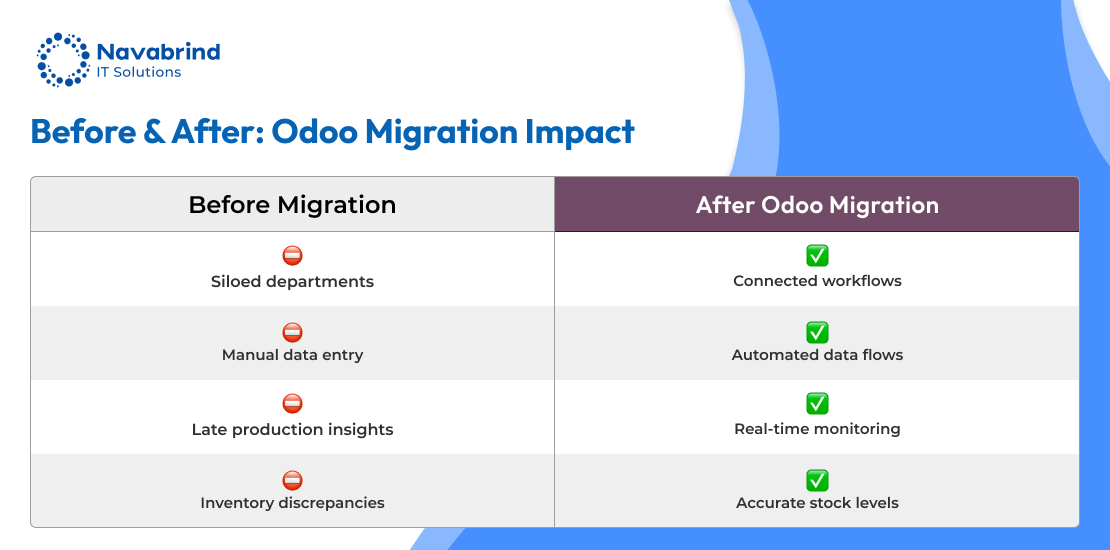
PostERP Data Migration Services for Manufacturers: Why Odoo is the Best Fit
ERP Data Migration Services for Manufacturers: Why Odoo is the Best Fit September 9, 2025 Posted by: Dania Sibionna Philemon Categories: Blog, Odoo No Comments Odoo has become a top choice for manufacturing companies looking for reliable ERP solutions. The platform serves millions of users worldwide and expects to continue its aggressive market growth. The -
Post
Is Odoo Worth It for Small Businesses in 2026?
Is Odoo Worth It for Small Businesses in 2026? August 26, 2026 Posted by: Jaishree Jayabal Singh Categories: Blog, ERP for Small Business, Odoo Reviews & Comparisons No Comments Why Odoo is a differentiator in 2026 For small businesses, choosing an ERP system is an investment that must deliver measurable value. Odoo has gained attention

written by
Sumit Sinha
Associate Lead, Odoo
Sumit Sinha is an Associate Lead with over a decade of experience in enterprise software implementation. At Navabrind IT Solutions, he leads large and complex Odoo projects, consistently delivering world‑class Odoo implementations and integrations. He is recognized for his meticulous attention to detail, commitment to excellence, and dedication to going the extra mile to ensure successful project outcomes.
How can we help you?
Get in touch with a solutions consultant that can share best practices and help solve specific challenges.
