Beyond the Electronic Health Record
For years, platforms like Epic Systems and Cerner have anchored clinical workflows, capturing diagnoses, prescriptions, and records. Yet documentation alone cannot drive engagement. Odoo CRM for healthcare in the US shifts the focus from storing data to activating it.
A healthcare CRM system like Odoo ensures guided patient journeys. With patient relationship management software and a connected patient management system, hospitals track screenings, follow-ups, and outreach performance with visibility.
This is where Odoo’s CRM software for hospitals in the US reshape care delivery. Paired with healthcare communication software, it enables targeted campaigns, consistent engagement, and measurable outcomes.
What is CRM Technology in Healthcare?
Healthcare customer relationship management is a technology platform that manages and analyzes interactions across the patient journey from first inquiry to long-term care. Unlike EHR platforms, which focus on clinical records, a CRM for healthcare in the US focuses on building patient relationships.
As a patient management system, a healthcare CRM unifies information from EHRs, websites, call centers, and billing platforms. This creates a complete understanding of patient behavior, preferences, and engagement history, enabling hospitals to respond with relevance and timing.
A CRM software for hospitals like ODOO automates appointment reminders, follow-ups, and health updates, supports targeted outreach, and strengthens coordination across care teams. CRM software for hospitals in the US turns interactions into an opportunity to improve outcomes, increase retention, and grow patient trust.
Why Do Hospitals Need CRM Systems for Patient Management?
A CRM for healthcare in the US equips hospitals with the visibility and control needed to manage relationships across the patient journey from first interaction to long-term care.
1. The Rise of the Consumer Patient
Patients evaluate healthcare the way they evaluate retail, banking, and travel. They expect convenience, speed, and personalized interactions at every step. Online appointment booking, instant confirmations, text reminders, and digital check-ins are no longer optional, they shape perception and loyalty.
CRM software for hospitals such as Odoo delivers this experience through connected workflows and healthcare communication software. It captures patient preferences, tracks interactions, and ensures timely outreach. Without a healthcare CRM system, hospitals struggle to meet these expectations, leading to missed appointments, lower satisfaction, and patient drop-offs.
2. The Mandate of Value-Based Care
Healthcare reimbursement models now focus on outcomes rather than volume. This shift requires hospitals to stay engaged with patients beyond visits, ensuring continuity of care and preventing avoidable complications.
A patient relationship management software enables care teams to monitor engagement, send follow-up reminders, and guide patients through treatment plans. Through a connected patient management system, providers can track adherence, manage chronic conditions, and reduce readmissions.This level of engagement supports measurable improvements in outcomes while strengthening long-term patient relationships through healthcare customer relationship management.
3. Fragmentation of Data Across Systems
Patient data is scattered across clinical platforms, billing systems, websites, and call centers. Most systems focus on clinical documentation, leaving gaps in engagement and outreach visibility.
A healthcare CRM system, such as Odoo acts as the unifying layer that connects these data sources. It consolidates information into a single, 360-degree patient view, giving hospitals the ability to understand behavior, track communication, and measure engagement outcomes. This unified approach enables CRM software for hospitals in the US to transform disconnected data into actionable insights.
4. The Need for Measurable Growth and Retention
Hospitals are under pressure to increase patient acquisition and retention without increasing operational complexity. Traditional outreach methods lack visibility into what drives conversions or repeat visits.
A CRM for healthcare in the US such as Odoo provides tracking and reporting across campaigns, channels, and patient interactions. With healthcare communication software, hospitals can launch targeted outreach, monitor responses, and refine engagement strategies. This turns marketing and patient engagement into measurable drivers of growth, powered by healthcare customer relationship management.
5. Improving Care Coordination Across Teams
Patient care involves multiple departments physicians, specialists, administrative staff, and support teams. Without connected systems, communication gaps lead to delays, duplication, and inconsistent patient experiences.
A patient management system within a healthcare CRM system ensures that every team has access to updated patient information and interaction history. Through patient relationship management software, hospitals maintain continuity across the care journey, strengthening trust and engagement.
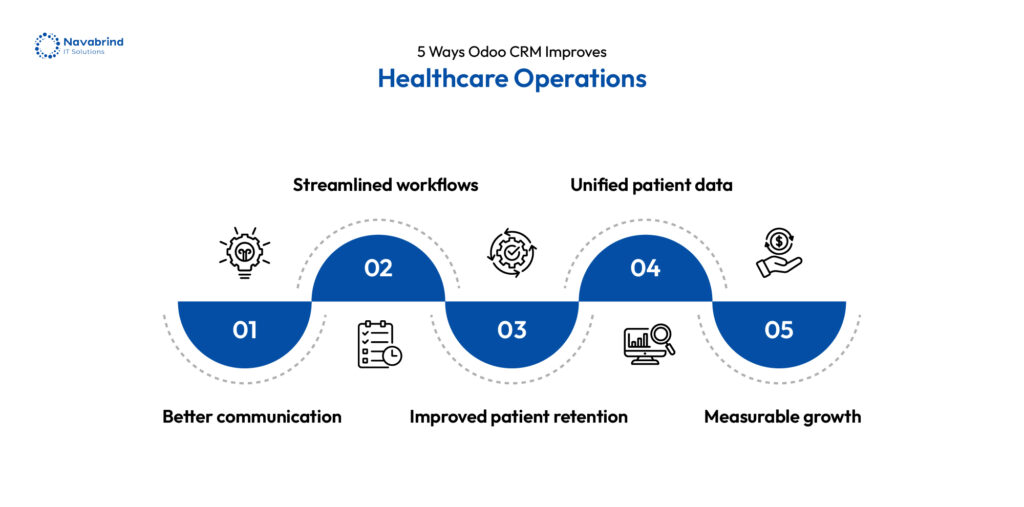
How Does CRM Technology Improve Healthcare Operations?
A CRM for healthcare in the US reshapes operations by connecting communication, data, and workflows across the patient journey. A healthcare CRM system, such as Odoo moves hospitals from reactive processes to coordinated, insight-driven action.
1. Revolutionizing Patient Communication
Traditional communication relies on repetitive calls and disconnected outreach. A healthcare communication software within CRM software for hospitals replaces this with personalized, automated journeys based on patient behavior and preferences.
Instead of staff making hundreds of calls, the system sends appointment reminders, follow-ups, and updates through SMS, email, or patient portals. If a patient cancels, the system fills the slot instantly. This is how patient relationship management software strengthens engagement while reducing operational strain.
2. Automating Revenue Cycle Management
Administrative delays impact revenue and patient experience. CRM software for hospitals in the US integrates with billing systems to streamline financial workflows within a connected patient management system.
A healthcare CRM system can verify insurance eligibility before visits, initiate authorization workflows, and send personalized payment reminders. This reduces delays, improves cash flow, and ensures patients stay informed throughout the billing journey.
3. Enhancing Care Coordination
Care delivery involves multiple teams, and gaps in communication lead to inefficiencies. A healthcare CRM system provides a shared view of patient interactions, care plans, and communication history.
4. Data-Driven Population Health Management
CRM for healthcare in the US enables providers to manage patient populations with foresight. By analyzing engagement and clinical data, hospitals can identify care gaps and act.
With patient relationship management software, providers can target patients due for screenings, promote preventive care campaigns, and identify those at risk of readmission. This shifts care delivery from reactive treatment to proactive management.
5. Optimizing the Digital Front Door
Patient journeys begin online. A healthcare CRM system tracks digital behavior across websites, portals, and campaigns, turning interest into action.
If a patient explores a service online, healthcare communication software can trigger educational content, follow-up messages, and outreach from care teams. This turns digital engagement into a coordinated operational process powered by CRM software for hospitals in the US.
The AI Factor and Technical Deep Dive
The next phase of innovation in CRM for healthcare in the US is driven by Artificial Intelligence. A healthcare CRM system goes beyond tracking interactions, it interprets data, predicts behavior, and guides action across the patient journey. This shift is redefining how healthcare customer relationship management operates at scale.
Predictive Analytics That Anticipates Patient Needs
AI-powered models within CRM software for hospitals in the US analyze historical and behavioral data to identify patterns. Solutions such as Odoo CRM enables hospitals to predict no-shows, detect gaps in care, and flag patients at risk of discontinuing treatment.
With patient relationship management software, care teams can intervene at the right moment sending reminders, initiating follow-ups, or offering support before issues escalate.
Intelligent Workflows That Reduce Operational Burden
AI is transforming workflows by connecting systems and reducing repetitive tasks. Emerging platforms like Odoo CRM are building AI-driven ecosystems that combine EHR, billing, and CRM software for hospitals into a single operational layer.
Within a healthcare CRM system, AI assists with documentation, streamlines processes, and enables care teams to focus on patient interaction rather than administrative load.
Natural Language Processing That Breaks Communication Barriers
AI-driven healthcare communication software uses Natural Language Processing (NLP) to understand and respond to patient inquiries across multiple languages.
Integrated into a CRM for healthcare in the US, this capability allows hospitals to deliver consistent, personalized responses through chat, email, or voice interactions.
The Integration Imperative: EHR + CRM
For a CRM for healthcare in the US to deliver impact, it must connect with the EHR. Several systems hold clinical data, and without integration, a healthcare CRM system cannot access the context needed for meaningful engagement. This connection turns isolated systems into a coordinated ecosystem powered by healthcare customer relationship management.
Real-Time Data Synchronization with FHIR
Modern standards like FHIR enable data exchange between EHRs and CRM software for hospitals in the US. When a patient updates contact details or schedules an appointment, the patient management system reflects it instantly across platforms.
Patient Identity Resolution for Accuracy and Safety
A healthcare CRM system must match patient records across multiple systems without duplication. Patient identity resolution ensures that communication reaches the intended individual, maintaining accuracy and data integrity.
With patient relationship management software, hospitals create a single, reliable patient profile that connects clinical, operational, and engagement data.
What Features Should a Healthcare CRM System Have?
Choosing the right patient management system is key for delivering connected care and consistent engagement. A CRM for healthcare in the US must go beyond basic functionality and support communication, data integration, and patient experience through a healthcare CRM system.
1. Compliance and Security You Can Rely On
Any CRM software for hospitals in the US must meet strict HIPAA requirements, including a signed Business Associate Agreement (BAA).
A secure healthcare CRM system, such as Odoo includes encryption for data at rest and in transit, role-based access controls, and detailed audit logs.
2. Deep Integration Capabilities
A healthcare CRM system must connect with existing clinical platforms. Integrations ensure that patient data flows across departments without gaps.
Support for FHIR enables API-based data exchange, keeping the patient management system synchronized.
3. Advanced Communication and Automation
Healthcare communication software within a CRM for healthcare in the US must support SMS, email, voice, and patient portals like MyChart.
A healthcare CRM system includes journey orchestration, automated workflows triggered by patient actions. For example, patient relationship management software can send preparation instructions before procedures or follow-up messages after visits, ensuring continuity across the care journey.
4. Analytics and Patient Segmentation
A healthcare CRM system, such as Odoo CRM provides a 360-degree patient view by combining clinical and engagement data within a single interface.
With CRM software for hospitals in the US, teams can segment patients by diagnosis, demographics, or risk level.
5. Patient Experience Tools That Drive Engagement
Patient experience starts before the visit. A patient management system should offer self-scheduling, allowing patients to book appointments based on availability.
Digital intake forms, accessible on mobile devices, reduce wait times and improve accuracy.
The ecosystem of CRM software for hospitals in the US continues to evolve, with platforms offering capabilities across patient engagement, communication, and care coordination. The table below presents a comparison of leading solutions within the CRM for healthcare in the US space.
|
CRM Platform
|
Best For
|
Key Features
|
Integration Strength
|
Role in Healthcare CRM System
|
|
Salesforce Health Cloud
|
Large health systems & enterprises
|
360-degree patient view, workflow customization, care journey tracking
|
FHIR-based integration, AppExchange ecosystem
|
Central hub for healthcare customer relationship management with enterprise-level scalability
|
|
LeadSquared
|
Patient acquisition & intake teams
|
Multi-channel campaigns, lead tracking, workflow automation
|
API-based integration with EHRs like Epic Systems
|
Drives conversion and engagement through patient relationship management software
|
|
Luma Health
|
Ambulatory & specialty clinics
|
Automated reminders, digital intake, patient messaging
|
Two-way sync with major EHRs
|
Strengthens engagement via healthcare communication software within a patient management system
|
|
TigerConnect
|
Inpatient care coordination
|
Secure messaging, alert management, team collaboration
|
Integration with Epic Systems
|
Enables coordinated communication across care teams in a healthcare CRM system
|
|
Omnipipeline
|
Small to mid-sized providers
|
Referral tracking, HIPAA-compliant interface, patient engagement tools
|
Designed for compliance with BAA support
|
Simplifies healthcare customer relationship management for growing practices
|
|
NexHealth
|
Patient self-scheduling & access
|
Online booking, waitlist management, digital forms
|
Integrates with practice management systems
|
Enhances access and acquisition through a responsive patient management system
|
|
Odoo CRM
|
Mid-sized clinics & healthcare groups seeking an affordable all-in-one platform
|
Lead pipeline management, activity tracking, email/SMS automation, customizable dashboards
|
Modular integration with Odoo’s native EHR, billing, and inventory apps; third-party API support
|
Delivers flexible healthcare customer relationship management within a broader operational suite, ideal for cost-conscious providers scaling their patient engagement workflows
|
The question is no longer whether to adopt patient relationship management software, but how fast healthcare organizations can implement it. As clinical care, operations, and patient experience converge, hospitals must move beyond fragmented systems. A CRM for healthcare in the US enables this shift by connecting people, processes, and data into one coordinated ecosystem built around the patient.
A healthcare CRM system acts as the foundation for this transformation. It breaks down silos across departments, streamlines repetitive tasks, and equips teams with actionable insights. Through healthcare communication software and a connected patient management system, hospitals can engage patients with relevance, consistency, and purpose.
For healthcare leaders, the direction is clear: unify operations, personalize engagement, and center care around the patient. CRM software for hospitals in the US delivers the capability to achieve this by turning disconnected experiences into meaningful interactions and sustainable growth.
Frequently Asked Questions
1.What is CRM technology in healthcare?
Healthcare customer relationship management refers to a healthcare CRM system that manages and analyzes patient interactions across the care journey. Unlike clinical systems such as Epic Systems or Cerner, Odoo CRM for healthcare in the US focuses on engagement, communication, and long-term relationships through a connected patient management system.
2.How does CRM technology improve healthcare operations?
A healthcare CRM system improves operations by connecting communication, automating workflows, and unifying patient data. Odoo CRM software for hospitals in the US supports appointment management, billing coordination, and care team collaboration, enabling hospitals to operate with better visibility and control through healthcare customer relationship management.
3.Why do hospitals need CRM systems for patient management?
Hospitals need a CRM for healthcare in the US to manage rising patient expectations and deliver consistent engagement. A connected patient management system, such as Odoo helps track interactions, improve follow-ups, and retain patients. Patient relationship management software ensures that no opportunity for engagement or care is missed.
4.What are the benefits of CRM software for healthcare providers?
Odoo CRM software for hospitals enhances patient acquisition, retention, and engagement. A healthcare CRM system enables targeted outreach, improves care coordination, and provides measurable insights. Through healthcare communication software, providers can maintain consistent interaction and build stronger patient relationships.
5.How does CRM technology improve patient communication in hospitals?
A healthcare communication software within a CRM for healthcare in the US enables personalized communication across SMS, email, and patient portals. Patient relationship management software automates reminders, follow-ups, and updates, ensuring patients stay informed and engaged throughout their journey.
6.How can CRM systems help manage patient relationships in healthcare?
A healthcare CRM system centralizes patient data and interaction history, giving providers a complete view of each patient. This allows CRM software for hospitals in the US, such as Odoo to deliver personalized care, targeted communication, and continuous engagement through a connected patient management system.
7.What features should a healthcare CRM system have?
A healthcare CRM system includes secure data handling, integration with platforms like Epic Systems, multi-channel healthcare communication software, workflow automation, analytics, and patient experience tools like self-scheduling. These features enable healthcare customer relationship management and support scalable growth.
Schedule a conversation with us now!
Related Articles








 Post
Post Post
Post