An ERP system for small businesses has moved far beyond accounting. It now sits at the center of operations, compliance, and growth strategy. With strict frameworks like GDPR and CSRD shaping how data is handled and reported, SMEs need systems that ensure accuracy, traceability, and control. At the same time, they need flexibility to scale, without rebuilding their tech stack every few years.
On one side is SAP Business One, structured, reliable, and built on decades of enterprise-grade thinking. It offers standardized processes, strong financial controls, and industry functionality, making it a trusted choice for businesses that prioritize stability and compliance.
On the other side is Odoo, the challenger to upgrades. Modular, flexible, and designed for adaptability, it allows businesses to build their ERP system step by step, adding only what they need. Its open architecture and lower entry cost make it attractive for SMEs that value agility and customization.
The contrast is clear:
- SAP Business One delivers structure and consistency
- Odoo delivers flexibility and scalability
But the choice is not that simple.
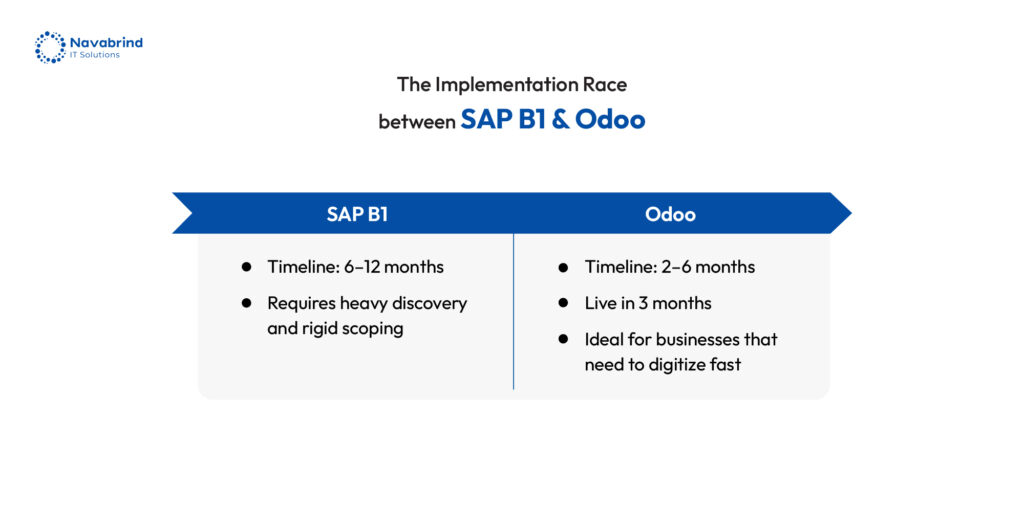
European SMEs must weigh more than features. Cost structures, implementation timelines, customization needs, and long-term scalability play a role. SAP Business One comes with a higher total cost and longer implementation cycles, while Odoo offers faster deployment and lower upfront investment, but may require the right expertise to leverage its flexibility.
What is SAP Business One?
SAP Business One is an ERP system for small businesses built to bring structure, control, and visibility into daily operations. It combines finance, sales, inventory, purchasing, and reporting into a single platform, eliminating the need for disconnected tools. For companies that have outgrown spreadsheets but aren’t ready for complex enterprise systems, it offers a clear step forward.
This ERP solution for small businesses focuses on standardization. It enforces consistent workflows, ensures data accuracy, and creates a single source of truth across departments. Businesses don’t just manage operations as they gain clarity over them. As an ERP for small companies, it delivers the core strength of SAP in a more compact and accessible form, without overwhelming teams with unnecessary complexity.
Who is it for?
SAP Business One is built for European SMEs that operate in structured, compliance-driven environments. It fits best in industries where precision, traceability, and regulatory alignment are non-negotiable:
- Manufacturing companies managing production, inventory, and supply chains
- Wholesale distributors handling large volumes and complex logistics
- Professional services firms that require financial accuracy and reporting discipline
These businesses need an ERP system for small businesses that doesn’t just support growth but controls it thoroughly.
The Key Strength: A “Safe Bet”
The biggest advantage of the SAP Business One ERP System is its reputation for reliability. It is a system that enforces disciplined business processes rather than leaving room for inconsistency. Every transaction, report, and workflow follows a defined structure, reducing errors and improving accountability.
For many SMEs, this makes it a “safe bet.” It minimizes risk, supports compliance requirements, and provides predictable performance. When regulations like GDPR and CSRD demand accuracy and transparency, this level of control becomes a necessity, not a luxury.
Understanding SAP Business One Cost
The SAP Business One cost reflects its structured approach. It includes licensing, implementation, customization, and ongoing maintenance. While the upfront investment is higher than some alternatives, it delivers stability, proven processes, and long-term reliability. For businesses that prioritize control over flexibility, and compliance over experimentation, this ERP for small businesses remains one of the dependable choices available.
Deconstructing the Cost: SAP Business One Price and ROI
The Transparency Issue
One of the biggest frustrations with SAP Business One is the lack of upfront pricing clarity. The SAP Business One cost is rarely published in a simple, standardized format. Instead, pricing depends on business size, number of users, required modules, and the implementation partner. For SMEs evaluating an ERP system for small businesses, this makes early-stage budgeting difficult and delays decision-making.
The Cost Breakdown
Understanding the cost of SAP Business One requires looking beyond licensing. The total investment includes multiple layers that impact ROI.
1. Licensing: Perpetual vs Subscription
SAP Business One offers on-premise (perpetual license) and cloud-based subscription models.
- Perpetual licensing involves a high upfront payment with long-term ownership
- Subscription spreads costs over time but adds ongoing expenses
For any ERP system for a small business, this choice determines how capital is allocated, either as a one-time investment or as an operational expense.
2. Implementation: The Hidden Cost
Implementation is where costs increase significantly. The SAP Business One ERP System requires certified partners for deployment, customization, and integration. This creates a structured but rigid setup process.
Compared to other ERPs for small companies, implementation takes longer and demands higher consulting fees. Customization is possible, but it adds complexity and cost. This is the stage where many SMEs underestimate their total investment.
3. Maintenance: Ongoing Commitment
Annual maintenance and support fees are a fixed cost of SAP Business One. These fees cover system updates, technical support, and access to new features. While they ensure stability, they also increase the long-term financial commitment required to maintain an ERP system for small businesses.
Is It Worth It for SMEs?
The value of SAP Business One depends on business needs and operational complexity.
Worth it if:
- You require manufacturing functionality with strict process control
- You manage multi-country operations with complex subsidiary structures
- You need strong audit trails and compliance support for public tenders
- You prioritize stability, structure, and proven workflows in an ERP for a small business
In these cases, the SAP Business One ERP System delivers measurable ROI through control, compliance, and operational consistency.
Not worth it if:
- You run a service-based business with minimal operational complexity
- You are an e-commerce startup that needs speed and flexibility
- You want a system that adapts quickly without heavy consulting involvement
- You are looking for a lightweight ERP for small companies with a lower upfront investment
For these businesses, the cost of SAP Business One outweighs its benefits. Rigidity and implementation overhead can slow growth rather than support it.
Feature Face-Off: SAP Business One vs Odoo
Choosing the right ERP system for small businesses comes down to how each platform handles structure, flexibility, and long-term value. SAP Business One and Odoo take different approaches, and those differences impact how SMEs operate and scale.
SAP Business One Strengths
1. Deep Process Rigor
The SAP Business One is built around strict workflows. It enforces best practices across accounting, inventory, and operations. This rigidity reduces errors, improves data consistency, and ensures that transactions follow a defined structure.
For companies that need discipline in their ERP for a small business environment, this is an advantage. It limits flexibility but strengthens control.
2. Industry-Specific Functionality
SAP Business One delivers strong out-of-the-box capabilities, especially for manufacturing and distribution. Features like Material Requirements Planning (MRP), inventory tracking, and supply chain management are integrated.
For small companies operating in production-heavy industries, this reduces the need for customization and accelerates operational efficiency.
3. Global Compliance
For European SMEs, compliance is non-negotiable. SAP Business One has a long-standing reputation for handling localization requirements across countries like France, Germany, and Italy. Tax structures, legal reporting, and regulatory alignment are built into the system.
This makes it a reliable ERP system for small businesses operating across multiple regions and requiring consistent compliance standards.
Odoo Strengths
1. User Experience
Odoo stands out with a clean interface. It is designed for usability, making it easier for teams to adopt and use daily.
In comparison, SAP Business One feels outdated to new users. For an ERP for small businesses, ease of use impacts productivity and adoption rates.
2. Modular Flexibility
Odoo follows a modular approach. Businesses start with core functions and add applications as needed for the CRM, accounting, inventory, eCommerce, and more.
This gives companies control over how their ERP system for small businesses evolves. In contrast, SAP Business One requires a broader upfront investment in features, limiting flexibility during the early stages.
3. Total Cost of Ownership
Cost plays a critical role in ERP decisions. The SAP Business One cost includes licensing, implementation, and ongoing maintenance, making it a higher upfront investment.
Odoo offers a predictable subscription model, reducing initial barriers. For many SMEs, this makes it a more accessible ERP for small companies, especially when scalability and budget control are priorities.
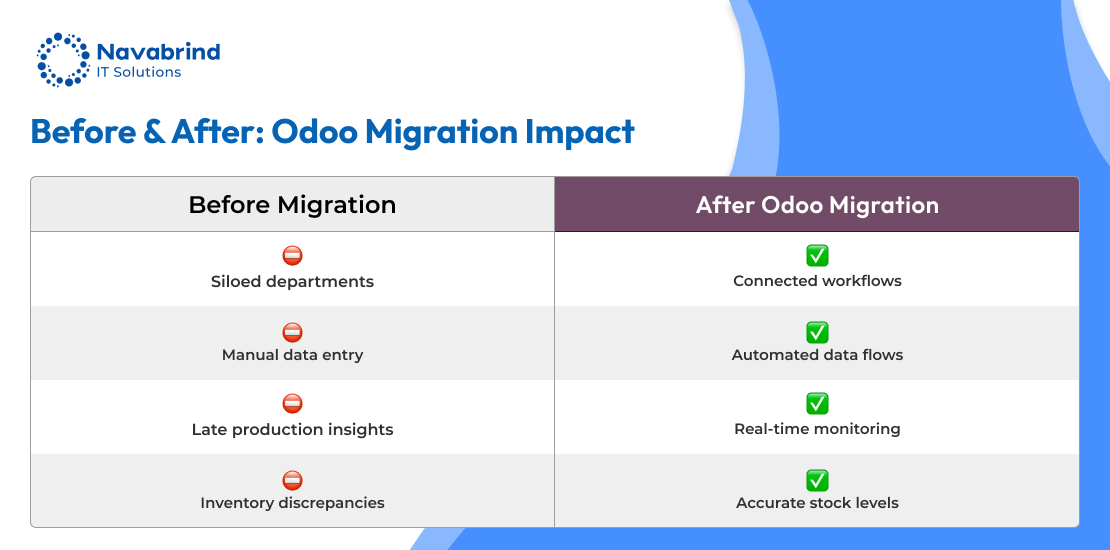
The financial benefits of Odoo open-source ERP system are apparent when an SME consolidates its operations into a single system. Here’s how Odoo delivers financial savings:
The Cloud Debate: Which Cloud-based ERP is Better for Small Business?
Cloud adoption has changed how companies choose an ERP system for small businesses. The expectation is no longer just remote access as real-time data, integrations, and the ability to scale without infrastructure constraints. This is where the difference between SAP Business One and Odoo becomes clear.
The SAP Business One ERP System offers a cloud version, but it is hosted or managed by a certified partner. In practice, this means the system runs on cloud infrastructure while retaining the structure of an on-premise setup. This approach delivers stability, control, and strong data governance. For SMEs that prioritize security and consistency in their ERP for a small business environment, it works well. However, it lacks the native flexibility expected from cloud platforms. Integrations with e-commerce systems or third-party tools require additional setup or middleware. From a cost perspective, the SAP Business One cost in the cloud still includes hosting, licensing, and partner management fees. It remains a structured and predictable system, but not the agile option for fast-changing business models.
Odoo is built as a native cloud platform. It is designed for flexibility, real-time updates, and connectivity across applications. For ERP for small companies that operate online, especially those using platforms like Shopify or WooCommerce, Odoo offers integrations and real-time inventory synchronization. This eliminates delays between sales, stock updates, and order processing.Its cloud-first design also simplifies scaling. Businesses can add features, users, and integrations without reworking the system. For an ERP system for small businesses, this level of adaptability supports faster growth and smoother operations.
If your priority is a cloud-first ERP for small business with strong API integrations, real-time data flow, and flexibility, Odoo is the stronger choice. If your focus is on stability, structured processes, and enterprise-grade control with less need for interface changes the SAP Business One ERP System remains a solid contender. The decision comes down to how your business operates. Fast-moving, digital-first SMEs benefit from flexibility. Process-driven companies benefit from control.
Exploring the Landscape: Best SAP Alternatives for European SMEs in 2026
Choosing an ERP system for small businesses is no longer limited to traditional players like SAP Business One. While SAP Business One remains a structured and reliable option, many European SMEs are exploring alternatives that offer flexibility, faster deployment, and better cost control. The rising cost of SAP Business One and the complexity of implementation are pushing businesses to evaluate systems that align closely with future operational needs.
Here are the strongest alternatives shaping the ERP for the small business landscape in 2026:
Odoo: The Flexible All-Rounder
Odoo stands out as the most balanced ERP for small companies. It combines usability, modular design, and scalability in a way that supports early-stage growth and long-term expansion. Businesses can start with core features and expand gradually, avoiding large upfront investments. This contrasts with the SAP Business One ERP System, where companies commit to a broader setup from the beginning. For SMEs that want speed, adaptability, and control over their ERP system for small businesses, Odoo delivers an advantage.
Microsoft Dynamics 365 Business Central: The Ecosystem Advantage
Microsoft Dynamics 365 Business Central is the natural choice for companies using Microsoft tools like Teams, Excel, and Outlook. It integrates into that ecosystem, creating a unified workflow across communication, reporting, and operations. For an ERP for small business, this reduces friction and improves productivity. Teams don’t need to switch between disconnected systems. Everything works within a familiar environment. Compared to SAP Business One, it offers a connected digital experience, especially for service-oriented and mid-sized companies.
Acumatica: The Cloud-First Challenger
Acumatica positions itself as a cloud-native ERP system for small businesses. Its biggest differentiator is its unlimited user licensing model, allowing companies to scale without increasing per-user costs. For growing SMEs, this creates a predictable cost structure, something that the SAP Business One cost model does not always provide.It is strong for businesses that need flexibility, remote access, and real-time collaboration across teams.
Industry- Specific Niche Players
In some cases, a specialized ERP for small companies outperforms general platforms like SAP Business One or Odoo. Solutions like Sage dominate in regions such as the UK and France due to strong local compliance features and accounting depth. Similarly, niche manufacturing ERPs offer tailored functionality that general systems cannot match without heavy customization. For businesses with highly operational needs, these niche platforms deliver faster results with less complexity.
SAP Business One remains a strong, process-driven ERP for small businesses, especially for companies that prioritize control and compliance. However, the market has evolved. SMEs now expect flexibility, a better user experience, and predictable costs from their ERP systems. The right choice depends on how your business operates. Structured environments benefit from SAP. Fast-moving, digital-first companies gain more from alternatives.
Selecting the right ERP system for small businesses is a strategic decision. It defines how your company operates, scales, and competes. A structured approach prevents costly mistakes and ensures the system supports long-term growth rather than just immediate needs.
1. Audit Your Core Operations
Start with how your business runs. If your operations depend on structured manufacturing workflows, strict inventory control, and compliance-heavy processes, SAP Business One is built for that environment. It enforces discipline and consistency across functions. If your business relies on e-commerce, CRM, and adaptability, Odoo aligns better. It supports fast changes, integrations, and customer-centric workflows. The right ERP for a small business must match your operational core, not force you to change how you work.
2. Calculate Total Cost of Ownership
Pricing goes beyond monthly subscriptions. A realistic view of ERP for small companies must include the full investment required to implement and maintain the system.
- Implementation Costs:
The SAP Business One ERP System requires certified partners, which increases consulting costs and extends timelines. Odoo offers a broader partner network, including smaller agile firms that reduce implementation overhead.
- Customization Costs:
SAP Business One involves structured customization with higher consulting fees. Odoo allows flexible and cost-effective adjustments.
- Migration Costs:
Moving from legacy systems requires data cleanup, mapping, and testing. This is a critical cost factor overlooked.
The SAP Business One cost is not just licensing but includes implementation, customization, and ongoing support. For any ERP system for small businesses, understanding TCO ensures there are no surprises after deployment.
3. Test Usability Before You Commit
Adoption determines success. If your team struggles to use the system, productivity drops and resistance increases. Request a live demo and involve actual users. Let them navigate workflows, generate reports, and test daily tasks. The SAP Business One ERP System offers strong functionality but feels complex to new users. In contrast, Odoo’s interface improves usability and speeds up adoption. For an ERP for small businesses, ease of use is not optional, as it impacts ROI.
4. Evaluate the Local Partner Ecosystem
In Europe, the implementation partner plays a critical role. The same ERP system for small businesses can deliver completely different outcomes depending on the partner’s expertise. Check whether partners specialize in SAP Business One or Odoo within your country, like Germany, France, or others. A strong local partner understands regional compliance, industry requirements, and operational challenges. This reduces risk and ensures smoother deployment.
Your ERP for small companies must support growth over the next five years.SAP Business One offers long-term stability, structured processes, and reliable performance as complexity increases. It is a strong choice for businesses that value control and predictability. Odoo offers flexibility and continuous expansion. Businesses can add features, users, and integrations without major system changes. The decision depends on your growth model. Stable, process-driven companies benefit from SAP. Fast-scaling, digital-first companies benefit from flexibility. There is no single “best” ERP system for small businesses that is the one that fits your operations, budget, and growth strategy. The right ERP for small business aligns with how you work today and how you plan to scale tomorrow.
Choose SAP Business One if your business operates in a structured, process-driven environment. It is the right fit for companies with complex manufacturing needs, strict compliance requirements, and the resources to invest in a certified implementation partner. The SAP Business One ERP System delivers control, consistency, and reliability but that comes with a higher SAP Business One cost and a rigid setup.
Choose Odoo if you prioritize flexibility, speed, and usability. It suits businesses that want an interface, faster implementation, and a lower upfront cost alternative to SAP Business One. For companies focused on e-commerce, CRM, and scaling, it offers an adaptable ERP system for small businesses.
The European market in 2026 demands agility, precision, and the ability to adapt quickly. Whether you choose the legacy strength of SAP Business One or the flexibility of Odoo, the real advantage comes from taking action.
An ERP for small companies is no longer optional; it is the foundation of efficient, compliant, and scalable growth. The sooner you implement the right system, the faster you move from operational limitations to strategic control.
Frequently Asked Questions
1. What is the Best ERP Software for Small Companies in Europe in 2026?
There is no universal “best” ERP system for small businesses. The right choice depends on how your company operates.
2. What is the SAP Business One Software Price and Is It Worth It for SMEs?
The SAP Business One cost is not fixed. It depends on licensing (perpetual or subscription), number of users, implementation, and customization.
- Costs include: licensing, certified partner implementation, maintenance, and upgrades
- Higher upfront investment compared to many alternatives
It is worth it for SMEs that need strong process control, compliance, and industry-specific functionality. For businesses seeking flexibility and lower entry cost, it may not deliver the best ROI as an ERP for small businesses.
3. What Does SAP Business One ERP Software Offer That Odoo Does Not?
The SAP Business One ERP System stands out in three key areas:
- Process discipline: Enforced workflows reduce operational errors
- Industry depth: Strong built-in functionality for manufacturing and supply chain
- Compliance: Proven localization for European regulations and reporting
Odoo, on the other hand, focuses on flexibility and usability. SAP Business One is stronger in structure; Odoo is stronger in adaptability.
4. Which Cloud-Based ERP is Better for Small Business: Odoo or SAP Business One?
The answer depends on your priorities.
- Odoo: A cloud-first ERP for small business with real-time integrations, UI, and scalability
- SAP Business One: A hosted cloud version that offers stability, security, and structured processes
If your business depends on integrations and changes, Odoo is the better ERP system for small businesses. If you prioritize control and consistency, SAP Business One is the stronger option.
5. What are the Best SAP Alternatives for European Small and Medium Businesses in 2026?
Beyond SAP Business One, several strong ERP for small companies options exist:
- Odoo: Best for flexibility and cost efficiency
- Microsoft Dynamics 365 Business Central: Best for Microsoft ecosystem users
- Acumatica: Best for cloud scalability and user-based pricing advantages
- Sage: Strong regional compliance and accounting focus
These alternatives provide lower SAP Business One cost barriers and faster deployment.
6. How Do You Choose the Right ERP Software for Small and Medium Enterprises in Europe?
Choosing the right ERP system for small businesses requires a structured approach:
- Assess your operations: Manufacturing vs service vs e-commerce
- Calculate total cost: Include implementation, customization, and migration, not just subscription
- Test usability: Ensure your team can adopt the system
- Check local partners: Strong regional expertise is critical in Europe
- Plan for growth: Choose a system that scales with your business
An ERP for small business is a long-term investment. The right decision balances cost, usability, and scalability, while supporting current needs and future expansion.
Schedule a conversation with us now!
Related Articles







 Post
Post Post
Post