








Odoo ERP for
Healthcare Management
Odoo unifies patients, staff, inventory, and compliance on one intelligent platform, giving healthcare providers the clarity to care and the tools to manage.
See how demand forecasting transforms your operations in 30 minutes.
Trusted by large brands













The healthcare industry relies on critical data, including patient, staff, inventory, billing, and compliance information. Odoo streamlines patient intake, appointment scheduling, insurance claim tracking, prescription fulfillment, financial reporting, and more. Automation frees up personnel to focus more on patients, reducing wait times, ensuring smoother visits, and enabling patients to feel valued rather than processed.
150+
Odoo
Technologists
50+
Successful
Implementations
10+
Years of Domain
experience
95%
Customer
Satisfaction Rates
150+
Odoo
Technologists
50+
Successful
Implementations
10+
Years of Domain
experience
95%
Customer
Satisfaction Rates
Odoo ERP services for
healthcare industry
01
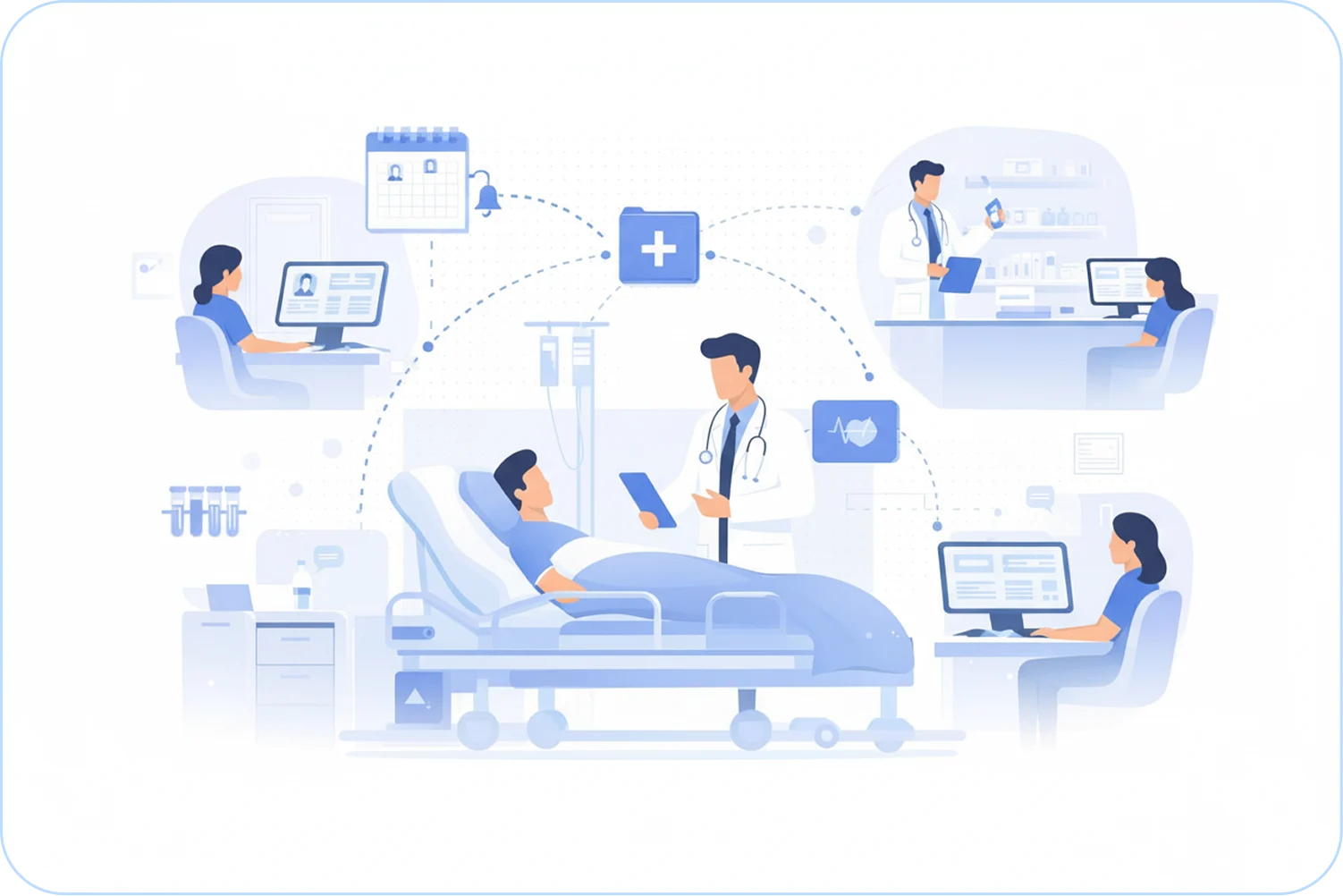
Patient management from intake to discharge
When patient data flows across touchpoints, providers can focus on care instead of hunting for files.
- Centralized patient registration and medical history tracking
- Appointment scheduling with automated reminders
- Data flow between departments, from the lab, pharmacy, & billing
02
Inventory & supply chain management
In healthcare, an out-of-stock alert isn’t just an inventory problem; it’s a potential patient safety crisis waiting to happen.
- Real-time tracking of medicine stock with expiry alerts
- Automated reorder points to prevent critical shortages
- Batch and lot tracking for recalls and traceability

03
Financial management & billing
When billing and claims are automated, providers get paid faster, and patients leave with clarity.
- Automated invoice generation and payment collection
- Insurance claim submission and tracking
- Revenue management with real-time financial reporting

04
Compliance & regulatory reporting
The best compliance system is one that is built into how providers work every day.
- Role-based access controls to protect sensitive patient data
- Automated audit trails for every transaction and access event
- Built-in report generation for regulatory submissions

The prescription for operational chaos
in the healthcare industry
Implement Odoo ERP without disrupting patient care
Assess & Plan
Understand current workflows, identify pain points, and define success metrics.
Configure & Integrate
Tailor Odoo modules to healthcare workflows and connect with existing systems.
Migrate & Test
Move clean, validated data from legacy systems and test all workflows end-to-end.
Train & Go-Live
Equip staff with the skills to use Odoo confidently and transition fully to the new system.
Put patients first. Automate the rest.
Schedule a Call to See How Odoo Fits into Your Healthcare Facility.
Integrate Odoo with third-party apps
How the US Healthcare Industry Transitioned from Paper Trails to Digital Workflows
A manufacturer of bathroom and bed safety products migrated to a new version of Odoo, redesigned their website, and integrated it with Odoo. This reduced their operational costs by 30%.
Order Ratio
60% 
Cost and Time
40%

Don't let a data gap become a liability.
Learn How Odoo Protects Your Patients and Your Reputation.
Got questions? We've got answers
What is Odoo ERP for the healthcare industry?
Odoo ERP is the operational backbone that ensures the doctor is in the right room, the scalpel is available, the patient is correctly billed, and the insurance claim is filed, all while keeping every transaction auditable and secure.
For healthcare providers, Odoo bridges the gap between patient care and business operations. It connects front desk, pharmacy, lab, finance, and management on one platform, eliminating the silos that cause delays, errors, and revenue leakage.
Think of Odoo ERP as the central nervous system of a healthcare organization, not delivering care directly, but ensuring every part of the organization knows what the other is doing, in real time.
How can Odoo ERP improve hospital management?
Hospital management is fundamentally about coordination. A patient moves from reception to consultation to lab to pharmacy to billing, and at every step, information must travel with them. In most hospitals, that information travels on paper, spreadsheets, or disconnected software.
Odoo transforms hospital management in four specific ways: real-time visibility into patient flow, automated inventory control, integrated billing and claims, and built-in compliance. The net effect is not just operational efficiency. It’s a hospital where staff spend less time hunting for information and more time attending to patients—where management uses dashboards rather than guesswork, and where patients experience shorter waits and clearer communication.
Is Odoo ERP suitable for small clinics as well as large hospitals?
Most ERP systems force healthcare providers into a false choice: buy a lightweight system that you’ll outgrow, or invest in an enterprise system that you’ll never fully use. Odoo eliminates that choice.
For small clinics: Odoo starts with exactly what you need—perhaps patient scheduling, basic billing, and medicine inventory. You pay only for the modules you use, implement in weeks (not months), and avoid the crushing overhead of enterprise software. A two-doctor clinic can run Odoo on a single server with minimal IT support.
For large hospitals: Odoo scales to hundreds of users across multiple buildings, departments, and even cities. You can add modules as you grow—laboratory integration, fleet management for ambulances, HR for medical staff, multi-warehouse inventory for central pharmacies, and advanced financial consolidation for multiple cost centers.
The key difference is configuration, not capability. The same Odoo platform that helps a small clinic track 500 medicines helps a large hospital track 50,000 across six warehouses. The same platform that schedules 50 patients a week for a clinic schedules 5,000 a day for a hospital.
What makes Odoo unique is that you never pay for capabilities you don’t need, and you never outgrow capabilities you do. Start small. Scale seamlessly. That’s the promise of modular ERP—and it’s why Odoo works for clinics, hospitals, and everything in between.
Does Odoo ERP support patient data security and compliance?
Odoo provides a strong baseline for data security through user authentication, group-based permissions, and access controls. However, patient data is among the most sensitive information any organization manages, and regulations such as HIPAA in the US and GDPR in Europe require strict compliance—not optional protection. It is important to note that Odoo Community Edition is not inherently HIPAA-compliant out of the box. Achieving compliance requires deliberate configuration, customization, and in many cases, the addition of specialized modules. With the right implementation approach, however, Odoo can be transformed into a secure and reliable platform for managing healthcare data.
A security framework in Odoo begins with Role-Based Access Control (RBAC), ensuring users have only the information they need for their roles, in line with the principle of least privilege. Beyond this, healthcare-grade security requires deeper controls, such as field-level security—where sensitive details like diagnoses are restricted—and record-level access, ensuring that practitioners view only relevant patient records. Dynamic record rules further refine access based on departments or relationships. Equally critical are audit trails that log every interaction with patient data, enabling compliance verification and accountability. To strengthen these capabilities, third-party modules such as Access Manager Ninja and DBSL Healthcare Service Management System extend Odoo’s native features with advanced controls like no-code security configurations, detailed audit logging, IP-based restrictions, and intelligent session management.
What healthcare modules are available in Odoo ERP?
Odoo ERP does not offer a single, monolithic “healthcare module” out of the box. Instead, it provides a flexible, modular ecosystem that can be configured and extended to support a wide range of healthcare operations—from clinics and hospitals to diagnostic centers and home healthcare providers.
At its core, Odoo enables healthcare organizations to build a connected system using its standard modules:
- Patient & Appointment Management (via CRM + Calendar): Manage patient records, schedule appointments, track interactions, and maintain a complete patient journey.
Billing & Insurance (Accounting): Handle invoicing, insurance claims, payments, and financial reporting with accuracy and compliance. - Pharmacy & Inventory (Inventory + Purchase): Track medicines, manage stock levels, automate replenishment, and ensure batch/expiry control.
- Hospital Operations (Custom / Studio / Third-party): Manage admissions, bed allocation, treatment workflows, and discharge processes.
- Human Resources (HR Module): Manage doctors, nurses, shifts, payroll, and compliance-related documentation.
Laboratory Management (Custom / Third-party): Track lab tests, results, and reporting workflows. - Document Management: Securely store patient records, prescriptions, reports, and medical history.
- eCommerce / Patient Portal: Enable patients to book appointments, access reports, and interact digitally.
To address the specialized needs of healthcare, Odoo is often extended with industry- specific modules available on the Odoo App Store. These include:
- Hospital Management Systems (HMS): Comprehensive solutions covering OPD/IPD management, EMR, prescriptions, and treatment tracking.
- Advanced Security & Compliance Modules: Features like audit trails, role-based access control, and enhanced data protection mechanisms.
- Healthcare Service Management Solutions: Tools for managing clinical workflows, diagnostics, and patient engagement.
The real strength of Odoo in healthcare lies in its customizability and integration capability. Odoo allows healthcare providers to design systems aligned with their operational models, regulatory requirements, and growth plans. With the right consulting and implementation approach, it becomes the digital linchpin for healthcare delivery, combining clinical, operational, and financial processes into a single, unified platform.