


Meet us at the Atlanta India Trade Fair 2026, 21– 23 Apr

Product Data Governance Done Right, with OdooPIM
No more inconsistent descriptions, duplicate SKUs, or delayed time-to-market. Trusted by 100+ businesses for product data quality management.
See how demand forecasting transforms your operations in 30 minutes.
Trusted by large brands


Odoo ERP is an all-in-one solution for managing production in the manufacturing industry. It automates BOM management and ensures precise assembly instructions. The ERP provides real-time tracking of raw materials and finished goods. It prevents stockouts and overproduction. Odoo ERP enhances production schedules, allows manufacturers to optimize resource allocation, and minimizes downtime. Its integrated quality control features ensure that products meet regulatory requirements. Odoo supports maintenance management, and the ERP’s reporting tool provides actionable insights for continuous improvement.
150+
Odoo
Technologists
200+
Successful
Implementations
10+
Years of Domain
experience
95%
Customer
Satisfaction Rates
150+
Odoo
Technologists
200+
Successful
Implementations
10+
Years of Domain
experience
95%
Customer
Satisfaction Rates
Odoo ERP services for
manufacturing industries
From legacy to lean:
The journey of a smart factory
How leading manufacturers transition from spreadsheets to cutting-edge automation.
Discovery & Process Mapping
Analyze your current workflows, pain points, and manufacturing processes.
Deployment & Configuration
Configure and test core modules in a controlled pilot environment.
Data Migration & Integration
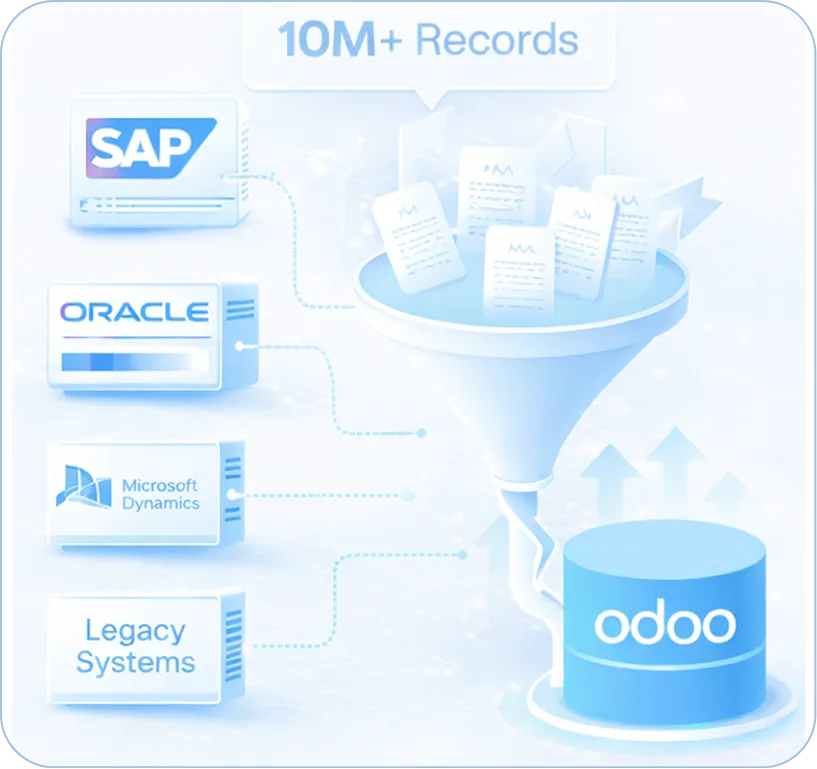
Clean and migrate data while integrating essential third-party tools.
Go-Live & Optimization
Launch with end-user training and establish a cadence for improvements.
Integration for
manufacturing industry
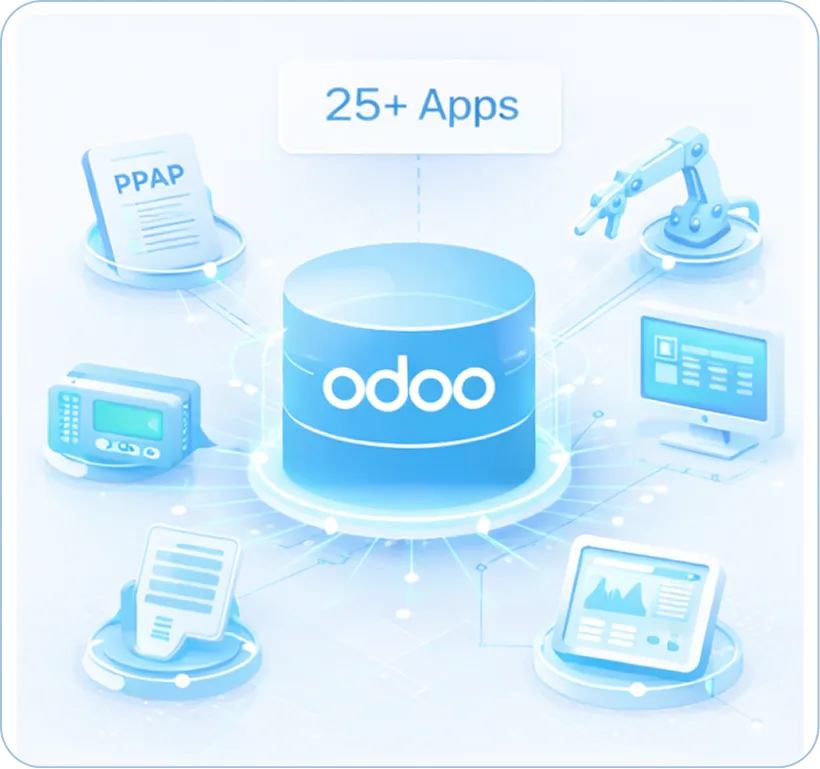
PPAP delivers unmatched quality assurance and compliance advantages for manufacturers chasing OEM contracts.
PPAP
Production Part Approval Process (PPAP) integrates with Odoo to meet quality requirements and streamline the approval process to enhance overall quality.
FMEA
Failure Mode and Effects Analysis (FMEA) integrates with Odoo to identify potential failure modes in processes and products, and prioritize and mitigate risks.
APQP
Advanced Product Quality Planning (APQP) integrates with Odoo to manage development phases and ensure products meet customer requirements.
CAPA
Corrective and Preventive Actions (CAPA) integrates with Odoo to manage processes to identify, address, and prevent recurring manufacturing issues.
SFC
Shop Floor Control (SFC) integrates with Odoo to monitor and manage manufacturing operations in real time, optimize performance, and productivity.
MRP
Material Requirements Planning (MRP) integrates with Odoo to plan material purchases and inventory levels, meet production schedules, and optimize resources.
Meet us at the Atlanta India trade fair 2026
Date: 21– 23 Apr, 2026
Venue: Georgia International Convention Center (GICC), College Park, USA
Book a personalized demo with our CTO
Integrate Odoo with third-party apps
Calculate Your ERP
Payback in Seconds
Find out if you’re leaving 6-figure savings on the table with disconnected systems.
Track every order, inventory movement, and production status in real time.
Start with the apps you need and add functionalities without costly migrations.
Replace legacy systems with a cost-effective integrated suite.
Calculate Your ROI
Estimate annual savings from reduced manual work, downtime, delays, and rework.
How they mastered PPAP compliance and saved thousands
A retailer of accessories for outdoor sports and recreational vehicles customized Odoo ERP to enable deeper automation and growth.
Sales
43%
Operational efficiency
65%
Home security provider consolidated disparate point solutions, streamlined workflows, and thus delivered a smarter buying experience to their customers.
Annual savings
$60,000
Data Accuracy
30%
Industrial Equipment Supplier customized Odoo and embedded AI capabilities to support their growing business.
Revenue
20%
Order pricing
32%
Future-proof your factory
with Odoo ERP
Integrate your manufacturing operations from the shop floor to the top floor with an Odoo Gold Partner.
Got questions? We've got answers
How does Odoo ERP help streamline production planning in manufacturing?
Odoo streamlines production planning by unifying real-time inventory visibility, demand forecasting, and shop floor scheduling into a single, intuitive platform. The Manufacturing module enables planners to create and manage multilevel bills of materials (BOMs) and routings, while the Master Production Schedule (MPS) tool automatically suggests procurement and production orders based on forecasted demand, current stock levels, and lead times. Real-time updates from the shop floor, via tablets, IoT devices, or integrations, allow planners to instantly adjust schedules in response to machine breakdowns, material shortages, or urgent change orders, minimizing downtime and improving on-time delivery.
Is Odoo ERP scalable as our manufacturing business grows?
Absolutely. Odoo is architected for scalability, growing seamlessly from a startup with basic inventory needs to a multinational corporation managing complex, multi-site production. As you expand, you can activate additional modules, such as MRP, Quality, Maintenance, and PLM, without migrating platforms or disrupting operations. Odoo’s multi-company and multi-warehouse capabilities allow you to manage multiple facilities, currencies, and legal entities from a single instance. Whether you’re adding 10 users or 1,000, integrating new acquisition companies, or expanding into new markets, Odoo scales both vertically (by adding complexity) and horizontally (by adding volume) without degrading performance.
Does Odoo support quality control and compliance tracking on the shop floor?
Yes, Odoo provides robust, embedded tools for quality control and compliance tracking directly on the shop floor. The Quality module allows manufacturers to define quality control points (QCPs) at any stage, incoming inspection, in-process checks, or final assembly, with customizable checklists, tolerance limits, and pass/fail criteria. Non-conformances can be flagged in real time, triggering automated alerts, corrective actions (CAPA), or rework orders. For compliance, Odoo maintains a complete audit trail of every quality check, batch traceability from raw material to finished goods, and documentation control for standards such as ISO 9001, AS9100, and IATF 16949, ensuring you’re always audit-ready.
How long does it take to implement Odoo ERP for a mid-size manufacturer with Navabrind IT Solutions?
With Navabrind IT Solutions, a mid-size manufacturer (typically 50–250 employees) can expect to go live on Odoo ERP within 3 to 6 months, depending on complexity, customization needs, and data readiness. Our phased implementation methodology accelerates this timeline by focusing on core manufacturing modules first, inventory, BOMs, purchasing, and basic production, before layering in advanced capabilities like quality control, maintenance, or MRP. Factors that influence the timeline include the number of integrations with legacy systems (e.g., MES, PLCs), the volume of historical data requiring cleansing and migration, and the scope of customizations needed to match niche workflows. Our proven approach ensures 95% of projects achieve go-live within this window while minimizing disruption to daily operations.
How does Odoo ERP support real-time tracking of work orders and shop floor activities?
Odoo enables real-time tracking of work orders and shop floor activities through a combination of intuitive user interfaces, IoT integrations, and automated data capture. On the shop floor, operators can access work orders via tablets, kiosks, or mobile devices, with real-time instructions, BOMs, and routing steps displayed at each workstation. As work progresses, operators log start and stop times, quantities produced, and scrap or rework incidents with a single tap, instantly updating inventory levels and work order statuses in the central system. For deeper automation, Odoo integrates with IoT devices, barcode scanners, and machine sensors (via SCADA or MES connectors) to automatically capture cycle times, trigger quality checks, and flag production deviations. This real-time visibility enables production managers to monitor shop floor status from any location, identify bottlenecks as they emerge, and dynamically adjust schedules to maximize throughput and on-time delivery.