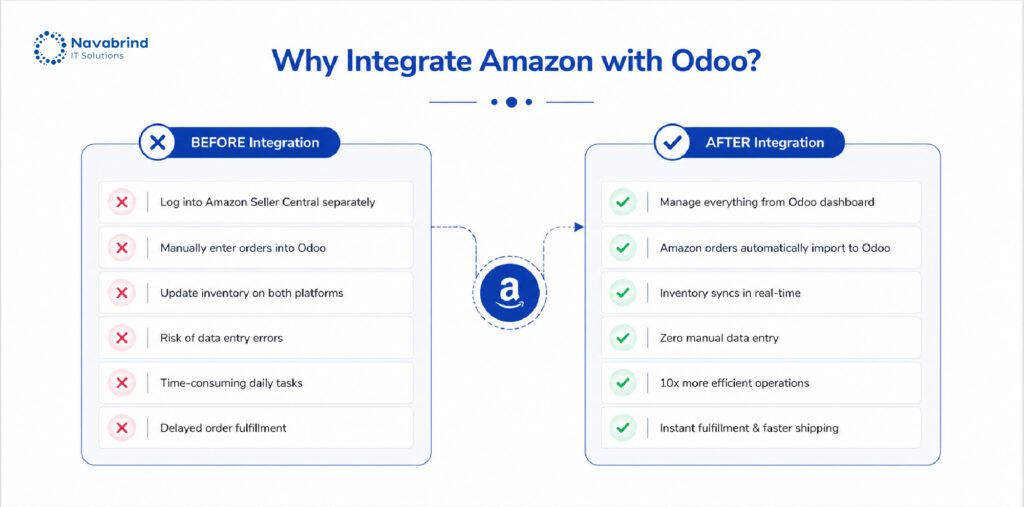
Amazon growth looks profitable from the outside, yet many sellers struggle with disconnected operations behind the scenes. Orders flow through Seller Central, inventory sits inside spreadsheets, and finance teams work across scattered systems with delayed updates. This fragmented workflow slows fulfillment, creates stock mismatches, and weakens customer satisfaction. An Odoo Amazon integration transforms this environment into a connected commerce ecosystem where inventory, invoicing, fulfilment, and product data move through one operational framework. Businesses using an Odoo Amazon connector gain stronger control over catalogue management, shipping coordination, and marketplace visibility without depending on repetitive spreadsheet tracking. Amazon Odoo ERP integration creates operational consistency across sales, warehouse activity, and accounting functions, helping sellers respond faster to demand fluctuations. As Amazon order volumes rise, Odoo Amazon order sync keeps transactions aligned across channels and prevents costly fulfilment gaps. Whether businesses operate through Amazon FBA FBM Odoo workflows or multi-channel commerce models, Odoo ecommerce integration strengthens scalability and operational accuracy for sustained marketplace expansion.
The Amazon Seller's Dirty Secret
Behind many “successful” Amazon stores lies operational pressure that sellers rarely discuss publicly. Teams spend hours correcting inventory mismatches, fixing delayed dispatches, reconciling payments, and managing disconnected data across platforms. Seller Central alone cannot support growing operational complexity once product ranges, warehouse locations, and order volumes increase. Without Amazon seller central ERP integration, businesses lose visibility into fulfilment performance, procurement activity, and stock movement. This creates revenue leakage through overselling, delayed shipments, cancelled orders, and poor customer experiences. Odoo Amazon integration removes these operational bottlenecks by connecting Amazon activity with accounting, warehouse management, CRM, and procurement inside one ecosystem. An Odoo Amazon connector gives sellers stronger operational visibility across departments and reduces dependency on fragmented tools. Amazon Odoo ERP integration supports faster execution, cleaner workflows, and stronger inventory governance. With Odoo Amazon order sync, sellers maintain consistent order tracking and stock coordination across Amazon FBA FBM Odoo operations and expanding ecommerce channels.
The Hidden Operational Chaos Behind a “Successful” Amazon Storefront
Fast-growing Amazon stores frequently operate under intense operational strain hidden beneath rising sales numbers. Inventory updates lag behind warehouse activity, finance records remain disconnected from fulfilment data, and customer service teams struggle with inconsistent order visibility. Sellers relying on spreadsheets and disconnected software lose operational control as transaction volumes increase. Odoo Amazon integration resolves this fragmentation by connecting inventory, finance, logistics, procurement, and customer management within one ERP environment. Businesses using an Odoo Amazon connector gain stronger control over catalogue synchronisation, shipment tracking, and warehouse coordination without relying on disconnected reporting methods. Amazon Odoo ERP integration supports stable operational flow by aligning backend functions with marketplace activity. Odoo Amazon order sync keeps stock levels, invoices, and order statuses aligned across departments, reducing costly fulfilment mistakes. Whether sellers manage Amazon FBA FBM Odoo operations or hybrid ecommerce channels, Odoo ecommerce integration strengthens scalability, operational discipline, and marketplace responsiveness for long-term revenue growth.
Juggling Seller Central, Spreadsheets, and a Disconnected ERP: The Daily Grind
Many Amazon sellers spend valuable business hours switching between Seller Central, spreadsheets, courier dashboards, accounting software, and disconnected ERP systems. This fragmented workflow slows decision-making and creates operational blind spots across inventory, fulfilment, and finance. Teams struggle to reconcile orders, monitor stock availability, track returns, and manage invoices without duplicated effort. Odoo Amazon integration centralises these activities into one operational environment, reducing dependency on disconnected tools and repetitive data handling. An Odoo Amazon connector synchronises product listings, order flow, inventory updates, and customer records across Amazon and backend operations. Amazon Odoo ERP integration improves visibility across procurement, warehousing, and financial management, helping businesses respond faster to marketplace demand. With Odoo Amazon order sync, transaction data remains aligned across sales channels, reducing dispatch errors and inventory conflicts. Whether businesses operate through Amazon FBA FBM Odoo workflows or expanding ecommerce operations, Odoo ecommerce integration creates operational stability that supports profitable marketplace growth.
Why Scaling on Amazon Without a Proper Amazon Seller Central ERP Integration Eventually Breaks Things
Amazon growth becomes difficult to sustain when operational systems fail to scale alongside rising order volumes. Sellers encounter inventory inconsistencies, delayed fulfilment, inaccurate financial reporting, and rising customer complaints when backend operations remain disconnected. Seller Central manages marketplace activity, yet businesses require stronger operational coordination across warehousing, procurement, accounting, and customer management. Amazon seller central ERP integration solves this challenge by connecting marketplace transactions with business operations inside one ERP framework. Odoo Amazon integration strengthens operational visibility by linking inventory movement, invoicing, product management, and logistics workflows across departments. Businesses using an Odoo Amazon connector reduce order processing delays and gain stronger stock control during high-demand periods. Amazon Odoo ERP integration supports operational continuity across expanding sales channels and warehouse networks. Odoo Amazon order sync keeps fulfilment data aligned across Amazon FBA FBM Odoo operations, helping businesses avoid overselling, shipment delays, and revenue leakage during aggressive marketplace expansion.
What Is Odoo Amazon Integration And Why Does It Matter?
Odoo Amazon integration connects Amazon marketplace operations with inventory, accounting, warehousing, procurement, CRM, and ecommerce management inside one ERP ecosystem. Businesses handling growing order volumes struggle with disconnected systems, delayed fulfilment, inventory mismatches, and reporting gaps. An Odoo Amazon connector removes these operational bottlenecks by synchronising products, orders, stock levels, invoices, and shipment updates between Amazon and Odoo. Amazon Odoo ERP integration creates stronger coordination between sales activity and backend operations, helping businesses maintain inventory accuracy, fulfilment consistency, and financial visibility. Odoo Amazon order sync keeps transaction data aligned across departments, reducing costly fulfilment errors and stock conflicts. Whether businesses manage Amazon FBA FBM Odoo operations or multichannel ecommerce environments, Odoo ecommerce integration supports organised scaling, operational visibility, and revenue-focused marketplace growth.
Brief Explainer on Odoo as an ERP for Ecommerce Businesses
Odoo helps ecommerce businesses manage inventory, accounting, fulfillment, procurement, CRM, and sales from one ERP platform. Instead of relying on disconnected tools, teams gain operational visibility across departments through one connected system. Odoo Amazon integration strengthens this workflow by linking Amazon marketplace activity with backend business operations. An Odoo Amazon connector synchronises orders, products, inventory, and invoices across Amazon and Odoo, helping businesses maintain stronger operational control as sales volumes increase.
What the Odoo Amazon Connector Actually Does In Plain English
An Odoo Amazon connector transfers operational data between Amazon Seller Central and Odoo ERP. Product listings, orders, inventory updates, shipment tracking, and invoices remain aligned across platforms without repetitive data entry. Odoo Amazon integration reduces stock mismatches, fulfilment delays, and reporting confusion. Amazon Odoo ERP integration gives ecommerce teams stronger control over inventory movement, warehouse coordination, and order management through one connected operational framework.
How Amazon Odoo ERP Integration Bridges the Gap Between Operations and Sales
Amazon sales growth creates operational pressure when fulfilment, inventory, and finance systems remain disconnected. Amazon Odoo ERP integration connects marketplace sales with backend workflows, helping businesses maintain inventory accuracy, fulfilment speed, and financial visibility. Odoo Amazon integration synchronises order flow, stock movement, warehouse activity, and invoicing across departments. Odoo Amazon order sync keeps operational data aligned across ecommerce channels, reducing fulfilment disruptions and inventory conflicts during high-demand periods.
Who It’s Built For: SMEs, Growing Amazon Sellers, Multichannel Retailers
Odoo Amazon integration supports SMEs, scaling Amazon sellers, and multichannel retailers managing rising ecommerce operations. Businesses using an Odoo Amazon connector gain stronger visibility across inventory, fulfilment, procurement, and finance workflows. Amazon Odoo ERP integration helps companies manage growing product catalogues, warehouse operations, and order volumes without operational fragmentation. Whether businesses operate through Amazon FBA FBM Odoo workflows or multichannel ecommerce environments, Odoo ecommerce integration supports scalable marketplace growth with stronger operational coordination.
The Real Cost of Not Integrating
Disconnected ecommerce operations create hidden revenue loss across inventory, fulfillment, finance, and customer experience. Businesses managing Amazon sales through spreadsheets and disconnected systems face rising operational pressure as order volumes increase. Without Odoo Amazon integration, teams spend hours correcting inventory mismatches, updating orders, reconciling invoices, and resolving fulfilment delays. These operational gaps damage seller ratings, slow warehouse activity, and reduce profitability. An Odoo Amazon connector connects Amazon marketplace operations with inventory, accounting, procurement, and fulfillment workflows inside one ERP ecosystem. Amazon Odoo ERP integration strengthens visibility across departments and reduces operational confusion during high-volume sales periods. Odoo Amazon order sync keeps transactions, stock updates, and shipment activity aligned across systems, helping businesses maintain operational accuracy. Whether businesses operate through Amazon FBA FBM Odoo workflows or multichannel ecommerce environments, Odoo ecommerce integration supports stronger inventory governance, faster fulfilment coordination, and stable marketplace growth.
Manual Order Entry Errors and the Time They Eat
Repetitive order entry creates operational delays, invoicing mistakes, shipment confusion, and inventory inconsistencies that consume valuable business hours. Teams switching between Seller Central, spreadsheets, and disconnected software struggle to maintain order accuracy during peak sales activity. Odoo Amazon integration removes repetitive data handling by synchronising order flow between Amazon and Odoo ERP. An Odoo Amazon connector keeps customer details, invoices, product information, and fulfillment updates aligned across systems, helping businesses reduce operational friction and improve order processing speed.
Inventory Mismatches Leading to Overselling or Stockouts
Inventory inconsistencies damage customer trust and create revenue leakage through cancelled orders, delayed shipments, and stock shortages. Businesses without Amazon seller central ERP integration struggle to maintain accurate inventory visibility across warehouses and ecommerce channels. Odoo Amazon integration synchronises stock movement between Amazon and backend operations, helping sellers maintain stronger inventory control. Odoo Amazon order sync keeps inventory data aligned across Amazon FBA FBM Odoo workflows, reducing overselling risks and improving fulfilment reliability.
Delayed Fulfilment Hurting Your Seller Ratings
Late shipments and inconsistent fulfilment performance weaken seller credibility and reduce marketplace visibility. Businesses managing fulfillment through disconnected systems face delays in order processing, warehouse coordination, and shipment tracking. Amazon Odoo ERP integration connects marketplace orders with warehouse and logistics workflows, helping teams process fulfilment activity faster. An Odoo Amazon connector strengthens operational coordination across departments, improving dispatch timelines and protecting seller performance metrics.
Finance Teams Reconciling Data Across Disconnected Systems
Finance departments lose valuable time reconciling invoices, payment records, inventory costs, and tax reporting across disconnected ecommerce systems. Odoo Amazon integration connects Amazon sales activity with accounting and operational workflows inside one ERP platform. Businesses using an Odoo Amazon connector gain stronger financial visibility across transactions, inventory movement, and fulfillment expenses. Amazon Odoo ERP integration reduces reporting inconsistencies and supports faster financial reconciliation across ecommerce operations.
How Odoo Amazon Order Sync Works
Odoo Amazon order sync connects Amazon marketplace activity with inventory, fulfilment, accounting, and warehouse operations inside one ERP environment. When a customer places an order on Amazon, the Odoo Amazon integration transfers order details, customer information, product data, and payment records into Odoo. Warehouse teams process fulfilment activity from one dashboard, helping businesses maintain faster dispatch timelines and inventory accuracy. Amazon Odoo ERP integration keeps stock movement, invoices, shipment tracking, cancellations, and returns aligned across systems without repetitive data handling. Businesses using an Odoo Amazon connector gain stronger operational visibility across Amazon FBA FBM Odoo workflows and multichannel ecommerce operations. Odoo ecommerce integration supports connected transaction flow that improves fulfilment coordination, financial tracking, and marketplace performance as sales volumes expand.
Step-by-Step: From Order Placed on Amazon to Fulfilment in Odoo
When a customer places an order on Amazon, the Odoo Amazon connector transfers order data into Odoo ERP. Product details, shipping information, payment records, and customer data appear inside the ERP system for fulfilment processing. Warehouse teams prepare shipments, update dispatch status, and track inventory movement through connected workflows. Amazon Odoo ERP integration keeps order processing aligned across inventory, finance, and logistics operations from purchase to delivery.
Real-Time vs. Sync Timing: What to Expect
Odoo Amazon integration supports connected order and inventory updates between Amazon and Odoo ERP through configured sync intervals. Businesses receive inventory updates, order flow visibility, and shipment tracking across connected systems without relying on spreadsheets or repetitive imports. Odoo Amazon order sync helps ecommerce teams maintain stronger operational coordination during high-volume sales activity and fulfilment cycles.
How Odoo Amazon Order Sync Handles Order Status, Cancellations, and Returns
Odoo Amazon order sync keeps order statuses aligned between Amazon Seller Central and Odoo ERP throughout the fulfilment lifecycle. Shipment updates, cancellations, refunds, and return requests remain connected across systems, helping businesses reduce operational confusion and customer service delays. Amazon Odoo ERP integration supports stronger transaction visibility across Amazon FBA FBM Odoo workflows and multichannel ecommerce operations.
Invoice and Payment Reconciliation: Automated, Not Manual
Finance teams managing Amazon transactions through disconnected software face reporting delays and reconciliation challenges. Odoo Amazon integration connects Amazon sales activity with accounting workflows, helping businesses track invoices, payment settlements, taxes, and transaction records from one ERP platform. An Odoo Amazon connector reduces repetitive reconciliation work and strengthens financial visibility across ecommerce operations.
FBA vs FBM: Odoo Has You Covered
Amazon sellers operate through two fulfillment models: Fulfilment by Amazon (FBA) and Fulfilment by Merchant (FBM). In FBA, Amazon stores, packs, and ships products through its warehouse network. In FBM, sellers manage inventory storage, packing, shipping, and returns through their own operations. Odoo Amazon integration supports Amazon FBA FBM Odoo workflows from one connected ERP environment, helping businesses maintain inventory visibility, fulfilment coordination, and operational control across fulfilment models. An Odoo Amazon connector synchronises stock levels, order updates, shipment activity, and warehouse movement between Amazon and Odoo ERP. Amazon Odoo ERP integration helps businesses route fulfilment activity based on warehouse availability, inventory location, and operational requirements. Odoo Amazon order sync keeps inventory and transaction data aligned across FBA inventory, FBM warehouses, and multichannel ecommerce operations. Odoo ecommerce integration supports scalable fulfillment management without disconnected workflows or operational confusion.
Quick Explainer on FBA vs FBM
Fulfilment by Amazon (FBA) allows Amazon to handle storage, packing, shipping, and customer delivery through its logistics network. Fulfilment by Merchant (FBM) places fulfilment responsibility on the seller, including warehousing, shipping, and returns management. Businesses using Amazon FBA FBM Odoo integration gain stronger visibility across inventory movement, order processing, and fulfillment activity from one ERP platform.
How Amazon FBA FBM Odoo Integration Handles Each Model Differently
Odoo Amazon integration manages FBA and FBM workflows through separate fulfilment logic inside Odoo ERP. FBA inventory updates synchronise with Amazon warehouse stock, shipment activity, and order status. FBM workflows connect seller-managed warehouses, dispatch operations, and shipping coordination with Amazon marketplace activity. An Odoo Amazon connector keeps operational data aligned across fulfilment models without disconnected tracking methods.
Stock Reservations, Fulfilment Routing, and Warehouse Logic
Amazon Odoo ERP integration supports inventory allocation and fulfilment routing based on warehouse availability and order requirements. Businesses can manage stock reservations across Amazon warehouses, seller-managed locations, and ecommerce fulfilment centres through connected workflows. Odoo Amazon order sync helps teams maintain inventory accuracy across Amazon FBA FBM Odoo operations and multichannel sales environments.
Managing Both FBA and FBM Simultaneously Within Odoo
Many Amazon sellers operate through hybrid fulfillment strategies that combine FBA and FBM operations. Odoo ecommerce integration gives businesses one operational platform to manage inventory, fulfillment, invoicing, and order tracking across fulfillment models. Odoo Amazon integration helps ecommerce teams maintain operational visibility across Amazon warehouses, internal logistics operations, and multichannel sales activity without fragmented systems.
Beyond Amazon: Building a True Omnichannel Operation
Amazon generates strong ecommerce revenue, yet long-term business growth depends on connected multichannel operations. Sellers managing Amazon alongside branded websites, retail stores, wholesale operations, or additional marketplaces face operational pressure when systems remain disconnected. Odoo Amazon integration helps businesses connect Amazon activity with wider ecommerce and operational workflows inside one ERP ecosystem. An Odoo Amazon connector synchronises inventory, product data, pricing, fulfilment, accounting, and customer activity across sales channels from one platform. Amazon Odoo ERP integration gives businesses stronger visibility across warehouse operations, procurement, invoicing, and order management without fragmented reporting. Odoo Amazon order sync keeps stock movement and transaction data aligned across Amazon FBA FBM Odoo workflows, ecommerce websites, and multichannel retail operations. Odoo ecommerce integration supports centralised inventory governance, consistent product management, and connected customer experiences across expanding digital commerce environments.
Amazon Is One Channel: What About Your Website, Store, or Other Marketplaces?
Relying only on Amazon limits operational flexibility and revenue expansion opportunities. Businesses selling through ecommerce websites, physical stores, wholesale networks, and additional marketplaces require connected operational visibility across channels. Odoo Amazon integration links Amazon operations with broader ecommerce workflows, helping businesses manage inventory, fulfillment, invoicing, and customer activity from one ERP platform.
How Odoo Ecommerce Integration Ties Amazon Into a Broader Multichannel Strategy
Odoo ecommerce integration connects Amazon marketplace activity with ecommerce websites, retail operations, warehouse management, procurement, and finance workflows. Businesses using an Odoo Amazon connector gain stronger control over multichannel operations without disconnected systems slowing fulfilment or inventory coordination. Amazon Odoo ERP integration supports scalable commerce operations across expanding sales environments.
Centralised Product Data, Pricing, and Inventory Across Channels
Disconnected product data creates pricing inconsistencies, stock conflicts, and fulfilment issues across ecommerce channels. Odoo Amazon integration centralises product catalogues, pricing updates, inventory movement, and order activity within one ERP ecosystem. Odoo Amazon order sync keeps stock levels and transaction data aligned across Amazon FBA FBM Odoo operations, ecommerce websites, and multichannel retail environments.
What to Look for in an Odoo Amazon Connector
Choosing the right Odoo Amazon connector shapes inventory accuracy, fulfilment coordination, financial visibility, and long-term ecommerce scalability. Businesses managing growing Amazon operations require an integration framework that connects inventory, warehousing, accounting, fulfilment, and marketplace activity without operational fragmentation. Odoo Amazon integration should support stable order synchronisation, multichannel inventory visibility, warehouse coordination, invoicing, returns management, and Amazon FBA FBM Odoo workflows from one ERP ecosystem. Amazon Odoo ERP integration helps ecommerce businesses maintain operational consistency as product catalogues, warehouses, and transaction volumes expand. Odoo Amazon order sync should keep inventory movement, shipment updates, and payment records aligned across Amazon and backend operations. Odoo ecommerce integration strengthens multichannel commerce management by centralising product data, fulfilment workflows, and financial reporting across connected sales channels.
Native vs. Third-Party Connectors: Pros and Cons
Businesses evaluating Odoo Amazon integration frequently compare marketplace connectors developed within Odoo ecosystems against third-party solutions. Native connectors support tighter operational alignment across inventory, warehousing, accounting, and fulfilment workflows. Third-party connectors may support wider marketplace compatibility or customised business requirements. The right Odoo Amazon connector depends on operational complexity, warehouse structure, fulfilment models, and multichannel commerce requirements.
Key Features Checklist: Sync, Warehousing, Tax Handling, Returns
An effective Odoo Amazon connector should support inventory synchronisation, warehouse management, shipment tracking, invoicing, tax handling, return processing, and Amazon seller central ERP integration. Businesses operating through Amazon FBA FBM Odoo workflows require stronger fulfilment visibility across warehouses and marketplace operations. Odoo Amazon order sync should maintain aligned transaction flow across inventory, finance, logistics, and customer management workflows.
Scalability: Does It Grow as Your Amazon Business Grows?
Amazon growth increases operational pressure across inventory, fulfilment, procurement, finance, and warehouse management. Odoo Amazon integration should support expanding product catalogues, rising order volumes, multichannel sales activity, and warehouse expansion without operational bottlenecks. Amazon Odoo ERP integration helps businesses maintain operational control during aggressive ecommerce growth phases.
Implementation Timeline: What’s Realistic?
Implementation timelines depend on catalogue size, warehouse structure, fulfilment models, accounting workflows, and multichannel requirements. Businesses operating through Amazon FBA FBM Odoo workflows may require additional fulfilment and inventory configuration. A properly planned Odoo ecommerce integration focuses on operational accuracy, inventory alignment, and connected transaction flow across Amazon and backend ERP operations.
Why Navabrind IT Solutions for Your Odoo Amazon Integration
Growing Amazon businesses require stronger operational coordination across inventory, fulfilment, finance, warehousing, and multichannel commerce. Navabrind IT Solutions delivers Odoo Amazon integration services designed for ecommerce businesses managing rising order volumes and operational complexity. Our team helps UK SMEs connect Amazon Seller Central with Odoo ERP through connected workflows that improve inventory visibility, fulfilment coordination, invoicing, and financial tracking. An Odoo Amazon connector configured around your operational model supports cleaner order processing, stronger warehouse visibility, and connected ecommerce management across Amazon FBA FBM Odoo operations. Amazon Odoo ERP integration through Navabrind supports multichannel scalability, operational consistency, and revenue-focused ecommerce growth without fragmented systems slowing business performance.
Our Experience with Amazon Seller Central ERP Integration for UK SMEs
Navabrind IT Solutions supports UK ecommerce businesses with Amazon seller central ERP integration across retail, distribution, and multichannel commerce environments. Our implementation teams configure Odoo Amazon integration around inventory workflows, warehouse structures, fulfilment requirements, accounting operations, and marketplace growth objectives. Businesses gain stronger operational visibility across inventory movement, order management, invoicing, and fulfilment activity through connected ERP workflows.
Implementation Approach: Tailored, Not Templated
No two Amazon businesses operate through identical fulfillment structures, warehouse models, or ecommerce workflows. Navabrind IT Solutions approaches Odoo Amazon integration through business-led implementation planning aligned with operational requirements, fulfilment strategies, and growth priorities. Amazon Odoo ERP integration is configured around inventory management, warehouse coordination, finance operations, and multichannel ecommerce activity to support operational continuity across expanding sales environments.
Ongoing Support Post Go-Live
Operational support remains critical after Odoo ecommerce integration deployment. Navabrind IT Solutions provides post-launch support for Odoo Amazon order sync, inventory alignment, warehouse workflows, accounting coordination, and Amazon FBA FBM Odoo operations. Our teams help businesses maintain operational stability, transaction visibility, and fulfilment consistency as ecommerce activity and marketplace demand continue expanding.
Frequently Asked Questions
1.How do I integrate Amazon Seller Central with Odoo ERP?
Odoo Amazon integration connects Amazon Seller Central with inventory, accounting, fulfillment, warehouse management, CRM, and ecommerce workflows inside Odoo ERP. Businesses configure an Odoo Amazon connector to synchronise products, orders, stock movement, invoices, shipment updates, and customer records across systems. Amazon Odoo ERP integration helps ecommerce businesses reduce operational fragmentation and maintain stronger visibility across marketplace operations.
2.Does Odoo support both Amazon FBA and FBM order synchronization?
Yes. Amazon FBA FBM Odoo integration supports fulfillment workflows for seller-managed operations and Amazon warehouse fulfillment models. Odoo Amazon order sync keeps inventory updates, shipment tracking, order statuses, returns, and fulfillment activity aligned across Amazon Seller Central and Odoo ERP. Businesses managing hybrid fulfilment operations gain stronger operational control across warehouses and ecommerce channels.
3.How does the Odoo Amazon Connector sync inventory in real time?
An Odoo Amazon connector synchronises stock movement between Amazon and Odoo ERP through connected inventory workflows. Inventory updates, order activity, fulfilment processing, and warehouse transactions remain aligned across systems, helping businesses reduce overselling risks and stock inconsistencies. Odoo Amazon integration strengthens inventory visibility across Amazon FBA FBM Odoo operations and multichannel ecommerce environments.
4.Can the Odoo Amazon integration manage multiple seller accounts and marketplaces?
Yes. Odoo Amazon integration supports businesses operating across multiple Amazon seller accounts, regional marketplaces, warehouses, and ecommerce channels. Amazon Odoo ERP integration centralises inventory, order management, invoicing, fulfilment coordination, and product data across connected marketplace operations. This structure supports scalable multichannel ecommerce growth with stronger operational visibility.
5.What are the main benefits of integrating Amazon Marketplace with Odoo for eCommerce businesses?
Odoo ecommerce integration helps businesses centralise inventory management, accounting, fulfilment, procurement, invoicing, and customer operations within one ERP ecosystem. An Odoo Amazon connector reduces repetitive data handling, improves order visibility, strengthens inventory governance, and supports connected multichannel operations. Amazon seller central ERP integration helps ecommerce businesses maintain fulfillment consistency, operational coordination, and scalable marketplace growth.
Schedule a conversation with us now!
Related Articles








 Post
Post Post
Post