What Is MRP in Odoo?
Odoo MRP brings production planning, inventory control, procurement, quality checks, and execution into one connected workflow that keeps manufacturing activities aligned with business demand. Manufacturing teams can generate production orders, allocate materials, monitor resource availability, and track progress from raw material receipt to finished goods without disconnected spreadsheets or isolated systems. When combined with Odoo PLM, design updates move into production through PLM integration with ERP, reducing engineering delays and preventing outdated product information from reaching the factory.
Adding shop floor data collection software strengthens production reporting by capturing operational activities as they happen across the Odoo shop floor, allowing supervisors to evaluate productivity, machine utilization, labor performance, and order completion. This connected manufacturing environment supports faster production cycles, improved inventory accuracy, reduced waste, and consistent product quality.
Work Orders
Within Odoo MRP, work orders divide a production order into sequential manufacturing activities, giving operators clear instructions for each production stage. Tasks such as cutting, machining, assembly, inspection, packaging, and finishing move through assigned work centers with complete visibility into progress and completion status. Using shop floor data collection software, operators record production output, material usage, processing time, downtime, and quality results from the Odoo shop floor, creating reliable production records without delayed reporting. When engineering updates arrive through Odoo PLM and PLM integration with ERP, revised work instructions reach production before manufacturing begins, preventing outdated specifications from entering the process. This connected execution model strengthens scheduling accuracy.
Routings
Routings within Odoo MRP define the manufacturing sequence required to transform raw materials into finished products. Each routing outlines the order of operations, assigned work centers, expected production time, required resources, inspection checkpoints, and production dependencies. This framework creates consistency across production runs and reduces variation between operators. Through PLM integration with ERP, engineering revisions made in Odoo PLM update production routings without relying on disconnected documentation, allowing manufacturing teams to follow approved processes. Combined with shop floor data collection software, production managers compare planned execution against actual performance across the Odoo shop floor, identifying delays, bottlenecks, and resource constraints. Consistent routing management supports balanced workloads.
Work Centers
Work centers in Odoo MRP represent the physical resources where manufacturing activities take place, including machines, assembly stations, inspection areas, and packaging lines. Each work center maintains production capacity, operating calendars, maintenance history, labor assignments, and equipment availability, allowing production planners to allocate work without creating resource conflicts. With shop floor data collection software, operators capture production status, machine performance, downtime, and output from the Odoo shop floor, giving supervisors reliable operational visibility. Engineering changes released through Odoo PLM using PLM integration with ERP reach production resources before execution begins, reducing confusion and maintaining product consistency. Effective work center management increases equipment utilization.
Shop Floor Data Collection Manual vs. Automated
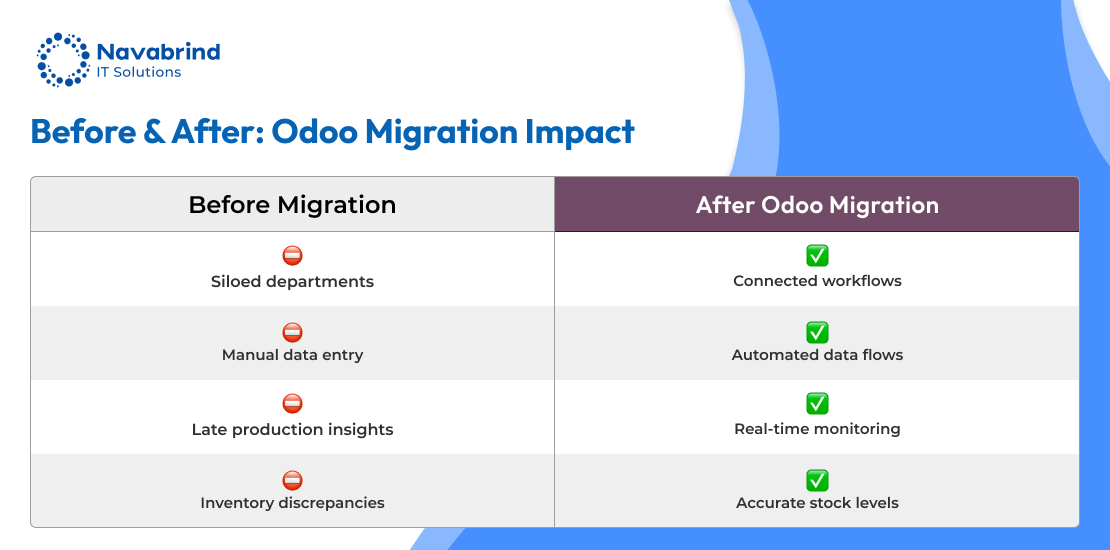
Manufacturers relying on paper records, spreadsheets, or delayed production updates struggle with missing information, inventory inaccuracies, production delays, and limited operational visibility. Replacing disconnected reporting with shop floor data collection software transforms how production activities are recorded across the Odoo shop floor.
Operators capture production quantities, material consumption, downtime, quality inspections, labor hours, and machine status at the point of execution, giving supervisors dependable manufacturing information without waiting for end-of-shift reporting. Odoo MRP converts this operational data into production insights that support scheduling, inventory planning, and capacity management. When combined with Odoo PLM through PLM integration with ERP, engineering revisions flow into production alongside accurate execution data.
Connecting PLM to MRP: Keeping Engineering and Production in Sync
Product development and manufacturing deliver stronger business outcomes when engineering and production operate from one connected information source. Odoo PLM manages product revisions, engineering change orders, drawings, bills of materials, and approval workflows, while Odoo MRP transforms approved product designs into manufacturing execution. Through PLM integration with ERP, engineering updates reach purchasing, inventory, production planning, and the Odoo shop floor before manufacturing begins, reducing production errors caused by outdated documentation. Combined with shop floor data collection software, manufacturing teams validate production performance against approved product revisions, allowing engineering and operations to collaborate using reliable manufacturing information. This connected process shortens product launch timelines.
Real-Time Shop Floor Visibility with Odoo
Production leaders gain greater operational control when manufacturing activities become visible from the moment work begins. Odoo MRP supports tablets, barcode scanning, and IoT connectivity across the Odoo shop floor, allowing operators to record production progress, material movement, quality inspections, equipment status, and order completion from production stations. Integrated shop floor data collection software captures manufacturing information as operations progress, allowing supervisors to evaluate productivity, inventory movement, resource utilization, and production efficiency without delayed reporting. Through PLM integration with ERP, engineering revisions from Odoo PLM remain available throughout production, reducing process deviations and maintaining product accuracy. This connected manufacturing environment strengthens manufacturing performance across the factory.
Common Pitfalls of Odoo for Manufacturing
Successful manufacturing outcomes depend on configuration, process alignment, and disciplined implementation rather than software installation alone. Organizations adopting Odoo MRP without validated bills of materials, production routings, work center planning, inventory accuracy, or employee training face scheduling conflicts, material shortages, reporting inconsistencies, and production delays. Ignoring shop floor data collection software limits production visibility and weakens operational reporting across the Odoo shop floor. Disconnecting engineering from production by avoiding PLM integration with ERP creates revision errors that affect manufacturing quality and delivery performance.
How Navabrind IT Solutions Implements Shop Floor Automation
Navabrind IT Solutions delivers manufacturing implementations centered on operational performance, production visibility, and measurable business outcomes. The implementation approach begins with production assessment, process mapping, routing validation, work center configuration, inventory alignment, and manufacturing workflow optimization within Odoo MRP. Shop floor data collection software is configured to capture production activities, operator performance, machine utilization, material movement, and quality records across the Odoo shop floor. Odoo PLM is integrated through PLM integration with ERP, allowing engineering revisions to move into production with controlled approvals and version management. User training, production testing, phased deployment, and post-implementation support help manufacturing teams achieve consistent execution.
Frequently Asked Questions
1.What is MRP in Odoo and how does it support shop floor automation?
Odoo MRP manages production planning, work orders, routings, bills of materials, inventory, and manufacturing execution from one ERP platform. When connected with shop floor data collection software, operators record production progress, material consumption, machine status, and quality checks from the Odoo shop floor. This continuous production visibility helps manufacturers improve planning accuracy, reduce delays, optimize resource utilization, and maintain consistent product quality across manufacturing operations.
2.How does Odoo PLM integrate with the MRP module?
Odoo PLM connects engineering and manufacturing through PLM integration with ERP, allowing approved product revisions, engineering change orders, bills of materials, and production instructions to flow into Odoo MRP. Production teams receive updated manufacturing information before work begins, reducing revision errors, preventing outdated documentation from reaching the factory, and improving collaboration between design, production, procurement, and quality teams.
3.Can Odoo collect real-time shop floor data without extra hardware?
Yes. Odoo MRP supports data capture through tablets, barcode scanners, mobile devices, and browser-based interfaces, allowing manufacturers to implement shop floor data collection software without investing in complex hardware. IoT devices can expand machine connectivity when required, though standard production reporting, work order updates, inventory transactions, and quality records can operate through existing devices across the Odoo shop floor.
4.What are the disadvantages of using Odoo for manufacturing?
Manufacturing performance depends on implementation quality rather than the ERP platform alone. Incomplete bills of materials, inaccurate routings, inconsistent inventory records, limited user training, or missing PLM integration with ERP can reduce production accuracy. Organizations that skip shop floor data collection software may experience limited production visibility, delayed reporting, and weaker operational insights. Careful configuration and process alignment help manufacturers avoid these challenges.
5.How much does Odoo manufacturing and inventory management cost?
The cost of Odoo MRP and inventory management depends on deployment model, selected applications, user licenses, implementation scope, custom development, data migration, training, and ongoing support. Small manufacturers with standard workflows invest significantly less than enterprises requiring multi-site production, Odoo PLM, PLM integration with ERP, and extensive shop floor data collection software. Requesting a detailed implementation assessment provides the most accurate cost estimate based on operational requirements.
Schedule a conversation with us now!
Related Articles









 Post
Post Post
Post