The Fear and the Reality
Every few years, a new technology arrives wearing a disruptive promise: this is the one that changes everything. The cloud was supposed to kill on-premise software. Mobile was going to make the desktop irrelevant. APIs were going to unbundle the monolith. And now, AI is being handed the same megaphone, with the claim that autonomous agents will make traditional business software, ERP included, a relic of how companies used to operate.
It’s a compelling story, but with just enough truth to make you research more.
The truth is that AI agents are capable of handling tasks that once required human intervention, such as, processing invoices, flagging anomalies, routing approvals, generating reports, and responding to supplier queries. The part that gets quietly left out, however, is that every one of those actions needs to pull data from somewhere, write results to somewhere, and operate within rules defined somewhere. That somewhere has a name. It’s called your ERP.
The current wave of excitement around autonomous AI agents is warranted. These aren’t chatbots that answer FAQs. They are systems that can reason over data, plan multi-step actions, and execute business workflows without a human at every stage. In the context of Odoo and similar platforms, the possibilities are significant.
But excitement has a way of outrunning understanding. The narrative that has taken hold in boardrooms and on LinkedIn is that “If AI can do the work, why do we need the system?” This is a wrong question, and asking it leads to exactly the wrong conclusions.
The more useful question is: what does AI need to do the work well? The answer to that question points squarely back to the ERP. AI agents don’t replace the need for a structured, governed, reliable system of record but make that need acute. A poorly implemented ERP with inconsistent data and undefined processes was always a problem. With AI agents in the picture, it becomes a much bigger one.
For businesses that have invested in building a solid operational foundation, it’s actually quite encouraging. AI doesn’t make Odoo obsolete. It makes getting Odoo right more important than ever.
What AI Agents Actually Do in an ERP Context
Before we can review what AI changes, let’s understand what AI agents are because the term gets used loosely enough to mean almost anything.
An AI agent is a system that can perceive a situation, decide what to do about it, take action, and then evaluate the outcome, often in a continuous loop, without waiting to be told what to do at each step. Unlike traditional automation rules, which execute a fixed sequence if certain conditions are met, an agent can reason. It can weigh options, handle exceptions, and adapt its approach based on what it encounters. Think of it less like a macro and more like a junior colleague who has been given a clear objective and authority to figure out how to achieve it.
In the context of an ERP like Odoo, this capability lands in some very practical places.
Invoice processing is one of the clearest examples. Traditionally, a finance team member receives an invoice, checks it against the purchase order, verifies quantities and pricing, flags discrepancies, routes it for approval, and posts it to the ledger. An AI agent can handle the bulk of this — extracting data from the document, matching it against the relevant PO in Odoo, identifying mismatches, and either resolving them within defined tolerances or escalating only the ones that genuinely need a human eye. What once took twenty minutes of someone’s morning becomes something that happens in seconds, at scale, around the clock.
Purchase order management follows a similar pattern. Agents can monitor inventory levels, anticipate reorder points based on consumption trends, generate draft POs, and route them for approval — all without a procurement manager having to initiate each cycle manually. The manager’s role shifts from executing the process to reviewing its outputs and handling exceptions.
Demand forecasting is where agents start to show something closer to genuine intelligence. By drawing on historical sales data, seasonal patterns, open opportunities in the CRM, and external signals, an AI agent can generate forward-looking demand estimates that update dynamically — and feed those estimates back into production planning and inventory management inside Odoo in near real time. The gap between what the business knows and how it acts on that knowledge narrows considerably.
Customer follow-ups represent another high-volume, low-complexity task that agents handle well. Chasing overdue invoices, sending order status updates, flagging at-risk accounts, nudging stalled deals — these are tasks that require consistency more than creativity. An agent can execute them with a reliability that human teams, managing dozens of other priorities, rarely can.
The efficiency gains here are not marginal. Businesses that deploy AI agents across these workflows report meaningful reductions in processing time, error rates, and the administrative overhead that quietly consumes a significant portion of most operational teams’ capacity. For growing companies on Odoo, this can translate into the ability to scale transaction volume without scaling headcount proportionally — which is a genuinely compelling value proposition.
But here is the part that tends to get glossed over in the enthusiasm: none of these agents are conjuring their outputs from nothing. The agent processing your invoices is matching against POs that live in Odoo. The one managing your procurement is reading inventory records stored in Odoo. The forecasting model is trained on sales history that Odoo has been capturing. The follow-up agent is working from customer and transaction data that Odoo maintains.
Remove Odoo from the picture — or replace it with a fragmented, inconsistent, poorly maintained version of itself — and the agents have nothing solid to work with. Efficiency built on unreliable data isn’t efficiency. It’s confident error at scale.
The promise of AI agents in an ERP context is real. But it is a promise that is only as good as the system underneath it.
Why AI Still Needs Odoo (or Any Robust ERP) to Function
There is a useful analogy buried in how we talk about AI agents. We describe them as autonomous — capable of acting independently, making decisions, executing tasks without constant human direction. And that description is accurate, as far as it goes. But autonomy is not the same as self-sufficiency. A surgeon operating independently still needs a sterile theatre, reliable instruments, and accurate patient records. The autonomy is real; the dependency on the surrounding system is equally real. AI agents in a business context work the same way. Their independence is genuine, but it rests entirely on the quality of the infrastructure beneath them.
That infrastructure, for most mid-market and growing businesses, is the ERP. Here is why that dependency is not incidental — it is structural.
Clean, Structured Data: The Foundation Everything Else Stands On
AI systems are sophisticated pattern-recognition engines. They find signal in data, draw inferences, and act on what they find. Which means the quality of what they produce is a direct function of the quality of what they consume. Garbage in, confident garbage out, and the confidence is what makes it dangerous.
An ERP like Odoo, when implemented and maintained properly, is the closest thing a business has to a single, authoritative version of the truth. Customer records, product catalogs, pricing structures, supplier terms, transaction histories, inventory positions all of it lives in one governed place, structured consistently, updated in real time. This is not a small thing. Most businesses that have operated without a proper ERP or with a poorly maintained one know what the alternative looks like: customer data in a spreadsheet that three people maintain differently, inventory figures that don’t match the warehouse floor, pricing exceptions that exist only in someone’s email thread.
An AI agent trying to operate on top of that kind of data environment doesn’t become more efficient. It becomes a very fast source of compounding errors. Clean, structured, centralised data isn’t a nice-to-have for AI deployment; it is the prerequisite. And Odoo, at its best, is precisely what provides it.
Financial Integrity and Compliance: Where Autonomy Has Hard Limits
There are parts of business operations where the tolerance for error is low and the consequences of getting things wrong are significant. Finance is the most obvious one. Transactions need to be recorded accurately, completely, and in the right period. Audit trails need to exist. Tax treatments need to be applied correctly. Regulatory requirements — which vary by geography, industry, and entity type need to be met consistently and documented thoroughly.
AI agents can do a great deal inside this space: matching transactions, flagging anomalies, preparing reconciliations, generating reports. But they cannot be the system of record for any of it. The moment an agent takes a financial action, that action needs to be captured, governed, and made auditable within a structure with built-in accountability. That structure is the ERP.
This matters not just for external compliance — regulators, auditors, tax authorities — but for internal governance as well. When something goes wrong, and in any business of sufficient complexity something eventually does, the ability to trace what happened, when, who authorized it, and what system recorded it is not optional. An AI agent operating outside a governed ERP environment doesn’t just create operational risk. It creates a traceability gap that can be very difficult to close after the fact.
Integrations: AI Plugs Into the Ecosystem, Not Around It
Modern businesses don’t run on a single system. They run on a constellation of them CRM, inventory management, accounting, HR, e-commerce, logistics, customer support. The value of an ERP like Odoo is that it sits at the centre of this constellation, connecting systems, synchronizing data, and ensuring that what happens in one part of the business is reflected accurately everywhere else.
AI agents need access to this connected ecosystem to function effectively. An agent handling customer follow-ups needs to know the customer’s order history, their outstanding invoices, their support ticket status, and their relationship tier. That information doesn’t live in a single place — it lives across the systems Odoo has already connected. The agent doesn’t bypass that integration layer. It depends on it entirely.
This is a point worth sitting with. The temptation, when thinking about AI deployment, is to imagine agents as a new layer that sits above existing systems and orchestrates everything from the top down. The reality is almost the opposite. Agents are consumers of the infrastructure that ERP already provides. They are powerful consumers faster, more tireless, and more consistent than human operators but consumers nonetheless. The integration work that went into connecting Odoo with the rest of the business stack doesn’t become redundant when AI enters the picture. It becomes the foundation the agents run on.
Business Process Governance: Rules, Approvals, and the Shape of How Work Gets Done
Every business has a logic to how it operates. Purchase orders above a certain value need a second sign-off. Credit notes require finance director approval. New suppliers have to go through a vetting process before they can be activated. Customer discounts beyond a certain threshold need a commercial review. These rules are not arbitrary; they exist because experience has shown that certain decisions carry enough risk or consequence to warrant a checkpoint.
In a well-implemented Odoo environment, this logic is encoded into the system. Workflows are defined. Approval hierarchies are configured. Thresholds are set. Exceptions are routed to the right people. The ERP doesn’t just record what the business does, it enforces how the business is supposed to do it.
AI agents operating within this environment inherit that governance. They know — because Odoo tells them — which actions they can take autonomously and which ones require escalation. They operate within the rules of the business rather than around them. This is what makes autonomous operation trustworthy rather than alarming. The agent isn’t making unconstrained decisions. It is making decisions within a framework that the business has already defined and that Odoo enforces.
Strip away that governance layer, and you don’t have an empowered AI agent. You have an unsupervised system acting on incomplete understanding of how the business is actually supposed to work. The results of that scenario are, in most cases, not difficult to imagine.
The Symbiosis: AI Agents as ERP Power Users
Somewhere in the evolution of every significant technology, there is a moment when the framing shifts, when the question stops being will this replace what came before and starts being how do these things work together. We are at that moment with AI and ERP, and the businesses that recognise it early will have a meaningful advantage over those still arguing about whether one makes the other obsolete.
The right mental model is not replacement. It is not even augmentation, which still implies that the ERP is the primary actor and AI is an add-on. The most accurate framing is symbiosis, a relationship in which two things make each other more valuable, and where the removal of either diminishes both.
Reframing the Relationship
Think about what it means to be a power user of any system. A power user isn’t someone who uses a tool occasionally and carefully. It is someone who knows the system deeply, pushes it to its limits, extracts value from corners that casual users never find, and operates at a pace and scale that ordinary users cannot match. Power users make the system do more — but they also depend on the system being solid enough to support that intensity of use.
AI agents are, in the most literal sense, power users of Odoo. They query data at volumes no human operator would attempt. They execute transactions at speeds that would overwhelm a manual process. They monitor exceptions continuously, across every module, without fatigue or distraction. They do not just use Odoo more, they use it harder, faster, and more comprehensively than any human team could.
And here is what that means in practice: every weakness in your Odoo implementation that a human user could work around, an inconsistent product naming convention, a supplier record with missing payment terms, an approval workflow that people bypass because it’s too slow, becomes a genuine problem when an AI agent is operating at scale. Humans compensate intuitively for gaps in a system. They know that “Supplier A Ltd” and “Supplier A Limited” are the same entity. They know that the approval workflow is broken so they call the finance director instead. Agents do not make those intuitive leaps. They work with what the system gives them, precisely and literally.
The Amplification Effect — In Both Directions
This is the dynamic that most discussions about AI in ERP quietly sidestep: AI doesn’t just amplify what your system does well. It amplifies what your system does badly.
A well-implemented Odoo environment — clean master data, consistent processes, properly configured workflows, well-maintained integrations — becomes dramatically more powerful with AI agents operating on top of it. The efficiency gains compound. The automation reaches further. The insights generated are more reliable. The speed at which the business can operate without adding headcount increases substantially. Good systems, with AI on top, become excellent.
But a poorly implemented Odoo environment, duplicate records, inconsistent categorization, workflows that exist on paper but not in the system, and integrations that occasionally fall out of sync becomes a much more visible problem when AI is involved. The agent processing invoices at high volume will propagate matching errors at the same volume. The agent managing inventory will make reorder decisions based on stock figures that don’t reflect reality. The agent following up with customers will operate on relationship data that is months out of date. Messy systems, with AI on top, become messier, faster.
This is not an argument against adopting AI. It is an argument for taking ERP hygiene seriously as a prerequisite for AI deployment, rather than an afterthought.
ERP Hygiene as a Strategic Asset
In a pre-AI world, the costs of a poorly maintained ERP were real but somewhat absorbed. Experienced staff knew where the gaps were and compensated for them. Reports were manually adjusted before being trusted. Exceptions were handled through informal channels that existed precisely because the formal ones didn’t quite work. The system had slack, and humans filled it.
In an AI-driven world, that slack disappears. Agents don’t compensate for gaps, they expose them, at scale and at speed. Which means ERP hygiene, the unglamorous, ongoing work of keeping data clean, processes well-defined, and configurations current, transitions from operational housekeeping into a genuine strategic asset.
Businesses that have invested in that hygiene are positioned to extract significant value from AI deployment. Their agents have reliable data to work from, clear processes to operate within, and governance structures that make autonomous action trustworthy. The returns on that prior investment get revalued upward considerably.
Businesses that have deferred that work face a more difficult situation. Deploying AI agents on top of a fragmented or underpowered ERP doesn’t accelerate the business; it accelerates the dysfunction. The responsible path, in that case, is to fix the foundation before building on it. Which means, counterintuitively, that the right response to the arrival of AI is sometimes to go back and do the ERP implementation work properly, not to skip past it in a rush to deploy agents.
What emerges, for businesses that get this right, is something close to a virtuous cycle. A well-maintained Odoo environment enables effective AI agent deployment. Effective agents reduce the manual workload on operational teams. Those teams, freed from repetitive processing, have more capacity to focus on data quality, process improvement, and system optimisation. Better data and processes make the agents more effective. This further reduces manual workload, which creates more capacity for system improvement.
This cycle doesn’t start with the AI. It starts with the ERP. The businesses that will get the most from autonomous agents over the next few years are not necessarily the ones that move fastest to adopt them. They are the ones that have built, or are now building, the kind of stable, well-structured operational foundation that makes autonomous action possible in the first place.
AI doesn’t make ERP a legacy concern. It makes ERP the most important investment a business can make in its own future readiness.
Implications for Businesses Using Odoo
Everything discussed so far has been, in a sense, theoretical — an argument about the relationship between AI and ERP at a structural level. This section is where that argument becomes practical. Because if the analysis is correct, it has direct and uncomfortable implications for how businesses should be thinking about their Odoo investments right now.
The Revaluation of ERP Quality
For a long time, the conversation around ERP implementation has been dominated by a particular kind of pragmatism. Get it live. Get people using it. Solve the immediate problems. The more nuanced work, data governance, process standardisation, configuration depth, master data quality, has often been treated as something to come back to later, once the business has stabilized and there is budget and bandwidth to do it properly. In many organisations, later never quite arrives.
That approach has always carried a cost. But it was a cost that could be managed, because human teams are adaptable. They learn the workarounds. They build the informal processes that compensate for what the system doesn’t do well. The gap between what Odoo could do and what it actually does for the business gets papered over by experienced people who know where the bodies are buried.
AI changes the economics of that trade-off significantly. When agents begin operating on your Odoo data, they do not know where the bodies are buried. They treat every record as equally valid, every process as equally reliable, every configuration as intentional. The gap that experienced staff quietly managed becomes a gap that agents quietly exploit, generating outputs that are wrong in ways that are difficult to detect precisely because they are produced with such consistency and speed.
The implication is stark: the quality of your Odoo implementation is no longer just an operational concern. It is a determinant of how much value you will be able to extract from AI. Businesses that have invested seriously in implementation quality, clean master data, well-defined processes, properly configured workflows, and disciplined change management are sitting on an asset that is about to appreciate considerably. Businesses that have not are facing a remediation project that, if deferred further, will only become more expensive to address.
Don’t Skip the Fundamentals in a Rush to Deploy
There is enormous pressure right now from boards, competitors, and the technology press to move quickly on AI. That pressure is not entirely misplaced. The businesses that figure out how to deploy AI agents effectively will have real advantages in cost efficiency, speed, and scalability. The urgency is understandable.
But urgency, when applied to AI deployment atop an unprepared ERP, yields more risk than advantage. And the temptation to shortcut the fundamentals in order to move faster is one that Odoo customers, and the consultants advising them, need to resist deliberately.
What does skipping the fundamentals actually look like in practice? It looks like deploying an AI-powered invoice matching tool before your supplier master data has been cleaned and deduplicated. It looks like standing up an autonomous procurement agent before your inventory categorisation is consistent and your reorder logic is properly defined in the system. It looks like using AI to generate customer insights from a CRM that hasn’t been maintained rigorously and contains records that are months or years out of date. In each case, the technology is real and the capability is genuine, but the foundation it is being asked to stand on is not solid enough to support it.
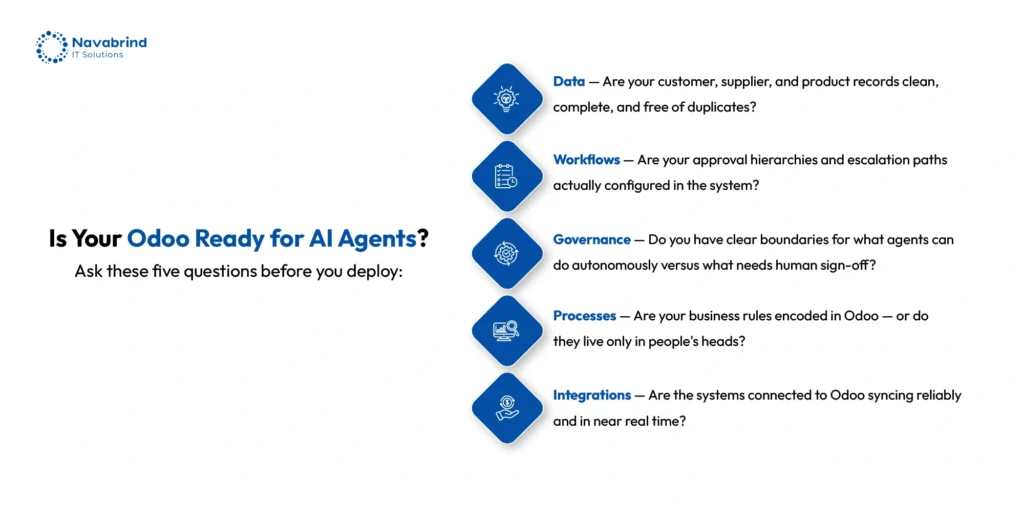
The implementation advice here is not complex, but it requires discipline to follow when the pressure to move fast is high. Before deploying AI agents in any area of your Odoo environment, ask three questions. First: is the data in this area clean, consistent, and current? Second: is the process that governs this area properly defined and actually encoded in the system — not just documented somewhere and informally followed? Third: are the integrations that this agent will depend on reliable and well-maintained? If the honest answer to any of those questions is no, the most valuable thing you can do is not deploy the agent. It is fix the answer.
That work is less exciting than deploying AI. It does not make for compelling announcements. But it is the work that determines whether your AI deployment creates value or creates the appearance of value while quietly generating errors that surface six months later in a board-level conversation about why the automation project didn’t deliver.
Perhaps the most consequential mindset shift that the AI era demands of Odoo customers is a reconsideration of how they think about ERP itself. For a segment of the market, ERP has drifted toward being perceived as a commodity, a necessary operational cost, a system of record that you run because you have to, implemented to a level that is good enough to avoid immediate pain and not much further. The selection conversation focuses on price and feature checklists. The implementation conversation focuses on going live on schedule and on budget. The post-go-live conversation, if there is one, focuses on keeping the lights on.
This framing has always undervalued what a well-implemented ERP actually does for a business. But in an AI-driven environment, it becomes actively damaging. Because if ERP is a commodity, it follows that ERP quality doesn’t matter much, that one implementation is roughly as good as another, that data governance is overhead rather than investment, that process discipline is bureaucracy rather than infrastructure. And if those beliefs drive your decisions, you will find yourself unable to extract meaningful value from AI agents, not because the technology is failing you, but because the foundation the technology needs simply isn’t there.
The businesses that will struggle most with AI adoption are not the ones that lack access to the technology. Access is increasingly democratised, Odoo’s own AI capabilities are expanding rapidly, and the ecosystem of agents and tools that integrate with it is growing. The businesses that will struggle are the ones that have been treating their ERP as an afterthought for years and now expect to layer sophisticated automation on top of a system that was never given the care it needed to function as a genuine operational backbone.
Conversely, the businesses that will extract disproportionate value from AI are those that have, through discipline, investment, or hard-won experience, built a genuinely solid Odoo environment. For them, the arrival of AI agents is not a disruption. It is a return on an investment that perhaps never felt like it was paying off quickly enough. The careful data governance work, the process standardization effort, the configuration decisions that were done properly rather than quickly, all of it suddenly becomes the foundation that AI runs on.
That is a powerful position to be in. And it is entirely available to any Odoo customer willing to do the work to get there.
ERP in the Age of AI
Every technology era eventually produces a moment of clarity, a point at which the noise settles and the actual shape of the change becomes visible. We are not quite there yet with AI. We are still in the phase where the possibilities are vast, the predictions are loud, and the gap between what is being promised and what is being delivered in practice is wide enough to cause genuine confusion about what businesses should actually do.
But some things are already clear enough to act on. And one of them is this: the businesses that will thrive in an AI-driven operational environment are not the ones that abandon their systems in pursuit of something newer. They are the ones that recognise what their systems are actually for — and invest in making them excellent.
We started with a fear: that AI would make ERP obsolete. That autonomous agents, capable of handling the work that enterprise software was built to support, would render the underlying systems redundant. It was a logical fear, given how the narrative around AI has been constructed. And it is, on examination, wrong.
Not wrong in the sense that nothing is changing, everything is changing. The way operational work gets done inside businesses running Odoo will look meaningfully different in five years than it does today. The volume of tasks handled autonomously will increase. The role of human operators will shift from execution toward oversight, exception handling, and strategic decision-making. The speed at which businesses can scale their operations without proportionally scaling their headcount will improve in ways that were not previously possible.
But through all that change, the ERP remains necessary. It becomes the axis around which everything else turns. AI agents need clean data, ERP provides it. They need governed processes, ERP encodes them. They need reliable integrations, ERP maintains them. They need financial integrity and audit trails, ERP guarantees them. The more autonomous the agents become, the more critical it is that the system they operate within is solid, well-structured, and trustworthy. Autonomy without a reliable foundation is not efficiency. It is risk that hasn’t surfaced yet.
AI amplifies ERP value. It does not deprecate it. That is not a reassuring platitude for people who have invested in Odoo. It is a structural reality that follows directly from what AI agents actually need in order to function.
An Honest Question Worth Asking Now
If that is the reality, then the most useful thing any Odoo customer can do right now is not to evaluate AI tools. It is to evaluate their foundation.
Not with the defensive question of is our system good enough to survive AI, but with the forward-looking one: is our system good enough to make AI work for us? That is a meaningfully different question, and it leads to a more productive audit.
Start with your data. Not at a high level, at the level of actual records. Are your customer accounts clean, current, and free of duplicates? Is your product master consistent in naming, categorisation, and attribute completeness? Are your supplier records accurate, with correct payment terms, tax configurations, and contact details? Data quality issues that a careful human can navigate around are issues that an AI agent will operationalise at scale. The time to find them is before deployment, not after.
Move to your processes. The question is not whether your processes are documented — it is whether they are in the system. A process that exists in a procedure manual but is not reflected in how Odoo is configured is not a process that an AI agent can follow. Approval workflows that are bypassed in practice, inventory rules that live in someone’s institutional knowledge rather than in the system, pricing logic that is applied manually because it was never properly set up — all of it needs to be surfaced and addressed.
Then look at your integrations. Every system that connects to Odoo is a data source that AI agents will draw from. Integrations that are unreliable, poorly maintained, or only partially implemented are weak links in the chain. An agent making decisions based on data that is twelve hours out of sync with the source system is making decisions based on a version of reality that no longer exists.
This audit is not a one-time exercise. ERP hygiene is an ongoing discipline, not a project with an end date. But there is particular value in doing it now, deliberately, with the explicit question of AI-readiness in mind — because it reframes the exercise from maintenance into preparation. You are not cleaning up old problems. You are building the foundation that your future operational capability will stand on.
The Future Belongs to the Well-Prepared
It has become fashionable to describe the near future of business operations in terms of AI-native companies — organisations built from the ground up around autonomous agents, operating without the legacy constraints of traditional software and traditional processes. There is something to this vision. New businesses starting today have the opportunity to build their operational infrastructure with AI in mind from the outset, and some of them will do so in ways that create genuine competitive advantages.
But the vast majority of businesses operating today are not starting from scratch. They have systems, processes, data, and operational histories that represent years of accumulated investment. The question for them is not how to become AI-native — it is how to become AI-ready. And the answer, almost always, runs through the ERP.
The future of business operations is not AI replacing systems. It is AI and systems working together in a way that neither could achieve alone. The ERP provides the structure, the data integrity, the process governance, and the integration fabric that autonomous agents require. The agents provide the speed, the scale, the tirelessness, and the analytical depth that human operators cannot sustain. Together, they create something genuinely new — an operational capability that is more responsive, more efficient, and more scalable than anything built on either element in isolation.
That future is not distant. It is arriving now, incrementally, in the businesses that are making the right investments in the right order. First the foundation. Then the automation. Not the other way around.
The age of AI does not belong to the businesses that move fastest. It belongs to the businesses that are most prepared — the ones with clean systems, well-governed processes, and the operational discipline to make autonomous agents trustworthy rather than merely fast. For Odoo customers who have invested seriously in getting their implementation right, that future is closer than they might think.
The work was never wasted. It was always preparation.
Frequently Asked Questions
1. If AI agents can automate most of our operational tasks, why do we still need to invest in Odoo?
Because the automation is only as good as the system it runs on. AI agents do not generate their own data, define their own processes, or create their own governance structures — they consume and act on what already exists in your ERP. When an agent processes an invoice, matches a purchase order, or triggers a reorder, it is drawing on records, rules, and configurations that live in Odoo. If those records are incomplete, those rules are inconsistently applied, or those configurations were never properly set up, the agent does not compensate — it operationalises the problem at scale. Investing in Odoo is not an alternative to adopting AI. It is the prerequisite for making AI work.
2. We’re a mid-sized business without a dedicated IT team. Is AI in Odoo realistic for us, or is this only for large enterprises?
The scale of your business changes the complexity of deployment, but it does not change the underlying logic. If anything, mid-sized businesses stand to gain disproportionately from AI agents in Odoo, because they are typically the ones most constrained by the ratio of operational volume to available headcount. The finance team processing a high volume of invoices with three people, the procurement manager juggling supplier relationships across dozens of product lines, the sales team trying to follow up consistently with a growing customer base — these are exactly the pain points that AI agents address most effectively. The entry point is not a large IT project. It is a honest assessment of where your data is clean and your processes are well-defined, and starting your AI deployment there.
3. Our Odoo implementation has been running for a few years and we know it has some data quality issues. Do we need to fix everything before we can start using AI?
Not everything — but you do need to fix the right things before deploying agents in specific areas. The practical approach is to map your AI deployment plans to your data quality reality, and sequence accordingly. If your customer master data is well-maintained but your supplier records are inconsistent, deploy agents in customer-facing workflows first and do the supplier data remediation work in parallel. The mistake to avoid is deploying an agent into an area where the underlying data is known to be unreliable, on the assumption that the agent will somehow work around it. It will not. Prioritise remediation in the areas where you intend to deploy first, treat data quality as an ongoing discipline rather than a one-time project, and expand agent deployment as the foundation improves beneath it.
4. How do AI agents handle exceptions and edge cases that fall outside normal business rules?
This is one of the most important practical questions in AI deployment, and the honest answer is that it depends significantly on how well your business rules are defined and encoded in Odoo in the first place. Well-configured AI agents are designed to operate autonomously within defined parameters and escalate when they encounter situations that fall outside those parameters — routing exceptions to the appropriate human decision-maker rather than attempting to resolve them unilaterally. The quality of that escalation logic is directly tied to the quality of the process governance in your ERP. Agents that operate within a well-structured Odoo environment know, with reasonable precision, where the boundaries of their authority lie. Agents operating in a loosely configured environment have a much blurrier picture of where autonomous action ends and human judgment should begin — which is precisely the scenario that creates operational risk.
5. We keep hearing that AI will keep improving rapidly. Should we wait for more mature AI tools before investing in our Odoo foundation?
This gets the sequencing exactly backwards. The AI tools will improve regardless of what you do — that trajectory is not something individual businesses control. What you do control is the readiness of your own foundation to take advantage of those improvements as they arrive. A business that spends the next twelve months cleaning its master data, standardising its processes, and configuring Odoo properly will be positioned to deploy progressively more capable AI agents as the technology matures. A business that waits for the technology to mature before addressing its foundation will find itself doing remediation work and AI deployment simultaneously — a much harder and more expensive problem. The foundation work has value independent of AI; it makes your operations more reliable, your reporting more accurate, and your team more effective right now. The fact that it also positions you well for AI deployment is reason to accelerate it, not to defer it.
Schedule a conversation with us now!
Related Articles









 Post
Post Post
Post