Indian manufacturers rarely start searching for ERP because of growth alone. The trigger comes when production delays, stock mismatches, vendor confusion, and reporting errors begin affecting cash flow month after month. Teams shift between spreadsheets, WhatsApp updates, disconnected accounting tools, and handwritten production notes until operations become difficult to control. That is where conversations around Odoo ERP implementation India begin.
Over the last five years, Odoo has gained attention among SME manufacturers because companies want one platform for inventory, production, procurement, accounts, CRM, and sales without the massive investment linked to legacy ERP systems. Yet many businesses underestimate what happens after selecting the software. They know they want Odoo, but they do not understand module planning, data migration, workflow mapping, or Odoo implementation cost India.
This blog post explains how to implement Odoo ERP, choose the suitable Odoo ERP partner India, plan Odoo ERP setup for manufacturing, estimate Odoo ERP pricing India, and prepare for a stable go-live process without operational disruption.
Why Indian Manufacturers Are Choosing Odoo ERP
Indian manufacturing SMEs are moving away from disconnected accounting software and rigid legacy ERP platforms because operational complexity has increased across procurement, production, inventory, compliance, and dispatch management. Traditional systems handle finance reporting but struggle to connect shop floor activities with purchasing, warehouse movement, vendor coordination, and production scheduling. This shift has accelerated demand for Odoo ERP implementation India among growing factories seeking operational control without excessive infrastructure spending.
Compared with SAP, Oracle, and Microsoft Dynamics, Odoo gives mid-sized manufacturers flexibility in deployment, customization, and expansion. Businesses can begin with inventory, manufacturing, purchase, and accounting modules, then expand into CRM, maintenance, HR, or quality management as operations scale. This approach keeps Odoo implementation cost India manageable during early adoption stages.
Manufacturers prefer Odoo ERP setup for manufacturing because work orders, routing, bill of materials management, procurement tracking, GST workflows, warehouse management, and production planning operate inside one ecosystem. CNC workshops, plastic moulding companies, food processors, pharma manufacturers, and sheet metal fabricators increasingly rely on experienced Odoo ERP partner India teams to streamline plant operations and reduce production bottlenecks.
Which Odoo Modules Are Needed for Manufacturing in India?
Module selection shapes the success of Odoo ERP implementation India far more than software installation itself. Many manufacturers either overload the system with unnecessary applications or choose too few modules, creating operational gaps after deployment. A factory ERP must reflect procurement flow, shop floor activity, inventory movement, compliance reporting, and financial control from day one.
For Odoo ERP setup for manufacturing, the primary stack includes Manufacturing (MRP), Inventory, Purchase, Sales, and Accounting. These modules manage BOMs, work orders, routing, warehouse transfers, vendor purchasing, GST invoicing, production planning, and stock valuation within one workflow. This foundation supports daily factory operations without fragmented systems.
Manufacturers with process-heavy environments expand into Quality, Maintenance, PLM, Barcode, and Purchase Requisitions to strengthen inspection tracking, machine upkeep, engineering revisions, and operator-level production execution. Businesses handling customer-driven production cycles frequently adopt CRM and Project modules.
Indian manufacturers must prioritize localisation during implementation. GST filing, e-invoicing, TDS, TCS, e-way bills, export transactions, and statutory reporting significantly influence Odoo ERP pricing India and implementation scope. An experienced Odoo ERP partner India helps configure these requirements correctly from the beginning, reducing compliance risks and operational disruption later.
Odoo ERP Setup for Manufacturing: The Implementation Architecture
Odoo ERP setup for manufacturing involves far more than installing software and activating modules. The implementation structure beneath the platform determines production visibility, inventory accuracy, reporting reliability, and long-term operational stability. Many manufacturers struggle after go-live because the ERP reflects software defaults instead of actual factory processes. Successful Odoo ERP implementation India begins with architecture planning across data, workflows, and user access.
The first layer focuses on data architecture. Bill of Materials structure, routing configuration, work centres, product masters, units of measure, and opening inventory define how production behaves inside the system. Incorrect stock migration or poorly designed BOM structures create planning errors that continue for years.
The second layer covers workflow configuration. Manufacturing order flow, procurement triggers, material planning, inspection checkpoints, and costing methods must match factory operations. FIFO, average costing, or standard costing decisions significantly affect reporting and profitability analysis in Indian manufacturing environments.
The third layer addresses operational usage. Role-based permissions, shop floor terminals, approval hierarchies, and dashboards shape how teams interact with the ERP daily. An experienced Odoo ERP partner India configures these layers carefully to control Odoo implementation cost India and strengthen adoption across production, procurement, warehouse, and finance teams.
How to Implement Odoo ERP: A Step-by-Step Process
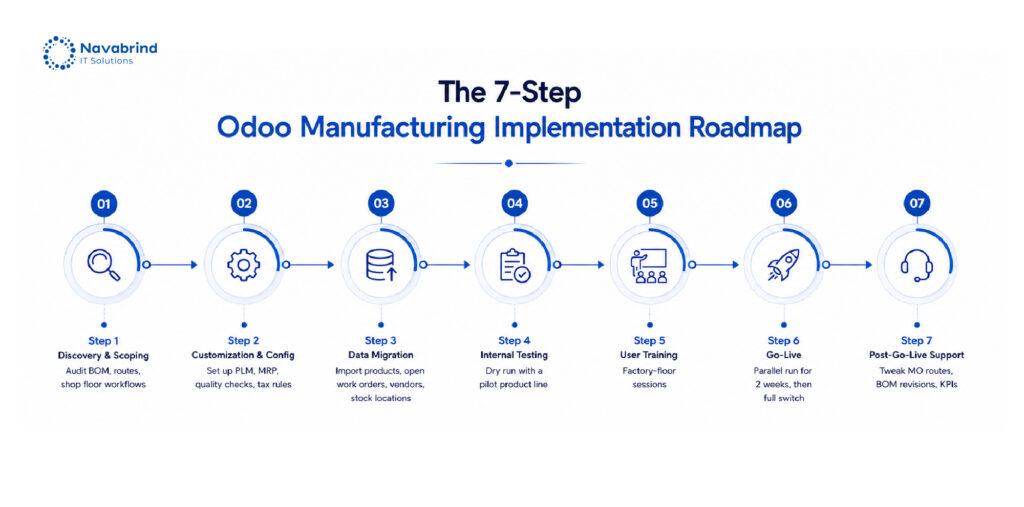
- Successful Odoo ERP implementation India depends on execution sequence, not software activation alone. Many manufacturers fail by launching inventory, accounts, production, procurement, HR, and reporting together without stabilizing workflows first. ERP implementation succeeds when businesses move through controlled stages with measurable validation at each phase.
- The process begins with business workflow mapping. Production, procurement, warehouse, finance, and quality processes must be documented before configuration starts. This stage identifies operational gaps requiring ERP intervention versus internal process correction.
- Next comes gap analysis and solution design. Businesses evaluate where standard Odoo functionality fits operations and where customization becomes necessary. This stage strongly influences Odoo implementation cost India because excessive customization increases deployment complexity and maintenance overhead.
- System configuration follows with hosting selection, module setup, localization, workflow logic, integrations, and staging validation. After that, businesses migrate cleaned master data, opening balances, inventory records, and historical transactions in controlled batches.
- Training, User Acceptance Testing, and parallel runs prepare teams before cutover. During go-live, the Odoo ERP partner India monitors adoption, data accuracy, production continuity, and reporting stability closely. Post-launch optimization then expands the platform gradually based on operational performance, helping manufacturers scale Odoo ERP setup for manufacturing without disrupting factory execution.
What Are the Steps to Implement Odoo ERP in a Factory?
Factory ERP rollouts demand operational preparation far beyond office-based software deployment. Odoo ERP setup for manufacturing affects machine operators, supervisors, warehouse teams, procurement staff, and production planners simultaneously. Without shop floor readiness, even technically successful deployments struggle during daily execution.
Before go-live, manufacturers must prepare hardware infrastructure across the plant. Tablets, barcode scanners, operator terminals, printers, and stable network connectivity influence how production data enters the system. Physical placement matters because operators need fast interaction during active production cycles without interrupting machine activity. Odoo ERP implementation India succeeds when data entry becomes part of operational rhythm instead of an additional administrative burden.
Production continuity planning remains equally important. Factories cannot pause manufacturing during ERP deployment. Businesses should select controlled pilot jobs during User Acceptance Testing and avoid cutover during peak production seasons. This reduces operational risk and stabilizes reporting accuracy during transition.
Human adoption determines long-term success. Supervisors and machine operators need clarity on why workflows are changing and how ERP improves production visibility. Experienced Odoo ERP partner India teams identify shop floor champions early because peer-led adoption accelerates acceptance and reduces implementation resistance across departments.
How Long Does Odoo ERP Implementation Take in India?
Odoo ERP implementation India timelines vary because manufacturing businesses differ in process maturity, data quality, plant complexity, customization requirements, and internal decision speed. Many ERP vendors promise aggressive delivery schedules during sales discussions, yet actual execution depends less on software installation and far more on operational readiness inside the factory.
Small manufacturers with one plant, 10–30 users, and standardized workflows can complete implementation within 6 to 10 weeks. These projects commonly include Manufacturing, Inventory, Purchase, Sales, and Accounting modules with limited customization. Clean master data, stable processes, and single-location operations reduce implementation friction and keep Odoo implementation cost India under control.
Mid-sized manufacturers operating across multiple warehouses or production lines generally require 3 to 5 months. Their deployments involve Quality, Maintenance, HR, vendor coordination workflows, approval structures, reporting customization, and integrations with existing systems. Odoo ERP setup for manufacturing becomes more detailed because routing logic, warehouse transfers, production scheduling, and user permissions increase in complexity.
Large manufacturers with multiple plants, multi-company structures, export operations, or MES integrations may require 6 to 12 months. These projects involve phased rollouts, extensive historical migration, localization configuration, machine-level reporting integration, and complex approval chains. Cross-location coordination significantly affects implementation stability.
The largest causes of delay are rarely technical. Poor inventory records, duplicate product masters, inconsistent BOM structures, undocumented production workflows, and delayed management approvals create serious deployment bottlenecks. Factories frequently underestimate the operational shift required on the shop floor during ERP adoption. Operator resistance, inconsistent production reporting habits, and insufficient training slow implementation momentum.
Timeline compression comes from preparation. Manufacturers with documented workflows, dedicated implementation leaders, stable decision-making, and organized master data move faster through configuration and testing stages. A phased rollout strategy also improves stability. Many successful factories launch inventory, procurement, production, and accounting first, then expand into Quality, Maintenance, HR, CRM, or PLM after operational stabilization.
An experienced Odoo ERP partner India plays a major role in execution speed. Manufacturing-focused partners identify workflow gaps early, reduce unnecessary customization, structure migration carefully, and guide factories through testing, training, and go-live without disrupting production continuity.
Odoo ERP Pricing India: Understanding the Full Cost Structure
- Manufacturers evaluating Odoo ERP implementation India frequently search for one final price, but ERP investment does not work that way. Odoo ERP pricing India depends on licensing, implementation scope, customization depth, infrastructure choice, training effort, and long-term support requirements. Two factories using the platform can operate with completely different cost structures based on workflow complexity and operational scale.
- Licensing forms the first layer. Odoo Community carries no subscription fee but lacks enterprise-grade capabilities, official upgrades, and support services required by growing manufacturers. Odoo Enterprise follows a per-user annual subscription model. Costs increase based on application usage and named user access. Manufacturing businesses must decide which employees require full licenses and which teams can operate through limited portal access.
- The second cost layer involves implementation services. Odoo ERP partner India teams charge for discovery workshops, workflow mapping, module configuration, data migration, training, testing, and go-live assistance. Odoo implementation cost India rises as user volume, plant count, customization requirements, and integration scope increase. Fixed-price engagements provide budgeting stability, though poorly defined scope creates disputes later. Time-and-material models offer flexibility but require tighter project governance.
- Customization introduces another major cost variable. Standard Odoo configuration handles many manufacturing operations, yet businesses frequently request production dashboards, vendor portals, barcode workflows, machine integrations, approval automation, and custom MIS reporting. Each development request affects deployment timelines, testing effort, upgrade compatibility, and long-term maintenance spending.
- Infrastructure selection shapes recurring operational costs. Odoo.sh provides managed hosting with staging and deployment management. Cloud infrastructure through AWS, Azure, or Google Cloud offers greater scalability but demands technical administration. On-premise deployment requires server investment, backup management, and internal IT oversight. Monthly infrastructure spending varies based on database size, transaction load, user count, and integration complexity.
- Training and adoption expenses are consistently underestimated during Odoo ERP setup for manufacturing. Production supervisors, warehouse operators, procurement teams, finance staff, and plant managers require role-focused learning sessions. Factories must account for operational time diverted toward workshops, testing, SOP preparation, and process validation during implementation.
- After go-live, annual support becomes an ongoing operational investment. Businesses budget for partner retainers, version upgrades, localization updates, compatibility checks, workflow enhancements, and additional module expansion as operational requirements evolve.
How Much Does Odoo ERP Cost for Manufacturers in India?
Odoo ERP cost for manufacturers in India depends on operational scale, user count, module selection, customization requirements, integrations, hosting model, and implementation complexity. A small factory running standard workflows with limited users will invest far less than a multi-plant manufacturer requiring production automation, barcode systems, quality management, custom reporting, and third-party integrations. Odoo ERP pricing India therefore varies according to business structure rather than software access alone.
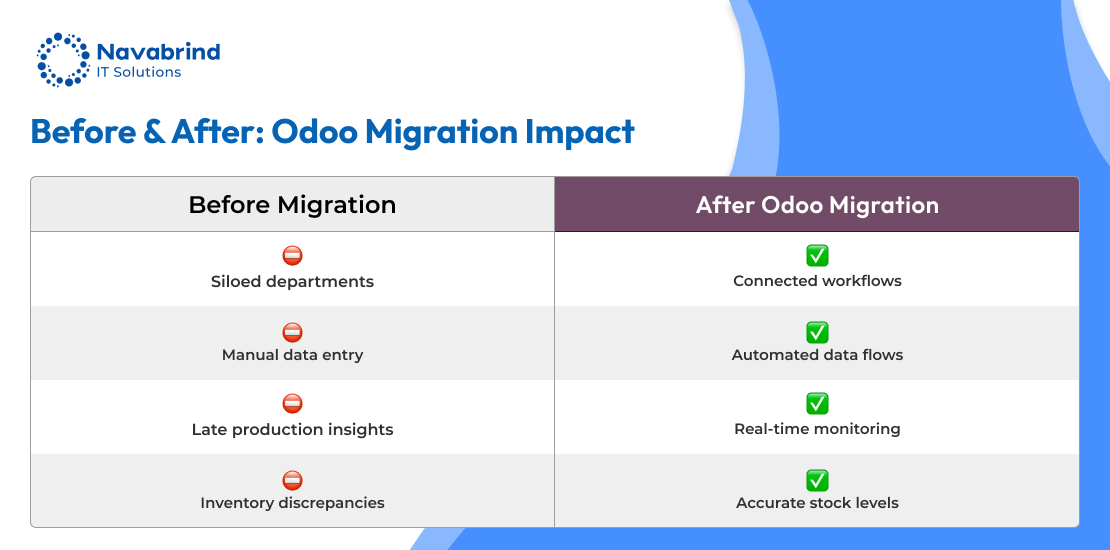
For many manufacturers, the larger financial question is not implementation expense but the ongoing cost of operational inefficiency. Inventory mismatches, delayed procurement, production downtime, excess raw material purchases, inaccurate costing, dispatch delays, and disconnected reporting quietly reduce profitability month after month. Odoo ERP implementation India replaces fragmented operational control with centralized production visibility and process accountability.
Manufacturers evaluating Odoo implementation cost India frequently measure ROI through inventory accuracy improvements, reduced stock carrying cost, stronger production planning, labour productivity gains, lower material wastage, faster reporting cycles, and improved on-time delivery performance. Mid-sized factories commonly begin seeing measurable operational impact within 12 to 24 months after go-live, especially when the Odoo ERP setup for manufacturing aligns closely with actual plant workflows and adoption remains consistent across departments.
How to Choose an Odoo Implementation Partner in India
- Choosing the correct Odoo ERP partner India shapes the outcome of the entire implementation journey more than the software itself. Odoo offers extensive flexibility across manufacturing, inventory, procurement, accounting, quality, and production planning. Without experienced execution, that flexibility can create operational confusion instead of process control. A poorly structured Odoo ERP implementation India may increase reporting gaps, user resistance, and workflow inconsistency across the factory floor.
- Official partner status provides a starting point, not a guarantee. Odoo Ready, Silver, Gold, and Platinum tiers indicate ecosystem participation and certification levels, though certifications alone do not confirm manufacturing expertise. The real differentiator is implementation experience inside production-driven businesses.
- Manufacturers should evaluate whether the partner has handled BOM complexity, routing logic, shop floor workflows, inventory valuation, machine maintenance, subcontracting, and production planning environments similar to their own operations. Questions around live manufacturing references, industry exposure, and post-go-live support reveal far more than presentations or sales brochures.
- Strong implementation teams balance functional consulting with technical capability. Manufacturing projects fail when developers drive configuration without operational understanding. Businesses must examine escalation processes, support commitments, ticketing systems, and hypercare structure before signing contracts.
- Several warning signs deserve immediate attention. Unrealistically low Odoo implementation cost India estimates, rushed timelines, excessive customization proposals, and vague scope definitions frequently indicate weak project planning. Reliable partners invest time understanding factory operations before discussing pricing or delivery schedules.
- Manufacturers must then choose the engagement structure that fits internal decision-making. Fixed-scope models support budget predictability, whereas agile execution supports evolving operational requirements during implementation. Local implementation partners provide stronger on-site coordination for factories managing production-sensitive rollouts, especially during testing, training, and go-live stabilization phases.
Is Odoo ERP Implementation Difficult for Small Manufacturers?
- Odoo ERP implementation India is not technically overwhelming for small manufacturers, yet the organizational shift can feel demanding because small factories operate with lean teams, informal workflows, and limited process documentation. The challenge rarely comes from the software itself. The challenge comes from changing how the business records inventory, tracks production, manages purchasing, and monitors operational accountability.
- Small manufacturers frequently struggle with bandwidth during implementation. The production manager handling machine scheduling may also become the ERP coordinator. Inventory records may exist across spreadsheets, notebooks, and operator memory rather than standardized master data. In many factories, workflows depend on long-term employee experience instead of documented procedures, which complicates Odoo ERP setup for manufacturing during configuration and testing stages.
- Despite these challenges, Odoo remains well suited for small manufacturers because adoption can happen gradually. Businesses can begin with Inventory, Purchase, and Manufacturing modules before expanding into costing, quality, maintenance, HR, or analytics later. This phased structure keeps Odoo implementation cost India manageable and allows teams to strengthen operational discipline step by step.
- Smaller factories frequently benefit from faster decision-making and shorter training cycles. Configuration approvals, workflow adjustments, and user feedback move faster because fewer stakeholders participate in implementation discussions. An experienced Odoo ERP partner India can use this advantage to stabilize deployment quickly without excessive complexity.
- The manufacturers that succeed with ERP view the project as an operational transformation initiative rather than a software installation exercise. The investment extends beyond technology into process consistency, production visibility, inventory accuracy, and stronger execution discipline across the factory floor.
Common Odoo ERP Implementation Mistakes Indian Manufacturers Make
- Odoo ERP implementation India failures do not come from software limitations. They come from rushed decisions, weak operational preparation, and unrealistic expectations during deployment. Manufacturers frequently attempt to launch inventory, production, finance, HR, quality, and procurement together without stabilizing foundational workflows first. This creates confusion across departments and weakens user adoption during the earliest stages of go-live.
- Data migration becomes another major problem area. Businesses move inaccurate stock records, duplicate vendor lists, incorrect BOM structures, and outdated product masters into the ERP, embedding operational errors into the system from day one. Poor data quality damages reporting reliability and weakens production planning accuracy long after implementation ends.
- Training is another underestimated area during Odoo ERP setup for manufacturing. Many companies reduce training investment to lower Odoo implementation cost India, expecting teams to learn during live operations. This approach creates reporting inconsistency, user frustration, and workflow bypassing across the factory floor.
- Partner selection also shapes implementation success. Manufacturers choosing an Odoo ERP partner India based only on pricing frequently encounter excessive customization, unstable workflows, delayed support, and operational disruption after go-live. Manufacturing expertise matters far more than low initial quotations.
- Another damaging mistake involves configuring ERP around broken internal processes instead of correcting those workflows first. ERP strengthens discipline; it does not repair unmanaged operations automatically. Factories without a dedicated internal implementation leader struggle with delayed approvals, inconsistent decisions, and weak accountability throughout deployment.
- Successful manufacturers treat go-live as the beginning of operational refinement rather than the end of the project. They define measurable success metrics early, monitor adoption carefully, and strengthen workflows continuously after launch.
Odoo ERP implementation in India is not a technology project:
Odoo ERP implementation India succeeds when manufacturers approach ERP as an operational transformation initiative rather than a software installation exercise. Technology alone does not improve production visibility, inventory accuracy, procurement control, or delivery performance. Results come from disciplined workflows, reliable data, accountable reporting, and organizational alignment across the factory floor.
The manufacturers gaining long-term value from Odoo are not always the largest plants or the companies with the largest IT budgets. Success comes from businesses that define workflows carefully, prepare clean operational data, commit internal leadership bandwidth, maintain realistic implementation timelines, and choose an experienced Odoo ERP partner India with manufacturing expertise.
A well-planned Odoo ERP setup for manufacturing carries a measurable and finite investment. Odoo implementation cost India becomes predictable when scope, workflows, and deployment priorities are defined early. In contrast, disconnected systems continue creating hidden operational losses through inventory mismatch, delayed purchasing, material wastage, production inefficiency, reporting gaps, and missed delivery commitments year after year.
Before evaluating Odoo ERP pricing India or deciding how to implement Odoo ERP, manufacturers should first understand their own operational bottlenecks, process gaps, and reporting limitations. The businesses that understand their operations clearly make stronger ERP decisions and achieve faster operational maturity after go-live.
Frequently Asked Questions
1.How much does Odoo ERP cost for manufacturers in India?
Odoo ERP pricing India depends on user count, module selection, customization scope, hosting choice, and implementation complexity. Small manufacturers with standard workflows invest less than multi-plant factories requiring integrations, barcode systems, quality management, and custom reporting. Odoo implementation cost India generally includes licensing, configuration, customization, migration, training, hosting, and annual support. Businesses should evaluate ERP investment against operational losses caused by inventory mismatch, delayed production planning, procurement inefficiencies, and reporting gaps.
2.How long does Odoo ERP implementation take in India?
Odoo ERP implementation India timelines vary based on factory size, workflow complexity, data quality, and customization requirements. Small manufacturers with limited users and standard manufacturing processes may complete deployment within 6 to 10 weeks. Mid-sized factories commonly require 3 to 5 months, whereas multi-plant manufacturers with integrations and phased rollouts may require 6 to 12 months. Strong internal coordination and experienced implementation support significantly reduce delays.
3.What are the steps to implement Odoo ERP in a factory?
The process begins with workflow discovery, operational mapping, and scope definition. After that, businesses move into gap analysis, module configuration, customization, data migration, user training, User Acceptance Testing, parallel runs, and go-live stabilization. Successful Odoo ERP setup for manufacturing continues after deployment through optimization, reporting refinement, and phased module expansion based on operational requirements.
4.Which Odoo modules are needed for manufacturing in India?
Manufacturers commonly begin with Manufacturing, Inventory, Purchase, Sales, and Accounting modules. Depending on operational complexity, businesses expand into Quality, Maintenance, Barcode, PLM, HR, CRM, or Project management. Indian manufacturers should prioritize GST compliance, e-invoicing, e-way bills, TDS, TCS, and statutory reporting during module planning for Odoo ERP implementation India.
5.How to choose an Odoo implementation partner in India?
An experienced Odoo ERP partner India should demonstrate manufacturing implementation expertise, strong functional consulting capability, stable post-go-live support, and live manufacturing references. Businesses should evaluate project methodology, escalation structure, customization approach, and factory-level implementation experience instead of selecting partners based only on pricing or aggressive timelines.
6.Is Odoo ERP implementation difficult for small manufacturers?
Odoo ERP implementation India is manageable for small manufacturers when deployment happens in phases. The larger challenge involves operational discipline, data organization, and process standardization rather than software complexity. Small factories benefit from faster decision-making, shorter training cycles, and modular deployment approaches that allow gradual expansion without overwhelming internal teams.
Schedule a conversation with us now!
Related Articles









 Post
Post Post
Post