Why ERP Migration is a Strategic Move:
Legacy ERP platforms drain time, inflate costs, and restrict growth. Disconnected workflows, delayed insights, and rising maintenance demands create friction across operations. Businesses aiming for scale cannot rely on outdated systems that limit visibility and control. This is where Odoo migration services become a turning point.
ERP to cloud migration replaces rigid infrastructure with flexible, scalable environments that support faster decision-making and stronger collaboration. Teams gain access to connected data, improved workflow continuity, and reduced dependency on fragmented tools. With ERP cloud migration, organizations unlock speed, adaptability, and cost efficiency without compromising control.
The shift toward Odoo ERP migration reflects a practical approach to transformation. Companies are moving away from complex, expensive systems toward a platform that unifies operations across finance, sales, inventory, and production. Odoo migration simplifies processes, reduces operational gaps, and strengthens data accuracy across departments.
At the center of this transition lies Odoo data migration, ensuring critical business information moves securely without disruption. Clean, reliable data becomes the foundation for better reporting and smarter planning. For growth-focused businesses, Odoo migration services are not just a technical upgrade that they redefine how operations perform, compete, and scale in a cloud-driven environment.
What is Odoo Migration?
Odoo migration refers to the process of transferring business operations, applications, and data into the Odoo ecosystem with improved performance, usability, and control. This includes Odoo data migration, where financial records, inventory details, sales history, and operational data move into a refined system without loss or distortion. The scope extends beyond data transfer covering workflow alignment, feature optimization, and system restructuring to match evolving business needs.
A version upgrade and Odoo ERP migration serve different goals. A version upgrade focuses on moving from one Odoo release to another, retaining the existing structure with incremental improvements. In contrast, Odoo ERP migration involves a broader transformation shifting from legacy ERP or disconnected tools into Odoo with redesigned processes, enhanced integrations, and improved usability. This makes ERP to cloud migration a transformation initiative rather than a technical update.
Odoo migration services play a decisive role in this journey. They manage data accuracy, reduce transition risks, and align the system with business workflows. Through structured execution of ERP cloud migration, businesses gain a reliable foundation for faster operations, stronger reporting, and scalable growth without operational disruption.
What Does a Complete Odoo ERP Data Migration Service Include?
Odoo migration services cover the full lifecycle of Odoo data migration, ensuring accuracy, continuity, and business readiness. The process begins with a data audit that identifies inconsistencies, duplicate entries, and outdated records. Cleansing removes noise, creating a reliable dataset ready for transition.
Next comes data mapping and transformation. Each field from legacy systems aligns with the Odoo structure, ensuring compatibility and usability. This step shapes how information flows across modules after Odoo ERP migration, preventing reporting gaps and workflow disruptions.
The migration phase includes transfer of master data such as customers, vendors, and products, along with transactional data like invoices, orders, and payments. Historical records move alongside, preserving business context and enabling trend analysis after ERP to cloud migration.
Validation and reconciliation follow immediately. Data accuracy is verified against source systems, ensuring financial balances, inventory levels, and operational records remain consistent. This step safeguards decision-making and compliance.
Integration plays a critical role during ERP cloud migration. Existing tools such as CRM platforms, E-Commerce systems, and third-party applications connect with Odoo without interrupting operations. Through structured execution, Odoo migration services transform raw data into a reliable, business-ready asset that drives performance after migration.
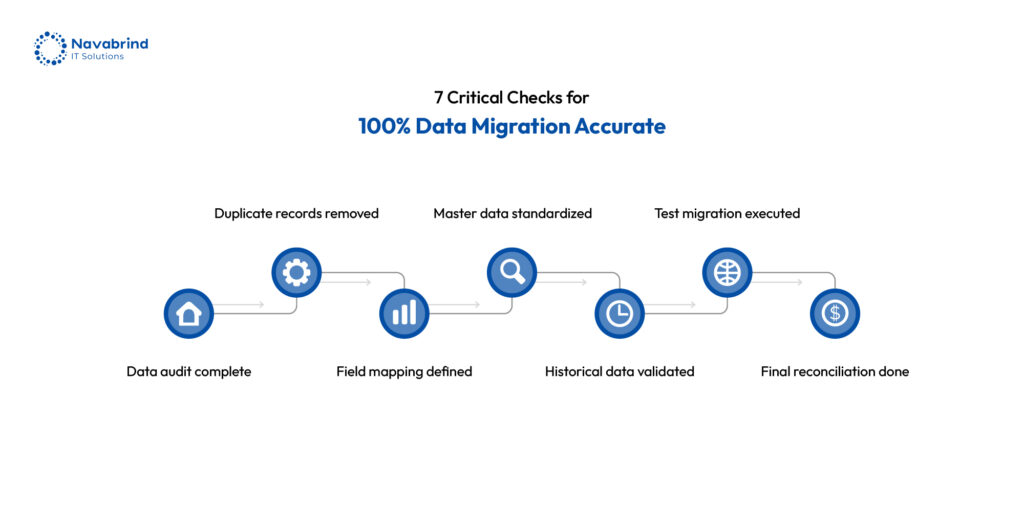
How Do You Achieve 100% Data Accuracy When Migrating to Odoo?
Accuracy begins with a disciplined pre-migration assessment. Odoo migration services start by identifying duplicate records, incomplete entries, and inconsistent formats across legacy systems. Clean datasets reduce risk during Odoo data migration and set a reliable foundation for reporting and operations.
Data mapping defines how information moves into the Odoo structure. Field-level alignment, format standardization, and dependency mapping ensure that financial records, inventory data, and customer details retain integrity after Odoo ERP migration. Validation frameworks cross-check mapped data against source systems to eliminate discrepancies before deployment.
Automated scripts accelerate ERP to cloud migration, reducing human error and ensuring consistency across large datasets. Manual intervention introduces risk through missed entries and inconsistencies, making automation a preferred approach for controlled execution.
Testing cycles strengthen confidence. User Acceptance Testing (UAT) validates business workflows, and parallel runs compare outputs between legacy systems and Odoo to confirm accuracy during ERP cloud migration. This stage ensures that operations continue without data-related disruptions.
Governance and audit mechanisms maintain control throughout the process. Access controls, audit logs, and reconciliation checkpoints ensure traceability and accountability.
With structured execution, Odoo migration services deliver dependable Odoo migration outcomes where data integrity supports confident decision-making and uninterrupted operations.
Which ERP Systems Can Be Successfully Migrated to Odoo?
Odoo migration services support transition from a wide range of ERP platforms, including SAP, Oracle, Microsoft Dynamics, NetSuite, Tally, and custom-built systems. Each platform carries distinct data structures, workflows, and dependencies, yet a well-planned Odoo migration aligns these elements into a unified operational framework.
On-premise systems present challenges such as rigid architectures, fragmented databases, and heavy infrastructure dependency. In contrast, cloud-based platforms involve API dependencies and integration layers that demand careful handling during ERP to cloud migration. Each scenario requires a tailored approach to ensure continuity and data integrity throughout the transition.
Data complexity varies across industries. Manufacturing involves bills of materials and production flows, retail includes multi-channel transactions, and service businesses depend on project and billing records. Odoo data migration addresses these variations through structured mapping, transformation logic, and validation checkpoints that preserve operational context.
Successful Odoo ERP migration relies on disciplined execution. This includes phased migration planning, prioritized data transfer, and controlled testing cycles to minimize disruption. Integration alignment ensures existing tools remain connected during ERP cloud migration, avoiding operational gaps. With the right approach, Odoo migration services convert even complex ERP environments into a streamlined, scalable system that supports growth and operational clarity.
Do You Need a Certified Odoo Gold Partner for a Full Data Migration?
Engaging a certified partner like Navabrind IT Solutions elevates the success rate of Odoo migration services. A certified Odoo Gold Partner brings validated experience across Odoo migration, Odoo ERP migration, and Odoo data migration, ensuring that technical execution aligns with business goals. Their role extends beyond system setup that they design migration pathways, safeguard data integrity, and align workflows with operational needs.
Unstructured or do-it-yourself migration introduces serious risks. Data loss, broken integrations, inconsistent records, and workflow disruptions can impact revenue and decision-making. Without a defined framework, ERP to cloud migration becomes unpredictable, increasing downtime and operational strain.
Working with an Odoo Gold Partner brings a disciplined, proven methodology. Each phase from data audit to validation is executed with tested frameworks that reduce uncertainty. Their combined technical and functional expertise ensures that complex datasets, custom modules, and integrations transition without gaps during ERP cloud migration.
Speed and risk reduction stand out as key advantages. Certified partners accelerate timelines through structured execution while maintaining control over data accuracy and system performance. With expert-led Odoo migration services, businesses gain a stable, scalable system that supports growth without compromising operational continuity.
How Long Does a Complete ERP to Odoo Migration Project Take?
The timeline for Odoo migration services depends on business size, data complexity, and system dependencies. A small company with limited data and minimal integrations may complete Odoo migration within 4–8 weeks. Mid-sized organizations with multiple departments, integrations, and historical records may require 8–16 weeks. Large enterprises handling complex workflows and extensive datasets can expect 4–6 months for a stable Odoo ERP migration.
Data volume and quality shape the pace of Odoo data migration. Clean, well-maintained datasets accelerate execution. Inconsistent or duplicated records demand additional time for validation and correction. Customizations and third-party integrations add another layer, requiring alignment during ERP to cloud migration to avoid disruptions.
A structured timeline ensures controlled execution:
- Discovery: assessment of existing systems, data structure, and business workflows
- Planning: migration roadmap, resource allocation, and risk evaluation
- Migration: execution of data transfer and system configuration
- Testing: validation cycles, UAT, and performance checks during ERP cloud migration
- Go-live: deployment with monitoring and issue resolution
With disciplined execution, Odoo migration services deliver predictable timelines, controlled risk, and a stable transition that supports business continuity and growth.
What is the Cost of a Full Odoo Data Migration Service in the US?
The cost of Odoo migration services in the US varies based on complexity, scope, and business requirements.
Key cost drivers shape the investment:
- Data complexity and volume: Clean datasets reduce cost, while fragmented or multi-year historical data increases effort during Odoo data migration.
- Number of modules: Expanding across finance, inventory, manufacturing, and CRM increases configuration and validation scope.
- Customizations required: Custom workflows and code development significantly raise project cost and long-term maintenance.
- Integration needs: Third-party systems such as eCommerce, logistics, or CRM add complexity during ERP to cloud migration.
Typical pricing models for Odoo migration services include fixed project pricing for defined scope, hourly billing ranging from $75–$150, and phased pricing aligned with milestones.
From an ROI standpoint, ERP cloud migration replaces high maintenance costs, licensing overhead, and infrastructure burden associated with legacy ERP systems. Instead of recurring upgrade expenses and operational inefficiencies, Odoo migration services deliver a scalable system that improves cost control, data visibility, and long-term profitability.
Common Challenges in Odoo ERP Migration (and How to Overcome Them)
- Odoo migration services address multiple risks that arise during Odoo ERP migration, especially when legacy systems contain fragmented data and disconnected workflows. Identifying these challenges early protects timelines, cost, and operational continuity.
- Data inconsistency and duplication remain one of the biggest barriers. Legacy systems carry redundant, outdated, or conflicting records. During Odoo data migration, this leads to reporting errors and operational confusion. Resolution starts with data audit, cleansing, and validation frameworks that standardize records before transfer.
- Resistance to change and user adoption can slow down Odoo migration progress. Teams accustomed to legacy systems may struggle with new workflows. Structured onboarding, role-based training, and early user involvement increase acceptance and reduce friction during transition.
- Integration issues arise when external systems fail to align with Odoo. CRM platforms, eCommerce tools, and third-party applications require careful mapping during ERP to cloud migration. Pre-defined integration checkpoints and testing cycles ensure continuity.
- Downtime risks impact revenue and operations. Poor planning can interrupt business activities during ERP cloud migration. Phased rollout, parallel system runs, and rollback strategies reduce exposure and maintain business continuity.
- Mitigation depends on disciplined execution. With structured planning, validation, and testing, Odoo migration services transform challenges into controlled steps, ensuring a stable and scalable transition.
A successful transition starts with a well-defined roadmap. Odoo migration services begin by outlining timelines, milestones, data scope, and risk checkpoints. This roadmap guides the entire Odoo migration, ensuring alignment between technical execution and business goals.
Data quality holds greater value than speed. During Odoo data migration, clean, validated datasets prevent reporting errors and operational disruptions. Rushing the process without proper validation leads to long-term inefficiencies after Odoo ERP migration. A disciplined approach to cleansing and reconciliation strengthens system reliability from day one.
Choosing the right migration approach shapes project outcomes. A phased rollout works well for complex environments, allowing gradual transition and risk control during ERP to cloud migration. A full migration suits businesses with simpler structures seeking faster deployment. The decision depends on data complexity, integrations, and operational dependencies.
Stakeholder alignment drives adoption. Leadership, department heads, and end users must stay involved throughout the process. Training sessions, workflow demonstrations, and early system exposure reduce resistance and improve usability after ERP cloud migration.
With structured planning, data discipline, and user readiness, Odoo migration services deliver a stable system that supports growth, accuracy, and long-term operational success.
Turning Migration into a Competitive Advantage
Odoo migration reshapes how a business operates, competes, and scales. This shift goes beyond system replacement that redefines workflows, data flow, and decision-making. Companies that treat ERP to cloud migration as a strategic move gain tighter control over operations, improved visibility across departments, and stronger alignment between teams.
A well-executed Odoo ERP migration strengthens operational clarity. Clean data, connected processes, and optimized workflows reduce inefficiencies and unlock faster execution. Through structured Odoo data migration, businesses gain reliable reporting, accurate forecasting, and consistent performance tracking across functions. The difference lies in execution. Expert-led Odoo migration services bring tested frameworks, risk control, and technical depth that safeguard business continuity. From data validation to integration alignment, each step ensures stability during ERP cloud migration. Investment in the right migration approach delivers measurable returns.
Reduced maintenance costs, improved productivity, and scalable operations position businesses for sustained growth. With the right strategy and execution, Odoo migration services turn system transition into a competitive advantage that drives long-term business success.
Frequently Asked Questions
1. What does a complete Odoo ERP data migration service include?
Odoo migration services cover data audit, cleansing, mapping, transformation, and transfer of master, transactional, and historical records. The process includes validation, reconciliation, and integration alignment to ensure business continuity during Odoo ERP migration and ERP cloud migration.
2. How do you achieve 100% data accuracy when migrating to Odoo?
Accuracy in Odoo data migration depends on structured data assessment, standardized mapping, automated scripts, and validation frameworks. Testing cycles such as UAT and parallel runs confirm consistency during Odoo migration and ERP to cloud migration.
3. Which ERP systems can be successfully migrated to Odoo?
Odoo migration services support transition from SAP, Oracle, Microsoft Dynamics, NetSuite, Tally, and custom ERP platforms. Each system requires tailored handling of data structures and workflows during Odoo ERP migration.
4. Do I need a certified Odoo Gold Partner for a full data migration?
A certified partner strengthens execution of Odoo migration by reducing risks related to data loss, integration gaps, and workflow misalignment. Expert-led Odoo migration services ensure stable and scalable outcomes.
5. How long does a complete ERP to Odoo migration project take?
Timelines for ERP to cloud migration range from 4 weeks for small setups to several months for complex environments. Duration depends on data volume, integrations, and customization involved in Odoo ERP migration.
6. What is the cost of a full Odoo data migration service in the US?
Costs for Odoo migration services vary from $5,000 for basic setups to over $100,000 for complex migrations. Pricing depends on data complexity, modules, integrations, and customization required during Odoo data migration.
Schedule a conversation with us now!
Related Articles








 Post
Post